The 6-Item EV Road-Trip Backup Kit (What Actually Belongs in Your Trunk)
A 6-item EV road-trip backup kit grounded in real r/electricvehicles reports and Electrify America's 2025 reliability data. What actually belongs in your trunk.

TL;DR
Tesla driver: pair a Tesla Gen 2 Mobile Connector with the WenStorm Tesla/NACS Road Trip Kit ($215.98) — TT-30 adapter + 21-ft NACS extension (Mobile Connector NOT included; kit is a Gen 2 MC accessory only). J1772 driver: WenStorm J1772 Road Trip Kit ($314.98) — 32A portable Level 2 + 21-ft J1772 extension (~46 ft combined reach). A portable charger isn't roadside rescue equipment — it's for a suitable destination outlet with permission (campground, hotel, RV park). Your first fallback on the road is another DC fast charger reachable with reserve range.
What to keep in your car — by situation
| Your situation | What to keep in the car |
|---|---|
| J1772 vehicle; confirmed 14-50 outlet at your destination | J1772 portable Level 2 charger with 14-50 plug (WenStorm J1772 Road Trip Kit anchor). |
| Tesla / NACS vehicle; confirmed 14-50 outlet | Tesla Gen 2 Mobile Connector with its bundled 14-50 adapter (MC not sold by WenStorm). If you don't own a Gen 2 MC, buy WenStorm's NACS-variant 32A Level 2 Portable Charger (fixed 14-50 plug). |
| Tesla Gen 2 Mobile Connector; other confirmed outlets (TT-30, 14-30, 10-30) | For TT-30 (RV parks): WenStorm Tesla/NACS Road Trip Kit ($215.98) — TT-30 adapter + 21-ft NACS extension. For 14-30: separate WenStorm NEMA 14-30 adapter. All are Gen 2 MC accessories only — MC required. Non-Tesla J1772 EVs currently have no WenStorm adapter path to these outlets. |
| No confirmed usable outlet at the destination | Plan another reachable DC fast charger. A portable charger cannot guarantee a backup on the road — it needs a suitable destination outlet with permission. |


Why bring a backup kit at all?
The honest counter-argument first: if your route is a well-planned Tesla Supercharger corridor with under 200 miles between stops, and your car pre-conditions the battery before each fast-charge session, you can complete most trips without touching a portable charger. That was the majority position among top-voted replies to a July 2025 r/electricvehicles thread whose OP reported nearly running out of range because their home charger had failed — several commenters pointed out that a 15-mile round trip to the nearest DC fast charger would have solved it.
The kit exists for the trips that don't go that way. Two recurring failure modes drive it:
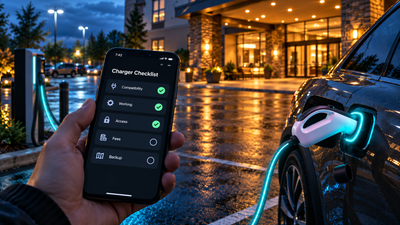
1. Non-Tesla network friction. A December 2023 rant on r/electricvehicles from a UX designer completing a 500-mile trip listed the apps required at the pumps: PlugShare to find stations, plus a separate account for each network with pre-loaded balances. A design researcher who studies EV road-trips replied in that same thread that dual-app strategy (PlugShare for status, A Better Route Planner for routing) is now standard practice among non-Tesla drivers. Any of those apps failing in an area with no cell service can delay a session, though Electrify America stations also support credit/debit-card and guest-payment options at the pedestal as fallbacks. Electrify America reported upgrading 121 stations with 518 next-generation chargers during 2024, per its 2024 EPA annual report. The network separately reported that its next-generation equipment required approximately 80% fewer on-site maintenance dispatches than its older equipment; that measure is a maintenance-workload delta, not a session-success delta. Rural coverage remains uneven regardless.
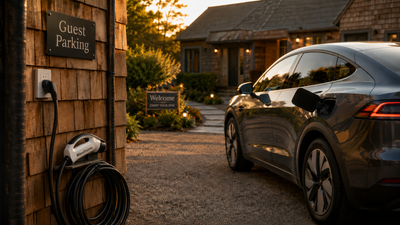
2. Destination outlets that don't match your factory cable. Most EVs ship with a Level 1 (120 V) cable. Tesla currently sells its Mobile Connector as a separate accessory; buyers should not assume it comes with the vehicle. If your overnight stop is a rental, campground, RV park, or friend's older garage, the outlet you find may be 14-50, 6-50, TT-30, 10-30, or 5-15 — none of which work with a bare J1772 or NACS pigtail. The WenStorm Level 2 portable charger has a fixed NEMA 14-50 plug and works at a 14-50 receptacle only. For TT-30, 14-30, or 10-30 outlets, Tesla drivers use the Tesla Gen 2 Mobile Connector paired with the matching WenStorm-branded adapter; non-Tesla J1772 EVs currently have no WenStorm adapter path to those outlets.
Nothing here is emergency-only. Owners on r/electricvehicles routinely describe keeping a portable charger and adapter set as basic hygiene, not a panic response. One top-voted reply summarized it: "Redundancy. I have two Level 2 EVSE both hardwired in my garage. I also have a Level 1 charger if necessary."
What actually belongs in the kit — 6 items
1. Portable Level 2 charger — pick your anchor configuration
Two workable anchor kits, chosen by how much outlet flexibility your route actually needs:
Configuration A — Fixed-plug simplicity (WenStorm L2 Portable Charger). A 32 A portable Level 2 with a fixed NEMA 14-50 plug, J1772 or NACS variant. No swappable adapter to lose, no chained connections to add heat risk. Delivers roughly 25 miles of range per hour on a 14-50 circuit. This is the simpler kit for most J1772 or NACS vehicles on routes where you can confirm 14-50 availability at each overnight stop — RV parks, newer garages, and 14-50-equipped destination charging.
Configuration B — Swappable-plug flexibility (Tesla Gen 2 Mobile Connector + WenStorm NEMA adapter kit). The Tesla Gen 2 Mobile Connector accepts swappable NEMA plugs. WenStorm's NEMA adapter kit is designed as a Tesla Gen 2 Mobile Connector accessory and covers common outlet types on top of the base 14-50. This is the more flexible kit for Tesla EVs, or for non-Tesla drivers willing to add a NACS-to-J1772 AC adapter to the setup — the tradeoff is one more connector interface at the vehicle inlet.
Regardless of configuration, confirm the outlet is properly wired and on its own circuit before plugging in; never assume an RV-site outlet can be used for EV charging. Get permission from the campground, confirm that the pedestal supports continuous EV charging, and use charging equipment that automatically limits current for that exact outlet and circuit. Do not assume WenStorm's adapters work with other manufacturers' portable chargers — they are validated as Tesla Gen 2 Mobile Connector accessories only.
2. Adapter strategy — for Configuration B users only
If you chose Configuration A (fixed-plug WenStorm L2), skip this item. Your kit is complete without adapters; your prep work is confirming 14-50 receptacles on your route.
If you chose Configuration B, carry only the adapters that match the outlet types on your specific route — not every adapter in the catalog. A three-adapter set typically covers realistic road-trip outlets: 6-50 for older garages with welder circuits (240 V, no neutral), 10-30 for 1980s-era homes with three-prong dryer outlets (240 V, no dedicated ground), and TT-30 for RV parks that only have 30 A / 120 V pedestals (Level 1 charging speed, not Level 2).
Two adapter categories to avoid regardless of configuration: any adapter that would connect your 240 V EVSE to a 30 A dryer receptacle without proper current derating, and any unlisted no-name adapter with no UL, ETL, or Intertek safety mark. Both are documented sources of connector heat damage.
3. EV-listed extension cable (vehicle-side, matched to your connector)
Extending the vehicle-side cable (the J1772 or NACS end that plugs into your car) is only safe with an EV-specific product that's listed for that use. Do not use a hardware-store extension cord to reach the wall outlet on the line side — household extension cords are typically rated for 15 A / 125 V and cannot safely carry the 30-50 A / 240 V current a Level 2 EVSE draws. That mismatch is a documented cause of connector heat damage in NHTSA charging-equipment incident reports and voids most EVSE warranties. See our companion post on whether a 25-foot cable is long enough for the routing-vs-straight-line-distance math.
4. Your OEM DC fast-charge adapter — if your vehicle supports one
Non-Tesla EVs on the NACS transition (Ford, Rivian, GM, Hyundai/Kia, and others) can charge at select Tesla Superchargers using a Tesla- or automaker-approved DC adapter for eligible CCS vehicles. Tesla's Supercharger network is not universally open to non-Tesla vehicles, and third-party adapters are not accepted for non-Tesla Supercharging. Check your vehicle manufacturer's list of compatible Supercharger stations and confirm the specific adapter your vehicle supports before you rely on it. Do not use a generic third-party "Supercharger adapter" — many are not certified for DC fast charging and can damage the vehicle inlet or the station.
5. PlugShare and A Better Route Planner — pre-loaded with your route saved offline
PlugShare shows real-time station status and check-ins from other drivers; A Better Route Planner (ABRP) computes DC-fast-charge stops based on your specific vehicle, load, and elevation. Neither replaces the other. Neither service clearly guarantees full offline operation. Before departure: save each station's address and charger ID in the app, take screenshots of your planned route, and download offline navigation maps in your phone's map app. Cell service at highway rest stops is not guaranteed — several top-voted r/electricvehicles comments describe apps failing to load in remote lots.
6. Printed roadside-assistance and insurance contact card
A phone with a dead battery or no signal makes it impossible to look up your roadside-assistance number. Print two cards: one in the glove box, one folded in your wallet. Include the vehicle VIN, insurance policy number, and the phone number for both your general roadside-assistance line and your automaker's brand-app emergency charging service if one is offered. Ford's FordPass app, for example, has included an emergency mobile-charging request for eligible Mustang Mach-E and F-150 Lightning owners in select regions; check your specific vehicle's app for current availability before you rely on it.
What NOT to pack (and why)
Dryer-outlet "adapters" that bypass current derating
A dryer receptacle (10-30 or 14-30) is not a 14-50. Its circuit is typically 30 A, not 50 A. A 32 A or 40 A charger exceeds the permitted continuous load of a 30 A circuit. The breaker may trip, but overloaded or deteriorated connections can also overheat before it does. Use only an approved charger-and-adapter combination that automatically limits charging to 24 A on a 30 A circuit. Some portable chargers auto-derate to a lower-amp adapter; most do not. Never assume derating without checking your specific EVSE and adapter manual.
Generic no-name adapters from marketplace sellers
Amazon, eBay, and AliExpress carry cheap NEMA-to-NEMA adapters with no UL, ETL, or Intertek listing. Unlisted adapters are a documented risk factor in connector heat and fire incidents. If your adapter's markings don't list a recognized safety mark (UL, ETL, or Intertek), don't use it with a 240 V EVSE.
Space heaters, hair dryers, or power inverters "to speed up charging"
These do nothing for charging speed and can trip breakers. There is no consumer-market device that converts 120 V AC into DC fast-charge power; DC fast charging requires a stationary charger with a dedicated three-phase or high-current utility connection. If your route needs faster charging, plan around a real DC station, not a workaround.
Kit variations by trip type
Rural corridor (sparse DC fast-charge coverage)
Add a second night's worth of L2-charging planning to your route. If your daily driving segment lands you at a motel with only a 5-15 outlet, expect Level 1 speeds (about 4 miles of range per hour). Some drivers prefer to plan the segment before to end well above their empty reserve — 40% is one conservative preference — so overnight L1 refills to a comfortable next-day departure. Your reserve target depends on your comfort and the next day's route. Cross-check DC station status on PlugShare within 24 hours of departure; rural stations lose network reliability first.
Mountain / elevation gain
Consumption tables assume level ground. On a route with sustained elevation gain (Denver-to-Vail, Sacramento-to-Reno, Salt Lake to Park City), expect real consumption to run above the manufacturer's estimate on the uphill segment. The exact penalty depends on elevation delta, speed, weather, and vehicle efficiency. ABRP's elevation-aware routing handles the math if you enable the correct vehicle profile.
Cold-weather charging
Cold-weather charging performance varies by battery temperature, whether pre-conditioning is active, and vehicle model. On a cold battery without pre-conditioning, DC-fast-charge peak speeds can be a fraction of the vehicle's rated peak until the battery warms up. Some vehicles pre-condition automatically when a fast-charge stop is set in navigation; others require manual pre-conditioning. Check your owner's manual for what your specific vehicle does. Cable stiffness at very low temperatures also affects handling — see our note on why EV charger cables get stiff in cold weather.
The 5-minute pre-departure test
Run this the day before you leave, not the morning of:
- Plug in the portable Level 2 at a known-working 14-50 outlet at home. Confirm the charger's status LED matches "charging" in your manual and that your vehicle displays a charging session with the expected amperage.
- Swap through each adapter you plan to carry, one at a time. Do this with the charger's plug outside the outlet, then plug in, confirm the vehicle recognizes the reduced-amperage session (if applicable), unplug, remove adapter. If any adapter looks discolored, has a loose fit, or the vehicle shows an error, do not pack it.
- Open PlugShare and ABRP offline. Turn on airplane mode and confirm both apps can display your saved route and station list without a live connection.
- Verify your OEM DC adapter connects at a known-compatible station on your route (a short local trip to check works). Do not do this test at the trailhead of a 500-mile day.
- Read your printed roadside card aloud. Confirm the phone number is your current insurance carrier's, not a lapsed policy.
The point of the test isn't to prove the kit works — it's to catch the one item that doesn't before you're 300 miles from home.
Quick compatibility guide
| Your situation | Recommended setup |
|---|---|
| J1772 or NACS vehicle with confirmed NEMA 14-50 access | WenStorm fixed-plug Level 2 charger in the correct vehicle connector |
| Tesla using a Gen 2 Mobile Connector | Exact Tesla-compatible adapter for the available outlet |
| No confirmed destination outlet | Plan alternate DC fast-charging locations; a portable charger cannot guarantee a backup |
| Campground or rental property | Obtain permission and confirm the outlet supports continuous EV charging |
Frequently asked questions
Is a portable Level 2 charger safe to leave outside overnight at a campground?
Only if the charger is rated for outdoor use, the outlet is under a covered pedestal, and no part of the cable sits in standing water. Confirm your specific charger's IP (ingress protection) rating in the manual. If the outlet is exposed and rain is forecast, unplug the charger's line-side plug and store it indoors until dawn.
Can I use the Tesla Mobile Connector as my kit anchor instead of a WenStorm L2?
Yes for Tesla owners with NACS-native cars; the current Tesla Gen 2 Mobile Connector accepts a range of NEMA adapters sold by Tesla as accessories. For non-Tesla EVs with a J1772 inlet, you'd need a separate J1772 EVSE — a Tesla Mobile Connector plus a NACS-to-J1772 AC adapter is a common setup, but it adds a connector interface and increases physical stress at the vehicle inlet. A native J1772 portable is the simpler kit anchor for J1772 vehicles.
Do I need one adapter per outlet type, or can I chain adapters?
One per outlet type, and never chain adapters. Chaining creates multiple contact points where heat can build, and each additional adapter reduces the current-carrying reliability of the connection. If your charger doesn't list an adapter for a specific outlet type, that outlet is not a valid destination for that charger.
What's the difference between a Tesla NACS adapter for AC charging and one for DC fast charging?
AC adapters (NACS-to-J1772 or J1772-to-NACS) are for slow home/destination charging up to about 48 A. DC fast-charge adapters are a completely different device — larger and certified for hundreds of amps, and designed and approved for specific vehicles and charging networks. Some are actively cooled; some are passive. A DC adapter can never substitute for an AC adapter (it won't fit or communicate correctly for AC L2) and an AC adapter used at a DC station will damage the connector. Read the label before every use.
How long should the extension cable be — is 25 feet enough?
It depends on the routed path from the outlet to your vehicle's inlet, not the straight-line distance. See our post on whether a 25-foot cable is long enough for the measurement method. In most home garages 25 feet is sufficient; at RV parks with pull-through sites the receptacle can be 20 feet from the vehicle inlet after accounting for the routed path — measure once at home with the exact car and cable before assuming.
Does the kit replace roadside assistance, or supplement it?
Supplement. Roadside assistance (through your automaker or a service like AAA that now includes EV coverage) handles the case where your vehicle can't move at all. The kit handles the case where you can reach an outlet but can't use it — a much more common trip-day disruption.
Related reading
- Why WenStorm Built Portable-First (Not Hardwired-First)
- Is a 25-Foot EV Charger Cable Long Enough?
- Is Electrify America Reliable? A Backup-Plan Buyer's Guide
- How to Charge an EV at an RV Park (TT-30 and 14-50)
Written by Nathan Park, EV Product & Market Analyst at WenStorm. Nathan covers charging-network reliability, portable EVSE market trends, and buyer decision frameworks for the WenStorm editorial team.