Why WenStorm Built Portable-First (Not Hardwired-First)

TL;DR
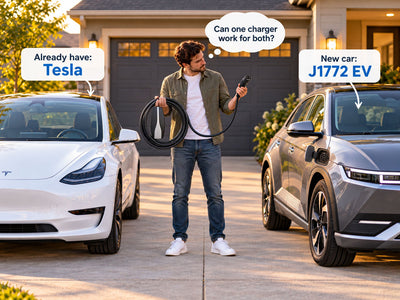
WenStorm built portable-first because it removes the electrician-appointment barrier for renters, apartment or condo dwellers, multi-property owners, and new EV buyers. The WenStorm portable is rated at 32A and delivers roughly 7.7 kW on an existing 240V NEMA 14-50 outlet — no electrician appointment or permit needed. If your garage doesn't have that outlet yet, price a receptacle install first. Hardwired stays the better call for high-daily-mileage drivers or homeowners who want a garage-integrated fixture.
What “hardwired-first” looks like in the Level 2 market
Most consumer Level 2 EV charger brands lead with a hardwired unit. That usually means:
- A wall-mounted enclosure sized to hang permanently in a garage or on an exterior wall.
- A cable run inside conduit from a dedicated 40A or 60A breaker in the main panel to the charger location.
- A licensed electrician handling the wiring, the connection at the panel, and the mount.
- An electrical permit and inspection in most U.S. jurisdictions.
The install cost varies with the panel-to-garage distance, whether panel-capacity work is needed, whether trenching is required, and local labor rates. Most published estimates for a straightforward hardwired Level 2 installation land between several hundred dollars and over a thousand. Panel upgrades, if the home needs one, are extra.
None of that is unreasonable for a homeowner who plans to stay in the house long-term, drives an EV daily, and wants the fastest home charging their vehicle supports. It is a real barrier for buyers who don't fit that profile.
What WenStorm chose instead
Every WenStorm Level 2 charger uses a NEMA 14-50 plug at the wall end and a J1772 or NACS connector at the vehicle end. The control electronics live inside the connector housing, not in a separate wall-mounted enclosure — a design decision covered in how WenStorm's portable chargers are architected.
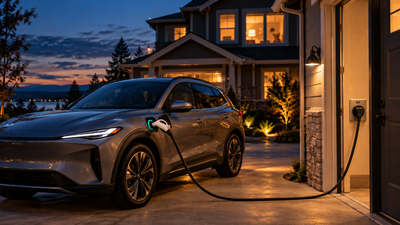
The practical result: a WenStorm portable Level 2 charger is rated at 32A and arrives ready to plug into a NEMA 14-50 outlet on a 50A circuit. If the outlet is already installed in the garage or driveway, there is no electrician appointment and no permit. Plug in, connect the vehicle, and charge.
If a 240V outlet doesn't exist yet, installing one is still an electrical job that requires the same core work as a hardwired charger install — a dedicated 50A circuit, the correct cable run, and panel capacity. The main differences are the endpoint (a wall receptacle rather than a fixed charger enclosure) and that the WenStorm portable charger travels with the owner if they move. It's worth getting quotes for both options and comparing them for your specific home.
Who portable-first serves
The product decision maps to buyer scenarios that show up across the WenStorm bundle catalog (which includes both Level 1 and Level 2 configurations depending on the kit):
- Renters. A landlord who won't approve a permanent hardwired charger may still approve using an existing 240V outlet, or paying for a wall receptacle that stays with the property. Portable charging reduces the permanent-modification ask, though written landlord permission for the electrical usage is still recommended.
- Apartment and condo dwellers. HOA and condo-board approval processes for permanent charging equipment are slow. A portable unit that plugs into a designated 240V outlet reduces the modification footprint, but board approval for outlet use, cable routing, or electricity metering may still be required. Check the governing documents before assuming a portable charger is exempt.
- RV park charging (14-50 pedestals only). A WenStorm portable Level 2 charger works at any properly-installed NEMA 14-50 pedestal at an RV park or campground. It does not work at TT-30 (120V) pedestals or lower-current RV outlets — the WenStorm L2 charger is a fixed-240V unit and cannot operate on a 120V circuit.
- Multi-property owners. A second home, a family cabin, or an Airbnb host location can each have a NEMA 14-50 outlet without a permanent charger — and the same portable unit works at every one.
- New EV owners who don't yet know their long-term charging pattern. Someone who bought their first EV three months ago often doesn't know whether they'll want 30 mi/hr or 44 mi/hr of overnight charging. A portable unit is reversible; a hardwired install is not.
The real trade-offs of portable vs hardwired
Portable is not a strict upgrade over hardwired. There are genuine trade-offs:
- Product amperage rating. The WenStorm portable Level 2 charger is rated at 32A, which delivers roughly 7.7 kW on a 240V circuit. A NEMA 14-50 outlet on a 50A breaker can support up to 40A continuous per NEC, so some other portable chargers on the market run at 40A on the same outlet. Hardwired chargers on a 60A circuit typically deliver 48A / roughly 11.5 kW. For high-daily-mileage EV owners with short parking windows, the amperage difference matters.
- Connection interface. A portable charger uses a plug and receptacle at the wall; a hardwired charger has no plug interface. Both can be safe when installed correctly, but the failure modes differ. Portable-charger installations depend on receptacle quality and torque discipline — see why NEMA 14-50 outlets fail under EV loads. Hardwired installations shift that risk to conductor sizing, breaker selection, and connection torque inside the charger enclosure.
- Enclosure aesthetics and permanence. A hardwired charger looks integrated into a garage. A portable unit hangs from a wall holder or coils on a hook. Neither is worse, but the two look different and behave differently — portable moves with the owner, hardwired stays with the property.
When hardwired is the better call
Hardwired charging is a legitimate alternative and is often the better fit when:
- The driver owns a long-range EV with a large battery and consistently arrives home with under 20% state of charge, needing higher amperage to fully recover overnight.
- The homeowner plans to stay in the house long-term and wants a garage-integrated fixture rather than a plug-in unit.
- Local code or utility incentive programs require or reward a hardwired install.
- The garage layout puts the charging position more than 25 feet from any outlet, making a fixed run the cleaner solution.
For buyers who don't fit those profiles — and that is a large share of first-time EV owners — the portable-first approach removes the electrician-appointment barrier while leaving hardwired open as an upgrade later.
Frequently asked questions
Is a portable Level 2 charger as safe as a hardwired one?
Both can be safe when installed and maintained correctly, but the failure modes differ. A portable charger's safety depends heavily on the outlet, the wiring behind it, and torque discipline at the receptacle. A hardwired charger eliminates the plug/receptacle interface but adds risk at the charger's internal terminal block and the panel connection. See why NEMA 14-50 outlets fail under EV loads for the plug-side risks.
What's the charging-speed difference between 32A portable and 48A hardwired?
A portable Level 2 charger at 32A on 240V delivers roughly 7.7 kW. A hardwired Level 2 charger at 48A on 240V delivers roughly 11.5 kW. For most EVs on an 8- to 10-hour overnight window, both fully recover a normal daily drive. Drivers with high daily mileage and short parking windows benefit most from 48A.
Why is the WenStorm portable charger rated at 32A rather than 40A?
32A is the WenStorm product's rated output. A NEMA 14-50 outlet on a 50A breaker can support up to 40A continuous per NEC 80%-of-rating guidance, so some other portable Level 2 chargers on the market run at 40A on the same circuit. The lower rating on the WenStorm unit is a product-design choice, not a limit of the outlet or the circuit.
Can a portable charger really work for daily home use?
Yes. Portable Level 2 chargers are rated for continuous use at their listed amperage. The plug-in form factor is a convenience feature, not a duty-cycle limitation.
Does WenStorm sell any hardwired chargers?
No. The current WenStorm Level 2 lineup is portable-only. See the portable EV chargers collection for the current models.
What if I want to eventually hardwire the portable charger?
The WenStorm portable Level 2 charger is designed to plug into a NEMA 14-50 outlet, not to be hardwired. If you decide you want a hardwired setup, buy a purpose-built hardwired charger and have an electrician install it. The portable stays useful as a backup or travel unit.
Which WenStorm bundle fits my situation?
The bundle catalog includes both Level 1 and Level 2 configurations depending on the kit — renter kits, apartment kits, RV park adapter kits, road-trip kits, and Airbnb-host kits are built around different portable chargers and accessory sets for each scenario. Browse the portable EV chargers collection or email contact@wenstormcharge.com for a scenario-specific recommendation.
Shop the WenStorm portable Level 2 charger lineup
Related reading: Why WenStorm chargers have no wall-hanging brick · How WenStorm fulfills U.S. orders · WenStorm 2-year limited warranty