Is Electrify America Reliable in 2026? How to Plan a Backup

TL;DR
Electrify America has replaced and upgraded substantial amounts of older equipment, but network-wide statistics cannot tell you whether one particular station will work when you arrive. Before traveling, check real-time availability in the Electrify America app, review recent driver check-ins, and keep enough battery to reach another compatible DC fast charger. A portable AC charger can provide an additional overnight option only when you have confirmed access to a suitable outlet and permission to use it.
What Electrify America has actually reported
Electrify America publishes network improvements in quarterly CARB reports and public press releases. It's worth separating what those numbers demonstrate from what they don't:
| Published EA information | What it actually demonstrates |
|---|---|
| 121 stations upgraded with 518 next-generation chargers in 2024 | Significant replacement of older equipment |
| New equipment required approximately 80% fewer on-site maintenance dispatches than older hardware (per EA's Q2 2025 CARB report) | Improved hardware maintainability — not the same as network-wide session-success improvement |
| 5,000+ DC fast chargers and 1,080+ sites by Q2 2025 | Broad network coverage — not a guarantee of local reliability at any specific station |
| The EA mobile app reports real-time charger availability | Useful pre-arrival information, but on-site conditions can still change between the check and the arrival |
The takeaway: EA's own reporting supports meaningful hardware improvements over the last several years. It does not answer the question a road-tripper actually needs answered — will this particular stall work in the next 20 minutes when I pull in.
What "reliable" actually means for a fast-charging network
Splitting reliability into three separate things a driver cares about makes the network-vs-station distinction clearer:
- Station uptime — is the physical charger powered on, connected to the network, and able to accept a session?
- Session-start success — does the payment / authentication / vehicle handshake work on the first try?
- Charging speed under load — is the station delivering the advertised kW, or throttling because of shared power cabinets, thermal derating, or utility limits?
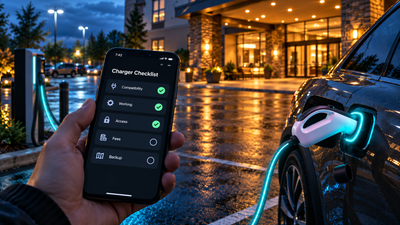
A network can be "reliable" on one dimension and unreliable on another. Uptime numbers reported at the network level are informative but do not fully predict any given driver's experience at any given site on any given day. Real-time PlugShare check-ins and the EA app's own availability display are the closest thing to a pre-arrival sanity check.
The backup hierarchy for EV road trips
Experienced EV road-trippers use a layered plan rather than depending on any single option. Ordered from primary to fallback:
- Another compatible DC fast charger reachable with reserve range. If the EA site is broken or blocked, the immediate answer is an alternative DC fast site (EVgo, ChargePoint DC, Rivian Adventure Network, Tesla Supercharger at compatible sites with an automaker-provided NACS DC adapter). This is faster and more predictable than any Level 2 fallback.
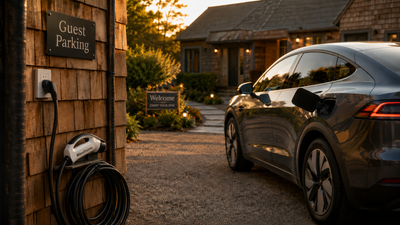
- A destination or hotel Level 2 charger confirmed before arrival. Many hotels, resorts, and vacation destinations offer Level 2 charging in the parking lot. Confirming it works and is available BEFORE you commit to the destination is the difference between a backup plan and a hope.
- A campground or RV park outlet specifically approved for EV charging. Some RV parks welcome EV overnight charging at their pedestals; others do not, and some pedestals were not designed for continuous EV loads (per KOA's EV-charging policy). Call the specific park ahead and confirm both permission and outlet condition before relying on it.
- Roadside assistance if no safe charging option remains. Most EV manufacturers and third-party auto-club plans include EV-specific roadside assistance with mobile charging or flatbed transport.
A portable Level 2 charger enables step 3 of that hierarchy. It's not the primary answer to EA reliability — steps 1 and 2 are. It's the overnight fallback that keeps a delayed day from becoming a stranded one.
WenStorm's two portable backup options (separate setups)
WenStorm sells two distinct portable-charging setups. They are not interchangeable, and the RV Adapter Kit is not compatible with the WenStorm portable charger.
For J1772 or NACS vehicles using the WenStorm 32A portable charger: the charger requires a permitted, properly-maintained 240V NEMA 14-50 outlet. It cannot operate from a TT-30 outlet.

For Tesla owners with a Gen 2 Mobile Connector: WenStorm's RV Adapter Kit includes separate TT-30 and NEMA 14-50 adapters. TT-30 provides 120V charging (slower); NEMA 14-50 supports faster 240V charging. The Tesla Mobile Connector is required and is not included in the kit.
When a portable AC backup is worth carrying
The backup pays for itself in situations where the DC fast plan is thinnest:
- Rural sections of the route where the next compatible fast-charger is more than an hour's driving away. If the EA site is down, reserve range may not be enough to reach the alternative.
- Cold-weather trips where charging speeds are reduced and battery preconditioning consumes a share of incoming energy. Slower charging means longer stops and thinner range margin between sites.
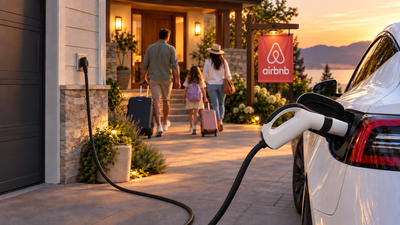
- Vacation-rental or Airbnb stops where the property offers a compatible outlet with the host's permission. Some properties may offer a compatible outlet; confirm the outlet type and permission to charge with the host before committing to the destination.
- Campground and RV-park itineraries where the park specifically permits EV charging at its pedestals. See the RV park charging guide for outlet-type specifics.
The backup plan doesn't need to be as fast as DC fast charging. It needs to reduce the risk of being unable to continue the trip when the primary plan doesn't work out.
Frequently asked questions
Is Electrify America getting more reliable over time?
EA's own reporting documents meaningful hardware upgrades — 121 stations refreshed with 518 next-generation chargers in 2024, and the newer equipment requires approximately 80% fewer on-site maintenance dispatches (per EA's Q2 2025 CARB report). That indicates improved hardware maintainability, which is not the same as a proportional improvement in successful charging sessions across the network. Real-time PlugShare check-ins and the EA app's availability display remain the best pre-arrival sanity checks for any specific station.
How much range can a portable Level 2 charger add overnight?
A 32A portable Level 2 charger on a properly-installed 240V NEMA 14-50 outlet delivers up to 7.7 kW. Over an 8-hour overnight stop that's up to approximately 61 kWh supplied by the EVSE before charging losses. Actual range added depends on your vehicle's efficiency, onboard AC charger acceptance rate, ambient temperature, and battery conditioning load.
Can I use a WenStorm portable charger at a Tesla Supercharger as backup?
No. Superchargers are DC fast charging with their own connector protocol and hardware. Portable Level 2 chargers are for AC charging at 240V outlets like NEMA 14-50. For CCS1 vehicles that can use Superchargers at compatible sites, an automaker-provided NACS DC adapter is required — see Tesla's compatibility rules for which vehicles and sites qualify. Third-party DC adapters are not authorized by Tesla.
What outlet do I need at an RV park for a Level 2 backup?
The WenStorm portable Level 2 charger uses a NEMA 14-50 plug and requires a permitted, properly-maintained 240V NEMA 14-50 outlet. It cannot operate from a TT-30 pedestal (TT-30 is 120V). The separate WenStorm RV Adapter Kit works only with a Tesla Gen 2 Mobile Connector, not with the WenStorm portable charger. Confirm outlet type, outlet condition, and EV-charging permission with the park before arriving.
Should I book RV parks in advance for backup charging?
Yes. Book the stay in advance and confirm EV charging is permitted at the specific pedestal you'll use. Availability of a pedestal does not automatically mean permission to charge an EV from it — some parks have EV-specific rules or additional fees, and older pedestals may not be maintained for continuous EV loads (per KOA's EV-charging policy).
Is a portable Level 2 charger too slow to matter on a road trip?
For adding overnight range at a destination stop — typically 60–150 miles depending on vehicle efficiency and outlet quality — a portable Level 2 charger is fast enough. It is not a replacement for DC fast charging when the route requires faster-than-overnight recovery; it is the overnight fallback layer beneath steps 1 and 2 of the backup hierarchy.
Shop the WenStorm Level 2 Portable Charger
Related reading: Why WenStorm built portable-first · Charging an EV at an RV park (TT-30 pedestals)