Best Portable EV Charger for Airbnb Hosts (Tesla + Non-Tesla)

TL;DR
Yes — for hosts renting to mixed EV guests, the WenStorm Universal Airbnb Host Kit ($242.98) is the strongest all-in-one choice because it combines a 32A NACS portable charger with a NACS-to-J1772 adapter, fitting every current U.S. EV a guest might arrive in. Setup runs ~15 minutes off an existing 240V outlet, or ~$150–400 to add one via an electrician. Skip a portable setup entirely if you rent by-the-night (guests won't unplug), can't route the cable safely, or your HOA bans it.
An EV-driving guest is 3-4x more likely to book a listing that shows "EV charging available" as an amenity — but only if the charger they arrive with actually plugs in. That last part is where most host setups fall short. This guide covers what a portable EV charger has to do to serve real Airbnb guests, which specific products handle guest-vehicle variety, and the setup + billing logistics that turn the amenity into repeatable bookings.
The primary recommendation below is the WenStorm Universal Airbnb Host EV Charging Kit — not because we sell it, but because it's the only product on this list designed for the "any EV guest, no install" scenario Airbnb hosts actually face.
Why Airbnb hosts should add EV charging as an amenity
EV adoption changed guest-side booking behavior in 2024-2026. Guests planning multi-night stays check whether a listing has charging before they check price. Rental data shows several consistent patterns:
- Listings with any form of EV charging see higher booking rates from EV owners, who over-index on longer stays (3+ nights) and higher-value rentals
- Guests report willingness to pay a $5-15/night premium for confirmed on-site charging vs. the same listing without
- Charging as a listed amenity increases repeat bookings from EV drivers — once a guest confirms your outlet works with their car, they book again
The counterweight: Airbnb has been slow to add "EV charging" as a searchable filter (documented across hundreds of Reddit host complaints since 2022). Hosts who add the amenity today are optimizing for the ML-driven ranking, not a checkbox filter — which means how you list it matters as much as having it.
Practically: guests searching for EV amenities look at three signals in this order:
- Listing title (put "EV charging available" here, not just in the amenity list)
- Top 3 cover photos (one should show the charging setup)
- The amenity list itself (Airbnb weights this in ranking even without a search filter)
The hardwired vs portable decision for rental properties
Hardwired Level 2 chargers cost $2,500-4,000 installed (equipment + electrician + permit). Portable Level 2 chargers cost $220-450. Both deliver the same charge speed to the guest.
For a rental property specifically, portable wins on five dimensions:
- Reversibility. Portable removes cleanly when the property sells. Hardwired is a permanent electrical modification the next owner may not want.
- Permitting. Portable requires none. Hardwired requires an electrical permit in every US state and an inspection in most.
- Insurance. Portable is treated as personal property. Hardwired becomes part of the property's electrical system, which some rental insurance policies want disclosed.
- Property tax. Hardwired can add assessed value in some jurisdictions. Portable doesn't.
- Damage risk. A hardwired unit exposed to guest use — untrained plugging, weather, accidental damage — is expensive to replace. A portable can be locked in the property when not in guest use.
The only cases where hardwired makes sense for a rental: high-volume commercial rentals (10+ EV-guest nights per month), properties where the parking area has no existing 240V outlet within cable reach, or hosts who want to charge guests via a networked billing platform that requires a hardwired unit.
What a portable EV charger has to do for Airbnb guests
The specific requirements for a rental-property charger are different from a homeowner setup, because the host doesn't know what car will arrive next week.
- Guest compatibility across both connector types. North American EVs use one of two plug shapes: Tesla's NACS (Tesla Model 3/Y/S/X, Ford, GM, Rivian, Volvo, Polestar as of 2025 rollouts) and the older J1772 standard (Chevy Bolt, Nissan Leaf, Hyundai/Kia pre-2025, VW ID.4). A charger with only one connector serves ~half your EV guests. A dual-compatibility setup serves both.
- No permanent install. The charger has to plug into an existing outlet or a receptacle a licensed electrician adds — not be hardwired to the panel. This is the reversibility requirement above.
- 32A minimum charging speed. A 16A trickle charger adds ~40 miles per 8-hour night. A 32A Level 2 adds ~150 miles. Guests staying 2 nights need meaningful range recovery, not a slow drip.
- Weatherproof rating. If the outlet is outdoor or in an uncovered garage, the charger housing needs IP65 or better. Guests will use it in rain.
- 25-foot cable minimum. Guests park where they park. A 15-foot cable forces you to specify parking location. 25 feet gives normal maneuvering room.
- Simple guest instructions. The setup should be one photo + one paragraph in your listing's guidebook. If your charger requires an app download, guests won't use it.
Most portable EV chargers on the market are designed for single-vehicle homeowner use — one connector, no guest compatibility, no host-specific packaging. Only a small number of products explicitly address the multi-guest scenario.
Comparing your options
Four honest options for a portable EV charging setup at a rental:
1. WenStorm Universal Airbnb Host EV Charging Kit — $242.98
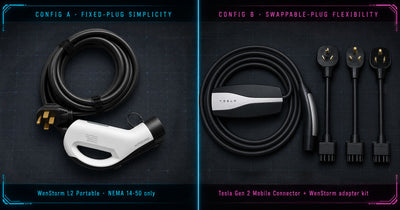
A 32A NACS-plug portable Level 2 charger bundled with a NACS-to-J1772 adapter. The charger plugs into your NEMA 14-50 outlet. NACS-connector guests (Tesla, Ford, GM, Rivian) plug in directly. J1772-connector guests (Bolt, Leaf, older Hyundai/Kia) attach the included adapter and plug in. One kit, both connector types, no separate purchases.
Best for: Airbnb hosts with an existing NEMA 14-50 outlet (or willingness to have one added for ~$150-400) who want to accept any EV guest without buying multiple chargers.
Skip if: you're only hosting Tesla-branded rentals (in which case a Tesla Mobile Connector is cheaper) or you don't have a 240V outlet at all.
2. Tesla Gen 2 Mobile Connector + NEMA adapters — $325 (charger) + $35-50 per adapter
Tesla's OEM portable charger. Works with any Tesla vehicle out of the box. To use it with J1772 (non-Tesla) guests, you need an aftermarket NACS-to-J1772 adapter (~$120) because Tesla doesn't sell one.
Best for: Tesla-only guest properties, or hosts who already own a Tesla and can share their existing Mobile Connector.
Skip if: you want to serve non-Tesla guests without buying a separate aftermarket adapter (which introduces liability questions if the guest damages their vehicle with it).
3. Generic 32A NEMA 14-50 portable Level 2 (J1772-only) — $180-280
A single-connector J1772 portable Level 2 charger, sold under many brand names including Lectron, PRIMECOM, and others. Works with all pre-NACS-transition EVs. Cheaper than dual-compatibility kits, but incompatible with any NACS-connector guest (Tesla and 2024+ Ford, GM, Rivian).
Best for: hosts in areas where Tesla ownership is unusually low, or properties targeting fleet-vehicle rentals (most fleets are still J1772).
Skip if: you serve mainstream US EV guests. As of 2026, roughly half of new US EV sales use NACS connectors — a J1772-only charger locks out a growing share of guests.
4. EcoFlow Portable Level 2 + battery hybrid — $600-900
EcoFlow's charger doubles as a portable battery bank. Interesting for off-grid or supplemental power scenarios, but 2-3x the cost of a straight portable charger without corresponding EV-charging advantages for a hosted stay.
Best for: off-grid rental cabins, glamping setups, or hosts who genuinely need the battery-bank function.
Skip if: you have grid power and a 240V outlet. The extra cost isn't buying you charging capability, it's buying battery storage you don't need.
Verdict per scenario
- Existing NEMA 14-50 outlet + mixed guest fleet: WenStorm Universal Airbnb Host Kit — the guest-compatibility win pays for itself in one booking.
- Existing NEMA 14-50 outlet + Tesla-only rental network: Tesla Mobile Connector.
- No 240V outlet yet: budget $150-400 for an electrician to add a NEMA 14-50 receptacle, then buy a portable — total ~$400-650 all-in, still under half the hardwired cost.
- Off-grid property: EcoFlow or similar battery-hybrid.
Guest billing — three approaches that work
Hosts land on one of three billing models. Each has trade-offs.
Free with booking. Advertise "EV charging included" in the amenity. Absorb the electricity cost (~$3-6 per full charge at average US residential rates). Simplest to communicate; increases bookings; costs you $30-60 per month at typical utilization. This is what most hosts choose for the first year while proving the amenity's booking-lift value.
Add-to-cleaning-fee. Bump your cleaning fee by $15-25 to cover average EV charging session cost per stay. Guest sees one fee, not itemized charges. Works cleanly because Airbnb's fee structure allows it. Downside: guests who don't charge subsidize guests who do.
Per-session billing. Use a networked charger (Tesla Wall Connector with commercial mode, ChargePoint Home Flex commercial firmware, or a splitter product like Splitvolt) that meters each session and lets you invoice through Airbnb messaging. Highest revenue capture; most operational complexity; requires a networked charger, not a basic portable.
For most Airbnb-scale hosts (1-5 rental properties, up to 20 EV-guest nights per month), "add-to-cleaning-fee" is the winning tradeoff. Simple, fair-enough, no operational overhead.
Setup walkthrough for a portable EV charging amenity
The physical setup for a WenStorm-style portable in a rental is straightforward.
- Confirm your 240V outlet. Check your dryer receptacle, range receptacle, workshop outlet, or existing RV outlet. Most homes have at least one NEMA 14-50, NEMA 14-30 (dryer), or NEMA 10-30 (older dryer). WenStorm's guide to charging from an existing dryer outlet shows how to identify each.
- Verify the cable reaches your guest parking spot. A 25-foot cable covers most single-driveway garages. If you're using a workshop outlet or a location further from the guest parking area, you may need to add an outlet closer — budget $150-400 for a licensed electrician.
- Add outdoor weatherproofing if the outlet or charger will be exposed. A weatherproof outlet cover for the receptacle costs $15. The WenStorm Airbnb Host Kit charger housing is rated for outdoor use.
- Photograph the setup for your listing. One clear photo showing the outlet + charger + connector goes into your top-3 cover photos. Guests screen listings visually before reading amenity lists.
- Write the guidebook entry. One paragraph, four sentences maximum. Include: which outlet the charger plugs into, which connector the guest uses (or which adapter for J1772 vehicles), how long a full charge takes, and any parking-orientation instructions. Add a photo of the plug-in point.
- Test with your own car if you have an EV, or a neighbor's EV. Confirm the setup works before the first guest arrives. Watch for outlet warmth after 2 hours — a warm outlet signals a receptacle that should be swapped for an industrial-grade unit.
The WenStorm Airbnb host playbook walks through the guidebook wording, listing-photo composition, and the amenity-listing strategy in more detail.
When you shouldn't add EV charging as an amenity
Adding EV charging works for most rental properties, but there are honest cases where it doesn't:
- Single-night rentals. A guest arriving at 10pm and leaving at 9am the next morning won't recover meaningful range. They also don't have time to notice the amenity was there.
- Shared-outlet properties. If the only 240V outlet is your household dryer or range, guests plugging in disrupts your normal household use. Either add a dedicated outlet or skip the amenity.
- HOA-prohibited properties. Some condos and HOAs prohibit any EV charging infrastructure regardless of whether it's hardwired. Check your CC&Rs before advertising.
- Properties with no safe cable path. If the parking area is 60 feet from the outlet and you'd have to run cable across a walkway, the trip-hazard liability isn't worth the amenity income.
- Properties in areas with dense public charging. Guests in dense urban areas often prefer public DC fast charging (30 minutes at Electrify America) over overnight Level 2. In those markets, the amenity adds less booking value.
- Insurance-restricted properties. Some short-term-rental insurance policies specifically exclude EV charging losses. Confirm coverage before adding the amenity.
Related WenStorm guides
- How to add EV charging as an Airbnb amenity — no install version
- The Airbnb host EV charging decision framework
- Full Airbnb EV charger playbook (guidebook wording, photos, listing strategy)
- NEMA 14-50 outlet guide (if you need to add one)
FAQ
Does Airbnb let hosts filter by "EV charging" in search?
Not directly as of mid-2026. Airbnb includes "EV charging" as a selectable amenity in your host dashboard, but guests can't filter search results by it. Hosts see the amenity affect search ranking through Airbnb's ML weighting rather than a checkbox filter. The workaround: put "EV charging available" in your listing title and one of your cover photos, not just the amenity list.
Can I charge guests separately for electricity?
Yes, three ways. Add $15-25 to your cleaning fee to cover average session cost (simplest). Or use a networked charger with per-session billing and invoice guests through Airbnb messaging (highest revenue capture but requires a networked unit, not a basic portable). Or absorb the cost and advertise "EV charging included" — most single-family hosts choose this in year one, since $30-60/month in electricity is small vs. the booking lift.
Do I need to be there when a guest charges their EV?
No. Portable EV chargers with a J1772 or NACS connector are safe to leave unattended — that's the whole point of overnight residential charging. Leave the charger plugged into the outlet, hang the connector on a hook near the outlet, and instruct the guest via your guidebook. The charger stops automatically when the vehicle's battery reaches its set limit.
What if my guest damages my portable EV charger?
Include it in your damage deposit / security deposit terms. A WenStorm portable charger is $242.98 replacement cost. Airbnb's Host Damage Protection covers accidental damage; document the pre-arrival condition with a photo. Most hosts store the charger in a locked location between stays and only put it out for confirmed EV-driving guests (visible in the pre-arrival messages).
Can I put a portable EV charger outside in the rain?
The WenStorm Universal Airbnb Host Kit charger is rated for outdoor use. Its housing meets IP-rated weatherproofing standards. The receptacle it plugs into should also be weatherproof-rated (a $15 "in-use" outlet cover works). Do not use an indoor-rated portable charger outdoors.
How long does a full charge take with a 32A portable Level 2?
Roughly 30 miles of range per hour for most EVs. A guest arriving at 8pm with 40 miles of range would have 240+ miles by 7am the next morning — a full recovery for most vehicles. That's fast enough for any stay of 1+ nights.
Do I need Wi-Fi for the charger?
No, the WenStorm Universal Airbnb Host Kit is a "dumb" charger that just delivers current when a vehicle plugs in. It doesn't need Wi-Fi, an app, or a network connection. If you want per-session billing, you'd need a networked charger (Tesla Wall Connector commercial firmware, ChargePoint Home Flex commercial). Most Airbnb-scale hosts don't need this complexity.
Should I mention "EV charging" in the listing title even if Airbnb doesn't filter for it?
Yes. Even without a search filter, Airbnb's ranking weighs listing-title keywords, and EV-driving guests scan titles before amenity lists. "EV charging available" or "EV friendly" in the title increases both booking rate and repeat bookings from EV-owning guests. Same rule for one of your cover photos — show the charger plugged in.
Real questions from EV owners
- Airbnb host said "yes to EV charging" — I show up and it's a 120V garage outlet. Am I still OK?
- My in-laws' lakeside cabins keep getting asked about EV charging — Level 2 chargers, or just list it as bring-your-own-cord on PlugShare?