Is an EV Charger Worth It for Airbnb Hosts? Cost, Bookings & ROI

TL;DR
Yes — for hosts with a compliant NEMA 14-50 outlet, EV charging can be a low-cost listing upgrade. Airbnb reported EV-charger searches grew more than 80% from 2022 to 2023 and associated the amenity with two additional booked nights per property. A portable 32A Airbnb kit costs about $409, so at a $200 nightly rate, two extra booked nights roughly equal the hardware cost. Results vary by market; a portable kit lets hosts test demand before committing to a permanent wall charger.
Table of contents
- Why Airbnb hosts are adding EV charging
- Can an EV charger actually help get more bookings?
- What does a $409 EV-charging amenity need to earn back?
- Could you charge a higher nightly rate?
- Why a portable charger is a low-risk way to test demand
- Who is most likely to benefit?
- Portable charger vs permanent wall charger
- How to add EV charging to your Airbnb listing
- What guests actually need
- Safety, outlet, and NEC 625.17(C) caveat
- Frequently asked questions
Why Airbnb hosts are adding EV charging
For an Airbnb host, an EV charger isn't primarily a charging-equipment purchase. It's an amenity investment.
Per Airbnb's May 2024 partnership announcement, searches using the EV-charger filter increased more than 80% from 2022 to 2023, and Airbnb's internal analysis associated adding EV charging as an amenity with an average of two additional booked nights per property.
Two nights per property isn't a guaranteed return for every listing. But it changes the question. Instead of "Do I need an EV charger?" the host question becomes: "How cheaply can I test whether EV charging improves my listing?"
If the property already has a compliant NEMA 14-50 outlet, a portable Airbnb charging kit costs about $409 and doesn't commit the host to a permanent wall-charger installation. Compared with a renovation, a hot tub, furniture upgrades, or a hardwired smart charger with electrician install, that's a small-dollar amenity experiment.
Can an EV charger actually help get more bookings?
EV charging can create value through three separate paths, and the host doesn't need all three to hold for the investment to make sense.
1. More searchable inventory. Guests filtering Airbnb search results for EV charging can find the property. Airbnb's 80% search-growth figure (2022 to 2023) shows this discovery-surface demand is expanding fast.
2. Better conversion against similar listings. Two otherwise similar homes — Listing A with parking only, Listing B with parking plus overnight EV charging — solve different trip-planning problems for an EV-driving guest. The host doesn't need a guest to say "I booked only because of the EV charger" for the amenity to lift conversion.
3. Potential nightly-rate premium. Some hosts include EV charging in the nightly rate as a premium amenity rather than billing electricity separately. Whether the market supports a premium depends on the listing and on comparable properties nearby.
The measurable data point from Airbnb is the two-incremental-nights association. The other two paths are plausible mechanisms that individual hosts may or may not realize. Model the investment on the measurable outcome and treat premium ADR as upside.
What does a $409 EV-charging amenity need to earn back?
At the $408.56 WenStorm Universal Airbnb Host Kit price, here's the gross-revenue break-even at different nightly rates:
| Your average nightly rate | Extra booked nights to recover ~$409 |
|---|---|
| $100 / night | ~5 nights |
| $150 / night | ~3 nights |
| $200 / night | ~3 nights |
| $250 / night | ~2 nights |
| $300 / night | ~2 nights |
Illustrative gross-revenue break-even examples only. They don't account for Airbnb service fees, electricity cost, taxes, or other operating costs. EV charging does not guarantee additional bookings.
Airbnb's own aggregate association — two incremental booked nights per property that added the amenity — sits inside this table. At a $150–$200 nightly rate, two extra booked nights are within a rounding error of the entire hardware cost.
At $200 ADR, two additional booked nights represent about $400 in gross room revenue — roughly the purchase price of the $408.56 kit. Airbnb's two-night figure is an association across its 2022–23 dataset, not a guaranteed outcome for any specific listing. It does illustrate why EV charging can be a low-cost amenity test for hosts who already have a suitable outlet.
Could you charge a higher nightly rate?
The other break-even path is ADR premium instead of extra bookings. If EV charging lets the host raise the nightly rate by even a modest amount, the payback math changes:
| Added premium per booked night | Booked nights to recover ~$409 |
|---|---|
| +$5 / night | ~82 nights |
| +$10 / night | ~41 nights |
| +$15 / night | ~28 nights |
| +$20 / night | ~21 nights |
Whether the market supports any premium at all depends on the listing. But a modest +$10 per booked night reaches gross-cost break-even in about 41 nights — well inside a typical year of hosting for most properties with steady demand.
There's no published Airbnb data confirming a specific EV-charger premium, so treat this as a sensitivity analysis rather than a promise. It shows how small the premium has to be for the kit's hardware cost to be recovered.
Why a portable charger is a low-risk way to test demand
A host doesn't need to commit to a permanent charging installation on day one. If the property already has a compliant dedicated NEMA 14-50 outlet, a portable kit lets the host add EV charging to the listing, monitor guest interest, collect feedback, and learn actual usage patterns before deciding whether a permanent smart wall charger is justified.
If EV-driving guests become frequent, a hardwired smart EVSE (ChargePoint Home Flex or equivalent) may eventually make sense as a long-term upgrade. If usage stays low, the portable kit can be removed, relocated to a different property, or resold — the host isn't left with a permanently installed asset that receives little use and can't be recovered.
The portable-vs-permanent decision isn't "which product is better." It's "commit first and learn demand later" versus "test demand cheaply and upgrade later if usage proves itself."
Who is most likely to benefit?
Not every Airbnb listing benefits equally from adding EV charging. Properties most likely to see the two-incremental-nights association actually move:
- Highway-adjacent listings where EV road-trippers plan overnight stops around charging availability
- Vacation destinations in EV-heavy metros (California, Washington, urban Northeast) where a larger share of inbound guests drive EVs
- Suburban listings with private parking where guests can charge overnight without competing for a shared spot
- Road-trip properties along common EV corridors where charging infrastructure planning matters
- Rural or long-drive listings where the nearest public fast-charger is far enough away that "charge at your stay" becomes a real convenience
- Properties near business travel destinations where corporate EV drivers stay overnight
Listings where guests typically arrive by public transit, walk, or in short-range non-EVs are less likely to see much uptake, but the low kit cost still keeps the downside contained if the amenity stays quiet.
Portable charger vs permanent wall charger
For hosts weighing a portable kit against a permanent wall-mounted smart charger, the trade-off looks like this:

ChargePoint Home Flex is one example of the permanent-smart-charger route (available hardwired or plug-in, J1772 or NACS, with a 3-year warranty per ChargePoint's Home Flex FAQ). Other vendors — Wallbox, Emporia, ClipperCreek — occupy similar territory.
Historical note: Airbnb and ChargePoint ran a US host promotion in 2024, but ChargePoint's promotion-terms document shows the special pricing ended May 21, 2025. A 2026 buyer should compare on the current products, not on the expired discount.
How to add EV charging to your Airbnb listing
Adding EV charging as a listing amenity is a two-part process — enabling the amenity on Airbnb and physically providing the charging equipment on-site.
- Add "EV charger" as an amenity in your Airbnb listing's Amenities section. This makes the listing appear in guest searches filtered for EV charging.
- Verify your existing outlet is a properly permitted dedicated NEMA 14-50 on its own branch circuit, or add one via a licensed electrician. Do not attempt to share the outlet with a dryer or other appliance.
- Set up the portable kit or install the wall charger in the parking area, with the cable able to reach the guest's charge port.
- Write clear guest instructions — plug type (NACS or J1772), included adapters, expected charging rate, any cable-management guidance, and where the kit is stored between guests.
- Decide on the fee structure — bundle charging into the nightly rate as a premium amenity, or use Airbnb's Resolution Center for disclosed per-guest charging fees. Airbnb doesn't offer a standard "EV charging" fee field alongside cleaning or pet fees.
- Monitor guest usage for 2–3 booking cycles before deciding whether to invest in a permanent upgrade.
What guests actually need
Guests aren't looking for spec sheets. They need six things to be true when they arrive:
- Reserved parking at the property (not a shared or first-come lot)
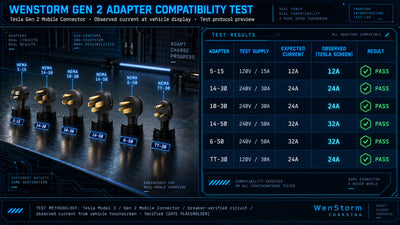
- Connector compatibility — NACS for Tesla vehicles, J1772 for most non-Teslas, or a portable kit that covers both with an included adapter
- Cable reach from the outlet or charger to the vehicle's charge port location
- Clear instructions in the listing and the on-site welcome guide — where the kit is, how to plug in, what amperage to expect
- Simple physical access — the outlet or charger shouldn't require unlocking a garage or moving other equipment
- A working outlet that's been recently checked (a portable kit is only as good as the outlet it plugs into)
A $409 kit that solves all six for a $200-ADR listing is a much better amenity than a $2,000 hardwired install that solves five of six.
Safety, outlet, and NEC 625.17(C) caveat
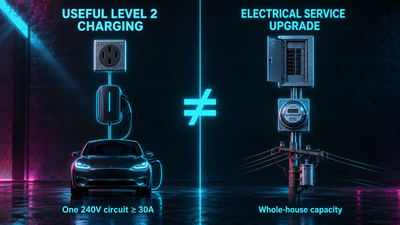
A portable Level 2 charging kit assumes the host already has a compliant, properly permitted dedicated 240V outlet. Adding a plug-in kit to an existing suitable outlet is generally not new fixed electrical work and typically does not require a new permit. But that does not, by itself, establish overall code compliance.
If the kit is used with an aftermarket vehicle-side extension cable, NEC 625.17(C) includes an overall usable EVSE cord/cable length requirement (generally 25 ft, measured attachment-plug to vehicle-connector for portable EVSE, unless qualifying listed cable management applies). An aftermarket extension adds to the combined path — it is not automatically exempt from the overall-length rule.
For Airbnb properties — where equipment is being supplied to changing guests — apply the conservative reading: verify total-length compliance for your specific EVSE + extension combination, and check your local AHJ interpretation. Some short-term-rental jurisdictions classify high-turnover STRs as commercial and impose different EVSE rules.
See Are EV Extension Cords Legal? What NEC 625 Says for the full framework.
Frequently asked questions
Will EV charging really get me more bookings?
Airbnb reported an association between adding EV charging and an average of two incremental booked nights per property in its 2022–23 internal analysis. That's a platform-level average, not a guarantee for any specific listing. Results vary by market, listing quality, guest mix, and competitive alternatives. The portable-kit approach lets you test the amenity's actual effect on your listing at a $409 hardware cost, without a permanent installation commitment.
How much will EV charging cost me in electricity?
At the US 2026 residential average of roughly $0.183/kWh (per EIA), a Level 2 32A charger drawing 7.7 kW for 4 hours uses about 30.8 kWh — roughly $5.64. Actual guest sessions vary by vehicle battery size and starting state of charge. Airbnb doesn't publish a standard fee-structure breakdown; the two working options are to bundle expected electricity cost into the nightly rate, or use Airbnb's Resolution Center for disclosed per-guest charging.
Do I need a special outlet?
Yes — a dedicated 240V NEMA 14-50 on its own branch circuit for the portable kit. If you don't already have one, adding it is a separate licensed-electrician job that isn't covered by the kit price. Do not attempt to share the outlet with a dryer, range, or other high-draw appliance; NEC 625.40 generally requires an individual branch circuit for EV supply equipment above 16A/120V.
Can I bill guests separately for EV charging?
Airbnb doesn't currently provide a standard "EV charging" fee field alongside cleaning, pet, or extra-guest fees. Hosts can incorporate expected electricity cost into the nightly rate, or — where treated as an optional disclosed amenity — use Airbnb's Resolution Center for permitted per-guest charging with disclosure. Check Airbnb's current fee policy before charging guests separately.
What if a guest damages the portable kit?
Damage from guests is a normal host-property risk. WenStorm's 2-year warranty covers manufacturing defects; guest-caused physical damage would be handled under your Airbnb host protection or a separate deposit-and-inventory policy. The portable kit's advantage here is replaceability — the whole unit costs less than a wall-mounted charger plus install, so a full replacement is a more manageable expense.
What about the §30C federal tax credit?
Not applicable for property placed in service after 2026-06-30. The IRS's Form 8911 instructions confirm the Alternative Fuel Vehicle Refueling Property Credit was terminated on that date under the One Big Beautiful Bill Act (P.L. 119-21). Consult a tax professional for your specific property and use case — treatment for an income-producing rental differs from a taxpayer's main home.
Should I get the portable kit or a permanent wall charger?
Match the choice to what you know about your listing's EV-guest demand. If you're testing whether EV charging will move your bookings, the portable kit's low-commitment approach is the right first step. If you already have proven ongoing EV-guest demand (repeat EV-driving guests, high fill rate, high review-mention frequency for charging), a hardwired smart EVSE (ChargePoint Home Flex or equivalent) makes long-term sense. The kit and the wall charger aren't mutually exclusive — a common progression is to start portable while demand is unproven and upgrade to a hardwired unit once guest usage justifies the install cost.
Related reading
- Best Portable EV Charger for Airbnb 2026 — the pillar buyer's guide
- EV Extension Cable Buyer's Guide: J1772 vs NACS, Length, and What Not to Do — cable sizing walkthrough
- Are EV Extension Cords Legal in the US? What NEC 625 Says — the code-compliance framework
- Why 8 AWG Is Enough for 50-Amp EV Charging — the voltage-drop math
WenStorm Airbnb-host solutions
A low-commitment way to test EV-charging demand for your listing. Plug-in Level 2 charging with cross-standard adapter coverage — no new fixed electrical installation when a compliant outlet already exists.
Not sure which fits your listing? The Universal Kit alone covers listings where guest parking is within reach of the kit's 25 ft cable. Add the 50A extension only if your parking spot is farther than that AND you've verified NEC 625.17(C) total-length compliance for your setup. Confirm your existing 240V outlet is a properly permitted NEMA 14-50 on its own branch circuit before ordering either.
Written by Priya Shanker, Rental & Airbnb Setup Specialist at WenStorm. Priya covers short-term-rental EV charging, host economics, and guest-agnostic charging setups for mixed-fleet properties.