Is a 25-Foot EV Charger Cable Long Enough?

TL;DR
A 25-foot EV cable is long enough for most single-car garages when the wall outlet is roughly on the same side as your car's charging port. If the outlet is on the opposite wall or your car parks outside the garage, size up to 30 or 50 ft. When you're extending an existing charger, match the cable's amperage rating to your EVSE's output — a cable rated below the EVSE's continuous current will overheat.
Disclosure: WenStorm sells the L2 Portable Charger and the vehicle-side extension cables discussed below. Verify current specifications, price, and availability on the product page and the extension cord collection before purchasing.

Extension amperage-matching quick reference
Match the extension's continuous current rating to your EVSE's output, or exceed it. A cable rated below the EVSE's continuous current will overheat under load — the extension must always be rated at or above your charger's amperage.
| Your EV charger | Minimum extension rating | WenStorm option |
|---|---|---|
| 16A (Level 1 or lower L2) | ≥ 16A continuous | Any WenStorm J1772 32A, J1772 50A, or NACS 50A extension |
| 32A (typical portable Level 2) | ≥ 32A continuous | J1772 32A (from $129.99), J1772 50A, or NACS 50A (from $169.99) |
| 40A (mid-range wall EVSE) | ≥ 40A continuous | J1772 50A variant or NACS 50A |
| 48A (higher-current wall EVSE) | ≥ 48A continuous | J1772 50A variant or NACS 50A |
Note: WenStorm's J1772 extension is available in 32A and 50A ratings; the Tesla/NACS extension is 50A across all lengths. For the complete J1772 vs NACS decision walkthrough, see the EV Extension Cable Buyer's Guide.
Before you buy an extension, consider these first
If your measured routed length exceeds 25 ft, the safer default is to change the setup rather than reach further with cables:
- Change your parking orientation. Pulling in nose-first when you currently back in (or vice versa) can move the charging inlet several feet closer to the outlet, depending on where the inlet is on the vehicle.
- Move the receptacle closer. A licensed electrician can install a new NEMA 14-50 receptacle in a more convenient location. This is a scoped electrical job with a permit and inspection in most jurisdictions, but it's often a one-time cost that removes the reach problem permanently.
- Move where you park the EV. If a different bay or driveway position brings the outlet within 25 ft of routed cable path, that's the simplest fix.
These options are usually preferable to extending cable length. NEC 625.17(C) limits the overall usable EVSE cord/cable length to 25 ft unless a cable-management system is part of the listed EVSE. For portable EVSE the measurement runs from the attachment plug to the vehicle connector; for fastened-in-place equipment, from the EVSE to the vehicle connector. States and municipalities adopt different NEC editions and may amend these requirements — see the NEC 625.17(C) authority note for the full context and jurisdiction guidance. Longer runs can create compliance and installation questions that a shorter setup avoids.
If you do need a vehicle-side extension
Which connector do I need — J1772 or NACS?
Check the shape of your car's charging inlet (or the connector on your factory charging cable):
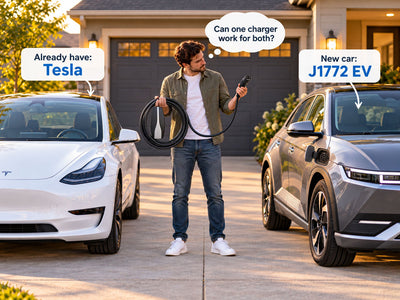
- Tesla and NACS-native EVs (all Teslas, plus newer Ford, GM, Rivian, and Hyundai models on the NACS transition) use the slim oval inlet. Extension cable: Tesla/NACS Extension Cord 50A 240V — 21 to 50 ft, from $169.99.
- Non-Tesla EVs with a J1772 port (Chevy Bolt, VW ID.4, Hyundai Ioniq 5/6, Rivian R1T/R1S, Ford Mach-E, Ford F-150 Lightning, and most 2013–2024 EVs) use the round 5-pin inlet. Extension cable: WenStorm J1772 EV Extension Cable — 21 to 50 ft, 32A or 50A, from $129.99.

WenStorm J1772 EV Extension Cable
21 to 50 ft, 32A or 50A. Built with UL 2263-certified EV cable (UL-US-2407470-0). For Bolt, Ioniq, Rivian, Mach-E, and any J1772 EV.
Buy It NowFrom $129.99
WenStorm Tesla/NACS Extension Cord
50A across all lengths (21 to 50 ft). Built with UL 2263-certified EV cable (UL-US-2407470-0). Confirm your specific EVSE's manual permits an extension first.
Buy It NowFrom $169.99A vehicle-side extension cable connects between the EV charger's vehicle connector (J1772 or NACS) and the car. These are not wall-outlet extension cords — those are a separate category and are generally not appropriate for continuous high-current EV charging.
Before using a vehicle-side extension, confirm:
- Its connector type matches your charger and vehicle (J1772-to-J1772 for a J1772 charger paired with a J1772 vehicle; NACS-to-NACS for the NACS pairing).
- Its current rating meets or exceeds your charger's amperage.
- The complete configuration — the specific charger + specific extension + your installation — is permitted by both the charger instructions and the extension instructions, by the applicable safety listing, and by your local electrical requirements.
- Every connection stays protected from water, physical damage, and vehicle traffic.
WenStorm offers J1772 and NACS vehicle-side extensions in multiple lengths, built with UL 2263-certified EV cable (Cert No. UL-US-2407470-0) at the cable-material level; specific conductor gauges vary by product (WenStorm's 32A extensions and 50A extensions use different wire sizes). See the extension cord collection for current SKUs, lengths, and full specifications. For the full safety framework — including when NOT to use an extension — see Can You Use an Extension Cord With an EV Charger?
Extension safety warnings
- Never route the cable through a closing door or window. Compression damages the insulation over time and can expose live conductors.
- Keep connections off the ground and away from standing water. The plug/connector interfaces are the failure points to protect first.
- Do not place the cable where vehicles may drive over it. A single tire pass can crush the internal conductors even if the outer jacket looks intact.
- Avoid sharp bends and do not pull the cable taut. Both stress the internal wires and connectors.
- Stop using it if a connector becomes unusually hot, loose, or discolored. Have the outlet and cable inspected by a licensed electrician before resuming.
- Never chain multiple extensions. Each added connection is another potential failure point and often falls outside the listing.
The cable-length trade-off
Longer cable is not strictly better. Trade-offs go both ways:
- Weight. Rated EV cable is thick copper; every extra foot adds meaningful weight. A very long factory cable is heavy enough to be awkward for daily plug-and-unplug use.
- Cost. Extra cable length pushes up the product's price without adding any charging speed — the charger's rated output is the same regardless of the cable length.
- Coiling and storage. Longer cables take more space to coil in the trunk for road-trip use and more real estate on a wall holder in the garage.
- Splitting into charger + vehicle-side extension improves portability and replaceability (each segment can be moved or replaced independently) but adds another electrical connection that must be protected and inspected. It is not a universal engineering improvement over a single continuous listed cable — the right trade-off depends on your setup and the specific listed configurations available.
- Charging power under load. Loss depends on conductor size, total run length, delivered current, voltage, and the condition of every connection along the path. Effects can be small over short runs but cannot be dismissed as zero without measurements specific to your configuration.
Voltage-drop reference at 32A continuous (240V system)
Voltage drop scales linearly with cable length and current. Reference numbers for a 240V system at 32A continuous, using standard stranded copper conductors:
| Total path length | 8 AWG copper | 10 AWG copper |
|---|---|---|
| 25 ft | ~1.0 V drop (~0.4%) | ~1.6 V drop (~0.7%) |
| 50 ft | ~2.0 V drop (~0.8%) | ~3.2 V drop (~1.3%) |
| 75 ft | ~3.0 V drop (~1.3%) | ~4.8 V drop (~2.0%) |
These are conductor-only calculations at 20°C; connections, terminations, and temperature increases add additional resistance. NEC informational note 210.19 flags 3% branch-circuit voltage drop as the point where derating becomes noticeable. For the full engineering math + per-length calculator, see the EV Extension Cable Buyer's Guide — Sizing your cable.
Common decision questions readers ask
32A vs 50A extension — does the difference matter?
For most single-car home setups, a 32A extension is enough if paired with a 32A (or lower) EVSE. A 50A extension does not charge faster than the EVSE's rated current — the EVSE determines the actual amperage delivered. Choose 50A only if (a) your EVSE is rated above 32A continuous, (b) you may move to a higher-current EVSE later, or (c) the length you need is only stocked in the 50A variant. WenStorm's 32A J1772 extension uses lighter-gauge conductors sized for its lower rating; the 50A variants use heavier conductor gauges — check the specific product page for exact spec.
Does an extension add measurable charge time?
A properly-rated short extension typically has a small effect on charging power. A 25 ft J1772 or NACS extension at 8 AWG copper conductors and 32A continuous introduces roughly 1 V voltage drop end-to-end (~0.4% of 240V) — invisible under normal charging. Combined runs past ~50 ft or extensions using undersized 10 AWG or smaller conductors introduce more measurable losses. Effects specific to your setup can only be confirmed with measurement.
Is a J1772 or NACS extension safer than a longer factory cable?
Neither is universally safer. A single continuous factory cable has fewer connection points; a charger + extension configuration adds one connection point but lets each segment be replaced or moved independently. The safer choice depends on the specific listed products, your installation, and setup constraints. For the full safety framework — including which extensions Tesla explicitly prohibits — see Can You Use an Extension Cord With an EV Charger?
Frequently asked questions
Can I use a regular household extension cord for EV charging?
No. A standard household extension cord is not rated for continuous high-current draw over hours of EV charging. Use only a vehicle-side EV extension cable designed for continuous 240V AC EV use at or above your charger's amperage.
Does adding an extension cable slow down charging?
Charging-power loss depends on conductor size, total length, delivered current, voltage, and the condition of every connection. A properly-rated short extension typically has small effects; long combined runs (past ~50 ft total) can introduce more measurable losses. Effects specific to your setup can only be verified with measurement.
Is 25 ft the same for both the J1772 and NACS variants of the WenStorm charger?
Yes. WenStorm specifies both variants of the L2 Portable Charger as having a 25 ft cable. The only difference between the variants is the shape of the vehicle-side connector.
What if my measured routed length is between 25 ft and 50 ft?
First try changing parking orientation or moving the receptacle closer. If neither is workable, a vehicle-side extension can extend the reach only when the complete configuration is permitted by the charger instructions, the extension instructions, the applicable listing, and local electrical requirements. Verify all four before using an extension for regular charging.
How is the 25 ft measured?
WenStorm specifies the product as having a 25 ft cable. Consult the product page or contact WenStorm support for the exact measurement method.
Are longer factory-cable EV chargers safer than a charger + vehicle-side extension?
Neither is universally safer than the other. A longer factory cable is a single continuous run with fewer connection points. A charger + extension configuration adds a connection point but each segment can be replaced or moved independently. The safer choice depends on the specific listed products, your installation, and your setup constraints.
Shop the WenStorm Level 2 Portable Charger
Related reading: The WenStorm bundle kit lineup · 32A vs 40A EV charger buyer guide · Why WenStorm built portable-first