My Tenant Wants an EV Charger: Who Pays and What Can a Landlord Require?

Published: 2026-07-28. Not legally reviewed prior to publication. This article is educational only. It is not legal, insurance, or electrical advice. Consult a landlord-tenant attorney about your specific lease and jurisdiction, your insurer about coverage, and a licensed electrician about installation.
When a tenant asks to install an EV charger at your rental property, the honest starting-point answer looks like this:
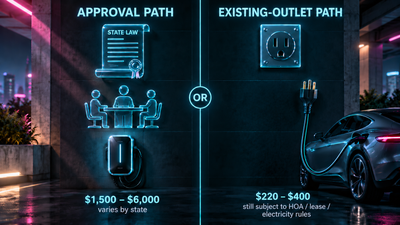
In many tenant-requested EV charging installations, the tenant pays for the charging equipment, electrical work, permits, electricity, maintenance, and removal, unless the landlord voluntarily agrees to share cost. Some state right-to-charge laws require landlords to approve qualifying requests, but they generally allow reasonable safety and documentation conditions. Using an existing outlet may eliminate new electrical work, but it does not automatically eliminate lease, parking, HOA, or landlord-approval requirements.
The article below walks through the cost-responsibility default, the five things a landlord should check before approving an installation, the state right-to-charge laws that may constrain how you respond, and the topics that belong in an attorney-reviewed lease addendum. If you're the tenant side of this conversation, our townhouse EV charging install guide covers the same relationship from your POV.
Cost-Responsibility Default: Who Pays for What?
| Cost category | Default responsibility | Common voluntary alternative |
|---|---|---|
| Charging equipment (EVSE, cable, connectors) | Tenant | Landlord may buy and keep it as a permanent amenity |
| Licensed-electrician labor for new circuits or outlets | Tenant | Landlord contributes for a long-term rental where the wiring becomes a property improvement |
| Permits and required inspections | Tenant | Same as above |
| Ongoing electricity used to charge | Tenant (often billed via sub-meter, added rent, or included in utility payments per lease) | Landlord absorbs a flat monthly amount |
| Ongoing maintenance and repair of installed equipment | Tenant | Landlord takes ownership and maintenance at end of tenancy if equipment stays |
| Removal and restoration at end of tenancy | Tenant | Landlord takes ownership; nothing removed |
| Insurance implications and any required policy amendments | Landlord (for permanent property changes) and Tenant (for their own liability) | Case-by-case; each party consults their own insurer |
Several state right-to-charge laws (Colorado and Oregon in particular) expressly place installation, electricity, maintenance, and removal costs on the tenant unless the parties agree otherwise. Some laws allow the landlord to require tenants to obtain additional liability insurance covering the equipment. The state-law section below covers this in more detail.
Five Things to Check Before Approving an EV Charger Request
Before you email back "sure, no problem" or "sorry, no way," get answers to these five questions. Every subsequent decision depends on them.
1. What state is the property in, and does a right-to-charge law apply? California, Colorado, Illinois, Connecticut, and Oregon have residential-tenant right-to-charge provisions, and each has specific scope and exclusions. Florida, Hawaii, New York, and New Jersey have provisions that primarily protect condominium unit owners rather than general renters. If you're in a covered state, the question is not whether you allow it, but what conditions you can impose. See the state-law section below.
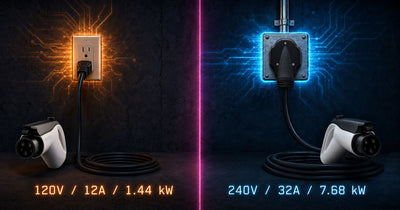
2. Does your existing electrical panel and circuit have suitable capacity? EV charging is treated as a continuous load under the National Electrical Code. Even Level 1 (120V) charging should use an appropriate branch circuit, and the U.S. Department of Energy's home-charging guidance recommends confirming circuit and outlet suitability with a licensed electrician. Adding a Level 2 (240V) circuit or a dedicated EV outlet may require a panel evaluation and potentially a service upgrade.
3. Is this a plug-in setup using an existing outlet, or a new hardwired or new-outlet installation? A tenant using a portable EVSE that plugs into an existing, code-compliant, adequately sized 240V outlet is a very different request from a tenant installing a new circuit, a new outlet, or a hardwired wall unit. The first uses the property as-is; the second modifies it. Every downstream question (permit, permission, cost, removal) depends on which one is being requested.
4. What does your insurer say about EV charging on the property? Some property policies treat a permanent EV charging installation as a covered improvement with no premium change. Others require the equipment to be listed (UL, ETL) and professionally installed to code. Others treat it as a material property change that requires a policy amendment. Call your insurer before agreeing to a hardwired installation, describe the specific setup being requested, and get any conditions in writing.
5. What happens to the installed equipment at end of tenancy? If the tenant installs a hardwired wall unit, does it stay as a property improvement or does the tenant remove it? Does removal include patching the wall? This has to be in writing before installation begins, not negotiated after the tenant moves out. Several right-to-charge statutes require this to be documented in advance.
Two of these questions (insurance and panel capacity) may not have quick answers. "Give me a week to check with my electrician and my insurer" is a legitimate response and buys you time to make an informed decision.
What Portable-Outlet Charging Does and Doesn't Change
A tenant using a portable EVSE that plugs into an existing, code-compliant, adequately sized outlet avoids one category of the request (property modification) but does not automatically waive all landlord approval or lease-clause requirements.
What portable-outlet charging typically avoids:
- New wiring, new circuits, or new outlets that would require a permit and licensed electrician
- Permanent equipment being installed on the property
- Wall-mounting or drilling that would need restoration at end of tenancy
What portable-outlet charging does NOT automatically avoid:
- Lease and parking-agreement compliance. Many leases restrict subletting, alteration of the premises, or non-standard use of shared amenities. Some parking agreements govern what can be plugged into shared electrical service or run through a parking area. Read the lease.
- HOA or condominium association rules. If your rental unit is inside an HOA or condo association, association rules may apply to common-area outlets, cord-routing across shared spaces, or visible modifications.
- Circuit and outlet suitability. Even an existing 240V outlet may not have been installed to the standards suitable for eight-hour continuous EV charging load. Have a licensed electrician confirm the specific outlet, breaker, and wiring before nightly EV use.
- Electricity billing arrangements. If electricity is included in rent or drawn from a common meter, tenant EV charging materially changes usage. This needs to be addressed in writing, either through a sub-meter, a flat charging fee, or a lease amendment.
- Insurance considerations. Coverage depends on your specific policy and the circumstances. Don't assume portable equipment is automatically outside your policy's concerns.
In many properties, portable-outlet charging is the easier path because it doesn't create a permit-and-installation conversation. But it is not a permission-free zone. Tenants should ask, and landlords should decide, in writing.
State Right-to-Charge Laws (Verify Before Relying)
Right-to-charge statutes vary in scope, protected class, and permitted landlord conditions. The table below summarizes the states most commonly cited in landlord-tenant EV discussions. This is not a legal opinion. Each state's statute has specific exclusions and requirements that a landlord-tenant attorney should evaluate against the specific property, lease, and request.
| State | Who is protected? | Notable qualification |
|---|---|---|
| California (Cal. Civ. Code §1947.6) | Residential tenants | Excludes certain properties, including properties with fewer than five parking spaces and leases without provided parking. Landlord may impose specific conditions. |
| Colorado (HB 18-1231, codified in CRS) | Residential and commercial tenants | Tenant generally bears installation, maintenance, and removal costs. Landlord may require insurance and specific safety conditions. |
| Connecticut (Conn. Gen. Stat. §47a-13b) | Residential tenants | For rental agreements executed, extended, or renewed on or after October 1, 2022, applies to landlords of 250 or more dwelling units. Tenant must have a dedicated parking space. Written approval process required. |
| Illinois (765 ILCS 1085/35) | Residential tenants | Qualifying tenants may install Level 1 or Level 2 infrastructure at their own expense, subject to safety, insurance, and written-agreement requirements. |
| Oregon (HB 2511, 2017) | Residential tenants | Formal application process. Tenant generally bears installation and usage costs. Landlord may require professional installation. |
| Florida (§718.113), Hawaii (§196-7.5), New Jersey (P.L. 2020 c.108), New York (§339-ll) | Primarily condominium unit owners, not general residential renters | Do not apply these to a standard rental relationship. If your rental unit is inside an HOA-governed condo building, both the association's rules and the underlying condo statute may apply. |
This list is not exhaustive. Other states have enacted or are considering right-to-charge provisions, and existing statutes are being amended. The National Conference of State Legislatures maintains an overview of state EV-charging deployment laws that is a useful starting point but does not replace consultation with a landlord-tenant attorney for your specific situation. See Sources for the NCSL link.
Even in a covered state, the specific conditions a landlord may impose (insurance, professional installation, cost allocation, specific equipment requirements, end-of-tenancy disposition) vary by statute and by facts. What one state permits a landlord to require may not match what another permits.
Insurance: Ask Your Insurer, Get It in Writing
Property insurance responses to EV charging vary widely. Some carriers treat a permanent installation as a covered improvement with no policy change. Others require specific certifications on the installed equipment. Others treat it as a material change that requires a policy amendment.
Three questions to ask your insurer before a hardwired installation:
- Does adding a permanent EV charging station to my rental property change my coverage, my premium, or my deductible?
- Do you require any specific certifications (UL, ETL listing) on the equipment installed?
- In the event of an electrical fire caused by the EV charging equipment, is that covered, or does it fall under an exclusion?
Get the answers in writing. If your insurer requires anything specific (a licensed electrician's certificate of compliance, a specific list of approved equipment, a periodic inspection), those requirements pass through to the tenant as part of any lease amendment.
For portable-charger setups plugged into existing outlets, the insurance question is often simpler because there's no property modification, but the "call your insurer" advice still applies. This is not legal or insurance advice. Read your specific policy and talk to your insurer.
Topics to Include in an Attorney-Reviewed EV Charging Addendum
The list below is a topic outline for a landlord-tenant attorney to draft or review. This is not a legal template. Do not adapt it into a signed lease amendment without professional review by an attorney licensed in your state.
- Scope of the installation. Portable EVSE plugged into an existing outlet? A new dedicated 240V receptacle? A hardwired wall unit? Which specific outlet, circuit, and location on the property?
- Cost allocation. Who pays for equipment, electrical labor, permits, and inspections? Who pays for ongoing electricity? Who pays for maintenance and repair during tenancy?
- Compliance requirements. Which licensed electrician will perform the work? What permits are required in your jurisdiction? What inspection sign-off is required? Copies to the landlord within what timeframe?
- Insurance. What must the landlord notify the insurer about? What certifications or documentation must the tenant provide? What separate liability insurance, if any, must the tenant carry on the installed equipment?
- End of tenancy. Does the equipment stay as a permanent property improvement (ownership transferring to the landlord)? Does the tenant remove it? What restoration is required if removal occurs?
- Electricity billing. Sub-metered? Flat monthly amount? Included in rent? Some jurisdictions restrict how utilities can be resold to tenants or how sub-metering must be disclosed. This needs jurisdiction-specific review.
- Safety and reporting. Tenant's obligation to report signs of failure (discoloration at outlet, unusual heat, breaker trips, error codes) to the landlord immediately, and to stop use until inspected.
- Amendment status. The addendum should reference the underlying lease and specify that all other lease terms remain in effect.
Landlord-tenant law is state-specific and the specific language matters. Have an attorney draft or review any amendment before it is signed.
When You Have Legitimate Grounds to Decline (or to Impose Conditions)
In a state without a right-to-charge law, a landlord has broader discretion to decline a request. In a right-to-charge state, the ability to refuse is much narrower, and the specific permitted conditions and grounds for refusal are defined by that state's statute. The list below is not a general legal justification for refusal in any state; it identifies electrical and property conditions that any responsible landlord should have addressed before installation begins, and that may (depending on the statute) be legitimate bases for imposing conditions or (in unregulated states) declining outright.
- Two-prong ungrounded outlets. EV charging should not occur from ungrounded outlets under any circumstances.
- Aluminum wiring without verified electrician evaluation. Aluminum expands and contracts more than copper under sustained heat, loosening connections over time. Continuous EV load accelerates this.
- Visibly worn or discolored outlets. Any brown, gray, or black around prong holes indicates arc damage. Replace before adding any EV load.
- Electrical panel already near its rated continuous load. A licensed electrician's load calculation should precede any new EV circuit or shared-circuit install.
- Building has an active municipal restriction on EV charging in enclosed or subsurface parking (some jurisdictions have introduced these; check your local code and any applicable municipal notices).
Before refusing a request in a right-to-charge state, consult a landlord-tenant attorney. Refusal that is not based on the specific grounds a statute allows can create legal exposure. Speculation about future demand from other tenants, or dislike of the request generally, are not legally supportable reasons for refusal in a right-to-charge state.
Related Reading
- Townhouse EV Charging Installation: Who Pays for What in 2026 — the tenant / owner POV of the same relationship
- How to Charge an EV at a Rental Home or Apartment: 2026 US Guide
- Why NEMA 14-50 Outlets Melt with EV Chargers — the "existing outlet may not be safe for continuous EV load" reference
FAQ
Can a tenant install an EV charger without my permission?
Installation of new electrical work (new outlet, new circuit, hardwired unit, panel modification) is property modification. It typically requires landlord consent under a residential lease and typically requires a permit and licensed electrician per local requirements. Right-to-charge state laws (California, Colorado, Illinois, Connecticut, Oregon) constrain a landlord's ability to unreasonably deny a qualifying request, but they don't waive the requirement for the request itself. Portable charging using an existing outlet is a narrower question that depends on your lease, parking agreement, HOA rules, and how electricity is billed. When in doubt, ask.
Who pays for the EV charger installation, landlord or tenant?
The default in most tenant-requested installations is that the tenant pays for the equipment, electrical work, permits, electricity, maintenance, and removal. Several right-to-charge statutes make this default explicit. Landlord contribution is a voluntary negotiation, typically arising when the installation becomes a permanent property improvement the landlord wants to keep. Put whatever you agree to into a signed, attorney-reviewed lease amendment before installation begins.
Will my insurance go up if I let my tenant install an EV charger?
Coverage depends on the policy and how the equipment is installed. Some property insurers treat a permanent EV charging installation as a covered improvement with no premium change; others require the equipment to be listed (UL, ETL) and professionally installed to code; others treat it as a material change requiring a policy amendment. Call your insurer, describe the setup, and get any conditions in writing.
What happens to the EV charger when the tenant moves out?
This has to be in the lease amendment before installation. Three common arrangements: tenant removes the equipment and restores the installation location; ownership transfers to the landlord as a property improvement; or landlord has the option to buy the equipment from the tenant. Several right-to-charge statutes require end-of-tenancy disposition to be documented in advance. Retrofitting a removal agreement after the fact is a common source of end-of-lease disputes.
Can I charge the tenant extra rent for EV charging electricity?
Utility resale, sub-metering, and rent-inclusion rules vary significantly by jurisdiction. Some states restrict how landlords can bill tenants for utilities beyond actual usage. A jurisdictionally appropriate approach is either a sub-meter that reports actual consumption (billed at cost), a documented flat monthly amount tied to expected usage (agreed in writing), or inclusion in an updated rent figure. Consult a landlord-tenant attorney about the specific rules in your state before setting a per-kWh markup or a fee that is not tied to actual usage.
Am I required by law to allow my tenant to install an EV charger?
Depends on your state. California, Colorado, Illinois, Connecticut, and Oregon have residential-tenant right-to-charge statutes with varying scope. Florida, Hawaii, New Jersey, and New York have statutes that primarily protect condominium unit owners rather than general residential renters. In states without a residential-tenant right-to-charge law, you have broader discretion, but a tenant who moves out over an EV plug request is a real cost in EV-heavy rental markets. Cite your state's specific statute and consult a landlord-tenant attorney before deciding.
Landlord-tenant EV charging is a legal, insurance, and electrical question rolled into one, and each piece varies by state, property, and lease. The framework above (five things to check, tenant-paid default, state-law scope, attorney-reviewed addendum) gives you a defensible starting structure. The specific answers require your state's statute, your specific lease, your insurer's response, and a licensed electrician's evaluation of the specific outlet and circuit.
See the WenStorm Portable Level 2 EV Charger →
Use the WenStorm Solution Finder →
Sources
- California Civil Code §1947.6 — Tenant EV Charging Station Installation
- Colorado HB 18-1231 (2018) — Tenant EV Charging Rights
- Connecticut General Statutes §47a-13b — Installation of Electric Vehicle Charging Station by Tenant
- Illinois 765 ILCS 1085/35 — Tenant EV Charging Installation
- Oregon HB 2511 (2017) — Tenant EV Charging Rights
- National Conference of State Legislatures — How States Help Streamline EV Charging Deployment (February 2026 overview)
- U.S. Department of Energy, Alternative Fuels Data Center — Electricity for EV Charging at Home
- WenStorm Return Policy — 2-year warranty
- WenStorm Level 2 Portable EV Charger (32A NEMA 14-50, J1772 / NACS)
Priya Sharma covers renter, tenant, and landlord EV charging scenarios for WenStorm. Content is educational only. Not legal, insurance, or electrical advice.