Emporia Pro vs WenStorm: Cost, Installation & Portability

TL;DR
Emporia Pro is a wall-mounted smart EV charger that delivers up to 40A plug-in or 48A hardwired charging and costs $599. WenStorm is a 32A, 7.7 kW portable Level 2 charger priced at $219.99. If a suitable NEMA 14-50 outlet and circuit already exist, WenStorm can provide Level 2 charging without installing a permanent wall charger. Emporia is better suited to drivers who want app controls, energy monitoring, solar integration, or higher charging power; WenStorm focuses on lower upfront cost, portability, and simpler plug-in charging.
Two Legitimately Good Products (For Different Buyers)
Emporia has been active in residential energy monitoring since 2020 and shipped an earlier Smart Home EV Charger from 2021. The Emporia Pro specifically launched in April 2025 — roughly 15 months on the market as of publication. It's a 48A hardwire-capable (40A plug-in) wall-mounted unit with app integration to Emporia's Vue 3 home energy monitor. Real product, real customers, and (as of publication) zero NHTSA or CPSC recall history on the charger line.
WenStorm is a portable Level 2 with electronics integrated into the J1772 or NACS connector handle at the car end. No wall mount. Plugs into an existing NEMA 14-50 outlet on a dedicated 50A circuit. Also has zero recall history.
Both work. Both are safe when installed and used per specifications. The buyer-decision question isn't "which one is better" — it's "which set of design choices matches how you actually charge."
Which charger fits your living situation?
The right answer depends less on peak amperage and more on where you live, how long you'll live there, and whether you'll take the equipment when you move.
| Your situation | Better starting choice | Why |
|---|---|---|
| Renting a house with a suitable NEMA 14-50 outlet near parking | WenStorm Level 2 Portable | Lower hardware cost, no charger mounting, easy to take when moving |
| Apartment with assigned parking and an authorized, suitable 14-50 outlet | WenStorm Level 2 Portable | Portable charging without adding a wall-mounted unit; property permission still matters |
| Rental with only a suitable standard 120V outlet | WenStorm Level 1 Portable | The 32A Level 2 charger cannot use a 120V outlet; a Level 1 charger may meet daily driving needs |
| Apartment with no accessible outlet near parking | Building, workplace, or public charging | A portable charger of any level still needs a compatible power source |
| Long-term homeowner wanting app controls, solar integration, or load management | Emporia Pro | Its additional features may justify the equipment and installation expense |
| Charging at multiple homes with suitable 14-50 outlets | WenStorm Level 2 Portable | One portable charger can move between locations |
A short remaining lease makes upfront installation spending harder to justify. Renters and near-term movers should also weigh how long they expect to stay, whether the landlord permits mounting or electrical changes, and what removal, relocation, or wall restoration might cost. A plug-in Emporia Pro can be unmounted and taken, and a hardwired Emporia Pro can be professionally disconnected — but both add friction that the WenStorm portable design avoids: no bracket to unmount, no wall to patch, no re-install labor at the next place.
See Level 1 vs Level 2 EV Charging for the range-per-hour math on the Level 1 fallback scenario.
Total cost of ownership: what actually goes on the credit card
The hardware price is the smallest of five cost lines. This table assumes a suitable NEMA 14-50 outlet already exists (no new circuit); if you need a new circuit, add the electrician's quote to whichever row applies.
| Cost to consider | WenStorm Level 2 portable | Emporia Pro |
|---|---|---|
| Charger hardware | $219.99 | $599 |
| Charger mounting | Not required | Required; paid labor depends on who performs it |
| Panel monitor installation | Not required | Vue 3 installation needed for PowerSmart load management |
| New circuit or outlet | Needed if a suitable 14-50 setup is absent | Electrical work depends on plug-in or hardwired setup |
| Moving to another property | Take the charger; confirm the next outlet is suitable | Unmount plug-in model; professional disconnection for hardwired model |
Verified 2026 Spec Comparison
Specs below come from each manufacturer's own published documentation. Verified July 2026 against the Emporia Pro product page and the WenStorm product page.
| Spec | Emporia Pro | WenStorm Portable |
|---|---|---|
| Design category | Stationary wall-mounted EVSE | Portable, boxless cable design |
| Power connection | NEMA 14-50 or hardwired | Fixed NEMA 14-50 plug |
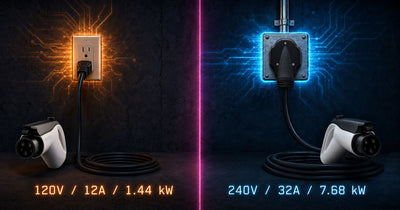
| Maximum output | 40A / 9.6 kW plug-in; 48A / 11.5 kW hardwired | 32A / 7.7 kW plug-in |
| Cable length | 25 ft | 25 ft |
| Electronics location | Wall unit at outlet end | J1772 / NACS connector at car end |
| Connector variants | J1772 or NACS | J1772 or NACS |
| Smart functions | App scheduling, charging data, solar integration, PowerSmart load management (Vue 3 included) | Standalone; no app |
| Environmental rating | NEMA Type 4 | IP55 (per product page) |
| Certification | UL certified; UL 2594 listing per Emporia | ETL Listed (per product page) |
| Warranty | 3 years | 2 years |
| Hardware price (USD)Delta | $599 | $219.99 — about $379 less |
| Installation | Wall mounting required; electrician needed for hardwiring and recommended for Vue 3 / panel work | None required when a compatible, properly installed NEMA 14-50 outlet on an adequate dedicated circuit already exists |
Two things worth naming from the table.
The hardware price delta is real: about $379. $599 for the Emporia Pro versus $219.99 for the WenStorm portable. Total installed cost depends on your circuit, panel, permitting and whether you already have a compliant NEMA 14-50 — so we don't publish a single "installed" number for either product. Emporia's installation quotes are individualized and currently include a $100 Treehouse credit.
The apples-to-apples plug-in comparison is 40A vs 32A, not 48A vs 32A. The Emporia Pro only reaches its 48A rating when hardwired. Plug-in on a NEMA 14-50, it's limited to 40A — roughly 25% more input power than WenStorm's 32A. The 50%-faster figure you'll sometimes see quoted is a hardwired-vs-plug-in comparison, not a like-for-like one.
What Emporia Pro Does Right
Fair credit where it's due.
48A hardwired ceiling. If your EV can accept 48A and your installer runs the wire directly, the Emporia Pro tops out ~50% higher than a 32A portable on input power. Overnight the difference is usually invisible — both fill the battery. In a short-window scenario (park at 11 PM, out at 6 AM) hardwired 48A wins on same-hour top-up speed. Note the 48A rating is hardwired only; plug-in tops out at 40A.
Hardwire option. Some buyers prefer no plug at all. Hardwired installs remove the NEMA outlet as a failure point entirely, and are the code-preferred configuration for high-current continuous EV loads in some jurisdictions. Emporia supports this natively.
Vue 3 home energy monitor integration. The Pro ships with a Vue 3 whole-home energy monitor and includes PowerSmart load management, solar integration and app scheduling. If you already run Emporia's Vue 3 (a legitimate product in its own category), the Pro is the sensible completion of that stack.
NEMA Type 4 enclosure. Rated for outdoor installations without additional weatherproofing.
3-year warranty. One year longer than WenStorm's 2-year coverage.
Colorado-headquartered, US-designed, India-manufactured. Per Emporia's company information, product design, engineering and testing are done in Colorado; primary manufacturing takes place in India. Corporate-transparency plus for buyers who care about supply chain provenance.
If your buying decision optimizes for any of the above, Emporia Pro is a legitimate pick. Nothing about a $599 wall unit is wrong for the right buyer.
What WenStorm Does Differently
Electronics integrated into the connector handle at the car end. No separate control box sitting on your wall outlet. When the connector plugs into the car, the vehicle's charging inlet carries the weight of the smart handle. The NEMA plug at the wall carries only cable weight.
Handle-side thermal cutoff. A temperature sensor inside the connector interrupts the charging session at 85°C (185°F) and resumes automatically once the handle cools below 70°C (158°F). This is a device-side protection at the vehicle end of the cable, not a wall-receptacle overheat sensor.
No new charger installation required — when a compatible outlet already exists. If you already have a properly installed NEMA 14-50 on an adequate dedicated circuit, the WenStorm plugs in and works. If you need a new or replacement outlet, that's an electrician job (and, in many jurisdictions, a permit). Renters should also check their lease.
Easier to relocate. WenStorm needs no charger mounting or hardwired disconnection. If you sell the house, move to a new address, or take a road trip, the charger comes with you. A plug-in Emporia Pro can also be unmounted and taken (bracket screws and drywall anchors stay with the property); a hardwired Emporia Pro needs a licensed electrician to disconnect. Both are possible, but WenStorm avoids the labor and wall-repair overhead entirely.
Price: $219.99. Roughly one-third of Emporia Pro's $599 hardware MSRP.
Same J1772 or NACS connector options. Choose at order time.
A Failure Mode Both Plug-in Chargers Must Account For
Neither manufacturer is naive about the plug interface. According to Emporia's own NEMA 14-50 outlet-safety guidance, real-world failures under EV load are documented and specific:
“Documented cases of NEMA 14-50 outlet failures from EV charging show scorched outlets, melted plugs, and smoke damage.” — Emporia Energy, NEMA 14-50 Outlet Safety
Emporia is also direct about what buyers should look for in the receptacle itself:
“EV charging requires an outlet specifically designed for continuous, high-amperage loads, not just any 14-50 receptacle that happens to fit the plug.” — Emporia Energy, NEMA 14-50 Outlet Safety
That's language on Emporia's own domain, not a WenStorm attack. The US Department of Energy takes the same view on the electrical side:
“EV charging infrastructure is considered a continuous load by the National Electrical Code (NEC). ... Electricians can inform homeowners whether their home has adequate electrical capacity for vehicle charging.” — US Department of Energy, Alternative Fuels Data Center
Where the two products respond to this shared concern is where the design philosophies diverge.
Emporia's response is a wall-mounted unit with a pre-attached bracket, bottom of the charger mounted at least 24 inches above the floor, and (for the plug variant) a plug interface that stays static because the wall unit takes the load rather than the plug body. If installed per instructions, mechanical strain on the receptacle is minimized compared to a floating brick.
WenStorm's response is a portable design that keeps the control electronics at the vehicle end of the cable — no wall brick, no midline control box. During charging the wall receptacle carries the cable weight only. WenStorm's fixed 32A continuous rating is below the plug-in Emporia's 40A ceiling, which is a lower continuous current on the same circuit.
To be clear: neither approach eliminates the underlying risk. Contact resistance, loose terminals, worn receptacles and thermal failure are properties of the outlet and wiring, not the charger. Both products still require a compatible outlet, a dedicated circuit and periodic inspection. What differs is how much mechanical and thermal strain the charger's own design adds on top.
Bottom line: choose by scenario, not by amperage
The honest recommendation is scenario-based:
- Choose Emporia Pro when app control, load management, solar integration, longer warranty, or 40–48A charging justifies the additional hardware cost and installation work.
- Choose WenStorm when portability, a simpler standalone design, and lower upfront hardware cost matter more — and a suitable NEMA 14-50 outlet is already in place.
Frequently Asked Questions
Can I hardwire the WenStorm portable?
No. WenStorm's portable Level 2 is a plug-in-only product with a fixed NEMA 14-50P plug. If your requirement is hardwiring, the Emporia Pro or a similar wall-mounted charger is the correct product category.
Can I use Emporia's Vue 3 monitor with a different charger?
Yes. The Vue 3 is a whole-home energy monitor that reports on any circuit, including a WenStorm-fed 14-50. You lose the tight Emporia Pro integration (kWh accounting flowing automatically into the Emporia app) but you retain panel-level visibility. Worth knowing if you're already an Emporia household but considering a different charger.
Is 48A actually necessary?
For most drivers, no — and it's also worth remembering that 48A only comes when you hardwire the Emporia Pro; the plug-in variant tops out at 40A. At 240V, WenStorm's 32A supplies up to 7.7 kW, the plug-in Emporia Pro supplies up to 9.6 kW at 40A, and the hardwired Emporia Pro supplies up to 11.5 kW at 48A. Actual miles added per hour depend on vehicle efficiency, charging losses, temperature and battery condition. The US Department of Energy uses roughly 25 miles per hour as a broad Level 2 average; heavier vehicles add considerably less. Ford publishes only ~20 miles per hour at 48A for the 2025 F-150 Lightning, for example. Match the charger to your vehicle's onboard limit and your parking window, not to a headline amperage number.
What's the price difference in real terms?
Hardware: $599 (Emporia Pro) vs $219.99 (WenStorm) = about $379. Total installed cost varies substantially with your circuit, panel capacity, conduit and permitting, so we don't publish a single installed figure. For most buyers who already have a compliant NEMA 14-50, the practical delta is close to the $379 hardware number. For buyers who need a hardwire run, panel work or a new outlet, the gap widens.
Which one has better warranty?
Emporia Pro's 3-year warranty is one year longer than WenStorm's 2-year coverage. Both sit within the industry norm for EV charging equipment. If long-term warranty is a deciding factor, Emporia is the stronger pick on this axis.
Emporia Pro and WenStorm's portable Level 2 are competing for different pieces of the same buyer's mind. Both are honest products. The comparison isn't good vs bad — it's wall-mount-plus-hardwired vs portable-plus-plug-in, and it's $599 in hardware plus installation vs $219.99 that plugs into an existing outlet. In practice, buyers face a scenario question, not a spec question.
Pick Emporia when app control, load management, solar integration, longer warranty, or 40–48A charging justifies the additional cost. Pick WenStorm when portability, a standalone design and lower upfront hardware cost matter more — and a suitable NEMA 14-50 outlet is already in place. Save your money in either direction by picking based on which scenario matches your life, not which brand's marketing you saw last.
About this guide + sources
This guide compares two commercial products against their manufacturer-published documentation. It has not been reviewed by a licensed electrician prior to publication. Decisions about receptacle installation, dedicated-circuit sizing, and continuous-load configuration should be evaluated by a licensed electrician for your specific installation and jurisdiction.
Sources referenced above:
- Emporia Energy — NEMA 14-50 Outlet Safety: What EV Owners Need to Know
- US Department of Energy, Alternative Fuels Data Center — Charging Electric Vehicles at Home
- Emporia — Emporia Pro EV Charger Product Page
- Emporia — Emporia Pro Charger Installation Guide (PDF)
- Emporia — Getting to Know Emporia (Company Information)
- WenStorm — Level 2 Portable EV Charger 32A NEMA 14-50 Product Page
- WenStorm — Return & Refund Policy (Warranty)
WenStorm sells the Level 2 Portable EV Charger discussed in this comparison. Emporia and the Emporia Vue 3 home energy monitor are third-party products; WenStorm has no commercial affiliation with Emporia. Feature descriptions are drawn from each manufacturer's public product pages.
Real questions from EV owners
Join the Renters, Apartments & HOA Charging discussion →