Townhouse EV Charging Installation: Who Pays for What in 2026

By Marcus Chen — WenStorm
Someone on r/electricvehicles just posted about their townhouse tenant asking to install a 240V outlet for a new EV. Landlord's dilemma: great tenant, three years, no issues. But the tenant leaves in a year or two and the landlord's stuck with an EV outlet the next tenant may not want. Fair to split cost? Refuse? The thread hit 152 upvotes and 285 comments before it even got to the top of the sub.
The honest answer is that townhouse EV charging install disputes are their own genre of Reddit thread, and almost every one goes wrong the same way. Both parties assume the install is a one-line item ("$1,500 electrician install") when it's actually five separate cost buckets. Both parties think the tenant owns the outcome, or the landlord does, when the reality is neither does cleanly. And both parties overlook the wall-damage trap that shows up two years later on the move-out inspection.
What follows is what I've watched actually work: the three cost-split arrangements that end without lawsuits, what each line item actually costs in 2026, the right-to-charge laws that matter and the ones that don't, and the portable Level 2 alternative most guides don't mention because it sidesteps the whole install conversation.
Why This Conversation Gets Ugly Fast
Three reasons.
Neither party can price it accurately. A townhouse install can be $400 or $4,500 depending on panel proximity, wire run distance, permit costs, and whether the panel needs an upgrade. When the tenant asks "how much" and the landlord says "no idea," both assume the worst.
The install is permanent, but the tenant isn't. A hardwired 240V circuit becomes part of the property. If the tenant paid for it and moves out in eighteen months, they've funded a $2,000 improvement to somebody else's asset. If the landlord paid for it and the next tenant is a diesel truck driver, they've funded a $2,000 fixture nobody uses.
Wall damage nobody talks about upfront. Heavy wall-mount chargers sag on their mounting hardware over years. Outlet plates crack under the weight. Drywall around the mount develops hairline fractures. When the move-out inspection happens, both parties argue about who caused what.
Every one of these problems has a solution — usually a specific arrangement or a specific piece of hardware. The problem is nobody talks about them before the check gets written.
The Three Cost-Split Arrangements That Actually Work
I've seen roughly three variants that end with neither party feeling ripped off.
Arrangement 1: Tenant pays 100%, install stays after move-out
The tenant pays the full install cost. The 240V circuit stays with the property. In exchange, the tenant gets a written lease amendment giving them exclusive use of the circuit for the remainder of their tenancy, and — this is the important part — a rent credit or lease-break flexibility if they move out within a stated window.
When it works: long-term tenant, mid-tier install cost ($800-$1,500), landlord willing to sign an amendment.
When it doesn't: short lease remaining, high install cost, or landlord unwilling to write anything down.
Practical numbers: tenant funds ~$1,200 install. Landlord agrees to a $50/month rent credit for the next 24 months, effectively amortizing $1,200 back to the tenant. If the tenant stays two years, cost recovered. If they leave early, the landlord keeps a permanent asset that increases the property's future rental appeal.
Arrangement 2: Split by remaining lease years
Both parties treat the install as a shared capital improvement. Total cost is divided by the remaining lease term. If the tenant has three years remaining and the install is $1,800, the tenant pays $600 (their share for years 1-3 of the outlet's useful life) and the landlord pays $1,200 (for years 4-10+).
When it works: mid-term lease, moderate install cost, both parties see the outlet as a long-term property upgrade.
When it doesn't: short-term tenancy, or when the landlord doesn't accept the "long useful life" framing.
Practical detail: put the split in writing, not just email. Reference the specific install invoice by date and amount. If either party moves out or sells the property, the amortization stops there.
Arrangement 3: Landlord pays, higher rent to amortize
The landlord funds the install and increases monthly rent by an agreed amount for a stated period. This is functionally a hardware lease — the landlord recovers the cost via rent, the tenant gets EV charging without upfront capital.
When it works: landlord who wants to preserve the property as EV-ready for future tenants, mid-to-large install ($1,500+), tenant with predictable multi-year tenancy.
When it doesn't: tenant who wants to move soon, landlord who wants immediate cash back, or rent increase that trips local rent-control caps.
Practical numbers: landlord funds $2,000 install. Rent increases $75/month for 30 months ($2,250 recovered). At month 30, rent reverts to prior baseline or continues at the new baseline as an EV-ready premium.
What Actually Costs Money in a Townhouse Install
Every install quote you see is a stack of five line items. Understanding which item the electrician is padding tells you where to negotiate.
The receptacle itself: $8-$70. A residential-grade Leviton NEMA 14-50 costs $8-15 at Home Depot. An industrial-grade Hubbell HBL9450A or Bryant 9450FR costs $45-70. This is the single most important upgrade for a townhouse — the industrial receptacle survives years of continuous EV load, the residential one usually doesn't. If the electrician quotes you "the outlet" without specifying brand, ask which one.
Electrician labour: $400-$2,200. The range is enormous because the labour depends on wire run distance, whether they're pulling through finished walls, and local electrician rates. A short run through an attached garage with an open unfinished wall is $400-$800. A long run through finished drywall with fishing tape and drywall repair is $1,200-$2,200. Get three quotes.
Permit and inspection: $50-$300. Depends entirely on your jurisdiction. Some cities charge $50 for an over-the-counter permit; others require plans and a $300 permit-plus-inspection fee. The permit is not optional — an unpermitted install voids your homeowner's or landlord's insurance in the event of an electrical incident.
Panel upgrade (only if needed): $1,500-$4,000. If the townhouse panel doesn't have an open 50A double-pole slot or if the total service (usually 100A or 200A) can't handle another 50A continuous load, you're upgrading the panel. This is the item that turns a $1,500 quote into a $5,500 quote. Ask the electrician to specifically verify panel capacity before quoting labour.
GFCI breaker: $50-$150. NEC 210.8(A)(11) requires GFCI on any 240V receptacle in a garage or outdoors. Some electricians include this in the labour quote; some don't. Ask specifically. Skimping on GFCI is a code violation.
Total for a typical townhouse install with a short panel-adjacent run, no panel upgrade needed, and an industrial receptacle: $650-$1,200. If your quote is above $2,000 without any of the "expensive scenario" conditions, get another quote.
Right-to-Charge Laws — What You Can Actually Force
State law matters here more than most guides admit.
Several US states have passed "right-to-charge" legislation that limits landlords' and HOAs' ability to unreasonably deny EV charging installations. As of 2026, at least twelve states have some form of this: California, Colorado, Florida, Hawaii, Illinois, Maryland, Massachusetts, New Jersey, New York, Oregon, Virginia, and Washington. Details vary sharply.
What most right-to-charge laws actually require:
- Landlord may not unreasonably prohibit the installation
- Tenant typically bears the install cost
- Tenant is responsible for maintenance and insurance during the tenancy
- Landlord is allowed to specify a licensed electrician, industrial-grade components, and permit compliance
- Tenant is usually required to restore the property to original condition at end of tenancy (this varies)
What right-to-charge laws don't do:
- They don't force the landlord to pay
- They don't override HOA rules if the HOA has legitimate structural safety concerns
- They don't waive permit or insurance requirements
- They don't help you if the townhouse panel simply can't support the load
Practical advice: before you cite the law to your landlord, look up the specific statute in your state. In California it's SB 880 (2023). In New York it's the 2024 rental-property EV charging amendment. Bring the actual statute text to the conversation. "State law requires you to allow me" without a specific citation reads as bluff.
The Wall-Damage Trap Nobody Talks About Upfront
Here's what the manuals don't tell you. Almost every hardwired Level 2 wall charger on the market weighs between 6 and 20 pounds and mounts directly on drywall via a metal bracket. Over months of thermal cycling and normal use, the mount develops a small amount of play. The outlet or hardwire junction below the mount takes the load whenever anyone unplugs the connector from the car.
Two years in, a lot of townhouse installs look like this: hairline cracks in the drywall around the mount, a slightly discoloured or slightly warm outlet plate, and — sometimes — visible sag in the mounting bracket itself. This is the failure mode Emporia's own customer service line has been recommending "add a wall bracket" for. It's real, it's documented on TMC and r/evcharging with owner photos, and it's the exact thing that lands both parties in an argument at the move-out inspection.
The landlord's contract lawyer will typically call this "damage caused by tenant equipment." The tenant's response is "the electrician installed it to code." Both are technically right. The wear is real, the install was code-compliant, and neither party is at fault in a legal sense. This ambiguity is where the $400 security-deposit withhold happens.
The Portable Level 2 Alternative
Independent of the marketing, the portable Level 2 charger sidesteps most of the townhouse conversation entirely.
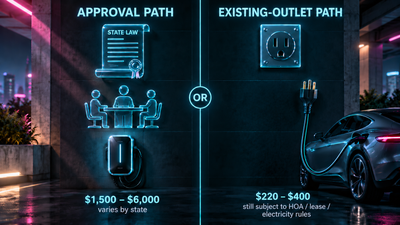
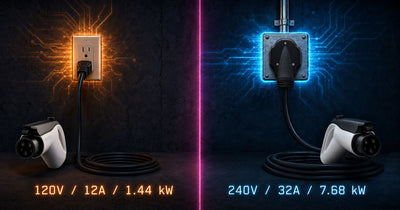
Portable Level 2 chargers plug into an existing 240V outlet — a dryer NEMA 14-30, an electric range 14-50, or a garage-installed 14-50. No install cost, no permit, no landlord amendment. If the townhouse already has a compatible outlet somewhere within a 25-foot cable run of where you park, you have Level 2 charging tonight for $220-$300 total.
The other benefit for townhouse tenants specifically: you take it with you when you move. The $220 you spent doesn't become part of the landlord's property. Two years later, you plug the same unit into your next place.
The design detail that makes this landlord-friendly: a portable Level 2 with the electronics integrated into the connector handle (like WenStorm's) puts no persistent weight on the wall outlet. Nothing hangs on the receptacle. Nothing wears out the drywall around a mount. When you eventually move out, the outlet looks the same as it did when you moved in.
The Tenant-to-Landlord Conversation Script
If you're the tenant approaching the landlord, here's what works. Practical, not theoretical.
Bring three things to the meeting:
- Your state's right-to-charge statute text (or a note that your state doesn't have one, so you're asking as a courtesy)
- Two or three electrician quotes from licensed contractors for a NEMA 14-50 install
- A specific proposal for one of the three cost-split arrangements above
Lead with the arrangement, not the demand. "I'm proposing to pay 100% of the install cost, keep the outlet with the property when I move, and get a $50/month rent credit for 24 months while I'm still here" lands very differently than "I'm going to have an EV, I need an outlet, when can you install it."
Offer to specify the receptacle brand. Landlords who worry about wall damage relax when you name-drop the Hubbell HBL9450A instead of the $8 Leviton. It signals that you care about the property.
Never propose a wall-mount hardwired charger. From the landlord's perspective, that's permanent equipment with wall damage risk. Propose a permitted NEMA 14-50 outlet and a portable Level 2 charger. Same charging speed for the tenant. Zero permanent equipment for the landlord.
Get everything in writing. Not email. A signed lease amendment or addendum. If your landlord won't sign anything, don't fund the install. The verbal-agreement-to-repay-you-later scenario ends in Small Claims Court.
When Hardwiring Actually Makes Sense
Three scenarios where a permanent hardwired install is the honest recommendation over a portable:
You own the townhouse. Not a rental. Then the wall-mount install pencils out because the asset stays with you. Even here, an industrial receptacle plus a car-end portable is usually cheaper and outlasts the wall unit.
Your lease has 10+ years remaining. Very rare for townhouse rentals but occasionally seen in commercial or corporate housing. The install cost amortizes cleanly.
Your household has two EVs and you're actively load-balancing. Some smart wall units support automatic load sharing between two chargers on one circuit. A portable can't do this. For two-EV townhouses, this is the case for the wall unit.
For every other scenario — median tenant, 1-3 year lease, one EV — the portable Level 2 into an existing outlet or a permitted new NEMA 14-50 receptacle is the honest recommendation.
Frequently Asked Questions
Can my landlord legally refuse an EV charger install?
In right-to-charge states (California, Colorado, Florida, Hawaii, Illinois, Maryland, Massachusetts, New Jersey, New York, Oregon, Virginia, Washington), the landlord may not unreasonably prohibit the installation, but they can impose conditions (licensed electrician, permit compliance, industrial-grade components, tenant covers cost). In states without right-to-charge laws, the landlord can refuse. Even in those states, a portable Level 2 charger plugged into an existing outlet is usually not considered an "installation" and doesn't require landlord approval.
Who's liable if the install damages the outlet or wall?
Whoever paid for the install typically holds the maintenance liability during the tenancy, but the landlord ultimately owns the property and inherits any long-term damage. In practice, disputes at move-out are often resolved by mediation or Small Claims Court. The cleanest defence is a permitted install with a documented industrial-grade receptacle and no evidence of heavy wall-mount charger sag. Portable Level 2 chargers rarely feature in these disputes because they don't create the wear pattern.
Does the Section 30C tax credit apply to rental properties?
The Section 30C EV charger tax credit (up to $1,000 for residential installations) applies to the person who pays for the qualifying installation, provided the address meets the census-based eligibility. Whether it applies to a rental depends on who paid: if the tenant paid, and the address qualifies, the tenant claims the credit. If the landlord paid, and the address qualifies, the landlord claims it. Consult IRS Form 8911 or a tax professional for edge cases.
Is a portable Level 2 legally an "install" under my lease?
Almost never. A portable Level 2 charger that plugs into an existing outlet is functionally an appliance — the same category as a coffee maker or a space heater. Most lease agreements distinguish "installation" (permanent, requiring modification of the property) from "use of appliances" (temporary, plug-and-unplug). Unless your lease specifically defines portable EVSEs as an installation, plugging one into an existing outlet doesn't trigger install-approval requirements. If in doubt, mention it to the landlord in writing as an appliance use, not a request for permission.
What if my townhouse HOA blocks it?
HOAs in right-to-charge states are typically also bound by the state statute. Even where the HOA has broad architectural review authority, it usually cannot unreasonably prohibit an EV charging installation in a resident's own garage or on their own service. Bring the statute text to the HOA meeting. If the HOA persists in blocking it, in some states you have a right to sue for enforcement plus attorney's fees. In states without right-to-charge laws, you're back to a portable Level 2 on an existing outlet — which the HOA usually can't touch because it's an appliance, not a structural modification.
The honest answer to "who pays for the install" is that it depends on which of the three arrangements you and the landlord actually write down. In my experience the arrangement itself matters less than getting it in writing. A verbal agreement to split costs 50/50 with a landlord who's "cool about it" is worth exactly nothing at move-out. A signed lease amendment with specific dollar amounts, a specific electrician invoice referenced by date, and a specific damage-liability clause is worth everything.
Save your money. If your townhouse already has any 240V outlet — dryer, range, garage — the portable Level 2 alternative is the low-friction path that skips the whole install conversation. If the install is genuinely the right call, get three quotes, spec the industrial receptacle, get the lease amendment in writing, and don't let the electrician skip GFCI.