How to Charge an EV at a Rental Home or Apartment: 2026 US Guide

TL;DR
Renters can sometimes charge without installing a wall charger if they have permission to use a suitable outlet near parking. A compatible 120V outlet can support Level 1 charging; an existing 240V outlet may support Level 2, but the charger must match that outlet and circuit. WenStorm's fixed 14-50 portable charger does not plug into a 14-30 or 10-30 dryer outlet. If no suitable outlet is available, check building, workplace, or public charging, and review any installation-request rights that apply to your specific home and state.
Can I charge an EV at my apartment without installing a wall charger?
Possibly, if you have authorized access to an existing compatible outlet near your assigned parking space. A portable Level 1 charger can use a suitable 120V outlet, while a portable Level 2 charger can use a compatible existing 240V outlet. The outlet and circuit must be properly wired, appropriate for continuous EV charging, and approved by the property owner. If no suitable outlet is available, workplace charging, shared building chargers, and nearby public charging are usually the most practical alternatives.
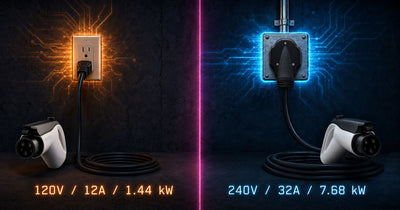
Charging speed on a portable setup depends on the outlet type. On a compatible 120V outlet, a Level 1 portable typically adds 2 to 5 miles of range per hour per the US Department of Energy's Alternative Fuels Data Center (roughly 16 to 50 miles for a typical overnight window, varying by vehicle efficiency, temperature, and charging losses). On a compatible 240V outlet, a portable Level 2 charger commonly delivers 24 to 32 amps continuous (approximately 5.8 to 7.7 kW), replenishing the same daily driving in fewer hours. Vehicle acceptance rates vary by model year and configuration; check the specific vehicle's onboard-charger rating.
Decision table by parking and outlet situation
| Your situation | Best starting option |
|---|---|
| Building already has chargers | Ask about access, availability, and billing before adding your own equipment |
| Assigned parking with an authorized 120V outlet | Consider permitted Level 1 portable charging |
| Assigned parking with an existing compatible 240V outlet | Consider permitted portable Level 2 charging after electrical inspection |
| Outlet exists but is too far away | Evaluate safe cable routing and an EV connector extension. Do not use a household extension cord. |
| No outlet near parking | Workplace or nearby public Level 2 charging |
| Shared or rotating parking | Ask management about managed shared chargers |
| Street parking only | Use workplace or public charging as the primary plan |
The sections below unpack each of these situations in detail. Read the outlet-audit section before you talk to your landlord, and read the state-law section before you assume any specific right applies to your situation.
Start With an Outlet Audit
Before you talk to your landlord, before you research chargers, walk your rental and inventory what 240V outlets exist. Some rentals have more than you'd think. An existing compatible outlet may avoid new electrical work. Renters should still confirm they are permitted to use it for EV charging and that the circuit, receptacle, and cable route are suitable. The audit itself is neutral information gathering; it doesn't authorize use.
NEMA 14-50. The 50-amp four-prong outlet used for newer electric ranges, welders, and RV hookups. Some apartments and townhouses have one in the garage or a shared outdoor location. This is the top-tier find for Level 2 charging.
NEMA 6-50, 10-50, or hardwired range. An electric range may use a modern NEMA 14-50, an older NEMA 10-50, a NEMA 6-50, or a hardwired connection with no receptacle at all. Range receptacles are typically located behind the appliance, are difficult to access for daily EV charging use, and should not be repeatedly disconnected and shared. See our NEMA 14-50 vs 6-50 comparison for how these differ for charging.
NEMA 14-30 or 10-30 (dryer outlets). An in-unit electric dryer may use a NEMA 14-30 or older NEMA 10-30 receptacle; some are hardwired with no receptacle. A 30A dryer circuit safely supports up to 24A continuous EV charging (80% of the circuit rating for continuous loads under NEC). If a receptacle is present, confirm it is accessible, permitted for EV charging by your lease and local code, and suitable for repeated continuous use. Shared laundry outlets in common areas generally are not available for tenant EV charging. Full breakdown in our 14-30 renter guide.
NEMA TT-30, NEMA 6-15, or NEMA 6-20. Odd outlets you might find in RV-friendly properties, older commercial-adjacent conversions, or specific-use spaces. Slower than a 14-50 but usable for overnight charging with the correct listed adapter.
Standard 120V (NEMA 5-15). Every household outlet. This is Level 1 charging. Per the US Department of Energy's Alternative Fuels Data Center, Level 1 adds approximately 2 to 5 miles of range per hour depending on vehicle efficiency. On a standard 15A NEMA 5-15 circuit, continuous EV charging is capped at 12A per NEC 210.19/210.20; delivered power is roughly 1.4 kW. An 8-hour overnight window adds roughly 16 to 40 miles; a 12-hour window adds roughly 24 to 60 miles. Cold weather and less-efficient vehicles land at the lower end. Not enough for a heavy commuter but often sufficient for a low-mileage renter, or as a supplement to workplace or destination charging. The DOE is explicit about the electrical scope:
“Many EV owners are able to meet their daily driving range requirements by charging overnight with Level 1 equipment, requiring no additional cost or installation, provided that a power outlet on a dedicated branch circuit is available near their parking location.” — US Department of Energy, Alternative Fuels Data Center
The DOE also notes that EV charging counts as a continuous load under the National Electrical Code, which is why sharing a circuit with high-draw appliances can trip breakers or heat wiring.
The audit takes 20 minutes. Photograph every 240V outlet you find, note the amperage rating stamped on it, note where the circuit runs on your electrical panel if you can access it. This is baseline information. It does not authorize use.
The Landlord / HOA Conversation
A common friction point is asking for permission to "install a charger." That triggers the wallbox mental model: mounted equipment, drilled holes, potential permits, potential liability, potential lease amendment. It is the ask that often gets steep insurance requirements or a flat refusal.
If you're planning to plug a portable EV charger into an existing, compatible, code-compliant outlet without any electrical work, the conversation is often easier. Even so: confirm permission, confirm circuit ownership (particularly for common-area outlets), confirm outlet condition, and confirm cable-routing arrangements before you start. Electricity from a common-area or common-metered outlet also raises billing questions that need to be addressed.
Things worth having ready before the conversation:
- Product certification documentation. A listing by a nationally recognized testing laboratory (such as UL or Intertek/ETL) to applicable standards including UL 2594 and UL 2231 helps address safety questions.
- Your insurance situation in writing. Ask your insurer whether EV charging equipment and related liability are covered under your policy, and obtain any required coverage or landlord/additional-insured documentation in writing.
- An electrical inspection offer. Offering to pay for a qualified electrician to inspect the outlet you propose to use, covering circuit rating, receptacle condition, and continuous-use suitability, is a good-faith gesture that reduces the landlord's risk.
- A metering arrangement for electricity. If your rental's electricity is not separately metered, propose a mutually agreeable way to reimburse the property for charging load (either through the EVSE's built-in energy reporting or through a properly rated and listed metering solution selected with your electrician).
For HOA scenarios the same approach applies, with the added note that HOA restrictions vary widely by state and by association. Read the actual bylaws before assuming what is or isn't permitted.
The State Legal Landscape (What These Laws Actually Do)
A common shorthand you'll see online is that many states have "right-to-charge" laws for renters. This is directionally true but often overstated. Some states protect a tenant's or unit owner's ability to request EV-charging installation, subject to procedural requirements, insurance requirements, cost responsibilities, parking arrangements, and sometimes a requirement that installation be performed by a licensed electrician.
These laws vary considerably in what they cover:
- California Civil Code §1947.6 protects a tenant's written request to install charging equipment, subject to procedural, parking, cost, and other requirements. It does not create unrestricted permission to use any existing outlet. (California Legislature)
- Oregon HB 2511 establishes a residential tenant installation process; the tenant must apply and the charging station generally must be installed by a licensed electrician. (Oregon Legislature)
- New Jersey P.L. 2020, c.108 primarily applies to unit owners in common-interest communities (condominium, cooperative, or homeowners' association contexts), not ordinary residential tenants. (NJ Legislature)
Other states (including Colorado, Hawaii, New York, and Virginia) have passed related legislation covering various combinations of tenants, condominium owners, and HOA members. Several more have introduced similar bills.
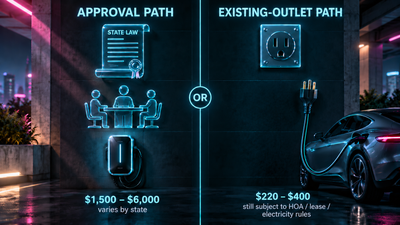
The pragmatic take: some states protect a tenant's or unit owner's ability to request EV-charging installation, but eligibility, approval procedures, insurance, parking, electrical work, and cost responsibilities vary substantially. These laws generally do not create an unrestricted right to use any existing outlet. Review your lease or association rules and verify current state and local requirements directly, or with a qualified attorney if the stakes warrant it.
Alternatives When No Suitable Outlet Exists
If your rental has no compatible outlet within reasonable cable reach of your parking spot, or the outlet you have cannot be authorized for EV use, home portable charging is not the primary answer. Three practical alternatives cover most drivers in this situation.
Workplace charging. An eight-hour workday is a second overnight window. Where employers offer Level 2 charging in the parking lot, a single workday session can add 100 to 200-plus miles of range depending on the station's output and the vehicle's onboard-charger acceptance rate. Availability varies by employer and by city. Check with facilities or HR before assuming access; some stations are reserved for specific spots, some are pay-as-you-go via network apps (ChargePoint, EV Connect, EVgo, and similar), and some have per-session or per-hour occupancy rules.
Public destination Level 2 charging. Grocery stores, shopping centers, gyms, movie theaters, municipal lots, and hotels increasingly host Level 2 charging in their parking areas. Session times align with typical dwell times (an hour of shopping adds roughly 25 to 40 miles at a 32A station). Pricing varies from free at some retailers to per-hour or per-kWh billing at most networks. Reliability varies station to station; check recent PlugShare reports for a specific location before relying on it as a regular part of your routine.
Public DC fast charging. DC fast chargers deliver 50 to 350 kW directly to the battery. For most modern EVs at a well-provisioned charger, 10 to 80% state of charge takes roughly 20 to 40 minutes; above 80% the charging curve tapers deliberately to protect the battery, so the last 20% can take as long as the first 70%. Session times and delivered rates vary substantially by vehicle, ambient temperature, battery preconditioning, and the specific charger's output. Public DC fast pricing in 2026 commonly falls in the $0.40 to $0.60 per kWh range (as checked mid-2026), materially higher than residential electricity at the US Energy Information Administration's projected 2026 average of approximately $0.183 per kWh. Occasional DC fast sessions supplement other charging cleanly; DC-fast-only ownership at high mileage can erode much of the fuel-cost advantage over gasoline.
Managed shared building chargers. Newer construction and larger multifamily complexes increasingly offer shared Level 2 stations for residents, sometimes with reservation systems or per-session billing. Ask your building whether such stations exist, what the access rules are, and how billing works before assuming they are or are not an option.
Per the DOE's multifamily charging resources, the four principal issues for multifamily EV charging are parking access, electrical access, billing, and legal concerns. Any renter without a compatible in-unit outlet is navigating some combination of these; the alternatives above address each without requiring landlord installation.
When a Portable Charger Is the Right Fit
Most homeowner-oriented EV charging articles end with "install a wallbox." For a renter with a compatible authorized outlet at their parking spot, portable charging is often the more sensible starting point than an installed wallbox: an installed $1,500 Emporia Pro or $2,000 ChargePoint Home Flex stays with the property when your lease ends. You paid for a permanent fixture on someone else's house.
Portable Level 2 chargers change the equation. A $220 to $310 portable moves with you when you move. For most renters that is the more flexible option, provided a compatible permitted outlet is available near assigned parking.
Three portable-specific advantages relevant to renters:
Often no new electrical installation is required when a compatible, code-compliant NEMA 14-50 (or other suitable outlet with a manufacturer-approved adapter setup) already exists at your rental. If you need a new or replacement outlet, common-area access, or wiring modifications, that is a separate conversation that may require landlord permission, permits, and licensed electrical work.
Nothing to leave behind. When you move, the charger comes with you. The next property may have a compatible outlet, or it may not. If not, you may need a different listed EVSE or a manufacturer-approved adapter system for the outlet you do have.
Cleaner handling than wall-mounted units. Portables with electronics integrated into the connector handle eliminate the mid-cable control box; the whole assembly coils and stores as one piece, which matters when you are moving between rentals.
For the full comparison of portable vs wall-mount, see our 2026 US portable buyer's guide.
Product Picks by Renter Scenario
Scenario A — You have a compatible NEMA 14-50 already in or near your rental
Plug a portable Level 2 directly in. At 240V, 32A supplies up to 7.7 kW and 40A supplies up to 9.6 kW; real-world miles added per hour vary by vehicle efficiency, temperature, and charging losses. The WenStorm portable at $219.99 is the direct pick; if you need 40A for a short parking window and your EV can accept it, the Lectron J1772 portable at $249.99 is the alternative. Both are ETL Listed (Intertek), both carry a 2-year warranty.
Scenario B — Your only 240V outlet is a dryer receptacle (14-30 or 10-30)
A 30A dryer circuit safely supports up to 24A continuous EV charging with the right adapter and charger. Use an EVSE with a manufacturer-approved 14-30 or 10-30 adapter that automatically limits charging to 24A. Do not rely on vehicle-side amperage settings alone to protect a 30A circuit from a 32A or 40A EVSE. Tesla owners with a Gen 2 Mobile Connector can use the appropriate Tesla-branded NEMA adapter (see our 14-30 renter guide for the setup). Non-Tesla renters have fewer plug-and-play options at the 30A tier. This is a scenario where a 30-minute consult with a licensed electrician before you plug anything in is well spent.
Scenario C — Your only 240V outlet is too far from parking
Precondition: this scenario assumes you also have an authorized 120V outlet within safe cable reach of the parking spot. If no 120V outlet is accessible either — no exterior receptacle, no bridgeable interior outlet — skip to Scenario D instead; a portable charger of any level won't help.
Level 1 charging (120V) is your fallback per the ranges above: approximately 2 to 5 miles of range per hour of charging, or roughly 16 to 40 miles for an 8-hour window and 24 to 60 miles for a 12-hour window. Enough for a low-mileage commuter or as a supplement to workplace or public charging. If your vehicle includes a compatible Level 1 cordset, confirm it. Delivery equipment varies by manufacturer and model year, so do not assume one is included.
For renters, the most common practical setup at this scenario is a Level 1 portable charger paired with a vehicle-side extension cable to bridge the common gap between the outlet and the parking spot. WenStorm offers this exact pairing as two variants — pick the one that matches your car's inlet:

WenStorm J1772 Renter EV Charging Kit
Level 1 portable charger + 21 ft J1772 extension cord. For most 2013–2024 non-Tesla EVs (Bolt, ID.4, Ioniq, Rivian, Mach-E, Lightning).
Shop This Kit$269.98
WenStorm Tesla/NACS Renter EV Charging Kit
Level 1 portable charger + 21 ft Tesla/NACS extension cord. For all Teslas and NACS-native models (Ford, GM, Rivian, Hyundai 2025+).
Shop This Kit$305.98A note on the “16A Level 1” naming. The linked kits contain WenStorm's Level 1 charger with a “16A” model designation, which refers to the charger's maximum current capability. A standard 15A NEMA 5-15 household outlet limits continuous EV charging to 12A per NEC 625.42 (80% of a 15A circuit); at 12A the charger delivers roughly 1.4 kW or 2–5 mi range per hour. Verify the actual operating current per the charger's manual before extended overnight use.
Both variants pair a portable Level 1 charger with a 21 ft vehicle-side extension. If daily driving comfortably fits the recovery numbers above, the kit is a durable long-term setup; if it does not, add workplace or destination Level 2 as a supplement before jumping to a hardwired install conversation. See our apartment EV charging article for the trade-off math.
Scenario D — No usable outlet near parking
If there is no 120V or 240V outlet within safe cable reach of your parking spot — no dryer receptacle you can bridge to, no RV pedestal, no exterior weatherproof outlet — a portable charger is not the answer. A Level 1 or Level 2 charger with no outlet to plug into is a $170–$400 paperweight. Renters in this situation should shift to off-site charging:
- Workplace charging is the most viable primary source when your employer offers it. Even 4–8 hours of Level 2 at work covers typical commute miles with margin.
- Building-provided EV charging if your property has shared stalls. Some buildings offer subsidized rates; others charge market rates — see Scenario F for the trade-off math.
- Public DC fast + destination Level 2: a weekly DC fast session (Electrify America, EVgo, ChargePoint) plus destination L2 at grocery stores, malls, or hotels covers most patterns.
- Ask before you buy: confirm with your landlord whether a nearby weatherproof exterior outlet exists. Many buildings have one for maintenance that tenants overlook.
Confirm the outlet exists and is authorized for your use before purchasing any charger.
Scenario E — RV park, campground, or property with a TT-30
The TT-30 outlet (RV-style 30A 120V) is not a Level 2 outlet, but it charges faster than a standard 5-15. Tesla Gen 2 UMC owners can add the WenStorm TT-30 adapter ($69.99, up to 24A at 120V) for use at campgrounds or RV-park hookups where permitted.
Scenario F — Building offers charging at a premium price
Do the math for your specific situation. If your building charges (for example) $215/month for garage EV charging access, that's $2,580/year. Compare against a one-time portable purchase plus any electrician inspection you commission, plus your actual estimated home electricity cost. The payback period is (equipment + inspection cost) ÷ (building fee − estimated home electricity cost). If your building refuses to allow you to use your own hardware on a metered outlet and you're in a state with a right-to-charge law, that's the moment to review whether the law applies to your specific situation.
What NOT to Do
Don't use a standard household extension cord for Level 2 charging. Continuous 32A or 40A draw overheats standard extension cords and can cause fires. If your outlet is too far from your parking spot, either extend the outlet (electrician job) or select a portable EVSE with a longer factory cable.
Don't use a generic passive adapter to run a higher-amperage EVSE on a lower-rated circuit. A NEMA 14-50-to-14-30 passive adapter that lets a 32A or 40A EVSE plug into a 30A circuit can overload that circuit. The vehicle-side amperage setting is not, by itself, sufficient protection. Only use an EVSE with a manufacturer-approved adapter that automatically limits charging current to the safe continuous rating of the target circuit.
Don't buy uncertified generic portables to save $50. Uncertified generics sold under rotating brand names are a compliance grey area. Use EVSE listed by a nationally recognized testing laboratory (such as UL or Intertek/ETL) to applicable standards including UL 2594 and UL 2231.
Don't modify a rental's wiring without permission. Even if you know what you're doing. Adding, moving, or upgrading outlets is a modification to the property that requires landlord consent and (in most jurisdictions) a permit and licensed electrician. Get authorization in writing.
Don't skip the insurance conversation. Ask your insurer whether EV charging equipment and related liability are covered under your policy, and obtain any required coverage documentation in writing before you begin charging.
Frequently Asked Questions
Can my landlord actually stop me from plugging in a portable EV charger?
It depends on your lease, your state law, and the specific circumstances (private outlet vs common-area outlet, separately metered vs shared electricity, etc.). Some states protect a tenant's ability to request EV charging installation, but those protections are typically narrower than commonly stated and don't create an unrestricted right to use any existing outlet. If your lease is silent on EV charging, that does not automatically mean it is permitted; get authorization in writing.
What if my landlord agrees but wants me to pay for the electricity?
That's reasonable. Options include your EVSE's built-in energy reporting (if available), or a properly rated and listed metering solution selected with a licensed electrician. Do not install a random plug-in kWh meter on a high-current EV charging circuit without professional guidance. US residential electricity rates vary widely by state. The current national average is approximately $0.1844/kWh, with individual states ranging from roughly $0.11 to over $0.50/kWh (EIA Electric Power Monthly). A full charge on a 60 kWh EV costs roughly $11 at the national average before charging losses.
My building has an EV charging station in the parking garage. Do I still need a portable?
Depends on availability, cost, and hours. If your building's station is reliably free at the hours you park, that's the easiest option. If it's often occupied, charged at a premium, or restricted to certain hours, a portable in your unit (for use on a permitted, compatible outlet) can be a useful backup.
What's the cheapest way to charge as a renter?
Level 1 (household 120V) charging using a compatible Level 1 cordset. Zero incremental hardware cost if your vehicle came with one; delivery equipment varies by manufacturer and model year, so confirm rather than assume. The tradeoff per DOE guidance is 2 to 5 miles of range per hour of charging, or roughly 16 to 40 miles per 8-hour overnight session, and up to 60 miles across a 12-hour window. This works when daily driving fits inside that recovery. Many renters supplement Level 1 with workplace or destination Level 2 the first time daily driving spikes past what an overnight session can replenish. Others upgrade to a portable Level 2 charger if a compatible 240V outlet becomes available.
What happens when I move?
Your portable Level 2 comes with you. The next property may or may not have a compatible outlet. If not, you may need a different listed EVSE or a manufacturer-approved adapter system for the outlet you do have.
Can I claim a federal tax credit for a portable EV charger?
Under current federal law, the §30C Alternative Fuel Vehicle Refueling Property credit does not apply to charging equipment placed in service after June 30, 2026. Equipment installed earlier in 2026 may qualify if the residence is the taxpayer's primary residence in an eligible census tract and the installation meets IRS requirements (IRS Publication 6027). A portable cordset that is not installed at the property should not be presented as eligible without professional tax advice specific to your situation.
Our Take
The renter EV charging problem gets treated as a corner case in most guides. It isn't. Roughly a third of US households rent, and the EV adoption curve is not going to wait for everyone to buy a house. Portable charging is often the most flexible option when a compatible, permitted outlet is available near assigned parking. A $220 to $310 portable that follows you from lease to lease is a very different capital equation than a $1,500-plus installed wallbox that stays with someone else's property.
Two years from now the legal landscape will likely evolve, with additional state action, clearer treatment of portables specifically, and possibly federal changes. For today: audit your outlets, confirm permission and lease implications before you charge, verify electrical safety with a qualified electrician, and select a portable that's listed by a nationally recognized testing laboratory. That's the framework that holds up.
About this guide + sources
This guide synthesizes US federal data (US Census Bureau, US Department of Energy, US Energy Information Administration, IRS) with the primary statutory text of three state right-to-charge laws (California, Oregon, New Jersey). It has not been reviewed by a licensed electrician or a tenant-rights attorney prior to publication. Decisions about outlet installation, dedicated-circuit sizing, lease interpretation, or statutory rights in your state should be evaluated by a qualified professional for your specific situation and jurisdiction.
Sources referenced above:
- US Census Bureau — Housing Vacancies and Homeownership (Q1 2026 press release)
- US Department of Energy, Alternative Fuels Data Center — Charging Electric Vehicles at Home
- US Department of Energy, Alternative Fuels Data Center — Electric Vehicles for Consumers (Level 1 range-per-hour guidance)
- US Department of Energy, Alternative Fuels Data Center — Multi-Unit Dwelling Charging Resources
- US Energy Information Administration — Electric Power Monthly — Average Price of Electricity to Ultimate Customers by State
- US Energy Information Administration — Short-Term Energy Outlook (2026 residential average projection)
- Internal Revenue Service — Publication 6027 (Alternative Fuel Vehicle Refueling Property §30C)
- California Legislature — California Civil Code §1947.6 (Tenant Right to Install Charging Equipment)
- Oregon Legislature — Oregon HB 2511 (2017)
- New Jersey Legislature — New Jersey P.L. 2020, c.108
- WenStorm — Level 2 Portable EV Charger Product Page
WenStorm sells the Level 2 Portable EV Charger discussed in this guide. Statutory text, federal data, and third-party references above are from each source's public publications; WenStorm has no commercial affiliation with any of the government agencies or state legislatures cited.