New EV Owner Checklist: What to Do in Your First 90 Days

Content is educational, not electrical, insurance, or financial advice. This article has not been reviewed by a licensed electrician prior to publication. Consult your vehicle's owner's manual for battery, charging, and warranty specifics; consult a licensed electrician for any home-charging installation; consult your insurer for coverage questions; and consult the DOE AFDC state-laws database for current federal and state incentives.
The first 90 days with an electric vehicle are the period when most owner mistakes get made and corrected. This is a hub checklist that points you to the deeper WenStorm guides for each stage. It intentionally avoids battery-chemistry rules, universal cold-weather percentages, and specific TOU-rate savings claims, because those all vary by vehicle, jurisdiction, and utility. Where a specific detail matters for your car, the source is either your owner's manual, your utility, your insurer, or a licensed electrician — this article tells you which one to ask.
The First 90 Days at a Glance
| Timeframe | Focus | Key action |
|---|---|---|
| First 24 hours | Familiarization | Manual, app, connector type, roadside contact |
| First week | Home charging assessment | Have a licensed electrician evaluate an existing outlet OR arrange installation |
| Weeks 1-2 | First public charging session | Practice at a Level 2 or DC fast charger before you need it |
| First month | Rate plan and daily energy | Track actual kWh use; compare utility rate plans against your household load |
| Months 2-3 | Optimize schedules and seasonal habits | Precondition, schedule, adjust charge limit per your owner's manual |
| Ongoing | Emergency preparedness | Save roadside contact, learn manual charge-port release, keep insurance info accessible |
First 24 Hours: Manual, App, and Connector
Before you leave the dealership or complete the delivery walkthrough, get three things straight:
- Read the sections of the owner's manual that cover charging, charge-limit recommendations, roadside assistance, and manual charge-port release. Manufacturers publish specific guidance on daily and trip charge limits (Tesla, for example, directs owners to the touchscreen or app for the recommended limits, which vary by pack and model year). Do not rely on a blog to tell you what your specific vehicle's recommended limit is — the vehicle's own documentation is authoritative.
- Set up the manufacturer app if your vehicle offers one, and confirm what functions are available. App feature sets vary by vehicle, model year, and subscription state; some features that were free at launch have moved behind subscriptions. Confirm what you actually have.
- Confirm your vehicle's charging connector. Most 2025 and earlier non-Tesla EVs in North America use a round J1772 port for AC charging. Most Tesla vehicles and many 2025+ non-Tesla EVs use the slimmer NACS port. Your charging equipment must match your connector, or you need a manufacturer-approved adapter. Verify what your specific vehicle has before buying any charging accessory.
Save the roadside assistance number in your phone. Coverage length and terms vary substantially by manufacturer, model, and warranty tier — check your warranty booklet for what your specific vehicle includes.
First Week: Home Charging Assessment
Most new EV owners have three home-charging paths, in order of complexity:
- Level 1 (120V). The Department of Energy notes that Level 1 may avoid new installation only when a suitable, grounded, code-compliant outlet on a dedicated branch circuit is available near your parking location (see the DOE AFDC guidance in Sources). Level 1 charging is slow — enough for many low-daily-mileage households, insufficient for many others. Do not just "plug into the nearest outdoor outlet and see what happens." Have a licensed electrician evaluate the outlet, the circuit rating, and the wiring condition before nightly EV charging.
- Level 2 plug-in (240V). Requires a code-compliant 240V receptacle (typically NEMA 14-50 or 6-50) on a dedicated branch circuit sized for continuous EV charging load. If your property doesn't already have one, a licensed electrician can install it. Permits and inspections may be required by your local Authority Having Jurisdiction. Cost varies widely.
- Level 2 hardwired. Higher current capability (48A and above) requires hardwiring rather than a plug-in receptacle, plus a larger dedicated circuit. Licensed electrician + permit + inspection are ordinarily required.
Choose based on your actual daily energy need, your existing electrical situation, and your dwell time (how many hours the vehicle is parked at home per day), not on a blanket "you need Level 2 if you drive over X miles" rule.
Related detailed guides:
- Level 1 vs Level 2 EV Charging: What's the Real Difference?
- How to Charge Your EV at Home Without Installation
- How to Charge Your EV in an Apartment
- NEMA 14-50 vs 6-50 for EV Charging
- Why NEMA 14-50 Outlets Melt with EV Chargers — the outlet-condition failure mode to inspect before nightly use
Weeks 1–2: Your First Public Charging Session
Do this before you need it. Ideally in your first week, and always before your first long trip:
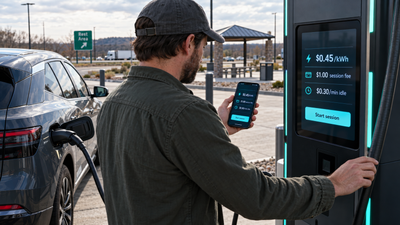
- Set up accounts with at least one Level 2 and one DC fast-charging network in your region. Common US networks include Electrify America, EVgo, ChargePoint, and Tesla Supercharger (now open to many non-Tesla vehicles via NACS or magic dock). Add a payment method to each.
- Practice at a Level 2 station first. AC charging is more forgiving. Confirm your vehicle's port door opens, the connector seats correctly, the session initiates, and the network app or RFID payment method works.
- Then practice at a DC fast charger. DC fast charging bypasses your vehicle's onboard charger and delivers DC directly to the battery. Confirm your vehicle's DC fast charging works with the network and connector you plan to use on trips. Some vehicles automatically precondition the battery when a DC fast charger is entered in navigation; some don't. Read your manual to know which behavior your car has.
Related detailed guide: EV Road Trip Charging: How to Never Get Stranded.
First Month: Rate Plan and Actual Daily Energy Use
Track your actual daily energy consumption for at least three weeks before making any structural charging decisions:
- Track daily miles and kWh added. Your vehicle app or in-car energy screen typically shows both. Divide monthly miles by your observed efficiency (miles per kWh) to get monthly kWh needed.
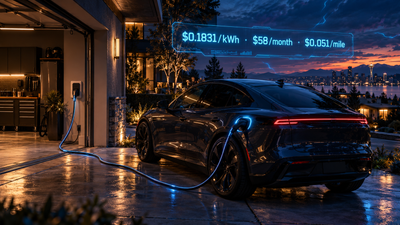
- Look up your electricity rate. Residential electricity rates vary significantly by state — the EIA's monthly retail electricity data (see Sources) is the authoritative reference. Rates range from around $0.12/kWh in some low-cost states to over $0.44/kWh in Hawaii, with the US residential average recently near $0.18/kWh. Actual monthly EV charging cost equals monthly kWh × your rate, adjusted upward for typical charging losses.
- Consider a time-of-use (TOU) rate plan carefully. Some utilities offer TOU rates that reduce overnight EV charging costs. However, moving your whole house to a TOU plan can increase your total bill if daytime household usage is high. Compare the complete plan using your actual usage patterns before enrolling; do not assume TOU is automatically cheaper.
Do the math with your specific numbers rather than trusting a "typical EV owner pays $X/month" claim. The actual answer depends on your vehicle's efficiency, your daily miles, your local rate, and your rate plan structure.
Months 2–3: Optimize Schedules and Seasonal Habits
Once you have three weeks of actual usage data, tune the setup:
- Charge limit: follow the recommended daily and trip limits shown on your vehicle's touchscreen or in the owner's manual. Manufacturer recommendations vary by pack chemistry, model year, and software update; do not use a blog's generic "80% for daily use" as a substitute for your vehicle's own guidance.
- Charging schedule: if you're on a TOU rate plan, schedule charging to occur during off-peak hours. Most EVSEs and vehicles support scheduling; use whichever is more reliable for your specific setup.
- Preconditioning: in cold weather, preheating the cabin while still plugged in draws energy from the wall rather than the battery. This is a real benefit but is not a fixed range recovery — the amount depends on outdoor temperature, cabin heating demand, trip length, and vehicle efficiency.
- Cold weather range: cold weather can materially reduce EV range, but there is no single percentage that applies to every vehicle. Battery thermal management, heat-pump availability, driving speed, trip length, and cabin heating demand all matter. Use your vehicle's recent energy consumption and route planner, and keep a larger reserve in severe weather. Related detailed guide: Electric Car Charging in Winter.
- DC fast charging frequency: frequent high-power DC fast charging may accelerate battery degradation. Follow your vehicle manufacturer's guidance in the owner's manual; do not rely on generic "keep DCFC under X% of your lifetime" thresholds without confirming what your manufacturer actually recommends.
Emergency Checklist (Save Somewhere Findable)
Keep the following accessible in your phone AND printed in the glove box:
- Manufacturer roadside assistance number from your warranty booklet
- Manual charge-port release procedure for your specific vehicle (in the owner's manual — typically involves a mechanical release cable behind a trim panel)
- Your auto insurance policy number and roadside coverage details
- Preferred flatbed towing company that has experience with EVs (EVs generally cannot be flat-towed without damage; a flatbed is usually required)
- At least one Level 2 charging network account with a payment method attached, so you have a fallback if a DC fast charging network is down mid-trip
Insurance pricing and coverage terms for EVs vary by vehicle, driver, location, and policy. Obtain a vehicle-specific quote and ask your insurer specifically how the policy handles collision damage, non-collision battery damage, towing, and roadside assistance. Collision and comprehensive are separate coverages; do not assume one substitutes for the other. This isn't insurance advice — talk to your specific insurer for coverage detail.
Federal and State Incentives
Federal and state EV incentives change frequently and vary significantly. Rather than relying on a static list in a blog, use the DOE Alternative Fuels Data Center's state-laws database (see Sources) as the authoritative reference for current federal, state, and utility incentives that apply to your specific vehicle purchase and installation. Your electrician and your utility can confirm any local rebates for home charging installation.
WenStorm Product — Not Sure Which Charger Fits
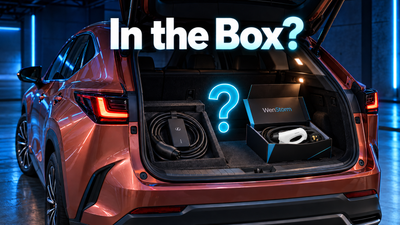
Choosing a home charger depends on your vehicle's connector, your available outlet, your circuit capacity, your daily mileage, and your overnight dwell time. Before buying any specific product, work through those five variables. WenStorm's Solution Finder tool walks through them; the WenStorm 32A portable Level 2 charger fits many but not all situations.
Still not sure which is the correct fit for your car?
Deeper WenStorm Guides for Each Stage
- Home charging setup: Portable EV Charger Buying Guide, Level 1 vs Level 2 EV Charging, NEMA 14-50 vs 6-50
- Apartment or rental: How to Charge Your EV in an Apartment, How to Safely Run an EV Charger Through a Window
- Outlet safety: Why NEMA 14-50 Outlets Melt with EV Chargers
- Adapters: Tesla NEMA Adapter Guide
- Winter: Electric Car Charging in Winter
- Road trips: EV Road Trip Charging: How to Never Get Stranded
- Diagnosing a slow-charging session: Why Is My EV Charging Slowly?
- Shared-charging scenarios: Sharing an EV Charger With a Neighbor
FAQ
Should I set my charge limit to 80% every day?
Follow the recommended daily and trip charge limits shown on your specific vehicle's touchscreen or in your owner's manual. Manufacturer recommendations vary by pack chemistry, model year, and software update, and any generic "80% for daily use" rule from a blog is not a substitute for what your vehicle's documentation actually says. Tesla, for example, directs owners to the touchscreen or app for the recommended limits.
Do I need Level 2 home charging or is Level 1 enough?
Depends on your daily energy need and your overnight dwell time. Level 1 (120V) delivers roughly 1.4-1.9 kW; Level 2 (240V) plug-in installations typically deliver up to about 7.7 kW (32A) or 9.6 kW (40A). If your daily energy need is small and your vehicle is parked at home 8+ hours, Level 1 on a suitable dedicated circuit may be enough. Higher daily energy needs or shorter dwell times point toward Level 2. Do the math with your specific numbers.
How much will my electricity bill go up?
Depends on your vehicle's efficiency, your monthly miles, your local electricity rate, and any TOU rate structure you're on. Monthly cost ≈ monthly miles ÷ vehicle efficiency in miles per kWh × your electricity rate, adjusted upward for typical charging losses. Look up your rate in your utility bill and do the math for your specific vehicle rather than trusting a "typical EV owner pays $X" figure.
Will my insurance premium go up because I bought an EV?
Depends on the vehicle, driver, location, and policy. Do not assume a fixed EV premium increase; obtain a vehicle-specific quote from your insurer and ask how the policy handles collision damage, non-collision battery damage, towing, and roadside assistance.
Can I road-trip in the first weeks of ownership?
You can, but complete one local public charging session first (both Level 2 and DC fast charger if possible), confirm your payment accounts and network apps, and confirm your vehicle routes to and preconditions for DC fast charging (if that behavior is supported). Skipping this practice step before a first long trip is the mistake to avoid.
What about extreme cold weather range loss?
Cold weather can materially reduce EV range, but there is no single percentage that applies to every vehicle. Battery thermal management, heat-pump efficiency, driving speed, trip length, and cabin heating demand all matter — DOE cold-weather testing has shown large variation across vehicles and conditions. Use your vehicle's recent energy consumption and route planner, and keep a larger reserve in severe weather.
The 90-day checklist is a starting framework, not a full manual. The two authoritative references for your specific vehicle are your owner's manual (for charge limits, warranty, roadside assistance, and DC fast charging behavior) and a licensed electrician (for anything involving your home's electrical system). Use this hub for structure and the deeper WenStorm guides above for detail on each topic.
Use the WenStorm Solution Finder →
Sources
- U.S. Department of Energy, Alternative Fuels Data Center — Electricity for EV Charging at Home
- DOE Alternative Fuels Data Center — State Laws and Incentives Database
- U.S. Energy Information Administration — Electric Power Monthly (retail electricity price data by state)
- WenStorm Return Policy — 2-year warranty
- NEC Article 625, 210.19(A)(1), and 210.20(A) — Continuous load and EV charging provisions (National Electrical Code, current edition; consult your local Authority Having Jurisdiction for adopted edition)
- Your vehicle's owner's manual — authoritative for charge limits, DC fast charging behavior, warranty terms, roadside assistance coverage, and manufacturer-specific recommendations. Manufacturer app documentation and the vehicle's own touchscreen guidance take precedence over any generic advice.
Priya Sharma covers first-time EV owner scenarios, renter and apartment charging, and multi-vehicle household planning for WenStorm. Content is educational, not electrical, insurance, or financial advice. This article has not been reviewed by a licensed electrician prior to publication. For any specific decision (home installation, insurance, tax incentives, battery care), consult the relevant professional or your vehicle's owner's manual.