Why Does My Tesla Say "Remove Extension Cords / Have Wiring Inspected"?

TL;DR
Tesla's "Remove extension cords / Have wiring inspected" alert usually appears as PCS_a053 or PCS_a054 when the vehicle's onboard charger detects excessive voltage drop during AC charging. Tesla lists causes including building wiring/outlet problems, extension cords, heavy loads on the same branch circuit, and — for PCS_a053 only — an incompatible adapter. PCS_a053 reduces the charging rate; PCS_a054 stops it. Tesla's Mobile Connector also uses separate temperature monitoring, which should not be confused with these voltage-drop alerts.
Table of contents
- What Does the Warning Mean?
- PCS_a053 vs PCS_a054: What's the Difference?
- Why Does Tesla Mention Extension Cords?
- What Causes Excessive Voltage Drop While Charging?
- What Should I Check First?
- Can This Happen Without a Tesla Mobile Connector?
- Voltage Drop vs Mobile Connector Temperature Sensing
- Supply-Side vs Vehicle-Side Extension Cables
- Related NHTSA Context — the 2023 Porsche/Audi Cable Recall
- Frequently Asked Questions
- If You Need a NACS-to-NACS Vehicle-Side Extension

What Does the Warning Mean?
The alert means your Tesla's onboard charger detected a large voltage drop on the AC power reaching it during charging, and reduced (or stopped) the charging rate to keep charging safely. The vehicle then displays the guidance message "Remove extension cords / Have wiring inspected" because the most common contributors to that voltage-drop condition are supply-side wiring problems, extension cords, and shared branch loads.
The warning is not a fault code that blames any single piece of equipment. It is a vehicle-side diagnostic saying "the electrical supply I'm receiving isn't behaving normally under load." Tesla documents this alert under two related diagnostic codes: PCS_a053 (charge rate reduced) and PCS_a054 (charging stopped). Both display the same on-screen guidance text; the difference is how severe the voltage-drop condition was.
PCS_a053 vs PCS_a054: What's the Difference?
PCS_a053 and PCS_a054 are two versions of the same alert, differentiated by severity:
- PCS_a053 — Charge rate reduced (Unexpected voltage drop): the vehicle's onboard charger detected a large voltage drop and reduced the charging rate to keep charging safely. Charging continues at a lower amperage while the alert is displayed.
- PCS_a054 — Charging stopped due to large voltage drop: the voltage drop was severe enough that the onboard charger stopped charging entirely.
Both alerts display the same touchscreen text: "Remove extension cords / Have wiring inspected." The message reflects Tesla's guidance about the most common contributors — not a diagnosis of a specific defect in your equipment. If you see PCS_a053, charging is continuing at a reduced rate; if you see PCS_a054, charging has stopped and you'll need to address the supply condition before resuming.
Why Does Tesla Mention Extension Cords?
A supply-side extension cord adds conductor length and additional plug/receptacle connections between the electrical supply and the EVSE. That added resistance can produce voltage drop under sustained AC EV charging loads. If the resulting voltage at the onboard charger falls outside the range Tesla considers safe for the requested current, the vehicle triggers PCS_a053 or PCS_a054.
The vehicle is measuring supply-voltage behavior — not merely looking at wall-plug temperature. Even a "heavy-duty" extension cord adds a plug/receptacle junction and additional conductor length, both of which can contribute to voltage drop under a sustained AC charging load. Tesla's Mobile Connector owner's manual prohibits supply-side extension cords for related reasons; the vehicle-side alert reflects the resulting electrical condition when a marginal supply is in use.
Extension cords are one of several possible contributors — not the only one, and not always the actual cause on a given vehicle.
What Causes Excessive Voltage Drop While Charging?
Tesla's documentation lists possible causes when PCS_a053 or PCS_a054 appears. Treat these as a checklist to work through — not a probability ranking:
- Problems with the building wiring and/or wall outlet — a compromised receptacle, worn conductor terminations at the receptacle, or damaged branch-circuit conductors.
- An extension cord or other wiring that cannot support the requested charging current — supply-side extension cords, or undersized branch-circuit conductors.
- Large electrical devices drawing power from the same branch circuit — a dryer, welder, or other high-current appliance sharing the circuit can reduce available voltage during EV charging.
- An incompatible charging adapter (PCS_a053 only) — an adapter that isn't rated for the current the EVSE is requesting.
The presence of the alert tells you the vehicle detected a voltage-drop condition; it does not tell you which cause specifically produced that condition. Work through the checklist to identify the actual contributor.
What Should I Check First?

Address these items when PCS_a053 or PCS_a054 appears. Tesla's guidance frames these as items to check, not as a strict priority order:
1. Remove any extension cord. Tesla's Mobile Connector owner's manual explicitly prohibits using an extension cord with the Mobile Connector. Even if the cord is heavy-gauge, its added length and connections can produce voltage drop that triggers the alert.
2. Inspect the wall outlet and building wiring. Look for loose fit, discoloration, blackening or melt marks around the plug slots, and any smell of hot plastic. Repeated alerts on the same outlet warrant a licensed electrician inspection.
3. Check whether other heavy loads are on the same branch circuit. Tesla identifies large electrical devices drawing power from the same branch as a contributor. A dedicated circuit for EV charging is the norm for sustained high-current charging.
4. Check the charging adapter you're using. For PCS_a053, Tesla notes an incompatible charging adapter can produce the alert. If you're using a third-party adapter with a Tesla Mobile Connector, that's a candidate.
5. Try charging at a different location or power source. This helps separate a location/installation problem from a vehicle problem. If the alert clears at a different outlet, the original installation is the contributor.
6. If the problem persists at your normal charging location, contact a licensed electrician. Repeated PCS_a053/a054 alerts at the same outlet indicate the branch circuit, receptacle, or building wiring should be inspected by a qualified professional before continuing to charge there.
Can This Happen Without a Tesla Mobile Connector?
Yes. PCS_a053 and PCS_a054 are vehicle diagnostic alerts associated with the AC power reaching the onboard charger. They are not exclusively Mobile Connector alerts. Problems with the wall outlet, building wiring, external charging equipment, branch-circuit voltage drop, or incompatible adapters can all contribute regardless of which EVSE is delivering current.
If you're using a Mobile Connector, Tesla directs owners to include its wall outlet and electrical installation in the inspection sequence. If you're using a Tesla Wall Connector or a third-party AC EVSE, troubleshoot that equipment and its supply connection according to its manufacturer instructions — but the diagnostic direction remains the same: the vehicle detected excessive voltage drop on the AC supply reaching the onboard charger.
Voltage Drop vs Mobile Connector Temperature Sensing
Tesla has both voltage-drop monitoring and temperature monitoring in its AC charging path, but they are not the same diagnostic system.
- PCS_a053 / PCS_a054 are vehicle alerts from the onboard charger detecting excessive voltage drop on the incoming AC supply. The vehicle is measuring the electrical condition reaching its own charger.
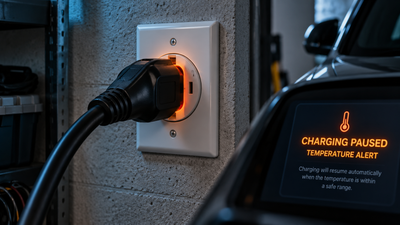
- Mobile Connector temperature sensing is a separate protection built into the Mobile Connector itself. The Gen 2 Mobile Connector's documentation lists high-temperature conditions monitored at the vehicle connector, the input plug where the adapter connects to the controller, the Mobile Connector controller, and the wall plug. When high temperature is detected at any of those locations, the Mobile Connector can reduce or interrupt charging on its own — this is Mobile Connector behavior, not the vehicle alert.
The two safety systems address related electrical problems (both point to unsafe supply conditions), but they use different sensors, produce different indications, and appear at different points in the charging path. Do not treat "the wall plug got hot" and "the vehicle saw voltage drop" as the same diagnostic condition.
Supply-Side vs Vehicle-Side Extension Cables

"Extension cord" in the EV world means two different products depending on which side of the EVSE they connect on. Tesla's alert message targets the supply-side kind.
| Extension type | Where it connects | Tesla's position |
|---|---|---|
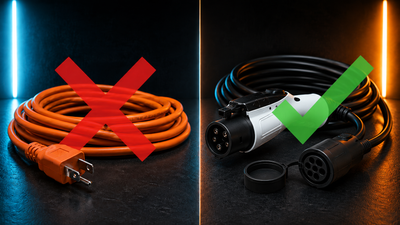
| Supply-side extension cord (household or NEMA extension) | Wall outlet → Mobile Connector plug (or other EVSE plug) | Explicitly prohibited by the Mobile Connector owner's manual. This is what the alert message names. |
| Vehicle-side NACS-to-NACS extension | EVSE's built-in NACS handle → vehicle's NACS charge port | A different product category. Tesla does not publish approval for pairing with the Mobile Connector or Wall Connector; verify your specific EVSE's instructions before use. |
Why Tesla mentions extension cords in the alert: a supply-side extension adds conductor length and additional plug/receptacle connections between the electrical supply and the EVSE. If that added resistance contributes to excessive voltage drop under load, the vehicle's onboard charger may detect the resulting voltage condition and trigger PCS_a053 or PCS_a054. This is separate from the Mobile Connector's own temperature-monitoring functions.
Even a vehicle-side extension is not automatically approved by Tesla. Vehicle-side NACS extensions insert an additional connection between the EVSE handle and the car's inlet. Tesla's documentation does not endorse adding one for the Mobile Connector or Wall Connector; if you use a vehicle-side extension, verify your specific EVSE's instructions permit it before charging.
Related NHTSA Context — the 2023 Porsche/Audi Cable Recall
Tesla's PCS_a053/a054 alert and the 2023 Porsche/Audi charging-cable recall address different signals in the same charging path. Tesla's vehicle alert detects excessive voltage drop during AC charging. The redesigned Porsche and Audi supply cables (NHTSA campaigns 23V-841 and 23V-842, 134,541 potentially affected vehicles combined) use temperature sensing near the supply connection to detect elevated heat at the plug/receptacle interface. Both can help identify unsafe electrical conditions during sustained charging, but they should not be described as the same detection system.
For the full breakdown of the Porsche/Audi recall — how each manufacturer described the cause, what the remedy is, and how it differs from Tesla's diagnostic approach — see our NHTSA 23V-841 / 23V-842 explainer.
Frequently Asked Questions
Does PCS_a053 stop charging entirely?
No. PCS_a053 reduces the charging rate while keeping charging active. PCS_a054 is the alert that stops charging entirely due to a larger voltage drop.
Can I dismiss the alert and keep charging normally?
You can dismiss the on-screen alert, but the underlying voltage-drop condition — and the reduced charge rate on PCS_a053 or the stopped state on PCS_a054 — continues until the electrical supply condition changes. Dismissing does not restore full charge rate; addressing the cause does.
What's the difference between a supply-side and vehicle-side extension?
A supply-side extension sits between the wall outlet and the Mobile Connector's plug — Tesla prohibits this configuration in the Mobile Connector owner's manual, and it's what the alert text names. A vehicle-side extension sits between the EVSE's built-in NACS handle and the car's NACS inlet — a different product category that Tesla's documentation does not address. See our full extension cord safety framework for the complete explanation.
Does the alert only appear when I'm using a Mobile Connector?
No. PCS_a053 and PCS_a054 are vehicle-side alerts from the onboard charger; they can appear regardless of which AC EVSE is delivering the current. If you're using a Tesla Wall Connector or a third-party NACS EVSE, the vehicle can still detect and flag excessive voltage drop.
Is my Tesla Wall Connector the cause of this alert?
Not necessarily. PCS_a053/a054 point to the AC supply reaching the onboard charger. If your Wall Connector is hardwired to a dedicated circuit and the branch-circuit installation checks out, the alert usually points elsewhere — heavy loads sharing the panel, or a compromised connection upstream of the Wall Connector.
Are the Mobile Connector's temperature sensors the same as PCS_a053?
No. Tesla's Mobile Connector has separate temperature monitoring at the vehicle connector, input plug, controller, and wall plug. When Mobile Connector temperature sensing detects an issue, it produces its own status-light behavior and can reduce or interrupt charging on its own. This is Mobile Connector-side behavior. PCS_a053 and PCS_a054 are vehicle-side alerts about voltage-drop conditions on the incoming AC supply.
Should I replace my NEMA 14-50 receptacle if this alert appears?
If the receptacle shows discoloration, melt marks, or a loose plug fit, a licensed electrician should inspect it and likely replace it with an industrial-grade unit. If the receptacle looks fine but the alert persists after removing extensions and checking shared loads on the branch circuit, an electrician inspection of the branch conductors and terminations is the next diagnostic step. See 7 signs your EV charging outlet is failing for the full symptom checklist.
What's the maximum current the Tesla Gen 2 Mobile Connector delivers?
The Gen 2 Mobile Connector is rated for a maximum of 32A, controlled by the installed adapter. A 32A EV charging load is commonly supplied by a 40A or larger appropriately sized branch circuit, depending on the outlet, adapter, wiring, and applicable electrical requirements. If PCS_a053 or PCS_a054 appears, the alert indicates the vehicle detected excessive voltage drop — not that the Mobile Connector exceeded its 32A rating.
If You Need a NACS-to-NACS Vehicle-Side Extension for a Separate Use Case
Vehicle-side NACS extensions serve a different problem than the one Tesla's PCS_a053/a054 alert is describing. They add reach between an EVSE's built-in NACS handle and your car's NACS inlet — useful when the EVSE's factory cable falls short of the parking spot. They do not extend the wall-side segment that voltage-drop alerts point to, and they do not substitute for a Mobile Connector, a Wall Connector, or a code-compliant 240V receptacle.
If your EVSE's specific installation guide permits a vehicle-side extension (not the Tesla Mobile Connector — see the disclaimer below), WenStorm's NACS-to-NACS extension is one option in this product category. The Tesla Gen 2 Mobile Connector owner's manual prohibits supply-side extension cords; WenStorm does not recommend pairing the NACS extension with the Mobile Connector or Wall Connector unless Tesla's own documentation permits your exact configuration.
Important: the WenStorm Tesla/NACS Extension Cord is a vehicle-side extension between an EVSE's built-in NACS handle and the car's NACS inlet. It is not a fix for Tesla's PCS_a053 or PCS_a054 alert, which points to a voltage-drop condition on the incoming AC supply. If your Tesla shows the alert, work through the checklist above — do not substitute this or any other aftermarket product for the Mobile Connector or a code-compliant receptacle.
Related reading
- Can You Use an Extension Cord With an EV Charger? — the full supply-side vs vehicle-side safety framework
- 7 Signs Your EV Charging Outlet Is Failing (Before Fire) — receptacle symptom checklist
- Audi & Porsche 240V Charging Cable Recall Explained (23V-841 / 23V-842) — the parallel NHTSA recall using temperature-sensing remedy
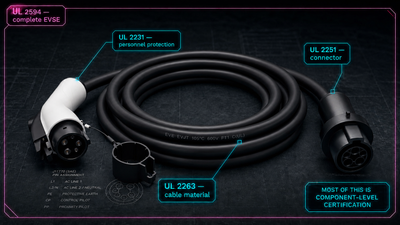
- UL 2263 vs UL 2251 vs UL 2231: What They Cover — the certification decoder
Written by Erik Nyholm, EV Charging Specialist at WenStorm. Erik covers electrical safety, receptacle and connector wear, Tesla PCS diagnostic alerts, and the distinction between vehicle-side and EVSE-side safety systems.