Sharing an EV Charger With a Neighbor: Safety, Cost and Rules

Published: 2026-07-28. Content is educational, not electrical, legal, or insurance advice. This article has not been reviewed by a licensed electrician prior to publication. Consult a licensed electrician for installation and equipment questions, a real-estate or landlord-tenant attorney for property-line, utility-resale, HOA and permitting questions, and your insurer for coverage questions.
Direct answer: Yes, neighbors can sometimes share an EV charger, but the arrangement must use compatible equipment, an adequate electrical circuit and safe cable routing. Before accepting payment or crossing a property boundary, confirm local permitting, utility, HOA, and insurance requirements. For long-term use, a metered listed smart EVSE or separate household charging setups are usually easier to manage than a shared portable EVSE with a cable across a shared driveway.
This guide walks the physical, cost, and rules considerations that show up when two neighboring households actually try to share one Level 2 charger, plus three common arrangement types this guide evaluates. The legal, insurance, HOA, and utility questions are named where they matter but not summarized here; those require jurisdiction-specific and policy-specific evaluation by your attorney and insurer.
Connector Compatibility Comes First
Before any arrangement can work, the two vehicles have to be compatible with the same charging setup, or a manufacturer-approved compatible solution has to exist.
A single fixed-connector portable EVSE ships with either a J1772 connector OR a NACS connector, not both. A fixed J1772 EVSE will not directly charge a NACS vehicle, and a fixed NACS EVSE will not directly charge a J1772 vehicle. Adapters exist for some vehicle-and-connector combinations, but adapter availability varies by manufacturer, model year, and market. Some Tesla vehicles ship with a J1772-to-NACS adapter; some do not. Some newer non-Tesla vehicles ship with a NACS-to-J1772 adapter; many do not.
Before you invest time in a shared arrangement, confirm what connector each neighbor's vehicle accepts and confirm the specific adapters (if needed) are manufacturer-approved for that vehicle. A single fixed-connector EVSE plus mismatched adapters is not a working shared setup.
Three Common Arrangements This Guide Evaluates
These are not the only ways two neighbors can arrange EV charging. Other options include smart-EVSE sharing platforms with access control, dual-port or load-managed shared systems, parking on the host's property, and workplace or public charging. The three below are the ones that most often show up in peer-to-peer neighbor conversations.
- Alternating on one existing outlet. One household's outlet, one portable EVSE, cable moved between the two vehicles on alternating days. The cable runs across the property line whenever the other household's car is charging.
- Shared installation with metering. The two households jointly pay for a licensed electrician to install a new dedicated 240V circuit and receptacle. Usage is measured (either via a listed smart EVSE with session metering or a properly installed submeter). One household reimburses the other based on measured consumption and a documented rate.
- Each household installs its own. Separate outlets, separate chargers, no cable across the property line. The "sharing" conversation gets replaced by "each of us has our own."
Arrangement 1: Alternating on One Outlet
Cable across the property line
A cable running from one household's outlet to a vehicle parked on the other household's property crosses ground the outlet-side household doesn't fully control. Practical considerations:
- Weather exposure. An outdoor cable on shared pavement sees UV, rain, snow, and freeze-thaw cycles that a garage-only cable doesn't. Manufacturer instructions for the specific EVSE describe permitted outdoor use conditions; follow those, not general internet advice.
- Trip and vehicle hazards. A charging cable should not be positioned where vehicles or pedestrians can damage the cable or trip over it. Any cable-management solution (ramp, protector, or channel) must be rated for the location and accepted by the equipment manufacturer and, where applicable, the local Authority Having Jurisdiction. A generic cable ramp does not automatically make driving over an energized EV charging cable acceptable.
- Wildlife and physical damage. Cables can be damaged by animals, tools, or foot traffic. Do not use DIY protective coverings (split-loom tubing, wraps, cable sleeves) that could conceal damage, retain heat, or conflict with manufacturer instructions. Regularly inspect the cable; replace damaged equipment.
The reviewer standard for any outdoor cable route on shared property is: does the specific EVSE manufacturer permit this use, does the local authority permit it, and can the cable be routed safely without creating a trip or vehicle-damage hazard for either household? If any of those is unclear, the arrangement doesn't work as-is.
Receptacle wear from two-household use
Every insertion-and-withdrawal cycle contributes some contact wear on a NEMA 14-50 receptacle. Sharing increases wall-side wear only if it causes more plugging and unplugging of the WALL end than the household would otherwise do on their own. If both households leave the wall plug connected and swap the connector between cars, wall-side wear is close to single-household use. If the wall plug gets disconnected and reconnected because of the sharing arrangement (for example, to move the whole EVSE between garages), the wall receptacle sees additional cycling proportional to that behavior.
Tesla's Gen 2 Mobile Connector owner's manual, for example, recommends leaving the Mobile Connector connected when used regularly. Manufacturer instructions for other EVSEs may differ. Read your specific EVSE's manual for the recommended operational pattern; do not assume a "leave-it-plugged-in rule" as a universal standard.
Warning signs to watch monthly on the wall receptacle regardless of the arrangement:
- Discoloration around any prong hole (brown, gray, or black — any color other than the outlet's original color; discoloration can indicate overheating or other thermal damage and requires evaluation by a licensed electrician).
- Warmth at the plug after 30+ minutes of continuous charging (slightly warm is normal; uncomfortably hot is not).
- Audible buzzing or crackling from the outlet during charging.
- A plug that wobbles noticeably when inserted or doesn't seat firmly.
Any of these signs is a stop-charging-and-inspect situation, not a keep-diagnosing situation. See our NEMA 14-50 outlet melt guide for the underlying failure mode.
Where alternating can break down
Cohabiting drivers can typically renegotiate a shared schedule casually. Non-cohabiting neighbors can run into friction that erodes the arrangement:
- One household drives more and the arrangement becomes asymmetric.
- One household is out of town and there's no protocol for who initiates a change.
- An incident (a warm plug, a tripped breaker, a driven-over cable) requires attribution that no one wants to have.
- One household moves out; the new occupant has different needs.
- Small cost disputes accumulate without a metered accounting.
None of these are guaranteed outcomes, and cohabiting-quality communication between neighbors can carry an arrangement for years. But each of the friction points above is structural to a two-household setup that wasn't designed with either household's full control in mind.
Arrangement 2: Shared Installation With Metering
Joint payment for a licensed electrician to install a new dedicated 240V circuit and receptacle, with usage metered so consumption is measured rather than estimated.
What this typically involves:
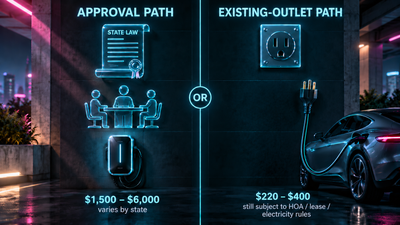
- Licensed electrician + permit process. Permits and inspections may be required and vary by jurisdiction. A qualified licensed electrician should design the installation under the locally adopted National Electrical Code. Do not treat this as a DIY project regardless of what any online forum says.
- Metering approach. Either a safety-listed smart EVSE with per-user or per-session metering, or a properly installed submeter selected by an electrician. A consumer smart plug is generally not listed or rated for continuous Level 2 EV charging load and should not be used as the metering device on a 240V circuit. If money changes hands between households, confirm the meter and billing method are legally acceptable in your jurisdiction — utility resale and sub-metering rules vary significantly by state.
- Physical location and property implications. A circuit or outlet installed on one household's property may raise easement, property-line, permitting, and utility questions if it's designed to serve the other household. Confirm with the utility, the local permitting authority, and an attorney before designing a circuit intended to serve a second parcel. A circuit or receptacle installed on real property may not be freely removable by the household that helped pay for it when they move.
- Written record between the households. Not a lease amendment (this is peer-to-peer, not landlord-tenant), but a written record of who paid what for install, how usage is measured, how billing works, and what happens if one household moves. Have an attorney review before signing if the amounts are significant.
This arrangement fits best when both households have long tenure, symmetric daily demand, and a durable working relationship. It fits worst when there's rental turnover on either side, when daily demand is very asymmetric, or when the property-line configuration doesn't allow a sensible outlet location.
Arrangement 3: Each Household Installs Its Own
Separate outlets on each household's property, each with its own EVSE. No cable across the property line, no shared accountability for an incident, no renegotiation when driving patterns change.
Cost tradeoff: two installations vs one shared installation. Most of the install cost is electrician labor, permits, wire run, and (where applicable) panel evaluation. Adding a second outlet on the shared circuit ordinarily cannot simply be added to an existing EV-charging circuit — an electrician must design any multi-outlet or load-managed system under the locally adopted National Electrical Code. Whether separate-per-household is cheaper than a single shared install depends on panel proximity for each household, wire run distances, and whether either household needs a panel evaluation.
What each-household-separate avoids operationally: cable across the property line, two-household plug cycling on one receptacle, any shared accountability for an incident, any renegotiation when driving patterns change, and any awkwardness when one household moves. Whether it "pencils out" financially is a household-specific calculation, not a general result.
Practical Considerations Beyond the Three Arrangements
Whichever arrangement fits, these questions should have an explicit answer before the arrangement runs regularly:
- Parking permission. Where must the neighbor's vehicle park while charging? On the outlet-side household's property, on the neighbor's own driveway, on the street? The parking location determines cable route, HOA implications, and any easement question.
- Cable and equipment security. A portable EVSE is portable. If the arrangement leaves it outdoors between sessions, who is responsible for storing or securing it? If the equipment is stolen or damaged, who owns the replacement cost?
- Access control. How does the owner prevent unauthorized charging? A publicly accessible outlet in a shared driveway can be used by anyone with an EV cable, not just the invited neighbor.
- Time-of-use electricity rates. If either household is on a time-of-use utility rate plan, reimbursement should reflect when charging actually happens, not merely an assumed flat electricity rate. Peak-hour charging costs more per kWh than overnight charging in most TOU rate structures.
- Charging losses. The EVSE display, the vehicle dashboard, and the utility meter for the outlet-side household do not necessarily report identical numbers for the same session. Losses in AC-to-DC conversion, in the cable, and in the receptacle add up. Any billing method should account for the fact that the utility meter is what the outlet-side household actually pays.
- Power outages and emergency disconnect. Either household must be able to disconnect or de-energize the shared equipment safely in an emergency. If the disconnect requires accessing a specific breaker inside one household's panel, the other household needs to know that.
- Moving or selling. A circuit or receptacle installed on real property typically stays with the property when the household that helped pay for it moves out. Money changing hands as a "share of the install" is not always recoverable at exit.
- Insurance and liability. Neither household should assume their standard homeowner or renter policy automatically covers a shared electrical arrangement. Both should call their insurers, describe the specific setup, and get any coverage confirmation or exclusion in writing before the arrangement runs long-term. This is not insurance advice.
Extension Cords, Extension Cables, and What Is Actually Safe
"Extension" gets used to mean at least three different products, and they are not interchangeable:
- An ordinary household or NEMA extension cord plugged between the wall receptacle and the EVSE. Most EVSE manufacturers explicitly prohibit this configuration. Tesla, for example, expressly prohibits extension cords, conversion plugs, power strips, and multi-outlet adapters with its Mobile Connector (see Tesla's Mobile Connector owner's manual). Do not use an ordinary extension cord between the receptacle and EVSE unless the specific EVSE manufacturer explicitly permits that exact configuration.
- A vehicle-side EV extension cable designed to extend the EVSE's own charging cable between the EVSE connector and the vehicle port. These are a distinct product category with their own safety and compatibility requirements. Compatibility and safety evaluation for these depends on the specific EV, the specific EVSE, and the specific extension cable's design and rating.
- The charging cable permanently attached to the EVSE. This is the manufacturer-specified cable and is the only cable that comes as standard equipment with the EVSE.
Follow the EVSE and vehicle manufacturers' instructions on what extensions are permitted with your specific equipment. Do not route any energized cable across a public sidewalk, vehicle path, or shared access area without an installation that meets local requirements.
Related Reading
- Why NEMA 14-50 Outlets Melt with EV Chargers — the receptacle wear and failure mode in depth
- Townhouse EV Charging Installation: Who Pays for What in 2026 — the townhouse cost-split conversation
- Portable vs Wall-Mounted EV Charger: Which Do You Actually Need?
For the specific case of two PHEVs sharing a single 120V outlet (versus one EV and a neighbor), see Charge Two PHEVs on One Outlet: The 120V Truth.
FAQ
Can I share my EV charger with my neighbor?
Yes, in some situations, if the two vehicles are compatible with the same charging setup (or use manufacturer-approved compatible solutions), the electrical circuit is adequate, and the cable can be routed safely. Confirm local permitting, utility, HOA, and insurance requirements before accepting payment or crossing a property boundary. For long-term use, a metered listed smart EVSE or separate household charging setups are usually easier to manage than a portable EVSE with a cable across a shared driveway.
How do I bill a neighbor for the electricity my charger uses on their car?
Two general approaches. First, a safety-listed smart EVSE with per-user or per-session kWh metering — usage times the utility's rate (accounting for time-of-use, if applicable) gives a measured number. Second, a documented flat monthly amount agreed in writing. Utility resale and sub-metering rules vary significantly by state, and some jurisdictions restrict how utilities can be resold to a third party even at cost. Consult a real-estate or landlord-tenant attorney in your jurisdiction before formalizing any payment arrangement.
Is running an extension cord across the property line to my neighbor's car OK?
Not with an ordinary household or NEMA extension cord — most EVSE manufacturers explicitly prohibit that use, and many do not warrant equipment used with an extension cord between receptacle and EVSE. A vehicle-side EV extension cable is a distinct product category with its own safety and compatibility considerations; consult the EVSE and vehicle manufacturers' instructions for what extensions are permitted. Regardless of product type, no energized cable should be routed across a public sidewalk, vehicle path, or shared access area without an installation that meets local requirements.
What if my neighbor's EV uses a different connector than mine (J1772 vs NACS)?
A single fixed-connector portable EVSE ships with either a J1772 connector OR a NACS connector, not both. It will not directly charge a vehicle with the other connector type. Adapters exist for some vehicle-and-connector combinations but adapter availability varies by manufacturer, model year, and market. Confirm what connector each vehicle uses and whether a manufacturer-approved compatible solution exists before assuming a single portable EVSE can serve both cars.
Whose insurance covers damage from a shared arrangement?
Depends on the specific policies, the specific cause of the incident, and the specific jurisdiction. Neither household should assume their standard homeowner or renter policy automatically covers a shared electrical arrangement, and neither should assume it does not. Both households should call their insurers, describe the shared setup in specifics, and get any coverage confirmation or exclusion in writing before the arrangement runs long-term. This is not insurance advice.
What if my HOA has rules about cables across shared driveways?
Those rules apply. HOAs vary significantly in what they permit and what they restrict; some address EV charging directly, some don't, some prohibit cables in common areas. Check your HOA's covenants and, if the rules are unclear, get written clarification from the association board before running a cable across a common area.
Neighbor-shared EV charging can work when the equipment is compatible, the electrical circuit is adequate, the cable route is safe, and the legal, insurance, HOA, and utility questions have real answers in the specific situation. The safest defaults are a listed smart EVSE with metering (for a long-term shared arrangement) or separate household charging setups (when the shared version doesn't fit). Get the electrical work done through a licensed electrician per your locally adopted code, and get the legal and insurance questions answered by your attorney and insurer for your specific facts.
See the WenStorm Portable Level 2 EV Charger →
Use the WenStorm Solution Finder →
Sources
- U.S. Department of Energy, Alternative Fuels Data Center — Electricity for EV Charging at Home
- Tesla Gen 2 Mobile Connector Owner's Manual (32 Amp, US) — Tesla's official documentation on Mobile Connector operational recommendations, extension-cord prohibitions, and cable positioning requirements
- Google Search Essentials — helpful, reliable, people-first content guidance
- WenStorm Return Policy — 2-year warranty
- NEC Article 625, 210.19(A)(1), and 210.20(A) — Continuous load and EV charging provisions (National Electrical Code, current edition; consult your local Authority Having Jurisdiction for adopted edition)
Nathan Park covers EV charging safety, adapter compatibility, and multi-vehicle charging scenarios for WenStorm. Content is educational, not electrical, legal, or insurance advice. This article has not been reviewed by a licensed electrician prior to publication and does not attempt to summarize state utility resale rules, HOA regulations, or insurance carrier positions.