One EV Charger for NACS and J1772 Cars: 4 Home Options

Educational content, not electrical, insurance, or product-approval advice. This article has not been reviewed by a licensed electrician prior to publication. Verify adapter compatibility, warranty language, and connector direction against your specific vehicle's owner's manual, the adapter manufacturer's documentation, and the EVSE manufacturer's charging instructions.
Your household has one EV with a J1772 inlet and one EV with a NACS/J3400 inlet. Do you buy one charger with an AC adapter and swap between cars, or do you buy two chargers?
Direct answer: A mixed NACS-and-J1772 household has four practical choices: (1) a J1772 EVSE with an AC adapter for the NACS vehicle, (2) a NACS EVSE with an AC adapter for the J1772 vehicle, (3) a universal EVSE with an integrated adapter (typically hardwired, not portable), or (4) two separate EVSEs, one per connector. The best option depends on which car charges most often, whether the adapter is permitted for that vehicle and that EVSE, and whether the home's electrical service can support the combined load.
The rest of this guide walks the compatibility pathway explicitly, covers the AC-versus-DC adapter distinction (which trips up a lot of new NACS owners), and includes the multi-EV service-capacity question that matters more than most content on this topic acknowledges.
The Compatibility Table (Read This First)
The correct way to think about home AC charging compatibility is the physical pathway:
EVSE connector → AC adapter (if needed) → vehicle inlet
Whatever the EVSE has at its vehicle-end connector must match whatever the vehicle has at its inlet, either directly or via an adapter that CHANGES the EVSE connector's shape to match the vehicle inlet's shape.
| EVSE has this connector | Vehicle has this inlet | What you need |
|---|---|---|
| J1772 | J1772 | No adapter |
| NACS / J3400 | NACS / J3400 | No adapter |
| J1772 | NACS / J3400 | J1772-to-NACS AC adapter (turns the EVSE's J1772 tip into a NACS-shape tip for the vehicle) |
| NACS / J3400 | J1772 | NACS-to-J1772 AC adapter (turns the EVSE's NACS tip into a J1772-shape tip for the vehicle) |
Commercial adapter names can be inconsistent across brands. If a product name confuses you, mentally translate it into "what does the EVSE end look like, what does the vehicle inlet look like, and does this adapter bridge them in that direction?" The physical shape at the vehicle end is what has to change.
Important: AC Home Adapters Are NOT the Same as DC Fast-Charging Adapters
This guide discusses AC Level 1 and Level 2 adapters only. Do not assume that a CCS1-to-NACS or NACS-to-CCS1 DC fast-charging adapter will work with a portable home EVSE.
- J1772 (SAE J1772) is used for AC Level 1 and Level 2 charging only.
- NACS / J3400 (SAE J3400, formerly the Tesla connector) supports BOTH AC and DC charging through the same physical connector.
- CCS1 combines the J1772 pin arrangement with two additional DC pins for DC fast charging.
Some DC fast-charging adapters (for example, Ford's official NACS-to-CCS1 adapter that ships with certain 2024+ Ford EVs) are explicitly designed for use at DC fast-charging stations only and are NOT compatible with AC Level 1 or Level 2 home chargers. Ford's product documentation explicitly says so.
If you are trying to charge at home with a portable EVSE, you need an AC adapter, not a DC fast-charging adapter. Check the adapter manufacturer's documentation and the vehicle manufacturer's charging instructions before assuming compatibility.
Option 1: A J1772 EVSE with a J1772-to-NACS AC Adapter
Buy a portable EVSE with a native J1772 vehicle-end connector. Charge the J1772 vehicle directly. When you need to charge the NACS vehicle, attach a J1772-to-NACS AC adapter to the EVSE connector (the adapter converts the EVSE's J1772 tip into a NACS-shape tip), then plug into the NACS vehicle inlet.
When this fits:
- Your J1772 vehicle is the primary daily driver and charges at home nightly, while the NACS vehicle charges at home less frequently.
- The NACS vehicle's charging instructions permit AC charging via a J1772-to-NACS adapter compatible with that vehicle.
Availability note: J1772-to-NACS AC adapters exist in both first-party and third-party form. Confirm the specific adapter is compatible with your specific vehicle and your specific EVSE per each manufacturer's instructions.
Option 2: A NACS EVSE with a NACS-to-J1772 AC Adapter
Buy a portable EVSE with a native NACS vehicle-end connector. Charge the NACS vehicle directly. When you need to charge the J1772 vehicle, attach a NACS-to-J1772 AC adapter to the EVSE connector (the adapter converts the EVSE's NACS tip into a J1772-shape tip), then plug into the J1772 vehicle inlet.
When this fits:
- Your NACS vehicle is the primary daily driver and charges at home nightly, while the J1772 vehicle charges at home less frequently.
- The J1772 vehicle's charging instructions permit AC charging via a NACS-to-J1772 adapter compatible with that vehicle.
Availability note: Tesla's Mobile Connector is a well-known NACS-side portable EVSE. Tesla currently states that a J1772 charging adapter (which lets a NACS vehicle charge from a J1772 station) is included with every new US Tesla delivery. That is Option 1 direction, not Option 2. For the Option 2 direction, WenStorm sells a standalone NACS-to-J1772 AC adapter (product page) with 50A and 80A variants; other first-party and third-party NACS-to-J1772 AC adapters also exist but availability varies. Whichever adapter you use, verify it is designed for AC charging (not DC fast charging), rated for your EVSE's current, and permitted by the specific vehicle's charging instructions before use.
Option 3: A Universal EVSE with Integrated Adapters
Some EVSEs are designed to serve both J1772 and NACS vehicles natively, with either a swappable connector head or an integrated dual-connector design. Tesla's Universal Wall Connector is a well-known example: it ships with a NACS connector plus a bundled J1772 adapter, so a single hardwired unit can charge both connector types.
When this fits:
- You want one EVSE, not two, and you don't want to manage a separate adapter attach/detach every session.
- You are OK with a hardwired installation (most universal units are wall-mounted and hardwired rather than portable).
- You have panel capacity for the higher-current circuit these units typically require.
Tradeoffs:
- Universal EVSEs are typically NOT portable. They install to a specific wall location via a licensed electrician; permits and inspections may be required per your locally adopted National Electrical Code.
- Higher upfront cost than a single portable EVSE plus an adapter.
- Adapter is still involved for one of the two connector types; the integration just means the adapter comes with the unit rather than being purchased separately.
Option 4: Two Separate EVSEs, One Per Connector
Buy one J1772-native portable EVSE for the J1772 vehicle and one NACS-native portable EVSE for the NACS vehicle. Each vehicle uses its native connector every session. No adapter between them.
When this fits:
- Both vehicles charge at home nightly and would compete for a single EVSE.
- You want to skip the adapter compatibility research entirely.
- Your household has (or is willing to install) two 240V outlets in reasonable positions.
Multi-EV Electrical Capacity: The Question Most Content Skips
Options 3 and 4 introduce a household-service question that a single-EVSE setup does not. Two WenStorm units charging simultaneously at 32A each represent up to 64A of continuous EV charging load. Even with separate branch circuits, the home's electrical service and panel must have sufficient calculated capacity to support both simultaneously.
Two separate circuits do not automatically mean the electrical service can support two EVSEs charging simultaneously. A qualified licensed electrician should perform the required load calculation before you commit to a two-EVSE setup. Where service capacity is limited, listed load-management equipment (which coordinates charging across multiple EVSEs to stay within a shared power budget) or an alternating charging schedule can avoid simultaneous full-power charging without requiring a service upgrade.
This is often a more important multi-EV consideration than adapter compatibility. See our Can You Charge Two EVs From One Outlet? guide for the electrical detail.
Decision Framework: Which Option Fits Your Household
Walk this order:
- Confirm each vehicle's inlet type. Owner's manual + physical inspection of the port. Do not infer from brand.
- Check adapter compatibility instructions for each vehicle. For each direction you would need (J1772-to-NACS for a NACS vehicle, or NACS-to-J1772 for a J1772 vehicle), look up the vehicle manufacturer's own charging instructions and any listed compatible adapter parts. Some manufacturers publish an approved list; some do not.
- Estimate connector-swap frequency. If both cars charge at home nightly and would need adapter swaps every day, Options 3 (universal) or 4 (two EVSEs) usually become operationally simpler than a single portable + adapter (Options 1 or 2). If one car charges at home nightly and the other charges primarily elsewhere, Option 1 or 2 is often enough.
- Check your outlet situation and panel capacity. Options 3 and 4 both raise the multi-EV service-capacity question above. A licensed electrician's load calculation should precede any two-EVSE install.
- Confirm the specific EVSE product ships in the variant you need. Many portable Level 2 EVSEs (including WenStorm's) ship in either J1772 or NACS variant at order time. You pick one at order.
Charging Speed: What Actually Sets the Rate
The delivered charging rate is capped by the lowest of five things: your supply voltage (208V vs 240V), the branch circuit's continuous-load capacity, the EVSE's hardware rating, the adapter's rating, and the vehicle's onboard charger.
For a WenStorm 32A portable EVSE, the EVSE itself is a 32A ceiling. A vehicle capable of higher AC charging rates than 32A will be limited to the WenStorm's 32A maximum regardless of the vehicle's own capability. A vehicle whose onboard charger caps at less than 32A will be limited by the vehicle. See our why is my EV charging slowly guide for the full diagnostic.
Warranty and Damage Coverage
Damage caused by an incompatible or prohibited adapter may not be covered by the vehicle manufacturer's warranty, the EVSE manufacturer's warranty, or the adapter manufacturer's warranty. Read the applicable warranty documents and the charging instructions for each product before combining components. If a manufacturer's charging instructions prohibit a specific adapter configuration and you use it anyway, warranty exposure and insurance-coverage exposure are both real risks.
Also: every additional connection in the pathway should be fully seated, inspected periodically, and used within its published environmental rating. Properly rated adapters can be used in outdoor charging conditions if the specific product is designed for outdoor use; do not assume any adapter is weatherproof unless the product documentation confirms it.
WenStorm Products in a Mixed-Connector Household
WenStorm's portable Level 2 EV charger ships in either a J1772 or NACS variant chosen at order time. The unit's core specs, verified against WenStorm's current product page:
- Fixed NEMA 14-50 wall plug (not user-swappable)
- Fixed vehicle-end connector: J1772 OR NACS, one per unit
- 32A maximum output (about 7.7 kW at 240V or 6.7 kW at 208V)
- 25-foot cable
- ETL Listed
- $219.99
- 2-year warranty (see WenStorm's return policy)
How the four options map to WenStorm variants:
- Option 1 (J1772 EVSE + J1772-to-NACS adapter for NACS vehicle): order the WenStorm J1772 variant. Pair with a J1772-to-NACS AC adapter compatible with your specific NACS vehicle and the WenStorm's electrical rating.
- Option 2 (NACS EVSE + NACS-to-J1772 adapter for J1772 vehicle): order the WenStorm NACS variant. Pair with a NACS-to-J1772 AC adapter compatible with your specific J1772 vehicle. Confirm the specific adapter's certification, electrical rating, and documented vehicle/EVSE compatibility before use.
- Option 3 (universal EVSE): WenStorm does not currently sell a universal-connector EVSE; consider Tesla's Universal Wall Connector or equivalent hardwired products.
- Option 4 (two EVSEs): order one WenStorm J1772 variant and one WenStorm NACS variant. Each plugs into its own 240V outlet. Confirm the household's electrical service supports both charging simultaneously (see the multi-EV service-capacity section above).
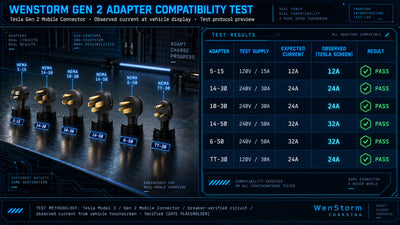
Important WenStorm product-naming clarification: WenStorm's NEMA outlet adapters (14-30, 10-30, TT-30, and similar) are a completely different product category. They convert between NEMA wall receptacle types (14-50 to 14-30, for example) for use with the Tesla Gen 2 Mobile Connector. They do NOT convert between J1772 and NACS vehicle connectors. Do not confuse the two product lines.
Note on adapter direction: this kit is the NACS-charger-plus-adapter setup (Option 2 in the guide above). WenStorm does not sell a J1772-to-NACS adapter as a first-party product; if your primary home vehicle is J1772 (Option 1 direction), consider a J1772-native EVSE paired with a compatible third-party adapter, or use the Solution Finder.
Related Reading
- J1772 vs NACS: What's Actually Changing in 2026 — the standards-level explanation of the 2026 transition
- Can You Charge Two EVs From One Outlet? — the electrical detail for two-EVSE households
- Tesla Mobile Connector vs Portable Level 2 — Tesla-specific portable comparison
- Why Is My EV Charging Slowly? — the full diagnostic on what caps the delivered rate
FAQ
Can one portable charger charge a Tesla and a non-Tesla in the same household?
Yes, with an AC adapter that bridges the EVSE's connector to the vehicle's inlet in the correct direction. If your EVSE has a J1772 connector and you are charging a NACS vehicle, you need a J1772-to-NACS AC adapter. If your EVSE has a NACS connector and you are charging a J1772 vehicle, you need a NACS-to-J1772 AC adapter. Confirm the specific adapter is compatible with your specific vehicle and your specific EVSE per each manufacturer's charging instructions.
Which adapter direction do I need?
Match the physical pathway: whatever the vehicle inlet looks like is what the adapter's vehicle-facing tip must look like. If the vehicle has a NACS inlet and the EVSE has a J1772 connector, the adapter must turn the EVSE's J1772 tip into a NACS-shape tip that plugs into the vehicle. That is a J1772-to-NACS AC adapter. If the vehicle has a J1772 inlet and the EVSE has a NACS connector, the adapter goes the other way (NACS-to-J1772).
Can I use a CCS/NACS DC fast-charging adapter at home?
Not necessarily. DC fast-charging adapters are designed for the specific electrical and communication protocols used at DC fast-charging stations. Some DC adapters (Ford's official NACS-to-CCS1 DC adapter, for example) explicitly state they are not compatible with Level 1 or Level 2 AC chargers. For home charging with a portable EVSE, use an AC adapter specifically labeled for AC Level 1 or Level 2 use. Read the adapter's product documentation.
Can two EVSEs use one circuit?
Ordinarily, no. A second EVSE cannot simply be added to an existing dedicated EV-charging circuit. However, listed load-management equipment can serve multiple EVSEs on shared capacity under specific listing and installation conditions per your locally adopted National Electrical Code. This is engineered work, not a DIY add. A licensed electrician should design any multi-EVSE or load-managed installation.
Will J1772 become obsolete now that NACS is the North American standard?
Not on any near-term timeline. Millions of J1772 vehicles and charging ports will remain in use for years. A J1772-to-NACS AC adapter allows a NACS vehicle to continue using J1772 EVSEs and stations, so buying a J1772-native portable EVSE today has a long useful life ahead even if your next EV purchase is NACS-native.
The mixed-connector household is the specific case where "just use an adapter" advice breaks into four options with different tradeoffs. Confirm each vehicle's inlet type, check adapter compatibility per manufacturer instructions for each direction, estimate connector-swap frequency, and get a licensed electrician's load calculation before committing to a two-EVSE setup that draws more from your service than a single-EVSE setup does.
See the WenStorm Portable Level 2 EV Charger →
Use the WenStorm Solution Finder →
Sources
- SAE J1772 — Standard for AC Level 1 and Level 2 EV charging couplers (SAE International)
- SAE J3400 — Standard for the North American Charging Standard (NACS) coupler (SAE International, published 2024)
- Joint Office of Energy and Transportation — EV connector types consumer guidance (driveelectric.gov / DOE)
- U.S. Department of Energy, Alternative Fuels Data Center — Electricity for EV Charging at Home
- Tesla — J1772 Charging Adapter product information (tesla.com/support/charging). Tesla currently states this adapter is included with new US Tesla deliveries.
- Tesla — Universal Wall Connector product information (tesla.com/support/home-charging-installation/wall-connector). Tesla's dual-connector home EVSE example.
- Ford — NACS Fast Charging Adapter product page. Ford's DC adapter explicitly states it is not compatible with Level 1 or Level 2 AC chargers.
- WenStorm Level 2 Portable EV Charger product page
- WenStorm Return Policy — 2-year warranty
- NEC Article 625 — Electric Vehicle Power Transfer System requirements (National Electrical Code, current edition; consult your local Authority Having Jurisdiction for adopted edition)
Priya Sharma covers first-time EV owner scenarios, renter and apartment charging, and multi-EV household planning for WenStorm. This article has not been reviewed by a licensed electrician prior to publication. Verify adapter compatibility, warranty language, and connector direction against your specific vehicle's owner's manual, the adapter manufacturer's documentation, and the EVSE manufacturer's charging instructions.