How to Charge Your EV at Home Without Installation

Every EV buying guide tells you to get a Level 2 wall charger installed. Almost none of them tell you that you probably don't need to.
If your home has any 240V outlet — in the garage, laundry room, or workshop — you can get full Level 2 charging speed tonight. No electrician. No permit. No $1,500–$3,000 installation bill.
This guide shows you exactly how to find the outlet you already have, pick the right charging solution for your car, and start charging at home faster than you thought possible.
Why Most No-Install Guides Get It Wrong
Search "charge EV at home without installation" and you'll find the same advice everywhere: plug into a standard wall outlet and use Level 1 charging.
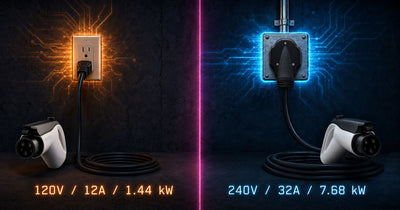
That's not wrong — but it's the worst of the viable options. A standard 120V outlet adds 3–5 miles of range per hour. If you drive 40 miles a day, you need 8–13 hours of charging just to break even. For commuters, that margin disappears fast.
Here's what those guides are missing:
| Charging Method | Speed | Equipment Cost | Installation | Practical For |
|---|---|---|---|---|
| Level 1 (120V wall) | 3–5 mph | $0 | None | Low mileage only |
| Portable Level 2 | 18–35 mph | $40–$200 | None | Most drivers |
| Installed wall charger | 35–44 mph | $300–$800 + install | Required | High mileage |
Portable Level 2 charging is the option most guides skip entirely. It's dramatically faster than Level 1, requires no installation, and costs a fraction of a wall unit. The only requirement: a 240V outlet somewhere in your home.
Step 1 — Do a 5-Minute Outlet Audit of Your Home

Before you buy anything, take a walk through your home with fresh eyes. You're looking for any 240V outlet within reasonable reach of where you park your car.
Where to check:
- Garage (most likely — often has outlets for RV hookups, workshop tools)
- Laundry room (dryer outlet — extremely common)
- Utility or storage room
- Outdoor power pedestal
What Each Outlet Looks Like
NEMA 14-50 — 4 prongs, L-shaped top-left slot. The ideal EV charging outlet. Delivers 32–40A at 240V. Found in garages, RV spots, and some utility areas.
NEMA 14-30 — 4 prongs, all straight slots. Standard dryer outlet in most homes built after 1996. Delivers 24A at 240V. Excellent for overnight charging.
NEMA 10-30 — 3 prongs (no separate ground). Older dryer outlet in homes built before the mid-1990s. Delivers 24A at 240V. Same charging speed as 14-30.
NEMA 6-50 — 2 flat blades plus round ground. Workshop or welder outlet. Delivers 32–40A at 240V. Less common but identical performance to a 14-50.
If you find any of these outlets near your parking area, you are already set up for portable Level 2 charging without any new wiring.
Step 2 — Match Your Outlet to the Right No-Install Solution

Once you've identified your outlet, the product match is straightforward.
Tesla Owners with a Gen 2 Mobile Connector
Your Tesla already came with a mobile connector. On a standard 120V wall outlet, it charges at 12A — Level 1 speed. A WenStorm NEMA adapter plugs into the connector's adapter slot and connects it to your 240V outlet, upgrading charging to up to 32A.
There's an adapter for every outlet type:
| Your Outlet | WenStorm Adapter | Charging Speed |
|---|---|---|
| NEMA 14-50 | NEMA 14-50 adapter | Up to 32A / 28–32 mph |
| NEMA 14-30 | NEMA 14-30 adapter | Up to 24A / 18–22 mph |
| NEMA 10-30 | NEMA 10-30 adapter | Up to 24A / 18–22 mph |
| NEMA 6-50 | NEMA 6-50 adapter | Up to 32A / 28–32 mph |
Cost: ~$40. No installation. Works with Gen 2 Mobile Connector only.
Shop WenStorm Tesla NEMA Adapters →
All Other EV Owners (and Tesla with Gen 3)
If you drive a Ford, Chevy, Hyundai, Rivian, or any non-Tesla EV — or a Tesla with a Gen 3 connector — you need a standalone portable Level 2 charger. The WenStorm Portable Level 2 Charger plugs directly into a NEMA 14-50 outlet and charges at up to 32–40A via J1772 connector.
Cost: ~$150–$250. Plugs into NEMA 14-50. Works with all J1772 EVs.
Shop WenStorm Portable Level 2 Charger →
If You Only Have Standard 120V Outlets
Level 1 is your option for now. It's genuinely fine if you drive under 20–25 miles per day and can leave the car plugged in overnight. If you want to upgrade, the cheapest path is asking your building manager about laundry room outlet access, or having a single NEMA 14-50 outlet added to your garage — a much smaller job than a full charger installation.
Step 3 — Plug In and Charge (What to Expect Overnight)

Once you have your adapter or portable charger, setup takes under a minute.
For a Tesla Gen 2 + NEMA 14-50 adapter, starting at 20% battery:
- Plug in at 10pm
- Wake up at 7am → ~100% (full battery)
- Range added: ~200+ miles overnight
- Cost: ~$3–6 at average US electricity rates
For a NEMA 14-30 dryer outlet setup:
- Plug in at 10pm
- Wake up at 7am → ~80–90% (most EVs fully charged)
- Still enough for any normal day of driving
For Level 1 (120V wall outlet):
- Plug in at 10pm
- Wake up at 7am → ~40–45 miles added
- Works for low-mileage drivers; not enough for heavy commuters
All certified portable chargers are built for nightly use. WenStorm chargers and adapters are ETL certified and include thermal protection, ground fault detection, and current limiting — the same safety systems found in permanently installed units.
Do You Need a Dedicated Circuit for EV Charging?
No — not for portable charging on an existing outlet, provided the circuit is in good condition and properly rated.
The National Electrical Code (NEC) requires EV charging equipment to operate at no more than 80% of a circuit's rated capacity. A NEMA 14-50 on a 50A circuit → 40A max draw. A dryer outlet on a 30A circuit → 24A max draw. Both are within safe operating limits for the outlet's rated capacity.
You may want to call an electrician if:
- The outlet is old, damaged, or shows signs of overheating
- The circuit is shared with other high-draw appliances running at the same time
- You want to charge above 40A (requires a hardwired 60A circuit)
- You're adding a NEMA 14-50 outlet where one doesn't currently exist
For the vast majority of homeowners using an existing garage or dryer outlet, no electrical work is needed.
What's the Cheapest No-Install Home EV Charging Setup?
| Setup | Upfront Cost | Charging Speed | Installation | Take It When You Move |
|---|---|---|---|---|
| Level 1 (wall outlet) | $0–$30 | 3–5 mph | None | Yes |
| Tesla NEMA adapter | ~$40 | 18–32 mph | None | Yes |
| Portable Level 2 charger | ~$150–$250 | 18–35 mph | None | Yes |
| Wall-mounted Level 2 | $300–$800 + install | 35–44 mph | Required | No |
For Tesla Gen 2 owners with any 240V outlet at home: the NEMA adapter is the cheapest path to real Level 2 charging at ~$40 — a one-time cost that pays back in the first week of avoiding public charging fees.
For everyone else: a portable Level 2 charger delivers the same overnight performance as a wall unit at 20–30% of the total installed cost.
Shop WenStorm No-Install Charging Solutions →
FAQ
Can I charge my EV at home without an electrician?
Yes — if you have any 240V outlet (NEMA 14-50, 14-30, 10-30, or 6-50) accessible near your parking spot. Tesla Gen 2 owners use a NEMA adapter on their included mobile connector ($40). All other EV owners use a portable Level 2 charger that plugs directly into a NEMA 14-50 ($150–$250). No electrical work, no permits, no installation.
Do I need a dedicated circuit for EV charging at home?
Not for portable charging on an existing outlet in good condition. Portable chargers operate at 80% of the circuit's rated capacity, which is within NEC safety guidelines. A dedicated circuit becomes necessary if you want to charge above 40A, if the existing outlet is shared with other high-draw appliances, or if you're adding a new outlet where one doesn't exist.
What is the cheapest way to charge an EV at home?
For Tesla Gen 2 owners with a 240V outlet nearby: a WenStorm NEMA adapter ($40) is the cheapest way to get Level 2 speed. For all other EVs: a WenStorm Portable Level 2 Charger ($150–$250) that plugs into an existing NEMA 14-50. Both require zero installation. Level 1 charging from a standard wall outlet is free to set up but adds only 3–5 miles per hour, which isn't practical for daily drivers.
Can I charge my EV from a dryer outlet?
Yes. Dryer outlets (NEMA 14-30 or NEMA 10-30) are 240V / 30A outlets capable of Level 2 EV charging. Tesla Gen 2 owners need the matching WenStorm NEMA 14-30 or 10-30 adapter. This delivers up to 24A — enough to charge most EVs overnight from any state of charge.
Is Level 1 charging fast enough for daily use?
It depends on how far you drive. If you drive 20–25 miles or fewer per day, Level 1 adds enough range overnight to keep up. For commuters driving 30–60 miles daily, Level 1 often falls short — especially in winter when range decreases. Portable Level 2 is strongly recommended for daily drivers.
How long does it take to charge an EV at home without installation?
On a NEMA 14-50 with a portable Level 2 charger or adapter: 6–8 hours for a full charge (75 kWh battery). On a NEMA 14-30 dryer outlet: 9–12 hours. On a standard 120V wall outlet (Level 1): 40–50 hours for a full charge. All 240V options support full overnight charging for most EVs.
Check Your Outlets. Skip the Electrician.
You don't need to spend $2,000 to charge your EV at home. You need to know what's already in your garage or laundry room.
Do a 5-minute outlet audit tonight. If you find a 240V outlet, you're already set up — all you need is the right adapter or portable charger.
Shop WenStorm No-Install Charging Solutions →
Not sure what you need? Use the WenStorm Charging Solution Finder →