Portable EV Charger Buying Guide: The Spec Nobody Publishes

TL;DR
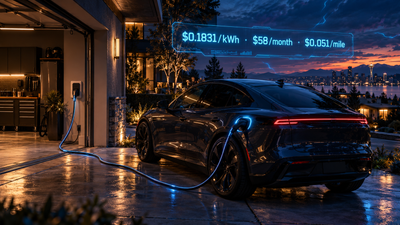
Pick a portable Level 2 charger by the circuit you'll actually plug it into, not by top-line amperage. For most single-family homeowners with an existing NEMA 14-50 outlet, a 32 A portable (7.7 kW, ~25 miles of range per hour) is enough to fully recharge overnight. If you have only an existing 30 A dryer outlet, you cap at 24 A continuous regardless of the charger. On that circuit, you need a charger whose plug matches the dryer outlet (14-30 or 10-30) OR a charger with an interchangeable-adapter design (Tesla Mobile Connector + its 14-30 adapter is a common path). The WenStorm 32 A portable has a FIXED NEMA 14-50 plug and is NOT approved for use with a dryer-outlet adapter. Installing a new EV-dedicated circuit (illustrative $500–2,500 before any utility rebate) tends to earn back its install cost for buyers with high daily miles or multiple EVs — exact break-even depends on your car, utility rate, and install cost, so treat the ranges here as illustrative, not promises.
What if you have no 240V outlet at all?
Honest answer: start with Level 1 — it's the WenStorm pick for this scenario, not a Level 2 charger with an adapter.
A standard 120V household outlet (NEMA 5-15, the three-prong outlet in every garage and most carports) is what you have when you rent, when your detached garage was never wired for 240V, or when you simply don't want to pay $500–2,500 to install an EV-dedicated circuit. On that outlet, no 32A or 48A charger will deliver its rated power — the circuit physically can't supply it.
Scope note: this is NOT a dryer-outlet workaround. A dryer outlet is 240V/30A and needs a Level 2 charger whose plug matches (14-30 or 10-30), or a charger with interchangeable adapters. The Level 1 recommendation below is for the different problem of having only a 120V outlet available.
Who this is right for: renters without a 240V outlet; drivers under ~40 miles per day; apartment residents with a parking-level 120V outlet; owners of a plug-in hybrid (small battery, replenishes overnight on 120V); households adding a second travel/backup charger for road trips. If your daily commute is longer or your car has a battery over ~75 kWh, plan for a Level 2 circuit — Level 1 won't keep up.
What Every Buying Guide Actually Compares
Read five portable EV charger buying guides and you'll walk away with the same rubric:
- Amperage. 16A, 32A, 40A, 48A. Higher = faster charging speed.
- Cable length. 16 ft to 25 ft, occasionally longer.
- Plug type. NEMA 14-50 is standard; some ship with adapter kits for 6-50, TT-30, and dryer outlets.
- Connector. J1772 (most EVs), NACS (Tesla and increasingly others).
- Smart features. App, Wi-Fi, load balancing, scheduling for time-of-use rates.
These are the specs you can put on a spreadsheet. They're the specs that fit into a comparison shortcode in a Wirecutter table. And they're the specs Amazon lets you filter by.
They're also the specs that describe how the charger performs on day one.
The Sixth Spec That Almost No Guide Publishes
Take any product listing for a portable Level 2 charger and count how many times the word "weight" appears in the technical specs. On most, it's zero. On a few, there's a single line — usually the total shipping weight, cable included.
Weight matters because a portable EV charger isn't stationary. It hangs. When you plug the NEMA end into your wall outlet and the connector end into your car, everything between those two anchor points is suspended in the air, pulling on both. Whichever end has more mass carries most of the mechanical load.
There are three places manufacturers put the electronics:
Plug-end brick. The control box mounts directly on or immediately behind the NEMA plug. Advantage: the connector at the car end stays light. Disadvantage: three to twenty-plus pounds hangs on your wall outlet whenever the charger is in use. Lectron 40A portable and older Tesla corded mobile connectors sit here. Emporia Pro ships plug-in with optional hardwire — it is often installed as a semi-permanent wall unit rather than carried as a travel charger, so grouping it with brick-style portables understates how most owners actually use it.
Mid-cable brick. The control box hangs in the middle of the cable. Advantage: neither end bears the full brick weight. Disadvantage: the cable now has a heavy pendulum that swings whenever anything moves. Some Tesla Gen 2 mobile connectors and various third-party units use this design.
Connector-integrated (handle). The electronics live inside the J1772 or NACS connector at the car end. The handle is slightly thicker than a standard connector. Advantage: once the connector plugs into the car, the car's charging inlet supports the full weight. The wall outlet carries only cable pull. Disadvantage: the connector handle is chunkier to hold.
The differences aren't cosmetic. A NEMA 14-50 receptacle is rated for continuous 40A load, but it's designed mechanically for a plug that goes in and stays in — like a dryer plug. Not a plug that has three to twenty pounds constantly torquing it downward for hours a night, seven nights a week, for five years.
The Comparison Table (Verified Specs Only)
The specs below come from manufacturer datasheets, owner's manuals, and authorized retailer listings — sourced individually. Where a manufacturer doesn't publish a weight, the table says so.
| Charger | Amps | Cable | ICCB Location | Weight | Source |
|---|---|---|---|---|---|
| WenStorm Level 2 Portable 32AOur Pick | 32A | 25 ft | Connector-integrated (J1772 / NACS handle) |
9.36 lb total; connector-integrated (no separate brick) | Product page |
| WenStorm Level 1 Portable (16A, 120V) | 16A rated / 12A continuous on standard 15A NEMA 5-15 (per NEC 625.42) | 25 ft | Connector-integrated (J1772 / NACS handle) |
5 lb total; connector-integrated (no separate brick) | Product page |
| Emporia Pro Level 2 | 48A | 25 ft | Plug-end / hardwire capable | 20.5 lb full unit | Qmerit spec sheet |
| ChargePoint Home Flex (CPH50) | Up to 50A | 23 ft | Wall unit + plug tail | 13.8 lb (6.26 kg) station + cable | ChargePoint datasheet PDF |
| Tesla Corded Mobile Connector (first-gen; discontinued) | 40A on 14-50 | 20 ft | Mid-cable brick | 5.2 lb controller / ~11 lb full assembly | Tesla owner's manual |
| Lectron Portable Level 2 (40A) | 40A | 16 ft | Plug-end brick | Not published on Lectron's site; 32A model manual lists 9.9 lb | Lectron 32A manual |
| Grizzl-E Classic | 40A | 24 ft | Wall-mounted with plug tail | 19.84 lb (9 kg) full unit | Grizzl-E product-specs page |
Two things worth noting from this table.
First, "portable" is used loosely. The Grizzl-E Classic and ChargePoint Home Flex are technically portable — they have plugs — but they're designed to be wall-mounted and left there. If you unmount them and let them hang from the outlet, you're using them in a way the mechanical design didn't anticipate. Twelve to twenty pounds of aluminum-cased electronics hanging on a NEMA plug for years is outside the design envelope of any residential-grade receptacle.
Second, the Emporia Pro's 20.5 lb figure includes the 25 ft cable. Not all of that weight bears on the receptacle. But the majority of the electronics — the relay, the controller board, the temperature sensor — is in the housing at the plug end, and that housing plus the first several feet of cable is what pulls on the outlet.
What NHTSA Has Actually Recalled
Scope note: the recalls below involved specific manufacturing defects (welded internal connections in Tesla Gen 1 NEMA adapters; receptacle-interface heating with certain lower-quality outlets). They are evidence of specific-model and installation-specific failure modes — NOT a general finding that inline control-box designs fail more than connector-integrated designs. Read each citation for what the recall actually was, not as category-level proof.
This is the part every buying guide leaves out.
Federal safety regulators track portable-EVSE failure modes through NHTSA recalls. Three matter for anyone comparison-shopping in this category.
December 2023 — Porsche recalled ~41,000 Mobile Chargers, and Audi jointly recalled ~95,000 Compact Charging Systems (NHTSA campaigns 23V-841 and 23V-842). The defect, in NHTSA's own language: "the charging cables can become hot during charging when plugged into certain types of lower quality electrical receptacles due to elevated electrical resistance at the receptacle interface." Porsche's remedy: replacement cables with a temperature sensor built into the NEMA plug.
January 2017 — Tesla recalled 6,729 mobile connector adapters (NHTSA 16E-091). The defect: "insufficient welds within the cable which can result in increased electrical resistance. Increased electrical resistance may cause overheating or arcing, increasing the risk of a fire." NEMA 14-30, 10-30, and 6-50 adapters were recalled. NEMA 14-50 was explicitly excluded.
The same root-cause language — increased electrical resistance at the plug interface causing overheating and fire — appears in a 2017 filing and a 2023 filing. Federal regulators have named this failure mode across a decade, and it always originates at the same spot: where the cable meets the wall.
Every buying guide that leaves this out is telling you how the charger performs on the day you unbox it. This is what happens across the next five years.
Before you pick a charger: existing dryer circuit vs new EV-dedicated circuit
The circuit you plug into caps how fast any portable charger can go. A 30 A dryer circuit tops out at 24 A continuous (per NEC 625.42's 80% rule) regardless of whether you buy a 32 A, 40 A, or 48 A charger. A new 50 A circuit unlocks 40 A plug-in or 48 A hardwired. The comparison below is the pre-work: decide the circuit first, then pick the matching charger. All installation costs are illustrative ranges from published US electrician-cost surveys (HomeAdvisor, Qmerit, local utility estimators) — they vary significantly by region, panel capacity, wire-run distance, and local permit fees. Get at least two quotes before committing.
| Dimension | Keep existing 30 A dryer circuit (14-30 or 10-30) | Install a new EV-dedicated circuit — 50 A for NEMA 14-50 (40 A continuous max) OR 60 A for a 48 A hardwired EVSE |
|---|---|---|
| Max continuous current | 24 A (80% of 30 A per NEC 625.42) | 40 A on 50 A circuit, or 48 A hardwired on 60 A circuit |
| Power delivered | 5.76 kW (240 V × 24 A) | 9.6 kW (40 A) or 11.5 kW (48 A) |
| Range added per hour (typical) | 18–22 miles | 30–38 miles (40 A) or 36–44 miles (48 A) |
| Hours to charge a 75 kWh pack from empty | ~13 hours (before losses) | ~7.8 hours (40 A) or ~6.5 hours (48 A) |
| Which charger spec you can actually use | Any 32 A portable with the right dryer-outlet adapter. A 40 A or 48 A unit is wasted capacity — the circuit caps you at 24 A no matter the charger. | 32 A, 40 A, or 48 A charger. Match the charger to your vehicle's onboard max for best overnight time. |
| Equipment cost (one-time) | NEMA 14-30 or 10-30 adapter: $50–75. Portable Level 2 EVSE: $220–400. Total: ~$270–475. | Portable 40 A EVSE OR 48 A hardwired unit: $400–750. Total: ~$400–750. |
| Installation cost (illustrative US ranges) | $0 if the dryer receptacle and circuit are in good condition. $100–400 if an electrician replaces the receptacle. If the existing circuit is a legacy 3-wire 10-30 outlet without a separate equipment-grounding conductor, do not bond neutral to ground at the receptacle as a retrofit — have a qualified electrician evaluate whether a compliant equipment-grounding conductor can be pulled or whether a new EV circuit is required. | $500–2,500 for a new 50 A branch circuit with short wire run and sufficient panel capacity. $2,000–4,500 if a panel upgrade (100 A → 200 A) is needed first. |
| Permit / inspection required | Not for the outlet itself. May be required if the circuit is modified. | Yes, in most US jurisdictions. Permit + inspection fee typically $100–300. |
| Can share with the dryer? | Not simultaneously. Either (a) manually unplug one when using the other, or (b) use a listed load-management splitter such as Splitvolt or NeoCharge ($400–600 added hardware). | Dedicated — no scheduling conflict. |
| Future-proofs for next EV? | Capped at 24 A regardless of the next vehicle's onboard charger. If your next car has an 11.5 kW onboard charger, half of it is unusable on this circuit. | Supports every current EV's onboard AC charger at 40–48 A. Headroom for a 2nd EV with a load-management EVSE later. |
| Best for | Low daily miles (< 40/day), apartment-adjacent garage with existing dryer outlet, renters, short-term solution, buyers who want to validate EV ownership before investing in installation. | Multi-EV household, long daily commute, frequent road trips, planning to add solar or home battery, buyer who wants charging done in 6–8 hours overnight regardless of EV model. |
How this changes which charger you buy
- If you'll stay on the dryer circuit: you need a charger whose plug matches your dryer outlet (14-30 or 10-30) OR a charger with an interchangeable-adapter design (Tesla Mobile Connector + its 14-30 adapter is a common path). The WenStorm 32 A portable has a FIXED NEMA 14-50 plug and is NOT approved for use with a dryer-outlet adapter — pick a different product if your only outlet is 14-30 or 10-30.
- If you'll install a new 50 A circuit: match the charger to your car's onboard AC charger. Most 2022+ EVs have 11.5 kW onboard chargers (48 A capable). A 32 A portable on a 50 A circuit still works — you just leave 25% of the circuit's capacity on the table.
- If you're renting or might move: default to a 32 A portable with a rich adapter kit. The dollar you save by not installing a dedicated circuit now funds a different charger later if your next place has NEMA 14-50.
How to Pick — A Decision Framework
Not everyone should optimize for the same spec. The right portable Level 2 depends on where you charge, not what a Wirecutter pick decided is universal.
If you rent
Amperage matters less than plug flexibility. You may move next year to a building with different outlets, or your current landlord may only let you use a dryer outlet on the way to the garage. Look for a charger that ships with an adapter kit (14-30, TT-30, 6-50) and has a shorter learning curve on the app. Prioritize a design that doesn't require permanent installation and doesn't stress the outlet — you don't own the receptacle, and replacing a melted one becomes a conversation with your landlord.
If you own, in a garage, with a dedicated NEMA 14-50
Amperage matters less than most guides claim, and mechanical outlet load matters more. A 32A portable running eight hours a night gets your EV to full overnight. A 40A portable does it in 25% less time — but if you're plugged in from 10 PM to 6 AM, the extra speed goes nowhere. Weight, ICCB location, and cable length become the dominant specs. If the receptacle is a five-year investment, you want a charger design that treats it that way.
If you road-trip
Cable length is the ceiling. A 16 ft cord means you're within 16 ft of the outlet, always. RV parks, Airbnbs, and hotels have outlets in weird places — behind columns, above workbenches, at the end of parking rows. Prioritize 25 ft. Also prioritize the adapter kit and NEMA 14-50 as the primary plug (RV parks universally supply this).
If you have solar or time-of-use billing
Smart-app features matter more than physical hardware. Load balancing, scheduling for cheap-rate windows, and Wi-Fi telemetry are what save the money. Amperage and weight matter less because the wall unit typically stays mounted and doesn't move.
Our Pick — WenStorm Level 2 Portable
The 32A WenStorm portable is our pick for the largest segment of buyers: single-family homeowners with a dedicated NEMA 14-50 who charge overnight. Independent of the marketing, the buyer-decision case is straightforward:
- 32A hits the overnight use case. Eight hours at 32 A delivers roughly 61 kWh at the outlet (before charging losses). Whether that fully recharges your car depends on your battery capacity and starting state of charge: a 60 kWh Chevy Bolt refills from 20% every night; a 100 kWh Model S won't fully recover from a 20% state. If you park at 10 PM and leave at 7 AM and drive < 150 miles/day, 32 A is almost always enough.
- Connector-integrated ICCB keeps the control-box weight at the car end rather than hanging from the wall outlet. Whether this measurably reduces long-term receptacle wear depends on receptacle quality, cable support, and installation — independent comparison testing would be needed to establish a safety advantage. The electronics live inside the J1772 or NACS connector handle at the car end. When plugged in, the car's inlet supports the connector handle. The wall receptacle carries only the cable pull.
- 25 ft cable. Nine feet longer than Wirecutter's Lectron pick, which is enough range to reach most NEMA 14-50 installations without a purpose-built extension.
- Compatible with J1772 and NACS. You pick which connector when ordering. No adapter juggling.
- NEMA 14-50 plug. Standard on RV parks and most EV-ready homes.
- 4.91-star average across 23 owner reviews as of publication.
At $219.99, it isn't the cheapest 32A portable. It's within $40 of Lectron's Wirecutter pick, and below Tesla's Gen 2 Mobile Connector after Tesla unbundled it from new-car accessories. The spec that justifies the delta is the one no other manufacturer at this price point offers: electronics off the wall outlet entirely.
When a Different Brand Fits Better
The WenStorm 32A isn't the right answer for every buyer. In practice, buyers face these edge cases:
You need 48A hardwired and you own the panel work. The Emporia Pro at 48A is a legitimate step up if you have a heat pump-scale panel and want the fastest possible overnight refill. Two years from now this decision looks different if J3400 charging speeds normalize, but today, 48A wins on speed if you're not amperage-limited by your panel.
You already own the Tesla ecosystem and want NACS-native support at every Supercharger. Tesla's Gen 2 Mobile Connector (verify current price at shop.tesla.com — Tesla's standalone price has moved between $230 and $300 since the 2022 unbundling) gets you first-class integration with Tesla's app, the widest adapter kit (14-30, 10-30, 6-50, and 5-15 all sold separately), and no third-party firmware risk. Its plug-end assembly is approximately 3 lb per Tesla's published specification; the full cable plus adapter adds mass at the outlet.
You want a permanently wall-mounted setup with Wi-Fi analytics. ChargePoint Home Flex or Grizzl-E Classic makes more sense here than any portable. Both are engineered to be mounted, not carried, and both are legitimately good products in that configuration. The "portable" label on these units is loose.
The market reality is that no single portable EV charger is best for every buyer. What matters is knowing which spec you're actually optimizing for, and which one you're accidentally underweighting.
Frequently Asked Questions
Is a 32A portable enough for my EV?
For overnight home charging, yes for nearly all mainstream EVs. 32A on a 240V circuit delivers 7.7 kW. Over eight hours that's ~62 kWh, which puts roughly 200-240 miles of range on most EVs. If you drive under 100 miles a day and park overnight, 32A is more than enough. The main case for stepping up to 40A or 48A is if you have short parking windows (evening errands, then out again) or if you want same-hour top-ups.
NEMA 14-50 vs 6-50 for portable charging?
Electrically identical for EV charging — both deliver 240V at 40A continuous. NEMA 14-50 has four prongs (two hots, neutral, ground); 6-50 has three (two hots, ground, no neutral). NEMA 14-50 is more common because it's also the standard RV park outlet, so portable chargers ship with 14-50 plugs by default. Use 6-50 if your charger requires it or if you're specifically installing to a welder-outlet-compatible circuit.
Do I need J1772 or NACS in 2026?
Depends on your car. Tesla owners: NACS. Ford, Rivian, Kia, Hyundai, and Chevy owners: check your model year. Every major manufacturer has committed to NACS for 2025-model-year vehicles or later, but J1772 is still what most current-generation non-Tesla EVs actually accept without an adapter. If you're buying today for a 2024 or earlier non-Tesla EV, J1772 is the native connector. Any charger sold as "J1772 or NACS" (like WenStorm's) lets you pick at order time, which future-proofs across a trade-in.
Can I use a portable charger in the rain?
WenStorm's charger is IP55 (dust-protected, protected against water jets). Weather protection and required GFCI protection are separate concerns, not interchangeable alternatives — don't rely on an IP rating to replace proper outdoor installation practices. rating on the connector and IP55 or better on the control unit. Most reputable portable Level 2 chargers meet at least IP55, which handles rain but not submersion. Never charge in standing water. The NEMA 14-50 outlet itself needs to be in a covered location or GFCI-protected — code (NEC 210.8(A)(11)) requires GFCI on garage and outdoor 240V circuits.
How long does a portable EV charger last?
The electronics themselves typically outlast the car — most 32A portables carry two-to-three-year warranties and last five to seven years in practice. The failure surface isn't the charger's control board. It's the interface between the NEMA plug and the wall receptacle, which degrades faster on any design that hangs weight on the plug. If you use a 40A charger nightly on a residential-grade Leviton 14-50, expect to inspect and potentially replace the receptacle inside five years. On an industrial-grade Hubbell HBL9450A paired with a car-end weight design, expect the receptacle to outlast the charger.
Independent of the marketing, portable Level 2 charging in 2026 is a mature category with real design differences between products. Amperage differences of 8A or 16A cost you 30 minutes of charging time and get most of the buying-guide attention. Weight and ICCB location cost you a receptacle or a house call from your electrician, and get almost none.
Read the spec sheet. Look at the product photos. If you can see a heavy control box hanging on the NEMA plug, you're buying a maintenance liability. If you can't, ask where the electronics live and whether they've been moved off the outlet end.