How Much Does It Cost to Charge an Electric Car in 2026?

TL;DR
Example estimate: a Tesla Model 3 driver covering 13,500 mi/year at the July 2026 U.S. average residential rate of $0.183/kWh pays about $51/month, or $0.046/mile, for 100% home charging. Public DC fast rates are typically 1.5-2× the residential rate depending on operator, plan and location. Your actual cost depends on your utility rate, EV efficiency, and how much you charge on the road — enter your own numbers in the calculator below.
What does it cost the average American to charge an EV each month?
There is no single national number — cost varies widely by state electricity rate, EV efficiency, and how often you charge in public. The estimate below is one worked example, not a claim about typical spending.
Example: Tesla Model 3 Long Range (EPA-rated 132 MPGe combined), 13,500 miles/year, U.S. average residential rate of $0.183/kWh (EIA, July 2026):
- Daily miles: 37 (13,500 ÷ 365)
- Daily energy from outlet: ~10.4 kWh (37 mi at EPA-rated 28 kWh/100 mi, which already includes charging losses)
- Daily cost: $1.90 (10.4 × $0.183)
- Monthly cost: ~$58 at 100% home charging
The same driver in a 30 mpg gasoline car at $3.10/gal pays about $116/month (13,500 mi ÷ 30 mpg × $3.10 ÷ 12 months). At $4.50/gal the gas cost is $169/month ($4.50 × 450 gal ÷ 12).
Whether the EV wins depends on your specific state rate, your public-charging mix, and the price of gasoline where you live. Enter your own inputs below.
EV charging cost calculator (Tesla, Ford, Hyundai, Chevy, VW, Rivian and more)
Enter your EV, state residential rate, public-charging rate, and driving habits. All rates are editable — the presets are examples, not guarantees.
EV cost vs gas comparison updates as you adjust inputs.
EPA kWh/100mi values include AC-to-DC charging losses (energy from outlet, not battery). Actual bill may still vary with weather, TOU tiers, taxes and delivery charges.
Vehicle presets use EPA Fuel Economy label values (EPA MPGe + kWh/100mi), which measure energy drawn from the wall — the number you're billed for. Battery capacity is manufacturer usable kWh, not gross. Public rate presets are examples; check Electrify America, EVgo, and Tesla's Supercharger app for rates at specific stations. Membership, session, idle and per-minute fees may apply separately.
Home vs public: example rates and what they mean per mile
Public charging typically costs more per kWh than residential electricity, but the gap depends on operator, plan, location, and time of day. The table below uses example rates — enter your actual numbers in the calculator for a real comparison.
| Option (example) | Example rate | Example 75 kWh outlet-draw | Example $/mi (Model 3, 28 kWh/100mi) |
|---|---|---|---|
| Home standard rate (U.S. avg) | $0.183/kWh | $13.72 | $0.051 |
| Home TOU off-peak (example) | $0.09-$0.13/kWh | $6.75-$9.75 | $0.025-$0.036 |
| Public Level 2 (typical range) | $0.20-$0.35/kWh | $15-$26.25 | $0.056-$0.098 |
| Public DC fast (typical range) | $0.25-$0.55/kWh | $18.75-$41.25 | $0.070-$0.154 |
Operators' actual pricing depends on the individual station, membership plan, and (for some networks) time of day. Idle fees, per-minute fees, and session fees may apply on top of the per-kWh rate. Check each operator's own pricing page for the station you plan to use.
Home Level 1 and Level 2 draw from the same meter — both are billed at your residential rate. The difference is speed (Level 1 adds roughly 3-5 mi/hr, Level 2 adds roughly 20-30 mi/hr depending on the circuit and vehicle), not price per kWh.
Cost to charge by state (EIA July 2026 residential rates)
State electricity rates vary widely. The table below uses the U.S. Energy Information Administration's Electric Power Monthly, July 2026 data (released September 24, 2026). All figures are residential-sector averages — your specific utility, delivery charges, taxes and rate plan may differ.
| Location | Rate ($/kWh) | Example: 75 kWh at home | Example: Model 3 monthly (13,500 mi/yr, 100% home) |
|---|---|---|---|
| Louisiana | $0.1272 | $9.54 | $40 |
| Texas | $0.1588 | $11.91 | $50 |
| U.S. average | $0.1831 | $13.73 | $58 |
| Hawaii | $0.4800 | $36.00 | $152 |
For your specific state, look up the current month's rate at the EIA Electric Power Monthly, Table 5.6.A, then enter it in the calculator above. Rates change month-to-month, and utility-specific rates within a state can vary from the state average.
Monthly cost columns assume 100% home charging using the Model 3 EPA figure (28 kWh/100mi outlet draw); a less efficient vehicle or higher share of public charging will raise the number, off-peak TOU rates can lower it.
Cost by EV model (75 kWh outlet-drawn energy at U.S. average rate)
| Model (year · trim) | Usable battery (kWh) | EPA kWh/100mi (outlet) | $ per mile at $0.183/kWh |
|---|---|---|---|
| 2023 Chevy Bolt EUV | 65 | 29 | $0.053 |
| 2024 Tesla Model 3 LR | 75 | 28 | $0.051 |
| 2024 Hyundai Ioniq 5 RWD LR | 77.4 | 30 | $0.055 |
| 2024 Kia EV6 RWD LR | 77.4 | 29 | $0.053 |
| 2024 Tesla Model Y LR AWD | 79 | 28 | $0.051 |
| 2024 VW ID.4 Pro RWD | 82 | 32 | $0.059 |
| 2024 Ford Mustang Mach-E ER RWD | 91 | 36 | $0.066 |
| 2024 Ford F-150 Lightning ER | 131 | 49 | $0.090 |
| 2024 Rivian R1T Dual Motor | 135 | 48 | $0.088 |
Efficiency (kWh/100mi) drives per-mile cost more than battery size. All values are EPA-rated combined figures — energy drawn from the wall, which already includes AC-to-DC charging losses. Real-world consumption is often 10-20% higher in cold weather, at highway speeds, or with heavy loads.
How to reduce your EV charging cost
Three practical levers, in order of typical impact:
1. Check if your utility offers an EV-specific TOU plan. Some utilities offer time-of-use plans with lower overnight rates (roughly $0.09-$0.13/kWh in several service areas). Availability, savings and enrollment rules vary — call your utility or check its rate schedule. If offered, scheduling your charge for the off-peak window lowers monthly cost. If your utility does not offer an EV TOU plan, this lever does not apply.
2. Charge at home when you can. Public per-kWh rates are typically higher than residential rates, and idle/session fees can add cost on top. If you rely on public networks by default, even a small shift toward home charging lowers the monthly total.
3. Match the charging hardware to your actual outlet and driving pattern. The right approach depends on what's already at your home:
- If you have a suitable existing 120V outlet and drive under your daily energy replacement threshold: a Level 1 portable charger may cover it without any electrical work. Rough rule: a standard 120V/15A circuit delivers ~1.4 kW, or roughly 10-11 kWh in a 10-hour overnight window (enough for many commutes, insufficient for heavy daily mileage or short parking windows).
- If you have a suitable existing 240V/50A outlet (NEMA 14-50) in the garage: a Level 2 portable charger plugs into that outlet and delivers ~7.2 kW without a hardwired wall unit. No electrician visit needed for the charger install itself — but the existing outlet should be inspected to confirm it can carry a continuous 32A load.
- If you have no suitable existing outlet: budget separately for the electrical work. Panel capacity, wire run length, and permitting all affect the total. Get 2-3 quotes.
Whichever route you take, the monthly electricity cost (calculated above) is separate from the one-time equipment and install cost. Compare them separately when deciding what to buy.
What about the federal EV tax credit and charger credit?
Both federal incentives ended in 2025 and 2026:
- Federal new-EV tax credit (up to $7,500): expired September 30, 2025. New EV purchases after this date do not qualify at the federal level.
- Federal home charger credit (§30C, 30% up to $1,000): expired June 30, 2026. Charger installations completed after this date do not qualify at the federal level.
Some state incentives and utility rebates for Level 2 chargers may still be available. Check your state energy office and your utility's rebate page for current programs — availability and amounts vary by jurisdiction.
Frequently asked questions
How much does it cost to fully charge a Tesla Model Y in 2026?
Example: about $14.46 for a 79 kWh charge at the U.S. average residential rate of $0.183/kWh (EIA, July 2026). At Louisiana's $0.1272 the same charge is ~$10.05; at Hawaii's $0.4800 it's ~$37.92. Your specific rate is on your utility bill.
Is it cheaper to charge an EV at home or at a public station?
Home is typically cheaper per kWh than public DC fast, but the size of the gap depends on your utility rate and the specific station. In high-rate residential markets (Hawaii, parts of California, Massachusetts, Connecticut), home electricity can approach or exceed some public per-kWh rates. Look up both numbers for your situation before assuming home always wins.
How much does it cost to install a Level 2 home charger?
Ranges reported by homeowners typically fall between $500 and $3,000+ total (hardware plus installation), depending on panel capacity, wire run length, permit requirements, and local labor rates. Get 2-3 quotes. The federal §30C credit for installations expired June 30, 2026; some utility rebates may still be available.
Can I skip the Level 2 install and just use a standard outlet?
Possibly, if three things line up: your daily energy replacement need is low enough that Level 1's ~1.4 kW delivery covers it overnight, you have a suitable dedicated 120V outlet available at your parking spot, and you don't need occasional fast top-ups. A Level 1 portable charger like the WenStorm NEMA 5-15 plugs into that outlet directly. If any of those conditions doesn't hold, budget for Level 2 or public charging.
How much does public DC fast charging cost per kWh?
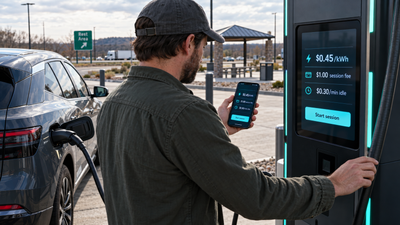
Rates depend on operator, plan, location, and (on some networks) time of day. Recent examples: Electrify America publishes different per-kWh rates for guest vs Pass+ members and by station; EVgo publishes different member and pay-as-you-go rates. Tesla Superchargers charge different rates for owners vs non-owners, and rates vary by station and time. Check the operator's app or pricing page for the station you plan to use. Idle fees, session fees, and per-minute fees may apply on top of the per-kWh rate.
Does charging speed affect cost?
Sometimes. The per-kWh charge is what you pay for the energy delivered, so a full charge at the same $/kWh costs the same whether it takes 45 minutes at DC fast or 8 hours at Level 2. But three effects can make faster charging cost more per session: some networks bill per-minute in addition to per-kWh; idle fees kick in if you leave the vehicle connected past the taper; and faster charging tends to have slightly higher AC-to-DC conversion losses. For a strict per-kWh comparison, check the operator's fee schedule.
How is EV charging cost calculated?
Simplest formula for monthly cost: (daily miles ÷ vehicle mi/kWh) × $/kWh × 30.42. Or if you have EPA kWh/100mi: (daily miles × kWh-per-100mi ÷ 100) × $/kWh × 30.42. The calculator above uses the second version because EPA kWh/100mi is billed energy from the outlet — already includes charging losses.
About this guide
Written by Marcus Chen, WenStorm's EV cost & practicality lead. Electricity rates in the state table and TL;DR are from the U.S. Energy Information Administration Electric Power Monthly, July 2026 (released September 24, 2026). Vehicle presets use EPA Fuel Economy label values (MPGe and kWh/100mi). Public charging pricing information references the operators' own pricing pages: Electrify America, EVgo, and Tesla Supercharger rates in the Tesla app. All specific dollar figures in the article body are worked examples using the assumptions stated near each figure — your actual costs will depend on your utility rate, EV, driving habits, and public-charging mix. Enter your own numbers in the calculator for a personalized estimate.
Real questions from EV owners
Join the General EV Talk discussion →