NEMA 14-50 vs 6-50 for EV Charging: The Verified 2026 Comparison

By Nathan Park — WenStorm
Ask an electrician "which outlet do I need for EV charging" and you'll get one of two answers. Ask r/evcharging the same question and you'll get 50 answers, split roughly evenly between "14-50 obviously" and "6-50 is fine and simpler." Neither camp is exactly wrong. Both are missing the piece of the picture that actually decides the question.
The market reality is that both outlets deliver 240V at 40A continuous — the electrical spec is identical for EV charging purposes. The difference isn't in the electrical performance. It's in the wire count, the contact count, the standardization economics, and — importantly — the federal regulatory record. Only one of the two has a documented recall history for the exact failure mode EV charging exposes.
Below: what's identical between the two, what's actually different, and the buyer-decision framework that gets you to a defensible answer instead of a Reddit flame war.
The Two-Second Answer, and Why It's Not the Whole Story
For most residential EV charging installations, NEMA 14-50 is the right answer. That's the two-second version. It's what every portable EV charger sold in North America ships with. It's what RV parks universally supply. It's what your future range or dryer might also plug into.
But "right answer" and "only defensible answer" aren't the same thing. NEMA 6-50 works for EV charging and works well when the specific scenario justifies it. The failure mode people worry about — outlet degradation under sustained EV load — is real for both outlets under some conditions and neither under other conditions. Which conditions apply depends on what's plugged into the outlet at the car end, not what the outlet itself is.
What's Identical Between the Two Outlets
Before the differences, the parts nobody argues about:
- Voltage: Both deliver 240V AC.
- Continuous current: Both rated for 40A continuous (on a 50A circuit, following the NEC 625.42 80% rule for continuous loads).
- Wire gauge required: Both need 6 AWG copper for standard runs, 4 AWG for long runs or aluminum wire.
- Breaker: Both use a 50A double-pole breaker.
- GFCI requirement: Both require GFCI protection when installed in a garage or outdoors per NEC 210.8(A)(11).
- Torque spec: Both require the same torque values on the terminal connections (typically 25-35 in-lb depending on the specific receptacle brand).
- Install cost: Effectively identical. The labour is the same. The wire is the same. Only the receptacle brand differs by a few dollars.
If you strip out the wire count and the receptacle body, these two outlets are electrically indistinguishable for EV charging. Any owner claiming a 14-50 charges faster than a 6-50 (or vice versa) is measuring something other than the outlet.
What's Actually Different
Four things.
Wire count — 4 vs 3
NEMA 14-50 is a four-wire receptacle: two hots, one neutral, one ground. NEMA 6-50 is three-wire: two hots, one ground, no neutral.
For EV charging specifically, the neutral wire is unused. Modern J1772 and NACS chargers are pure 240V — they use both hot legs and the ground, but not the neutral. Whether the neutral is present or not doesn't affect charging.
Where the neutral matters is future-proofing. If you ever want to convert the circuit to a different appliance — an electric range (needs neutral), a modern dryer (needs neutral), a subpanel (needs neutral) — the 14-50's neutral is already there. The 6-50 requires pulling a new wire.
Contact count — 4 vs 3
This is where the honest comparison starts diverging from the marketing.
A NEMA 14-50 receptacle has four internal metal contacts that make continuous conductive contact with the plug prongs during operation. A 6-50 has three. The current path splits across those contacts.
Under a continuous 40A load, the 14-50 distributes 40A across two hot contacts (20A per contact). The 6-50 also distributes 40A across two hot contacts (20A per contact). So far identical.
Where it becomes different is under mechanical strain. If a heavy plug-mounted charger is hanging off the receptacle — creating a lateral force that shifts the plug body a millimetre or two off-axis — the contact area between the plug blade and the receptacle terminal changes. When contact area decreases, resistance at that point increases. When resistance increases under continuous current, heat concentrates at the reduced-contact spot.
The 14-50's four-contact geometry provides slightly more geometric redundancy against this failure mode. The 6-50's three-contact geometry has less. Neither is inherently unsafe — both work fine under design conditions — but the 6-50 has less mechanical tolerance for the specific failure mode that plagues heavy plug-mounted portable chargers.
Standardization — 14-50 dominates
NEMA 14-50 is the default across:
- Every portable EV charger sold in North America (all ship with 14-50 plugs)
- Every RV park hookup (universal 14-50)
- Most newer electric-range installations
- Most modern dryer installations that use the four-wire configuration
NEMA 6-50 is the default for:
- Legacy welder outlets (pre-1996 industrial workshops)
- Some older stationary EV charging installations where the original electrician didn't know EV chargers had standardized on 14-50
- Custom installs where the wire budget was tight (one less conductor to pull)
Practical implication: an EV charger you buy today will ship with a 14-50 plug. To use it on a 6-50, you need either a 6-50-to-14-50 adapter (available but not universally UL-listed for continuous EV loads) or a new receptacle in 14-50 config.
The regulatory record — not a draw
Here's the piece almost no comparison guide includes.
In January 2017, Tesla recalled 6,729 mobile connector adapters under NHTSA campaign 16E-091. The recalled adapters covered three plug configurations: NEMA 14-30, NEMA 10-30, and NEMA 6-50. NEMA 14-50 was explicitly excluded from the recall.
The NHTSA defect language is worth quoting verbatim: "The affected adapters may have insufficient welds within the cable which can result in increased electrical resistance. Increased electrical resistance may cause overheating or arcing, increasing the risk of a fire."
Independent of the marketing, this is federal-record evidence that NEMA 6-50 adapters have been recalled for the exact failure mode this article is about, and NEMA 14-50 adapters have not. Two incidents triggered the 2017 recall. There have been no comparable recalls for 14-50 in the intervening decade.
This doesn't make the 6-50 categorically unsafe. It does make the buyer-decision math easier: the outlet variant with zero recall history and the outlet variant with a documented recall history are not carrying the same regulatory weight.
The Contact-Count Physics Nobody Publishes
To be direct about the math.
Under normal seated conditions with both outlets in factory-new condition, the difference between 4 contacts and 3 contacts is essentially zero. Both handle 40A continuous fine. Both meet UL specifications. Both survive their warranty period without incident.
Under the failure mode that shows up years into ownership — receptacle contacts have loosened slightly from thermal cycling, plug is off-axis from the weight of a heavy control box, contact area has decreased — the difference matters.
Imagine the same charger causing the same lateral shift on both outlets. The plug displacement is identical, say 1 mm. The contact area lost is proportional to the displacement, and the concentration of current onto the remaining contact area is where heat accumulates.
On a 14-50, that displacement affects some fraction of four contact points. On a 6-50, it affects some fraction of three. The per-contact stress and per-contact heat concentration is higher on the 6-50.
The math doesn't say 6-50 is unsafe. It says 6-50 has less redundancy against the mechanical failure mode that plug-mounted chargers create. Which brings us to the design choice that changes the equation on both outlets.
When 6-50 Actually Makes Sense
Three scenarios where 6-50 is the honest recommendation.
You're retrofitting an existing welder outlet. If the shop already has a 6-50 wired to a 50A breaker on 6 AWG copper, use it. Don't tear out working infrastructure to conform to a spec preference. The 6-50 will charge your EV. The regulatory record is a statistical concern, not an immediate one.
Extremely long wire run and wire cost matters. On a 100-foot-plus run through a difficult path, saving one conductor's worth of copper wire adds up. If your electrician quotes materially cheaper for 6-50 vs 14-50 on the same install, and the labour savings are real, the 6-50 is a defensible choice.
You're certain the circuit will never be repurposed. If the outlet is in a dedicated EV charging closet or garage bay that will never host a range, dryer, or subpanel, the neutral wire is genuinely surplus. Skip it.
In every other scenario — median residential install, first-time EV charging setup, general-purpose 240V outlet in a garage — the 14-50 is the answer.
When 14-50 Is the Answer (Which Is Almost Always)
Default for a reason. Ships with every portable EV charger. Compatible with every RV park. Future-proof for any 240V appliance. Zero recall history for continuous EV loads. Costs $5-10 more in the receptacle body — a rounding error against install labour.
Practical recommendation: if you're specifying a new install for EV charging with any ambiguity about future use, install 14-50. If you're specifying a retrofit of an existing 6-50, keep the 6-50 and buy a UL-listed 6-50-to-14-50 adapter for chargers that ship with a 14-50 plug. If you're specifying a permanent hardwired EV wall unit, the plug question goes away entirely.
The Charger Design That Makes Both Outlets Last Longer
Two years from now this decision looks different if the failure mode we've been discussing — heavy plug-mounted brick chargers creating lateral force on the receptacle — gets designed out of the mainstream portable charger market. In practice, this is already happening on the portable side.
WenStorm's design integrates the electronics into the J1772 or NACS connector handle at the car end. No control box hangs on the wall outlet. Once the connector plugs into the car, the vehicle's charging inlet supports the weight of the smart handle. The wall receptacle carries only the cable's own weight — usually under 1 inch-pound of lateral torque, versus 24+ inch-pounds for wall-brick designs.
This changes the outlet-choice question. On a car-end-weighted portable charger, the 6-50's fewer contact points still matters in theory, but the mechanical strain that amplifies the difference is essentially removed. Both outlets are dramatically less stressed. The 14-50's advantage over 6-50 narrows to just the statistical recall history and the standardization convenience.
In practice, buyers face the same recommendation either way: install a 14-50 unless you have a specific reason not to. But if your charger design keeps the electronics off the wall, either outlet is going to outlast the car.
Our Pick — For Either Outlet
Frequently Asked Questions
Is 6-50 actually unsafe for EV charging?
No. NEMA 6-50 is a code-compliant option for EV charging on a 50A circuit. What it is is a slightly less redundant option under the specific failure mode of heavy plug-mounted chargers creating lateral force on the receptacle. Tesla recalled 6,729 6-50 (and 14-30, 10-30) adapters in 2017 for increased-resistance-related overheating, and 14-50 was excluded from that recall. That's not the same as "unsafe" — it's "less regulatory-clean track record for the specific application."
Do I really need the neutral wire for EV charging?
No. Modern J1772 and NACS EV chargers don't use the neutral. They're pure 240V devices, drawing from the two hot legs and grounding to the safety ground. The neutral wire in a NEMA 14-50 is future-proofing for other appliances (electric range, modern dryer, subpanel) that do need it. If you're certain the outlet will only ever be used for EV charging, the neutral is surplus.
Can I use a 14-50 to 6-50 adapter?
Yes, provided it's UL-listed for continuous EV loads. Not every adapter sold online is. Look specifically for UL 2251 or UL 2252 certification on the adapter body. Cheap unlisted adapters bypass the safety testing that ensures the internal ground bond is correct. In practice, most portable EV chargers ship with 14-50 plugs, so an adapter is only relevant if you're plugging into a legacy 6-50 installation.
Which is cheaper to install?
Essentially identical. The receptacle body itself differs by $5-10 (14-50 slightly more expensive because more terminals). Labour is the same. Wire is the same in gauge, but 14-50 requires one additional conductor, which on a 50-foot run is another $10-20 in copper. Total delta: usually under $30 on a typical residential install. Not the deciding factor.
What about NEMA 14-30 vs 14-50?
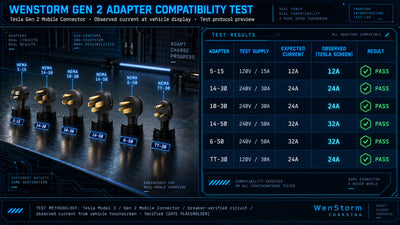
Different question. NEMA 14-30 is a 30A circuit — designed for a dryer, not for continuous 40A EV charging. You can charge from a 14-30 at 24A continuous (80% of 30A) via an adapter, delivering roughly 5.5 kW. That's slower than a 14-50 (40A/9.6 kW), but faster than a Level 1 wall outlet. If your only 240V circuit is a dryer 14-30, it's a workable option. If you're installing new, 14-50 is the answer.
Independent of the marketing, the buyer-decision on 14-50 vs 6-50 collapses to a few facts. Both deliver identical electrical performance for EV charging. Only one has a clean federal recall history for continuous EV loads. Both have code-compliant use cases; 14-50 is the default and 6-50 is the specific-scenario alternative. The physics of contact count matters only under mechanical strain from a plug-mounted charger — which is a solvable problem with the charger design, not the outlet.
Two years from now this decision looks different if the mainstream portable charger market converges on car-end weight designs and the plug-mounted brick becomes rare. For today, the honest recommendation is: install 14-50 if you're specifying new, keep 6-50 if you're retrofitting, and pair either outlet with a charger that doesn't hang its electronics off the wall.