Apartment EV Charging in 2026: Renters, Condos, and Shared Garages
Renters, condo owners, shared garages: which outlets are safe, how to get landlord approval, what right-to-charge laws actually protect, and 2026 costs.

Direct answer: Apartment EV charging is practical when you have permission to use a suitable outlet near your parking space and a written arrangement for paying for the electricity. A Level 1 charger on a compatible 120V circuit typically adds about 2–5 miles of range per hour. If an approved 240V outlet is available, portable Level 2 charging can replenish the same daily driving in fewer hours. Renters should confirm outlet condition, circuit capacity, cable routing, and building approval before charging.
What this guide covers
- Is apartment EV charging even possible for you?
- The three parking situations that decide everything
- What outlets exist in your building (and which you can actually use)
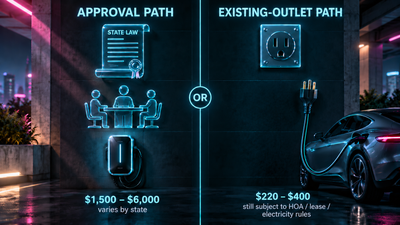
- Getting landlord or HOA approval
- Level 1 vs portable Level 2 in an apartment context
- Cable routing, extension cords, and shared-outlet safety
- Who pays for the electricity — attribution, metering, cost sharing
- Backup: workplace charging, public Level 2, DC fast
- Signing (or renewing) a lease as an EV driver
- Right-to-charge laws and where they exist
- When apartment charging is not yet workable
- WenStorm apartment kits and portable options
- Frequently asked questions
Related reading: our general EV ownership guide covers the broader ownership picture (costs, insurance, battery care, incentives), and our step-by-step charging setup for renters walks through the practical build for a specific unit. If you have a shared or two-household charging situation, our sharing an EV charger with a neighbor guide covers the cable, metering, and etiquette details.
1. Is apartment EV charging even possible for you?
Before comparing chargers or drafting an HOA proposal, three questions decide whether apartment EV ownership is realistic in your specific unit.
Do you have consistent access to any outlet within reasonable cable reach of your parked vehicle? A dedicated 120V outlet at your assigned spot changes everything. Access to nothing but the wall of your unit two floors above the garage changes everything in the other direction. This is the single most important question. If the answer is no, and your building has no plan to add EV infrastructure in the next year or two, the honest recommendation is often to defer the EV purchase until the parking situation changes.
Do you have authority (or a reasonable path to authority) to use that outlet? An outlet in the shared garage is not always yours to plug into. Common-area electricity is usually billed to the building and paid for by everyone through rent, condo fees, or HOA dues. Using a common-area outlet without permission may be considered unauthorized electricity use and could violate the lease, HOA rules, or building policies. Obtain written approval and agree on how the electricity will be measured and reimbursed.
Do you drive a distance the available outlet can actually replenish? A Level 1 outlet adds approximately 2–5 miles of range per hour of charging per the US Department of Energy's Alternative Fuels Data Center. A ten-hour overnight window on a compliant 15A dedicated circuit adds roughly 20–50 miles depending on vehicle and conditions. If your realistic daily driving is well within that recovery, you have a workable Level 1 setup. If not, you need Level 2, a longer connected window, or a backup charging plan for high-mileage days.
These are the questions any apartment EV owner needs to answer honestly before signing a purchase agreement. The vehicle can be beautiful; the ownership can still be miserable if the answers are no.
2. The three parking situations that decide everything
Every apartment charging scenario reduces to one of three physical parking realities. The right setup is different for each.
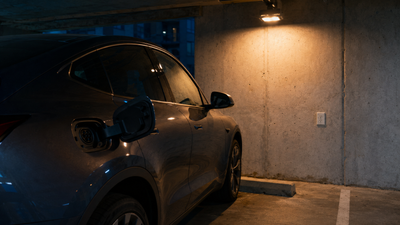
Assigned dedicated spot in a covered garage or lot
The most workable scenario. The building has assigned your unit a specific parking space, and that space either already has a nearby outlet or has visible conduit / electrical infrastructure that suggests one can be added. In this case, the conversation with the landlord or HOA is about (a) whether an existing outlet is safe and approved to use, or (b) whether a new dedicated circuit can be installed and how the cost and the ongoing electricity is billed. This is the situation where a portable Level 2 EVSE on a 240V outlet, or an approved hardwired install if the building is willing, gives you the closest thing to a homeowner's charging experience.
Shared garage without assigned charging access
You park in the building's garage but you do not have a dedicated spot or a dedicated outlet. Any outlet you plug into is shared with other residents or with common-area needs (elevator lighting, cleaning equipment, HVAC service outlets). This is the scenario where landlord or HOA approval matters most, where cable routing across common walkways becomes a safety and liability question, and where the answer often ends up being some combination of Level 1 in an approved outlet plus supplementary workplace or public charging.
Street parking or uncovered lot with no outlet
The hardest scenario. There is no outlet at your parking spot and no realistic path to add one in the near term. Your charging strategy is either (a) a workplace or destination charging setup where you spend your working hours, (b) frequent public Level 2 or DC fast charging on a route you drive anyway, or (c) waiting until your parking situation changes. Some jurisdictions permit outdoor curbside EV charging infrastructure, but the timeline for widespread residential deployment is years, not months.
3. What outlets exist in your building (and which you can actually use)
A walkthrough of your building's parking and utility areas often surfaces more outlets than you'd expect. The question is whether each one is suitable, whether it is on a circuit you're allowed to draw from, and whether it is code-compliant for continuous EV load.
Common US residential and shared-space outlet types and their maximum continuous EV charging amperage under NEC 210.19(A)(1) and 210.20(A) 80% continuous-load rules:
| Outlet | Voltage | Branch circuit | Max continuous EV charging |
|---|---|---|---|
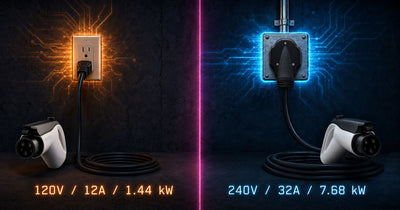
| NEMA 5-15 (standard household) | 120V | 15A | 12A / ~1.4 kW |
| NEMA 5-20 | 120V | 20A | 16A / ~1.9 kW |
| NEMA TT-30 (RV, some shared garages) | 120V | 30A | 24A / ~2.9 kW |
| NEMA 14-30 (four-prong dryer outlet) | 240V | 30A | 24A / ~5.8 kW |
| NEMA 14-50 (rare in apartments — RV/range outlet) | 240V | 50A | 40A / ~9.6 kW |
Several apartment-specific caveats matter here:
- Old or shared 120V outlets are not automatically safe for continuous 12A EV loads. If an outlet has been powering vacuum cleaners and holiday lights for 40 years, that does not certify it for eight hours of continuous 12A draw every night. Ask building maintenance or a licensed electrician to inspect before nightly use.
- A tripping GFCI must not be bypassed. Garage and outdoor receptacles are commonly required to have GFCI protection under locally adopted electrical codes. If charging repeatedly trips a GFCI device, stop charging and contact the EVSE manufacturer. Have the receptacle and branch circuit evaluated by a qualified electrician before trying again. The electrician and property owner can determine whether the EVSE, receptacle, circuit, or installation needs to be changed.
- Aluminum-conductor wiring is common in US buildings constructed 1965–1975 and requires torque-checked terminations for continuous EV loads. If your building predates 1975, ask maintenance whether the branch circuit is copper or aluminum before nightly Level 1 or Level 2 use.
- Shared outlets on common-area circuits may be sized for occasional low-draw uses (janitorial equipment, seasonal lighting). Continuous 12–16A EV draw on a circuit shared with other loads can trip the breaker at the panel and inconvenience other residents. Confirm branch-circuit dedication before assuming you can draw continuously.
Your landlord, HOA, or building manager may not know the specific answers. A one-visit inspection by a licensed electrician (often $150–$300) gives you documented answers, and the paperwork itself is often what makes the landlord conversation more productive.
4. Getting landlord or HOA approval
This is the single largest obstacle to apartment EV charging, and it is more often solvable than most first-time EV drivers assume. The failure mode is asking the wrong question of the wrong person in the wrong format.
What to ask for
Do not lead with "can I install a Level 2 charger." Lead with a specific, narrowly scoped request: "Can I use the existing outlet at parking spot 47 for overnight EV charging, on the understanding that I pay for the electricity via [proposed metering method]?" This is a request the landlord or HOA can answer without commissioning an electrical study.
Broader requests — a new dedicated circuit, a hardwired EVSE, a wall-mounted unit in a shared area — need a proposal document, not a verbal conversation. See below.
Building the proposal
An HOA or landlord proposal that actually gets approved usually contains, at minimum:
- The specific outlet or circuit you want to use, or the specific new install you're requesting (with the panel location, circuit ampacity, and proposed EVSE model)
- A written estimate from a licensed electrician for any new install work, including the electrician's insurance and licensing verification
- A proposed method for metering or estimating your electricity usage, and a mechanism for reimbursing the building (see Section 7)
- Any insurance, indemnity, or liability documentation required by the property owner, HOA, state law, or building insurer — review these terms carefully before agreeing to assume additional liability
- A commitment to keep charging equipment inside your assigned parking area and to remove all portable equipment at move-out
- A note on your renter's or condo insurance policy showing that EV charging equipment is covered
Most landlord and HOA denials are actually risk-aversion decisions — the decision-maker does not want to be blamed for a fire, an electrical incident, or a common-area cable trip hazard. A proposal that visibly answers those specific concerns (licensed electrician, insurance, indemnity, clean cable routing) removes most of the actual objection.
When to escalate to a lawyer
If your building denies a reasonable, well-scoped request and you live in a state with a right-to-charge law (see Section 10), it may be worth a paid consultation with a local landlord-tenant attorney before either accepting the denial or escalating. In right-to-charge states, some categories of blanket denial are legally challengeable; the specifics depend on your jurisdiction and lease.
5. Level 1 vs portable Level 2 in an apartment context
For apartments, the Level 1 vs Level 2 question is different than it is for homeowners. The homeowner picks the tier that matches their driving; the apartment dweller often picks the tier that the building will actually approve and safely support.
Level 1 on a compatible 120V circuit
Approximately 2–5 miles of range per hour of charging per DOE guidance. On a standard 15A NEMA 5-15 circuit, continuous EV charging must be limited to 12A per NEC 210.19/210.20 — approximately 1.4 kW delivered. On a 20A NEMA 5-20 circuit, up to 16A / ~1.9 kW is possible with a compatible EVSE. For most apartment dwellers whose realistic daily driving is well under the miles their connected overnight window can replenish, Level 1 is a durable long-term setup. It also produces the smallest possible landlord conversation — you are drawing what a small space heater draws.
Portable Level 2 on a 240V outlet the building has approved
A portable Level 2 EVSE on a correctly wired NEMA 14-30 or NEMA 14-50 outlet delivers 24A or 32A continuous (approximately 5.8 kW or 7.7 kW) — enough to replenish typical daily driving in just a few hours rather than overnight. In apartments, 240V outlets are rare and usually reserved for common laundry equipment or maintenance. Where they exist and where the building will approve their use, portable Level 2 is a major quality-of-life upgrade over Level 1. But do not assume approval — the shared laundry outlet is almost never approvable for private EV use.
Hardwired install in a shared garage
Rarely available for renters, sometimes negotiable for condo owners with HOA approval, and usually the most expensive option because it involves new electrical work, permit filings, and often a new dedicated meter. For a renter, the difficulty is that a hardwired install is a capital improvement you pay for but cannot take with you at move-out. Some landlords will accept a hardwired install if you pay for it and it stays with the property; this is a lease-negotiation point, not a default answer. See our townhouse EV charging installation guide for the cost-attribution mechanics that apply to condo, townhouse, and shared-wall situations.
6. Cable routing, extension cords, and shared-outlet safety
Cable routing across shared spaces is where apartment charging most often runs into physical and legal friction. Three rules matter.
Do not use ordinary household extension cords for EVSE input power. The EVSE plugs directly into the wall outlet using its own cable; adding a household extension cord between the wall and the EVSE puts a lower-rated conductor in the path of a continuous EV load and creates a documented fire risk. Follow the EVSE manufacturer's manual and applicable electrical code. If cable reach is a genuine problem, the solution is either a longer manufacturer-designed EVSE cable, a licensed electrician moving or extending the receptacle, or a landlord-approved outdoor-rated solution — not a hardware-store extension cord run under a car.
Do not route charging cables across public walkways, accessible routes, doors, fire exits, or vehicle travel lanes without written building approval. A cord ramp does not automatically make a route safe or legally acceptable, and residents should not improvise an overhead cable installation. Any common-area cable-management system must be approved by building management and comply with applicable accessibility, egress, fire, and electrical requirements. The building's insurance may specifically exclude damages caused by resident-installed cables in walkways.
Outdoor outlets need weatherproof enclosures and while-in-use covers installed according to locally adopted code. An outdoor receptacle exposed to rain, snow, or freezing spray without a compliant enclosure shortens receptacle life and creates arcing risk. Do not use an indoor-rated outlet for outdoor EV charging even if the cable can physically reach.
For the specific mechanics of cable routing when your setup crosses a property line — the outlet is at a neighbor's unit or in a shared area — our sharing an EV charger with a neighbor guide covers the cable, metering, and etiquette details in more depth.
7. Who pays for the electricity — attribution, metering, cost sharing
Electricity attribution is the second-largest apartment-charging obstacle after outlet access. In a private home, the electricity you draw comes off your own meter and shows up on your bill. In an apartment charging from a shared or common-area outlet, that same electricity often comes off a meter the building pays and passes through to all residents. Charging without a metering or cost-attribution arrangement means the other tenants are subsidizing your EV.
Three commonly workable arrangements:
Sub-meter or dedicated meter
A dedicated electric meter on the outlet or circuit you use records exactly what you consume. The building bills you monthly, or you deposit an estimated amount into escrow. Cleanest option; also the most expensive to install (a licensed electrician plus utility permitting; costs vary widely).
Estimated monthly reimbursement
When dedicated metering is not practical, the landlord and resident may agree on a monthly reimbursement based on miles driven, vehicle efficiency, charging losses, and the building's actual electricity rate.
For example, driving 1,000 miles per month in an EV averaging 3.5 miles per kWh requires about 286 kWh at the battery. After normal charging losses, approximately 300–330 kWh may be drawn from the outlet. At $0.183 per kWh, that would cost approximately $55–$60 per month.
The building may pay a residential, commercial, or multifamily tariff, so the national residential average should be used only as an illustration. Use the rate shown on the building's actual utility bill when calculating reimbursement.
EVSE-integrated reporting or an approved electrical submeter
Some connected EVSEs record monthly electricity consumption. A properly listed, load-rated submeter can also be installed or approved for the circuit. Do not place an ordinary consumer smart plug between the outlet and EVSE; many consumer smart plugs are not suitable for continuous EV charging loads. Reimbursement should be based on recorded kWh and the building's actual applicable electricity rate.
Whatever the arrangement, put it in writing. A verbal understanding at move-in becomes a dispute at year two or at the sale of the building. See our step-by-step charging setup for renters for sample lease-addendum language.
8. Backup: workplace charging, public Level 2, DC fast
Even a fully approved and functional apartment setup benefits from a backup plan for the days when driving exceeds what your Level 1 outlet can replenish overnight.
Workplace charging. Roughly-eight-hour workdays are a second overnight window. If your employer offers Level 2 charging in the parking lot — a growing benefit in urban office markets — a single workday can add 100–200+ miles of range depending on the shared-station rate. This is often the single most important supplement for an apartment dweller doing a longer commute than Level 1 covers.
Public Level 2 destination charging. Grocery stores, gyms, movie theaters, municipal lots, and workplace campuses often offer Level 2 charging at pay-as-you-go rates. Cost-per-kWh is typically higher than residential home rates but lower than DC fast charging. Route-planning apps (PlugShare, ChargePoint, Electrify America) map available stations and current pricing.
DC fast charging. For weekend or high-mileage days, a 20–40 minute stop at a DC fast charger adds 100–200+ miles. Public DC pricing in 2026 has commonly been observed in the approximate range of $0.40–$0.60 per kWh (as checked mid-2026); network pricing, memberships, session fees, and state taxes vary. For an apartment dweller with no home Level 2, occasional DC fast charging is normal and manageable. For an apartment dweller with no home charging at all, DC-fast-only ownership is expensive enough that a gasoline or hybrid vehicle may still make more financial sense — run the monthly math before committing.
For long trips and hospitality-based charging setups (Airbnb, hotels, second homes), see our road trip charging guide.
9. Signing (or renewing) a lease as an EV driver
The lease is the point of maximum leverage. Once you sign, most terms are fixed until renewal. Before signing:
- Ask specifically about EV charging — not "can I charge my EV," which invites a blanket answer, but "which specific outlet at my assigned parking spot am I permitted to use for overnight EV charging, and how is the electricity billed." A specific question forces a specific answer.
- Request written confirmation. A verbal yes from a leasing agent does not survive a change of building ownership or management. Anything you rely on should be in writing, ideally as a lease addendum specific to EV charging.
- Ask about future changes to the parking area. Some buildings are actively planning to add EV infrastructure. Understanding that timeline changes whether you commit to Level 1 for the next three years or wait six months for the building's install.
- Ask about the outlet's current age and condition. A landlord who cannot answer is a landlord who has not thought about it; that is not disqualifying, but it is your cue to add "landlord agrees to inspect and, if necessary, replace the receptacle before charging begins" to the lease addendum.
- Know your alternatives. If this building denies charging access entirely, are there other units in the market that permit it? The presence of a real alternative changes the negotiation. If there is no alternative in the market, know that going in.
Renewals are also leverage moments. A landlord who has been happy with you for two years is often willing to add an EV charging clause at renewal that they would not have granted at move-in.
10. Right-to-charge laws and where they exist
Several states and the District of Columbia have enacted laws restricting unreasonable prohibitions on residential EV charging installations. However, the coverage differs substantially. Some laws protect residential tenants, while others apply only to condominium owners, HOA members, or residents with deeded or specifically assigned parking spaces.
A February 2026 National Conference of State Legislatures review identifies right-to-charge laws in states including California, Colorado, Connecticut, Florida, Hawaii, New Jersey, New York, Oregon, Virginia, and Washington. Maryland, Massachusetts, and the District of Columbia also have provisions affecting certain condominium or association-controlled installations. This should not be treated as a complete legal determination for an individual property. The DOE state laws and incentives database lists current statutes searchable by state.
These laws commonly require the resident to pay installation, electricity, maintenance, insurance, and removal costs; use a licensed contractor; comply with building standards; and avoid interfering with common areas. Check the current statute for your state and property type before relying on a general summary.
If your building has denied a well-scoped, well-documented request and you live in a state with right-to-charge language, a paid consultation with a local landlord-tenant attorney is often worth the fee. This is jurisdiction-specific, statute-specific, and lease-specific — general internet guidance is not a substitute for a lawyer familiar with your specific situation.
11. When apartment charging is not yet workable
Some apartment EV situations do not have a good answer today. Recognizing them saves months of frustrated buyer's remorse.
The honest "not yet" signals:
- No outlet within any reasonable cable reach of your parked vehicle, and no willingness on the building's part to add one within the ownership horizon you're planning for
- An outlet exists but is on a shared circuit the building will not certify as safe for continuous EV load, and no alternative circuit is available
- The building has actively denied EV charging in writing and you do not live in a right-to-charge jurisdiction
- Your driving pattern requires more overnight recovery than Level 1 can deliver, and no Level 2 outlet is available or approvable
- Your commute has no workplace charging and no public Level 2 within a reasonable route, meaning the backup plan reduces to weekly DC fast charging that erodes most of the fuel-cost savings
None of these situations are permanent. Buildings add EV infrastructure. Right-to-charge laws expand. Workplace charging becomes more common. Public Level 2 gets denser. If today's answer is no, next year's answer may be yes. In the meantime, a hybrid or a plug-in hybrid can bridge the gap without the compromises of DC-fast-only EV ownership.
12. WenStorm apartment kits and portable options
WenStorm's apartment-focused kits pair a portable EVSE with the extension cable, mount, or accessories most useful for the specific apartment scenario. All portable EVSEs move with you when your parking spot, unit, or building changes.
J1772 Apartment Kit — J1772 Apartment EV Charging Kit, $341.98. Includes a Level 1 J1772 portable charger and a vehicle-side J1772 extension cable. Provides additional reach from an approved 120V outlet without placing an ordinary household extension cord between the wall and charger.
Tesla / NACS Apartment Kit — Apartment Kit (NACS 16A + extension cable), $341.98. A NACS 16A portable charger paired with a vehicle-side extension cable. The extension is installed on the vehicle side, between the portable charger's connector and the vehicle. It does not connect between the wall outlet and the charger. Check the product page for current extension-cable length before ordering.
J1772 Renter Kit — J1772 Renter Kit, $269.98. The lower-cost renter-oriented setup for J1772 vehicles. A different accessory bundle than the Apartment Kit; better fit for renters whose landlord conversation is still in progress.
Tesla / NACS Renter Kit — Tesla/NACS Renter Kit, $305.98. The renter-oriented setup for Tesla and NACS vehicles.
Portable Level 1 — Level 1 Portable EV Charger, $169.99. Designed for overnight charging from a compatible 120V circuit. On a standard 15A NEMA 5-15 circuit, continuous EV charging must be limited to 12A per NEC 210.19/210.20. Any higher-amperage setting requires a suitable 20A circuit and the connection specified in the product manual. Suitable for apartment residents whose daily driving fits well within Level 1's overnight recovery on a code-compliant existing 120V outlet.
All WenStorm portable EVSEs come in both J1772 and NACS connector variants — check which your vehicle uses and order the matching variant.
Not sure which kit fits your specific building, parking spot, and vehicle? Our Solution Finder walks through the outlet and vehicle questions and returns the matching kit. For a broader look at the range of apartment charging discussions, our apartment charging community hosts scenario-based apartment charging questions, practical answers, and building-negotiation examples.
13. Frequently asked questions
Can I charge my EV in an apartment without landlord approval?
Plugging into any outlet in a shared or common area without permission can be classified as unauthorized use of building electricity — treated similarly to unauthorized use of a shared amenity — under many leases and HOA governing documents. Even in your own assigned space, if the outlet is billed to a common-area meter, the electricity is not automatically yours to use. Get approval, put it in writing, and set up an electricity-cost arrangement. Section 4 and Section 7 walk through the specifics.
Will Level 1 charging really be enough for me?
It depends on your daily driving and the number of hours the vehicle is parked and connected. At approximately 2–5 miles of range per charging hour per DOE guidance, a ten-hour overnight window on a compliant 15A dedicated circuit adds roughly 20–50 miles depending on vehicle and conditions. If your realistic daily driving is well within that recovery, Level 1 is a durable long-term setup. If not, plan for Level 2 (if approvable), workplace charging, or occasional public sessions.
Does my building have to let me install a Level 2 charger?
Sometimes, depending on your state. Per a February 2026 NCSL review, right-to-charge laws exist in states including California, Colorado, Connecticut, Florida, Hawaii, New Jersey, New York, Oregon, Virginia, and Washington, plus condo-specific provisions in Maryland, Massachusetts, and the District of Columbia. Coverage differs substantially: some cover tenants, others only condo owners or HOA members with assigned parking. Most require the resident to pay install, electricity, maintenance, insurance, and removal costs; use a licensed contractor; and comply with building standards. In a state without a statewide right-to-charge law, the result may depend on the lease, HOA documents, local ordinances, and negotiations with the property owner. Do not assume that a denial is automatically final or automatically unlawful. Consult a local attorney when necessary.
What if my only outlet is a GFCI receptacle that keeps tripping?
Stop charging and do not assume it is merely a nuisance trip. Never bypass, remove, or disable GFCI protection. Contact the charger manufacturer to confirm compatibility, and ask building management to have the outlet and circuit inspected by a qualified electrician. If receptacle-connected charging remains unsuitable, the property owner and electrician can evaluate an approved dedicated or hardwired charging setup.
Can I run an extension cord from my apartment window to my parking spot?
No. Ordinary household extension cords are not rated for the continuous current an EVSE draws for hours at a time, and extending the input side of an EVSE with an unrated cord is a documented fire risk. If cable reach is a genuine problem, the correct answers are a longer manufacturer-designed EVSE cable, a licensed electrician moving or extending the receptacle, or a landlord-approved outdoor-rated solution designed for the specific load. Do not improvise.
What happens to my Level 2 charger when I move out?
A portable Level 2 EVSE is designed to move with you. Unplug it from the wall outlet, coil the cable, and pack it. A hardwired Level 2 EVSE is permanently mounted and typically stays with the property unless you negotiated otherwise in your lease or condo governing documents. This is one of the strongest reasons apartment EV drivers usually choose portable over hardwired: the cable goes where you go.
How much extra electricity will apartment EV charging actually add to my bill?
Monthly cost depends on miles driven, vehicle efficiency, charging losses, and the building's electricity rate. For example, 1,000 miles per month at 3.5 miles per kWh may require approximately 300–330 kWh from the outlet after losses. At $0.183 per kWh, that is approximately $55–$60. Level 2 charges faster than Level 1, but it does not automatically consume more monthly electricity when the same number of miles is driven.
What if my landlord denies my request and I do not live in a right-to-charge state?
Practically, the options are: negotiate (offer more of the cost and risk yourself; a good landlord conversation often unblocks in the second or third conversation, not the first); wait until the building adds infrastructure (many are on multi-year plans); move to a building that permits EV charging (increasingly common in newer construction); or defer the EV purchase in favor of a plug-in hybrid or hybrid that does not require home charging. None of these are ideal; some are more practical than others depending on your local rental market and driving pattern.
Disclosure: WenStorm publishes this article and sells the portable Level 1 and Level 2 EV chargers and apartment-focused kits referenced in the recommendations section below. Tesla, Ford, GM, Rivian, Hyundai, Kia, and other referenced brands are not affiliated with WenStorm; their trademarks are used descriptively.
For deeper coverage on adjacent scenarios, see our general EV ownership guide, EV adapters guide, road trip charging guide, and EV charger troubleshooting guide.
If your household runs two PHEVs off a shared 120V circuit, the load math is worked out in Charge Two PHEVs on One Outlet: The 120V Truth.