TL;DR
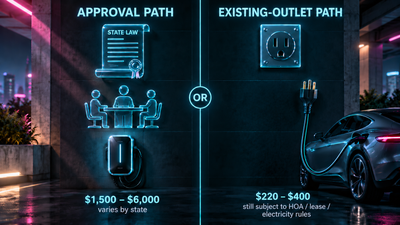
Usually no — for a typical daily commute, Level 2 isn’t necessary if you have a permitted 120V outlet. A 12A Level 1 setup delivers 1.44 kW, adding roughly 30–40 miles of range in a 10-hour overnight session; that covers most renters driving under ~35 miles a day. Use the math table below to check your specific coverage. Level 2 becomes worth pursuing when daily miles, cold weather, or limited plug-in hours push coverage under 100%, and that path adds landlord consent, an electrician for the 240V circuit, permits, and an electricity-billing arrangement.
Do the math for your situation, not the average
Instead of relying on published averages, calculate the wall energy your vehicle needs each day.
Required wall energy per day = daily miles ÷ vehicle efficiency (mi/kWh) ÷ charging efficiency
Example: 30 miles/day, 3 mi/kWh, and ~85% charging efficiency = ~11.8 kWh at the wall per day. Time to deliver that energy at common supply levels:
| Charging supply | Maximum power | Approx. time for ~11.8 kWh |
|---|---|---|
| 120V / 12A (typical OEM Level 1) | 1.44 kW | ~8.2 hours |
| 120V / 16A (on a permitted 20A circuit with a compatible EVSE) | 1.92 kW | ~6.1 hours |
| 240V / 24A | 5.76 kW | ~2.0 hours |
| 240V / 32A | 7.68 kW | ~1.5 hours |
Vehicle efficiency varies (a Model 3 delivers roughly 4 mi/kWh; a large SUV or truck can be closer to 2 mi/kWh), and cold weather can cut real-world efficiency 20–30%. Redo the math for your vehicle and climate before deciding. This kind of calculation is more accurate than any fixed "miles per hour" figure, because "miles per hour added" is a vehicle property, not a property of the charger.
When Level 1 is enough
Level 1 covers a typical commute when three conditions hold at the same time:
- A dedicated 120V branch circuit is available at your parking space and you have permission to use it. NEC Article 625 treats EV charging as a continuous load; a shared circuit with a fridge, freezer, or workshop tools is not a Level 1 charging circuit.
- Your daily energy need (from the table above) fits inside your available parking window at 1.2–1.9 kW of delivered power.
- No household extension cords, no daisy-chained outlet strips, and no shared receptacle. Any of those turn a compliant setup into a fire risk regardless of how the math works out.
Redo the calculation if your commute grows, your vehicle changes, or winter cuts your available energy. This is a per-year check.
When Level 2 becomes worth pursuing
Level 2 is worth the added installation and coordination when Level 1 cannot replace the energy you use overnight, or when the lease term makes the payback work. Common triggers:
- High daily miles — enough that 6–8 hours at 1.2–1.9 kW won't cover it.
- Short home-parking window — swing-shift or split-parking schedules.
- Cold climate — winter efficiency losses can push a borderline Level 1 setup over the edge.
- A suitable 240V outlet already exists — a permitted, approved NEMA 14-50 in your parking area removes most of the installation friction.
In a rental, Level 2 typically means: a written proposal to the landlord, a licensed electrician's load calculation, a permit where local code requires one, and a way to allocate the electricity cost (a sub-meter, an EVSE-reported energy log, or a fixed monthly reimbursement worked out with the landlord in writing). None of that happens automatically because you bought a portable EVSE.
What "portable Level 2" actually skips — and what it does not
A plug-in portable Level 2 EVSE avoids hardwiring and wall-mounting. It does not automatically skip permits, landlord approval, or electrical work. Which parts you skip depends on whether the outlet already exists and is approved for the use.
- If a permitted, approved 240V outlet is already in place (a NEMA 14-50 originally installed for an RV or a welder, for example), a plug-in portable EVSE plugs in with no new electrical work. Landlord consent for the load and the electricity billing is still needed; the outlet's original permit does not cover a new continuous EV load without confirmation.
- If no 240V outlet exists, or the existing one is not approved for continuous EV load, you are in installation territory. That means an electrician, likely a permit, and often a panel-load calculation.
- Do not use a conversion adapter to fit a 50A-plug EVSE onto a smaller receptacle unless the EVSE manufacturer explicitly approves that exact configuration. Adapters shape the plug; they do not lower the current the EVSE draws. An unapproved adapter puts a continuous 40A load on a 30A or smaller circuit.
Panel capacity and load calculations
Older buildings with 100A or 150A service may or may not have room for a 40A EV circuit. The right answer depends on the existing load — a service upgrade to 200A is one option, but a qualified electrician's load calculation may show that the existing service can support the EV circuit as-is, or that a listed energy-management system can add the load without a service upgrade.
Do not assume a panel upgrade is required or that it is not. Ask the electrician to run the calculation.
The right-to-charge landscape
Some states and municipalities limit a landlord's ability to reject qualifying EV-charging requests, but eligibility, costs, insurance, and installation requirements vary significantly. Check your state's current law and obtain local legal guidance before relying on any right-to-charge provision.
California and Illinois, for example, both have tenant-facing EV-charging provisions with detailed but different requirements. See California Civil Code §1947.6 and Illinois 765 ILCS 1085/35 as starting points, and consult a landlord-tenant attorney licensed in your state before quoting statute language to a landlord.
Even where a right-to-charge statute applies, the tenant typically pays for installation, carries insurance for the modification, and is responsible for removal or restoration at lease-end.
Making the ask to your landlord
Put the request in writing. A landlord proposal that lands well typically includes:
- A licensed electrician's scope of work and quote, with permit numbers where required.
- A load calculation confirming the building's panel capacity supports the new circuit (or a documented energy-management approach if not).
- An electricity-allocation plan — a sub-meter, an EVSE energy log, or a fixed monthly reimbursement agreed in writing.
- A renter's insurance rider naming the modification.
- A restoration commitment for lease-end where required.
Address the three things landlords actually worry about: whether the building's panel can carry the load, who is on the hook for an electrical fault, and what happens for the next tenant.
FAQ
Can I plug an EV into a regular apartment outlet?
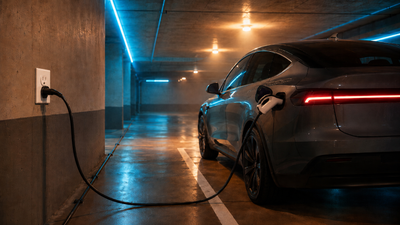
You can plug a Level 1 EVSE into a 120V outlet if the outlet is on a dedicated branch circuit, is approved for the use, and you have the landlord's permission for the electricity draw and cable routing. Do not use a household extension cord or share the circuit with a fridge, freezer, or workshop tool.
How much range does Level 1 add overnight?
It depends on your vehicle's efficiency. At 1.2–1.4 kW delivered over 8–10 hours, a typical Level 1 session puts roughly 10–14 kWh into the pack, which covers a typical daily commute for most sedans in fair weather. Use the math table above for your specific vehicle and climate.
Does portable Level 2 avoid permits?
It avoids new electrical work only when a suitable, permitted 240V outlet is already in place and approved for continuous EV load. If a new circuit is required, permits and electrician work are still required.
Can I adapt a 50A EVSE onto a 30A dryer outlet?
Do not use a conversion adapter unless the EVSE manufacturer explicitly approves the exact configuration. The plug shape does not change the current the EVSE draws; without manufacturer-approved current-limiting, you are running a continuous EV load on an undersized circuit.
Does my landlord have to allow Level 2?
Only where a state or local right-to-charge law applies, and even then subject to eligibility, cost, insurance, and installation requirements that vary by jurisdiction. Get local legal guidance before quoting statute language.
Do I need a panel upgrade for Level 2?
Not necessarily. A qualified electrician's load calculation on the specific building service will determine whether an upgrade is required or whether the existing panel — possibly with a listed energy-management system — can support the EV circuit.
What if I can't get Level 2 approved?
Many renters run a mixed pattern: Level 1 overnight for daily driving, workplace Level 2 where available, and occasional public DC fast charging for road trips or weeks where daily miles spike. Whether that pattern works depends on the same math as the Level 1 sufficiency question above.