Is an EV Worth It If You Can't Charge at Home?
Yes — an EV can work without an installed Level 2 wall charger, but “no home charging” is a different situation. Use our DOE-anchored fit test to see whether your outlet, workplace, and public charging cover your weekly driving. Not a mileage cutoff.

TL;DR
Yes — an EV can work without an installed home Level 2 charger, but "no home charging" is a different situation. If you have a suitable 120V outlet on a dedicated circuit where you park, Level 1 charging adds about 2–5 miles of range per hour per the U.S. Department of Energy. Without a home outlet, an EV can still work when workplace or public charging reliably replaces your weekly energy use. The right question isn't a mileage cutoff — it's whether your actual charging opportunities cover your actual driving.
"No Wall Charger" and "No Home Charging" Aren't the Same
The single most important distinction in this whole conversation:
- No installed Level 2 wall charger — you may still have Level 1 home charging, just at a slower rate.
- A suitable 120V outlet on a dedicated circuit where you park — you have home charging.
- No usable outlet at your parking spot — you truly have no home charging, and your EV must rely on workplace, public Level 2, DC fast charging, or a combination.
- Street parking — usually the hardest case; workplace or public charging typically has to become the primary strategy.
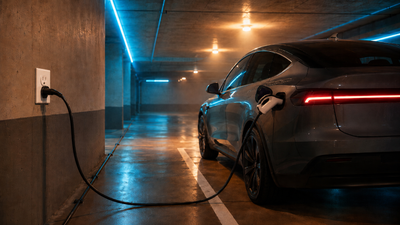
DOE notes that many EV owners can meet daily driving needs with overnight Level 1 when a power outlet on a dedicated branch circuit is available near the parking location. That's a different question from "do I have a wall charger?"
5-Minute Decision Test: Can You Live With an EV Without Home Charging?
Fill in your actual situation. The tool uses DOE's Level 1 estimate (~3 mi/hr midpoint) to see whether your charging opportunities can cover your weekly driving — no universal mileage cutoff.
Every field is used only in your browser — nothing is sent anywhere.
Decision rule: Don't ask whether you have a wall charger. Ask whether your reliable weekly charging opportunities can replace your weekly energy use with enough margin for unusually high-mileage days, cold weather, and charging interruptions.
Is Level 1 Charging Enough If You Can't Install a Home Charger?
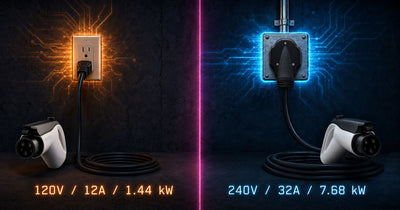
DOE estimates Level 1 charging at roughly 2–5 miles of added range per hour. That means Level 1 should be evaluated against your actual daily driving and the number of hours your EV can remain plugged in — not against battery size alone.
| Connected overnight | At 2 mi/hr | At 5 mi/hr |
|---|---|---|
| 8 hours | 16 mi | 40 mi |
| 10 hours | 20 mi | 50 mi |
| 12 hours | 24 mi | 60 mi |
Actual miles of range added per hour vary with vehicle efficiency, charging power, temperature, and other conditions. Use your specific vehicle's owner-manual charging table when planning.
Example: If your EV adds about 3 miles of range per hour and remains connected for 10 hours, that's roughly 30 miles of recovered range. If you routinely drive 25 miles per day, the math may work. If you routinely drive 60 miles, Level 1 alone probably won't keep up and you need another charging source.
What If You Have No Outlet at Home? Charging Options Compared
When home charging is genuinely unavailable, the right question is: can your other opportunities replace what you drive?
| Option | DOE typical range-added estimate | Best use |
|---|---|---|
| Level 1 | 2–5 mi/hr | Long overnight parking |
| Level 2 | 10–30 mi/hr | Workplace, apartments, destinations |
| DC fast | 100–200+ miles / 30 min | Trips and faster top-ups |
Workplace charging is especially valuable because an EV may remain parked there for many hours. Public Level 2 works best when the station is somewhere you already spend time (grocery store, gym, downtown parking). DC fast charging requires less dwell time but should be evaluated using the actual price and charging performance available in your area.
Apartment & Renter Scenarios: Which Situation Are You In?
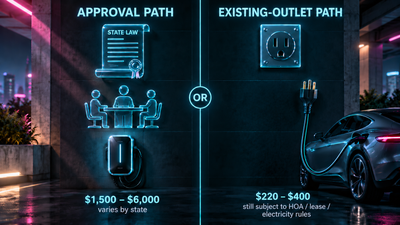
DOE notes that multifamily housing has additional issues including parking access, electrical service, billing, and legal concerns. Match your situation to the right first step:
| Parking situation | First option to investigate |
|---|---|
| Assigned space + nearby 120V outlet | Ask management whether charging from that outlet is authorized, and what the electricity-reimbursement arrangement should be |
| Assigned space + no outlet | Ask about adding an outlet / EVSE, or about a designated charging space with shared cost |
| Shared garage with existing chargers | Understand access hours, billing, and overnight availability before assuming they meet your needs |
| Street parking | Workplace or public charging may need to be your primary strategy — validate reliability before purchase |
| Outlet exists but too far from vehicle | Do not improvise with a household extension cord. Determine an approved charging setup with your electrician or landlord. |
Is an EV Still Cheaper If You Rely on Public Charging?
Public-charging prices vary by network, state, membership, location, time, kWh vs minute pricing, and session or idle fees. Instead of a national average that will be stale next month, use the formula and plug in your actual local prices.
Monthly EV charging cost = monthly miles × vehicle energy consumption (kWh/100 mi) ÷ 100 × electricity price
Example: A vehicle consuming 30 kWh/100 miles and driving 1,000 miles per month uses about 300 kWh for that distance. At 18¢/kWh (roughly the current U.S. residential average per EIA Table 5.6.B, YTD through June 2026 = 18.16¢), that's about $54. At 50¢/kWh public DC fast pricing, it's about $150. These are illustrations — use your utility or charging network's actual price.
Whether public charging is cheaper than gasoline depends on your EV's efficiency, local charging prices, and the fuel economy and gasoline cost of the vehicle you're comparing against. Use DOE's alternative fuel cost calculator for a like-for-like comparison in your ZIP.
When an EV Probably Isn't a Good Fit Yet
Not a mileage cutoff — a set of practical signals:
- You have no usable outlet at home and no reliable workplace or public Level 2 option
- Your only realistic charging is DC fast, and local network pricing eliminates the fuel-cost savings
- You depend on the vehicle for long-distance daily commutes without dwell time to charge along the way
- Cold-weather range loss (see our winter EV charging guide) would routinely put you below your daily need
In those cases, a plug-in hybrid or hybrid may be worth comparing — especially a PHEV if you'd charge it often enough to actually use the electric-driving range it's designed for.
A Note on Extension Cords
Do not add a household or other supply-side extension cord between the wall outlet and EVSE unless the EVSE manufacturer expressly permits that exact configuration. A purpose-built vehicle-side charging extension is a different product category — it still needs to meet current, compatibility, manufacturer-instruction, and applicable electrical-code requirements for your setup. See our EV extension cord safety guide for the specifics.
If You Decide to Buy: The Right Starter Setup
If your test above concluded that a suitable 120V outlet works for your driving, the right starter product is a plug-in Level 1 portable charger. No wall install, no landlord conversation, no electrician bill.

2026 incentive note. The federal New and Previously-Owned Clean Vehicle Credits (§30D) are unavailable for vehicles acquired after Sept 30, 2025, subject to transition rules for qualifying acquisitions before that date. The federal §30C charging-equipment credit generally ended for property placed in service after June 30, 2026. State and utility incentives may still apply — check your local programs. See IRS clean-vehicle guidance.
Frequently Asked Questions
Can I buy an EV if I live in an apartment with no charger?
Yes, if you have a reliable charging path. Start with the parking-situation table above. If assigned parking has a suitable 120V outlet and your building authorizes its use, Level 1 may cover typical daily driving. If not, workplace or public Level 2 has to reliably cover the energy you use each week.
Is Level 1 enough for daily EV charging?
It depends on your daily miles and connected hours. DOE estimates Level 1 at roughly 2–5 miles of added range per hour. Ten overnight hours at 3 mi/hr recovers about 30 miles — enough for many drivers, not enough for 60-mile commuters.
Can I own an EV if I only use public charging?
Practically, yes — if reliable public charging (workplace, Level 2 at destinations, or DC fast) is available where you already spend time and the cost per kWh doesn't eliminate the fuel-cost benefit. Validate this before purchase by tracking a hypothetical week's charging in your area.
How often would I need to public-charge an EV?
Enough to replace your weekly energy use. For 200 miles a week at 30 kWh/100 mi, that's about 60 kWh — one 45-minute DC session or several Level 2 sessions, depending on the network's speed at your vehicle.
Is an EV still cheaper if I can't charge at home?
Sometimes. Use the formula above with your actual local prices. Public DC fast can approach or exceed gasoline cost in some networks; workplace Level 2 (often free) can be dramatically cheaper.
What if my apartment parking space has a regular outlet?
Ask management whether charging from it is authorized and how electricity should be reimbursed. Confirm the outlet is on a dedicated circuit and in usable condition before daily charging.
Is workplace charging enough to own an EV without home charging?
For many commuters, yes. If your EV is parked at work for 6–8 hours and workplace Level 2 delivers 10–30 mi/hr, that alone can cover 60–200 miles per workday — often more than needed.
Should I buy a hybrid instead if I can't charge at home?
A hybrid (HEV) or plug-in hybrid (PHEV) is worth comparing when reliable charging access is poor. A PHEV only delivers its electric-driving benefit if you can actually charge it often; a HEV needs no charging at all. Match the vehicle to your realistic charging pattern, not the ideal one.
Primary sources used in this guide
- U.S. DOE Alternative Fuels Data Center — Charging Electric Vehicles at Home — Level 1 dedicated-circuit guidance
- U.S. DOE Alternative Fuels Data Center — Electric Vehicles for Consumers — Level 1 / Level 2 / DC fast typical rates
- U.S. DOE Alternative Fuels Data Center — Multifamily Housing Charging — apartment/renter guidance
- EIA Electric Power Monthly Table 5.6.B — residential electricity prices
- IRS Clean Vehicle Tax Credits — §30D sunset guidance
- Tesla Mobile Connector Support — per-model NEMA 5-15 charging rates
Last verified: 2026-09-11. EIA figure checked against Electric Power Monthly Table 5.6.B YTD June 2026. Product prices checked on WenStorm product pages on 2026-09-11.