EV Charging Outlet Wear: 7 Warning Signs to Check

Direct answer: Physical inspection of the outlet, plug, and cable is a valuable habit for a home EV owner. There is no single industry-wide inspection interval that applies to every outlet and EVSE; the useful trigger is any change in how the equipment looks, feels, or behaves. If your specific EVSE's product manual specifies an inspection cadence, follow it.
Safety check. Stop using any outlet, plug, adapter, or cable that becomes unusually hot, loose, discolored, corroded, or damaged. Verify your specific vehicle and charging equipment for active recalls at nhtsa.gov/recalls. If any warning sign described below is present, discontinue charging until a qualified electrician has evaluated the branch circuit.
Disclosure: WenStorm publishes this article and sells the portable Level 1 and Level 2 EV chargers referenced below. Tesla, Ford, GM, Rivian, Hyundai, Kia, Leviton and other referenced brands are not affiliated with WenStorm; their trademarks are used descriptively.
Warning signs and immediate actions — at a glance
| Warning sign | Immediate action |
|---|---|
| Unusual or increasing heat on the outlet, plug, or cable | Stop charging and investigate |
| Loose plug fit or reduced grip in the receptacle | Stop using the receptacle |
| Discoloration, pitting, or deformation of the outlet face or plug body | Switch off the circuit at the breaker and arrange inspection |
| Repeated breaker or GFCI trips | Do not repeatedly reset; investigate the underlying cause |
| Visible oxidation, pitting, residue, or corrosion on plug blades or receptacle contacts | Discontinue charging and have the receptacle evaluated |
| Burning odor, arcing, sparks, smoke, or melting | Do not touch the equipment. Isolate power at the breaker only if safe. Contact emergency services if smoke or fire is present. |
| Vehicle reports a fault, terminates a session early, or shows a new charging error | Note the message, stop charging on that outlet, and have the branch circuit evaluated |
The rest of this article walks through each warning sign in detail, explains when the useful inspection triggers are, and describes what to do next.
Why outlet wear matters more for EV charging
Most household electrical loads are intermittent. A microwave runs for a few minutes. A refrigerator's compressor cycles on and off. EV charging is different: during active charging, the vehicle may draw substantial current continuously for several hours, subject to vehicle and EVSE limits.
Two distinct wear mechanisms compound over time.
Thermal cycling every session. The receptacle, plug blades, and internal metal-to-metal contacts warm during charging and cool between sessions. Repeated thermal cycling gradually loosens contacts and accelerates any pre-existing installation weakness.
Insertion-cycle wear when the wall plug is repeatedly removed. If the EVSE is left plugged into the wall between sessions (only the vehicle connector is unplugged), the wall receptacle sees no additional insertion-cycle wear. If the EVSE itself is unplugged and re-plugged into the wall repeatedly, the receptacle's mechanical grip degrades with each cycle. An older receptacle may not have been installed, maintained, or selected with years of sustained EV charging in mind.
Failure modes are usually quiet until they aren't. A degrading receptacle typically shows subtle heat marks, a slight loosening of the plug fit, or minor discoloration long before it causes an incident. Those signs are visible during a routine look, and easy to miss if nobody is looking.
Why the breaker doesn't always trip first
Most people assume that if an outlet were dangerous, the breaker would trip. That assumption misses the specific failure mode that damages EV charging outlets. The breaker monitors total current flowing through its circuit; it does not monitor localized heat at a specific plug or terminal. Continuous EV charging can degrade a receptacle for months without the breaker ever tripping.
Two distinct physical mechanisms are at work:
1. Thermal-resistive heating at loose or corroded contacts
Every plug-to-receptacle connection has some contact resistance. When the connection is tight and clean, that resistance is very low and the heat it generates (P = I²R) is negligible. When the connection loosens — because the screw terminal was under-torqued during install, because years of thermal cycling have relaxed the spring contact, or because a heavy EVSE plug is cantilevering on the socket — that resistance rises at that specific spot. A single localized micro-ohm of extra resistance, carrying 32 A continuously, generates measurable heat only at that spot. That heat can soften plastic, discolor terminals, and eventually melt the receptacle body long before total circuit current climbs high enough to trip a properly rated breaker.
2. Micro-arcing at intermittent contacts
When a spring contact starts to lose tension, the electrical connection becomes momentarily intermittent under vibration or thermal expansion. Each break-and-remake at a loose contact generates a tiny arc. Repeated arcing deposits carbon on the contact surfaces, which raises resistance further, which generates more heat, which accelerates further wear. This is a self-reinforcing failure: once micro-arcing starts, it tends to progress rather than stabilize.
Neither of these mechanisms trips a standard thermal-magnetic breaker because the total circuit current never exceeds the breaker's trip threshold. The energy dissipates as heat at the failing contact instead. This is why the seven warning signs in the next section matter — inspection at the receptacle is the only way to catch these failures before they damage the outlet or start a fire.
Where cantilever mass fits in
A charging cable that hangs its control electronics on the receptacle adds mechanical stress that accelerates the terminal-loosening step of the first mechanism above. This is one of the reasons portable EV chargers that place the electronics inside the vehicle-end handle (instead of hanging a heavy control box on the wall receptacle) reduce long-term strain on the outlet. It doesn't eliminate outlet wear — plug/receptacle interfaces still degrade with any repeated connect/disconnect cycle — but it removes one of the mechanical contributors.
For more on the mechanical stress problem specifically, see Why WenStorm's Portable EV Charger Has No Brick Design. For a comparison of extension-cable ratings and safety limits, see Is a 25-Foot EV Charger Cable Long Enough?
The 7 warning signs in detail
- Unusual heat on the outlet, plug, or cable. Connected electrical equipment runs slightly warm during normal operation. Warmth that is hotter than similar equipment normally runs, or that feels uncomfortable to hold immediately after unplugging, is a warning sign — not automatic proof of failure, but a signal to investigate.
- Discoloration or brown/black marks on the receptacle face, plug blades, or cable near the plug. This is heat damage that has already occurred. Do not sand or clean the marks off; the underlying damage is inside the receptacle, not on the surface.
- Loose plug fit. The plug wiggles noticeably, falls out under mild cable weight, or does not grip the receptacle as it once did. Reduced grip means poor metal-to-metal contact, which raises resistance, which raises heat — a compounding failure mode.
- Visible oxidation, pitting, residue, or corrosion. Do not rely on specific colors; some plug blades are nickel-plated and appear gray in normal condition. Look for irregularity: pitting, buildup that was not there before, or deposits that rub off when touched.
- Melting, deformation, cracking, or scorch marks on the outlet face, plug body, or cable insulation. These are late-stage indicators. Any of them means stop charging on that outlet immediately, and do not use it for any other purpose until a qualified electrician has evaluated the branch circuit.
- A tripping GFCI or breaker. Tripping indicates a condition that must be investigated — a ground fault, an overload, a wiring problem, an equipment defect, or an interaction between protective devices. Never bypass, defeat, or repeatedly reset without investigating.
- A burning smell, plastic-melting smell, arcing sound, sparks, or smoke. This is the emergency case; see the escalation section below.
When to check — trigger-based, not calendar-based
The most useful triggers for a physical outlet check:
- Whenever you plug in or unplug — a quick visual scan takes seconds and catches most emerging problems.
- Whenever the equipment feels different from normal use — warmer, looser, noisier, or with a smell.
- After any electrical event — a tripped breaker, a tripped GFCI, a power surge, or a storm outage.
- After severe weather, water exposure, flooding, or visible moisture intrusion, particularly for outdoor or garage-adjacent outlets.
- When the vehicle's charging behavior changes — noticeably slower charging, sessions terminating early, or new error messages.
- When the specific EVSE product manual recommends an inspection. Some manuals specify inspection cadence; follow the specific manual for the equipment you own.
A regular calendar check is fine as a floor if you prefer it, but trigger-based inspection catches emerging problems more reliably than a fixed schedule.
Outlet types with specific vulnerabilities
NEMA 5-15 and 5-20 (standard 120V household outlets)
Common failure mode: gradual loosening of the plug grip over time. Different receptacle grades have different endurance ratings; consult the manufacturer's spec sheet for the specific receptacle. On a receptacle used for daily EV charging, insertion-cycle wear accumulates faster than on a receptacle used for a lamp — but only when the wall plug is repeatedly removed. If the plug fits loosely and the outlet is aged, replacement by a qualified electrician is often the right call.
NEMA 14-50 (240V RV / range outlet)
NEMA 14-50 overheating incidents are frequently discussed in EV-owner and electrical-safety reports. Contributing factors documented in these reports include: inexpensive builder-grade receptacles installed on new homes, conductors incompatible with the receptacle or improperly terminated, receptacles installed outdoors without a properly rated weatherproof enclosure, and continuous-load use at or near the receptacle's rating. Some EV-grade receptacles specifically require copper conductors — Leviton's 1450R specification is one example. For deeper coverage of receptacle selection and installation for continuous EV load, see our why NEMA 14-50 outlets melt guide.
NEMA 14-30 and 10-30 (dryer outlets)
Common in laundry rooms and older homes. A properly installed 30A circuit can supply a compatible EVSE at up to 24A continuous — subject to circuit condition, receptacle grade, outlet-sharing considerations, and manufacturer compatibility. Two specific EV-charging concerns: the 10-30 has no separate equipment-ground conductor and is compatible with some EVSEs and not others (check the EVSE manual); and simultaneous or repeated-alternate use with a dryer on the same circuit is a specific fault pattern to avoid. An approved load-management device may be preferable where simultaneous appliance and EV operation must be prevented.
NEMA 6-50 (welder outlet)
The NEMA configuration itself does not establish receptacle quality. Evaluate a 6-50 the same way as any other outlet: grade, condition, conductor compatibility, and installation quality.
Outdoor outlets of any type
Outdoor exposure adds moisture, freeze-thaw cycling, and UV degradation. Outdoor receptacles used for EV charging should be in a weatherproof enclosure and while-in-use cover suitable for the location, installed according to locally adopted code. Indoor-rated outlets are not suitable for outdoor EV charging.
What NHTSA charging recalls have documented
Two recall families in the past decade have specifically flagged EV charging equipment thermal issues.
Tesla 16E-091 (2016). Tesla's 2016 recall covered 6,729 specified NEMA 14-30, 10-30, and 6-50 UMC adapters. Some adapters had insufficient-quality internal welded connections that could develop increased resistance, overheating, or arcing. The NHTSA report also references an earlier recall involving certain NEMA 14-50 adapters. The remedy was replacement adapters.
Porsche and Audi 23V-841 and 23V-842 (2023). The combined figure is 134,541 vehicles: 41,345 Porsche plus 93,196 Audi. The 240V portable charging cables could overheat at the full-current setting on home outlets. The remedy was replacement cables incorporating a temperature sensor. These recalls show that temperature monitoring can reduce risk, but it does not make a damaged, loose, or unsuitable receptacle safe.
What to do if you spot a warning sign
For non-emergency warning signs (unusual heat, discoloration, loose fit, oxidation, repeated breaker trips):
- Stop charging through the vehicle or app.
- Once charging has stopped, disconnect the vehicle from the EVSE. Unplug the EVSE from the outlet only if the equipment is cool and undamaged.
- Do not use the outlet for any purpose until a qualified electrician has evaluated it.
- Contact a licensed electrician. Describe what you saw and how long you have been charging on that outlet.
- Check the vehicle's recall status at nhtsa.gov/recalls, and the EVSE manufacturer's owner portal for equipment-side advisories.
- If you rent: notify management in writing and obtain permission before electrical work. Responsibility and cost depend on the lease and applicable law.
For emergency signs (smoke, arcing, melting, burning odor, or excessive heat):
- Stop charging through the vehicle or app if it is safe to do so.
- Do not touch or unplug the equipment. Switch off the circuit at the breaker only if you can do so safely.
- Contact emergency services if smoke or fire is present.
- Do not reuse the outlet or the charging equipment until it has been evaluated by a qualified electrician.
What actually prevents outlet wear
- Use the outlet type and receptacle grade the EVSE manufacturer specifies. An EV-grade or commercial-grade receptacle is designed for a longer duty cycle than a builder-grade one.
- Have a qualified electrician install the receptacle using the receptacle manufacturer's specified conductor type and torque. Terminations must be verified at install on de-energized equipment — never under load.
- Use the receptacle only for what it was installed for. A receptacle installed for occasional RV use is not automatically sized for continuous EV charging; an electrician's evaluation determines whether the branch circuit is appropriate.
- Do not repeatedly unplug and reconnect to share a circuit with another high-draw appliance. Where simultaneous appliance and EV operation must be prevented, an approved load-management device is preferable.
- Use a weatherproof enclosure and while-in-use cover for any outdoor outlet, installed according to locally adopted code.
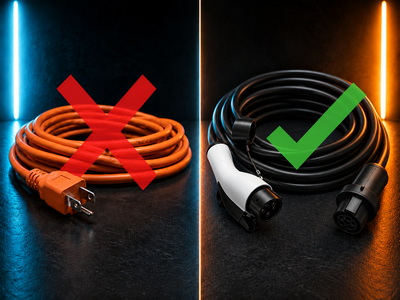
- Do not use household extension cords on the input side of the EVSE. If cable reach is a problem, the correct solution is a longer manufacturer-designed EVSE cable, a licensed electrician moving or extending the receptacle, or a landlord-approved outdoor-rated solution.
Frequently asked questions
How often should I physically inspect my EV charging outlet?
There is no single industry-wide interval that applies to every outlet and EVSE. Trigger-based inspection — a quick visual check at each plug/unplug plus a closer look after any electrical event, severe weather, water exposure, or noticeable change in equipment behavior — catches emerging problems more reliably than a fixed calendar. If your specific EVSE product manual specifies an inspection cadence, follow it.
The plug feels warm after charging — is that normal?
Connected electrical equipment runs slightly warm during normal operation, so some warmth is expected. Warmth that feels different from normal, is uncomfortable to hold, or combines with any of the other warning signs above is a signal to stop charging on that outlet and have the branch circuit evaluated.
Can I just replace the receptacle myself?
Only if you are qualified to perform electrical work under your locally adopted code. A receptacle swap addresses only the visible part of the problem and can miss underlying causes involving terminations, wiring, or panel-side conditions. A licensed electrician's evaluation is the correct next step for most owners.
Is a portable EVSE safer than a hardwired one from an outlet-wear standpoint?
From an outlet-wear perspective, a properly installed hardwired EVSE removes the wall-plug and receptacle interface, eliminating one potential heat and wear point. A plug-in portable EVSE provides flexibility but depends on a compatible, sound receptacle and correctly sized circuit. Some portable EVSEs include a handle-side thermal cutoff (WenStorm's Level 2 Portable, for example, interrupts the session at 85°C connector-handle temperature and resumes below 70°C) — a device-side protection at the vehicle end of the cable, not a substitute for a sound wall receptacle. Neither approach compensates for improper wiring, loose terminations, or uncertified equipment.
What should I ask when buying a home with existing EV charging infrastructure?
Ask when the receptacle was installed and by whom, whether the branch circuit is dedicated for EV charging or was originally installed for another purpose, and whether the receptacle was installed to the manufacturer's specified conductor and torque requirements. If the seller cannot answer, budget for a licensed electrician's evaluation before you rely on the setup for nightly EV charging.
Related reading: why NEMA 14-50 outlets melt covers receptacle selection and installation for the most-discussed home EV charging failure mode. Our general EV ownership guide covers the broader ownership picture.