Can an HOA Deny an EV Charger?

TL;DR
Sometimes — but an HOA may not have the right to simply ban EV charging. In many states it cannot impose a blanket ban on a compliant installation in an owner's designated parking space. “Right-to-charge” laws in at least 14 U.S. states and Washington DC limit an HOA's ability to prohibit EV charging, while still allowing reasonable requirements on electrical safety, permits, insurance, installation standards, common areas, and who pays.
For example, California law generally prevents HOAs from prohibiting or unreasonably restricting EV chargers in a homeowner's designated parking space, but the homeowner may still need HOA approval, a licensed installer, appropriate insurance, code compliance, and may be responsible for installation, electricity, maintenance, and related costs. Source: California Civil Code §4745 (as amended by SB 770, eff. 2026-01-01); U.S. DOE AFDC.
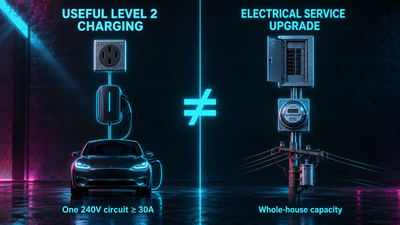
The real answer depends on your state, your parking arrangement, who owns the parking area, and how the charger would be installed. Where a code-compliant 240V receptacle already exists near your parking spot, a portable Level 2 EVSE can also reduce (though not eliminate) association scrutiny.
When Can an HOA Say No?
Not every scenario carries the same association authority. The table below shows where the HOA typically has broader or narrower ability to deny — a diagnostic before you jump to the state-law section.
| Scenario | HOA authority to deny |
|---|---|
| Compliant installation in an owner's designated space, in a right-to-charge state | Very limited — can impose reasonable conditions (licensed installer, permits, aesthetic, insurance where required), cannot flatly deny |
| Compliant installation in an owner's designated space, in a state without a right-to-charge law | Broader — depends on the CC&Rs; the association can typically apply general architectural review authority |
| Installation in a common area (shared parking, common wall, common panel) | Broader — even in right-to-charge states. Most statutes protect installations in dedicated spaces; common-area installations usually require association agreement. |
| Installation with a code violation (undersized wire, no permit, non-compliant EVSE) | Legitimate denial basis — the association can require code compliance before approving; NEC Article 625 governs EV supply equipment. |
| Installation with an unsafe electrical condition (near-capacity panel, degraded receptacle, missing GFCI where required) | Legitimate denial basis — the association can require remediation of the safety condition before approving. |
| Portable EVSE plugged into an existing compliant 240V outlet, no new installation | Situational. Not new electrical work, so architectural review may not apply — but the association's governing documents may still control use of the electrical supply, cord routing across common areas, or use of association-metered electricity for personal EV charging. |
Once you've identified which row describes your situation, the state-by-state table below tells you the specific statute language that applies.
Can Your HOA Actually Deny an EV Charger?
In states with a right-to-charge law, the HOA cannot flatly ban an installation in your dedicated space — but it can impose reasonable conditions on how the installation is done. Reasonable conditions vary by state and by governing documents, but typically include using a licensed electrician, pulling permits, following the association's architectural aesthetic (conduit color, mounting location), maintaining an appropriate liability insurance policy where the statute requires one, and paying for the installation and the electricity you use.
Outside right-to-charge states, the association has broader authority. The fight typically turns on whether the CC&Rs specifically address EV charging (rare) or whether the board is applying general architectural authority (common). Source: state right-to-charge statutes (see table below); U.S. Department of Energy Alternative Fuels Data Center — EV Charger Policies for Associations.
State-by-State Right-to-Charge Laws

Every currently well-ranking article in this space name-drops the same 3–4 states and vaguely references “more.” The table below is the one thing they don't have: every named right-to-charge state and Washington DC, the specific statute cite, the property type covered, and — where the statute addresses them — insurance requirements, decision deadlines, and renter coverage.
| State / District | Property type | Statute | Renters? | Decision deadline | Insurance requirement (post-2026) |
|---|---|---|---|---|---|
| California | HOA / condo | Civil Code §4745 (updated by SB 770, eff. 2026-01-01) | Yes (§1947.6 for renters) | Process through architectural review; unreasonable delay not permitted | Additional-insured requirement removed by SB 770. §4745 still requires liability coverage in applicable installation situations, and contains an exception for use of an existing NEMA-standard AC power plug. |
| Colorado | Common-interest community | C.R.S. §38-33.3-106.8 | Partial | None specified in statute; reasonable timeframe implied | May require reasonable liability coverage |
| Connecticut | Condo / common-interest ownership | Conn. Gen. Stat. §47-261g | No | Not specified | May require reasonable coverage |
| Florida | Condo (limited common element / exclusively designated space) | Fla. Stat. §718.113(8) | Not directly | Not specified in this section | Owner pays; specific requirements around metering, insurance, compliance |
| Hawaii | Condo / association | Haw. Rev. Stat. §514B-113 | No | Not specified | Owner pays install and electricity |
| Illinois | Common-interest / association | AFDC-documented protection [statute cite verify pending] | Not directly | Not specified | Statute-specific |
| Maine | Condo / residential association (effective 2026-01-01) | AFDC-documented protection [statute cite verify pending] | Not directly | Not specified | Statute-specific |
| Maryland | HOA / condo | Md. Real Prop. §11-111.4 (condo) and §11B-111.8 (HOA) | No | Not specified | May require reasonable coverage |
| Massachusetts | Condo (limited common element) | Mass. Gen. Laws ch. 183A §10 | No | 60-day deemed-approval mechanism in specified circumstances | Statute-specific |
| New Jersey | Residential / common-interest association | N.J.S.A. §45:22A-48.4 | No | Not specified | May require reasonable coverage |
| New York | HOA (§343); Condo (§339-LL) | N.Y. Real Prop. §343 (HOA) / §339-LL (condo) | Partial | Not specified | Owner pays install / maintenance; reasonable conditions permitted |
| Oregon | Homeowner association | ORS §94.762 | No | Not specified | Reasonable conditions permitted |
| Virginia | Common-interest community (POA §55.1-1823.1; Condo §55.1-1962.1; Coop §55.1-2139.1) | Va. Code §55.1-1823.1, §55.1-1962.1, §55.1-2139.1 | No | Not specified | May require reasonable coverage |
| Washington | Various (SB 5129, eff. 2025-04-22) | RCW 64.32.290; 64.34.395; 64.38.062; 64.90.513 | Not directly | Not specified | Certificate of insurance required per SB 5129 |
| Washington DC | Common-interest / condo | AFDC-documented protection [statute cite verify pending] | Not directly | Not specified | Statute-specific |
Sources: U.S. DOE Alternative Fuels Data Center (afdc.energy.gov) EV Charger Policies for Associations database; individual state code sections cited above. Statute language is amended periodically. Before submitting formal correspondence, verify against your state's official legislative code.
Insurance requirements vary by state, property type, and installation location. Do not treat one state's insurance instruction as universal. Check the specific statute for your state before purchasing or modifying coverage.
Three Questions That Decide Your Path
Before the state table can tell you what to do, you need to answer three questions. Different combinations lead to different paths.
1. Owner, Renter, or Condo Resident?
Owner in single-family HOA. Your state's right-to-charge statute — if it exists — most directly protects you. Your fight is with the architectural review committee.
Owner in condo / co-op. Right-to-charge protections often exist as separate statute sections for condos (distinct from HOA sections). Check the state table above for the property-type-specific citation.
Renter. California Civil Code §1947.6 extends right-to-charge protections to renters in dwellings with dedicated parking. Most other states don't. Where you're not covered by statute, the portable-EVSE approach on an existing outlet — with your landlord's permission — is often the practical path. See our tenant EV charger guide for who-pays-what and lease-conversation framing.
2. Dedicated or Shared Parking?
Dedicated / deeded space. Most right-to-charge statutes cover this configuration explicitly.
Exclusive-use limited common element. Covered by some statutes (Florida §718.113(8) specifically addresses this). Check your state.
Shared / unassigned parking. This is the hardest case. Most statutes don't cover it. The realistic paths are (a) petition the board to install common charging infrastructure (a multi-year project), (b) use a nearby existing outlet with a portable EVSE (with association permission), or (c) charge at public infrastructure.
3. New Installation or Existing Outlet?
New installation. You're modifying the property. Architectural review, permits, licensed electrician, insurance where required, aesthetic conformance, and the state statute's conditions all apply.
Existing code-compliant 240V outlet within cable reach. You're not modifying the property — but you still need permission to use the outlet for continuous EV charging, and any lease, parking, or shared-electricity rule your governing documents impose still applies. This is where a portable EVSE can materially reduce installation work but does not automatically waive HOA authority.
The Portable-EVSE Path: What It Can Avoid — and What It Cannot

If a suitable, code-compliant 240V receptacle already exists near your parking space, a portable Level 2 EVSE may eliminate the need to install a new circuit, receptacle, conduit, or wall-mounted charger. That can materially reduce installation cost and the scope of architectural-review requirements — because there's less for the association to review when nothing is being modified.
Portable, however, does not automatically mean approval-free. The rules that can still apply, even without new electrical work:
- HOA governing documents (CC&Rs, rules, architectural guidelines) can address use of electrical equipment on the property, not just installation. California Civil Code §4745, for example, addresses restrictions on the installation or use of EV charging stations.
- Lease terms, if you rent, may address high-continuous-current appliances on the electrical service.
- Parking agreements can restrict what equipment stays in the parking bay.
- Shared-electricity policies (common in condo garages) determine whether you're allowed to use association-metered electricity for personal EV charging and how you pay for it.
- Cord routing across common areas is typically a governing-document concern.
- Local electrical requirements and manufacturer restrictions on the EVSE still apply — some EVSE manufacturers specifically prohibit use with extension cords (Tesla's Gen 2 Mobile Connector Owner's Manual, for example, prohibits extension-cord use).
What existing-outlet-plus-portable actually gets you: potentially less installation work, potentially reduced architectural-review scope, and — because you're not modifying the property — potentially a lower-friction conversation with your board or landlord. Not immunity from association authority.
Who this path realistically fits
- Renters in condos where installation is not permitted, if the landlord and any applicable association allow use of an existing outlet.
- Owners whose dedicated parking is within cable reach of an existing compliant 240V outlet — dryer receptacle in an adjacent laundry room, welder receptacle in a shared workshop, RV pedestal in the driveway — provided the governing documents permit its use for EV charging.
- Owners in states without right-to-charge protection where formal install approval is uncertain, but where the association has no rule against using an already-permitted receptacle.
- Owners in stalemate cases — the board is stalling on install approval, and the reader wants to charge tonight while the approval process continues.
When it doesn't fit
- No existing 240V outlet is within cable reach of your parking spot. Solving reach with a general-purpose extension cord is typically prohibited by the EVSE manufacturer (Tesla's Gen 2 Mobile Connector Owner's Manual, for example, prohibits it) and creates real fire risk on continuous loads.
- The receptacle is in poor condition — worn contacts, discoloration, warm plug fit. Verify condition first; see seven signs your EV charging outlet is failing.
- Your governing documents or lease specifically prohibit high-continuous-current appliances on the shared electrical service, or restrict what equipment can remain in your parking bay.
- You need a hardwired 48A (11.5 kW) EVSE rather than a 32A portable. The portable path caps at 32A / 7.7 kW.
Already Have Permission to Use a Suitable 240V Outlet?
If no new electrical work is required and you're permitted to use the receptacle for EV charging, a portable Level 2 charger provides home charging without installing a permanent wall-mounted station.
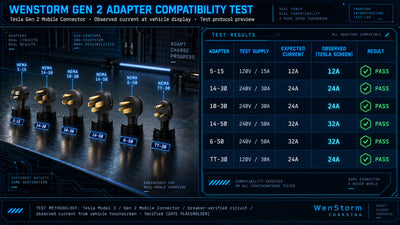
The WenStorm Level 2 Portable Charger is 32A at 240V (up to 7.7 kW), with adjustable current settings (16A / 24A / 32A) and a NEMA 14-50 plug. If your outlet is a NEMA 14-30 (a modern four-wire dryer receptacle), NEMA 10-30 (a legacy three-wire dryer receptacle with grounding limitations), or NEMA 6-50 (a common welder / workshop receptacle), the WenStorm adapter line matches those outlet types.

Before buying: confirm (1) your outlet's NEMA type, (2) the branch-circuit capacity and breaker rating, (3) receptacle condition, (4) permission to use that electrical supply for continuous EV charging, and (5) your vehicle's connector type (J1772 or NACS).
Match your car and outlet with the Solution Finder if you're not sure which components you need.
Portable does not automatically mean approval-free. HOA, lease, parking, shared-electricity, and local electrical requirements may still apply. Check them before treating an existing outlet as permission to charge.
What Each Path Typically Costs
Illustrative ranges, not quotes. Actual costs vary materially by region, electrical capacity, wiring distance, permits, HOA-imposed conditions, and whether a panel or service upgrade is needed. The U.S. Department of Energy Alternative Fuels Data Center documents that residential Level 2 equipment costs vary substantially and installation cost depends on wiring, location, permitting, electrical upgrades, trenching, and labor.
| Line item | Illustrative range | Notes |
|---|---|---|
| Level 2 EVSE (wall-mounted / hardwired unit) | $400 – $800 | 32A–48A models; varies by feature set |
| Dedicated 240V circuit + breaker (labor + materials) | $600 – $1,500 | Depends on run length and panel access |
| Permit + inspection | $75 – $300 | Local variance |
| Liability insurance endorsement (where required) | $100 – $200 / year | State- and statute-specific. California removed the additional-insured requirement effective 2026-01-01 (SB 770). |
| Cosmetic repair / conduit / trenching | $0 – $2,000 | Zero for indoor garage; higher for outdoor / long runs |
| Panel or service upgrade (if triggered) | $1,500 – $4,000 | Often avoidable; see NEC 220.83 load-calc walk-through |
| Typical all-in — no panel upgrade | $1,500 – $3,000 | Most straightforward garage installs land here |
| All-in with panel upgrade | $3,000 – $6,000+ | Older buildings, all-electric homes, near-capacity panels |
| Portable-EVSE alternative (existing outlet) | $220 – $400 (one-time) | Assumes a suitable compliant existing outlet within cable reach; no new circuit / permit / insurance-endorsement work required |
When a suitable 240V circuit already exists and its use is permitted, a portable EVSE can eliminate much of the electrical-installation cost. The specific savings depend on your governing-document requirements, your outlet situation, and how much of the install list above you would have needed.
The Approval Playbook — Customize the Letter to Your Scenario
If the portable path isn't right for you and you're going through formal approval, the key insight nobody in this space gives you: the board letter should pre-answer every objection they're going to raise — but the specific statutory language, insurance instruction, and conditions vary too much across states, property types, and parking configurations to use one universal template. Adapt the framework below.
Before writing, confirm five things:
- Housing type: HOA / condominium / cooperative / rental.
- Parking status: deeded / designated / exclusive-use limited common element / shared.
- Applicable statute: from the state table above — cite the correct property-type section.
- Statute-specific conditions: reasonable conditions the association is entitled to impose under that specific statute.
- Statutory response deadline, if any: Massachusetts has a 60-day deemed-approval mechanism in specified circumstances (Mass. Gen. Laws ch. 183A §10); other states have varying timelines or none at all.
Letter framework
To: [HOA Board / Architectural Review Committee]
From: [Owner name, unit / address]
Date: [Date]
Re: Request to install a Level 2 EV charging station at [dedicated parking space]Under [your state statute — e.g., California Civil Code §4745; New York Real Property §343 for HOA / §339-LL for condo; Massachusetts ch. 183A §10], the association may not [quote or paraphrase the exact applicable protection]. I am requesting approval subject to the reasonable conditions permitted by that statute.
Installation. The work will be performed by [Electrician Name], License #[XXX], per the attached quote. Permits will be pulled through [City/County]. Installation will follow NEC Article 625 for EV supply equipment.
Aesthetics. Conduit will match [existing garage finish / paint color]. The unit will be mounted [inside my parking bay / on my dedicated wall] and will not be visible from common areas.
Insurance. [Insert the state- and statute-specific insurance provision that applies to you. For California installations after 2026-01-01, do not insert an “additional insured” commitment; SB 770 removed that requirement. For other states, cite the specific insurance the statute permits the association to require.]
Costs. I will pay for all installation, permit, and inspection costs. Electricity will be metered through [dedicated meter / sub-meter], and I will pay for all consumption.
Compliance. I will provide the passed inspection report to the association upon completion.
I request the board's decision, along with any specific reasonable conditions, in writing within [statutory decision window if your state has one; otherwise, request 30 days as a reasonable timeframe]. If the association is unable to approve, I request the specific statutory or CC&R basis for denial, in writing.
Sincerely,
[Owner name]
Why this framework works: it converts common stalling tactics into checked boxes and forces any remaining denial to identify a specific statutory or CC&R basis. What it does not do is assume every state requires the same insurance instruction, the same reasonable conditions, or the same response window — because the reviewer of your letter (and, ultimately, any attorney you consult) will need the correct statute-specific language, not boilerplate.
Insurance: State- and Statute-Specific, Not Universal
Insurance requirements vary considerably by state, property type, and installation location. The single most important 2026 change: California SB 770, effective January 1, 2026, amended Civil Code §4745 and removed the requirement that a homeowner name the HOA as an additional insured when installing an EV charging station in a common area. §4745 still requires liability coverage in applicable installation situations, and it also contains an exception for use of an existing NEMA-standard AC power plug. Source: California Department of Real Estate 2026 legislative summary; Civil Code §4745 as amended.
For any state other than California, do not assume the “additional insured” instruction applies. Cite the specific statute for your state and configuration. If the statute is silent, and your governing documents are silent, the association's ability to require any specific insurance is thin.
When the board's insurance objection is legitimate: if the CC&Rs specifically require a stated coverage limit or specific endorsement type, you'll see that language in the governing documents. When the board invents a limit that has no basis in either the statute or the CC&Rs, ask them to point to the section that requires it.
If Your HOA Delays or Denies the Request
The realistic post-denial process is state- and statute-specific, not a fixed 90-day timeline:
- Check the statutory response deadline for your state and property type. Massachusetts has a 60-day deemed-approval provision in specified circumstances; other states have no explicit deadline and rely on “reasonable timeframe” language.
- Ask for the denial or the delay in writing, along with the specific governing-document section or statutory basis the association is relying on.
- Use any internal dispute-resolution procedure required by your governing documents. Many CC&Rs include a required mediation or informal-resolution step before either party can proceed further.
- Check whether your state requires ADR (alternative dispute resolution) before the type of legal action you're considering. California Civil Code §5930 has an ADR prerequisite for certain HOA enforcement actions; Florida has its own condominium ADR framework. These vary; do not assume a universal Day-60 mediation trigger.
- For continued denial after the internal and ADR steps, consult a state-licensed HOA or real-estate attorney. Budget $200–$500 for an initial consult with an attorney licensed in your state; they will evaluate the specific statute language against your governing documents and the association's stated basis for denial.
Special Cases
Renters. California Civil Code §1947.6 extends right-to-charge protections to renters in dwellings with dedicated parking. Most other states do not. Where you're not covered by statute, the existing-outlet-plus-portable-EVSE path is often the practical option, provided the landlord permits use of the receptacle for EV charging. Our tenant EV charger guide covers the who-pays-what and lease-conversation framing.
Shared or unassigned parking. This remains the hardest case in the space. Most right-to-charge statutes cover deeded or exclusive-use spaces only; shared parking is typically outside their scope. Realistic paths: petition the board to install common charging infrastructure (a multi-year project), use a nearby existing outlet with a portable EVSE (with association permission), or charge at public infrastructure.
Older buildings with limited electrical capacity. Buildings built before ~1990 often have service capacity that's already near the ceiling for existing loads. Adding EV charging can genuinely require a service upgrade — but this is a separate decision from adding charging capability. See our two-decisions framing and the actual NEC 220.83 load calculation walk-through for the math.
FAQ
Can my HOA legally stop me from installing an EV charger?
In at least 14 U.S. states (California, Colorado, Connecticut, Florida, Hawaii, Illinois, Maine, Maryland, Massachusetts, New Jersey, New York, Oregon, Virginia, Washington) and Washington DC, right-to-charge laws restrict HOAs from banning EV charger installations in an owner's dedicated space — but the specific protection scope, insurance rules, decision deadlines, and renter coverage vary by state. Outside those jurisdictions, the association has broader authority; the outcome depends on your governing documents.
What is a “reasonable condition” the HOA can impose?
Reasonable conditions vary by state. Common ones — where the statute permits them — include requiring a licensed electrician, permits, appropriate liability insurance, aesthetic conformance (conduit color, mounting location), and payment for installation and electricity. What counts as “reasonable” is defined by the specific statute; do not assume one state's conditions apply to another.
Do I need HOA approval for a portable EV charger?
Not automatically. A portable Level 2 EVSE plugged into an existing code-compliant 240V outlet is not new electrical installation, so architectural-review procedures for property modifications may not apply. However, HOA rules, lease terms, parking agreements, shared-electricity policies, cord routing, and local electrical requirements can still apply to use of the receptacle for continuous EV charging. Check your governing documents before treating an existing outlet as permission to charge.
What if my parking spot doesn't have a nearby outlet?
If the nearest 240V outlet is not within cable reach of your parking spot, the portable path typically doesn't work — solving the reach problem with a general-purpose extension cord is prohibited by many EVSE manufacturers (Tesla's Gen 2 Mobile Connector Owner's Manual, for example, explicitly prohibits extension-cord use). At that point, either pursue formal approval for a new circuit, or request that the association add a receptacle in your bay as a smaller architectural change than a full charging station.
How long does HOA approval typically take, and when should I get an attorney?
Statutory response deadlines vary by state. Massachusetts has a 60-day deemed-approval mechanism in specified circumstances; several other states rely on “reasonable timeframe” language without a fixed number. Realistically, well-constructed board letters that pre-answer common objections often resolve within 30–60 days. If you're past the statutory deadline (or well past 90 days where no deadline exists) with no substantive decision, or you've received a denial without a statutory or CC&R basis, an initial consult with a state-licensed HOA / real-estate attorney is the next step. Budget $200–$500 for that consult.