Can Two PHEVs Charge on One 120V Outlet?
The two receptacles of a duplex outlet are usually on the same 15A or 20A branch — so what actually happens when you plug in two PHEV chargers at the same time?

TL;DR
No — not simultaneously on an ordinary 120V branch circuit. Two typical 12A Level 1 EVSEs would draw 24A continuously, which exceeds the allowable continuous load of either a 15A circuit (12A) or a 20A circuit (16A). The two receptacles in a normal duplex outlet usually share the same branch circuit, so using both does not double the available power. If two PHEVs share one 120V charging circuit, the simplest approach is to charge one vehicle at a time. If both vehicles need to charge simultaneously, use separate suitable circuits or EV charging equipment specifically designed and listed for load sharing.
Can Two PHEVs Share One 120V Outlet? — Quick Answer Table
| Setup | Safe for simultaneous charging? | Why |
|---|---|---|
| 15A circuit + two 12A EVSEs | No | 24A combined exceeds 12A continuous capacity |
| 20A circuit + two 12A EVSEs | No | 24A combined exceeds 16A continuous capacity |
| One EVSE, alternate vehicles | Yes, if the circuit and EVSE are suitable | Only one charging load at a time |
| Split-wired duplex on separately verified circuits | Possibly | Must be verified for the actual wiring and applicable code |
| Listed dual-port / load-managed EV charging system | Yes, when properly designed and installed | Equipment actively controls total available current |
| Y-splitter on one ordinary circuit | No | A splitter doesn't increase branch-circuit capacity |
| Consumer smart plug used as EV load manager | No | Not a substitute for EV-specific listed load management |
Why the Two Openings Almost Always Share One Circuit
A normal duplex outlet has two receptacles, but under standard residential wiring both openings are usually powered from the same 15A or 20A branch circuit. Plugging into the top vs bottom does not double the available current.
A split-wired duplex — where the two receptacles are actually on two separate circuits — does exist, but it's uncommon in North American homes and requires a specific wiring configuration and (typically) a two-pole breaker or handle tie. If you're not certain which arrangement you have, have a qualified electrician verify the circuit and breaker arrangement before assuming two independent charging paths.
The 15A vs 20A Load Calculation
EV charging is treated as a continuous load under the National Electrical Code. A continuous load is limited to 80% of the branch-circuit rating:
- 15A circuit → maximum 12A continuous
- 20A circuit → maximum 16A continuous
Two typical Level 1 EVSEs drawing 12A each = 24A combined. That exceeds the continuous capacity of either circuit. What actually happens under overload depends on breaker characteristics, receptacle condition, and how the EVSEs behave — but operating two 12A EVSEs on the same ordinary branch circuit is outside the circuit's allowable continuous-load capacity and should not be relied on for daily charging.
How Much Energy One PHEV Recovers Overnight at 120V / 12A
A 120V EVSE drawing 12A supplies up to about 1.44 kW of AC power from the wall. Over an overnight window, that translates into a specific amount of AC energy delivered — the amount actually stored in the traction battery is slightly lower and depends on the vehicle, temperature, and cabin conditioning.
| Time at 120V / 12A | Maximum AC energy supplied |
|---|---|
| 4 hr | ~5.8 kWh |
| 6 hr | ~8.6 kWh |
| 8 hr | ~11.5 kWh |
| 10 hr | ~14.4 kWh |
| 12 hr | ~17.3 kWh |
These are AC energy values before charging losses. Actual battery energy stored will be somewhat lower and varies by vehicle.
Example: Toyota Prius Plug-in Hybrid
Toyota publishes a 13.6 kWh battery capacity and approximately 11 hours for a 120V full charge on the Prius Plug-in Hybrid. That illustrates why a single overnight Level 1 session can work well for one PHEV but often leaves insufficient time to fully charge a second vehicle sequentially in the same overnight window.
Whether one 120V circuit is enough for a two-PHEV household depends on how depleted each battery is on a given evening — not simply on the batteries' total capacity.
Why Splitters and Ordinary Smart Plugs Do Not Solve It
A Y-splitter or duplex adapter adds two outlets — it does not add a second circuit. The wall behind the splitter is still on one 15A or 20A branch, and simultaneous 12A EVSEs would still draw 24A combined.
Consumer smart plugs designed for lamps, appliances, or general household loads are not designed or listed as EV load-management equipment. Using one to "schedule" two EVSEs on the same circuit is not a substitute for equipment specifically designed and listed to control EV charging current.
Safe Sequential-Charging Options
If you have one 120V circuit and two PHEVs, the simplest safe pattern is charge one at a time. Three practical approaches:
- One EVSE, one vehicle overnight, other vehicle in the morning. Works if each vehicle's daily energy need fits within the hours it can be plugged in.
- One EVSE, physically move it between vehicles. If both PHEVs use the same connector type (both J1772 or both NACS) and the cable reaches both parking positions, leaving one EVSE connected to the wall and moving only the vehicle-side connector avoids repeated plugging and unplugging at the household receptacle. Do not repeatedly use a loose, worn, discolored, or heat-damaged receptacle.
- Alternate nights. Two PHEVs with modest daily use can often each go 24+ hours between charges. Charging them on alternating nights gives each vehicle a full overnight window.
WenStorm Level 1 Portable — For One-Circuit Sequential Charging
The WenStorm Level 1 Portable is a plug-in 120V EVSE designed for one vehicle at a time. If your household shares one 120V circuit between two PHEVs, one of these units — used sequentially — fits the pattern above.

If You Need Both PHEVs Charging Simultaneously
If sequential charging doesn't fit your schedule, two options let both vehicles charge at the same time:
- Install a second suitable circuit. A qualified electrician can add a dedicated 120V or 240V branch circuit for the second vehicle. This is the simplest and often the cheapest long-term solution if your panel has capacity.
- Use a listed dual-port or load-managed EV charging system. Purpose-built dual-port EVSEs (for example, Enphase's HCS-D40) and networked/load-managed systems from wall-mounted brands can charge two vehicles from one circuit by actively controlling total current. This is different from a Y-splitter or smart plug — the equipment itself is listed and designed for the shared-charging role.
Whichever route you choose, an EV-capable licensed electrician should size the circuit for the actual EVSE(s) and verify the installation meets the applicable code.
When to Install Another Circuit or Move to Level 2
Sequential 120V charging works well when each PHEV's daily electric miles are modest and the parking window is long. Consider moving to a second circuit or Level 2 charging when:
- Both vehicles routinely arrive home nearly depleted and need substantial energy replaced before morning
- Neither PHEV can run in electric-only mode as often as the household wants because of overnight charging bottlenecks
- You're adding a full BEV (not just PHEVs) — daily BEV energy replacement typically doesn't fit within one overnight Level 1 window for two vehicles
Frequently Asked Questions
Can I use two extension cords from one outlet to charge two EVs at the same time?
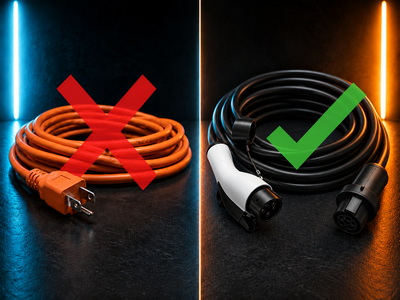
No. Two extension cords from one duplex still draw from a single branch circuit. Two 12A EVSEs would still be pulling 24A combined, which exceeds the allowable continuous load of a 15A or 20A circuit — regardless of how many extension cords are between the outlet and the EVSEs. And separately: household extension cords generally are not appropriate for continuous EV charging loads. See our EV extension cord safety guide.
Does each socket of a duplex outlet have its own 15A?
Under standard residential wiring, no — the two receptacles in a duplex are usually powered from the same 15A or 20A branch circuit. A split-wired duplex (two receptacles on two separate circuits) does exist but is uncommon and requires specific wiring. If in doubt, have a qualified electrician verify.
Can I use a Y-splitter or duplex adapter to charge two PHEVs at once?
No. A splitter adds outlets, not circuit capacity. The wall behind the splitter is still one branch circuit; two simultaneous 12A EVSEs still exceed its allowable continuous load.
Can a smart plug do EV load management?
No — consumer smart plugs designed for household loads are not listed or designed as EV load-management equipment. Use EV-specific equipment (dual-port EVSE or a networked/load-managed EVSE system) if you need two vehicles to charge on one circuit safely.
Can I install a NEMA 5-20 outlet to get 16A per plug?
A 20A branch circuit and NEMA 5-20 receptacle allows up to 16A continuous EV charging on a single suitable EVSE — that's still one vehicle at a time, and two 16A EVSEs on the same 20A circuit would draw 32A combined, well over the circuit's continuous capacity. Adding a second dedicated 120V circuit is usually the simpler solution if you truly need both vehicles charging at the same time.
Are two PHEVs on one 120V outlet a fire risk?
Sustained overcurrent on a branch circuit — repeatedly exceeding the continuous-load rating — can degrade the receptacle, damage wiring, and stress the breaker. The exact failure mode depends on the specific hardware. The safer path is to not put both loads on one ordinary circuit in the first place.
Can I charge one PHEV and one BEV on the same 120V circuit?
Not simultaneously — the same 24A combined problem applies. Also, most BEVs benefit from Level 2 at home; if you're adding a BEV to a PHEV household, this is usually when a second 240V circuit or a hardwired Level 2 EVSE becomes worthwhile.
Do PHEVs actually pull the full 12A?
Most stock PHEV Level 1 cordsets are 12A / 120V, and modern EVSEs signal maximum current to the vehicle via the SAE J1772 pilot. Actual momentary current can be lower if the vehicle throttles for thermal or state-of-charge reasons, but planning around 12A continuous is the safe assumption.
Primary Sources
- U.S. DOE Alternative Fuels Data Center — Charging Electric Vehicles at Home — dedicated branch circuit guidance, Level 1 characteristics
- NFPA 70 National Electrical Code — continuous-load treatment for EV charging (Article 625)
- Toyota — Prius Plug-in Hybrid specifications — 13.6 kWh battery capacity, ~11 hour 120V charge
- Enphase HCS-D40 dual-port EV charger — example of listed dual-port equipment for one-circuit shared charging
Last verified: 2026-09-13. OEM specifications and product-page references checked on 2026-09-13.