Switching EVs: Which Parts of Your Home-Charging Setup Still Work?

TL;DR
Most of your home-charging setup carries over when you switch EVs: the NEMA 14-50 outlet, the branch circuit, and the wall-mount holder stay put. What changes depends on the connector. Same inlet (J1772 to J1772, or NACS to NACS), you keep the EVSE too. Different inlet, you swap the EVSE or add an adapter. A NEC 625-compliant 14-50 circuit supports any 32A portable Level 2 on either standard. Exception: hardwired units and brand-locked cables like the Tesla Mobile Connector don't travel the same way.
Which situation describes you?
Find your pivot in the table below and jump to the matching recommendation.
| Your switch | What changes |
|---|---|
| Same connector (J1772 to J1772, or NACS to NACS) | Outlet, EVSE, holder, and adapters all stay. Re-check extension-cable amperage against the new car's onboard charger rating. |
| Different connector (J1772 to NACS, or NACS to J1772) | Outlet stays. Swap the EVSE variant, or use a certified adapter. Extension cable must match the new inlet type. |
| PHEV to BEV (power step-up) | Outlet usually fine. A 16A Level 1 unit is now underpowered — a 32A Level 2 on NEMA 14-50 covers an overnight full charge on most BEVs. |
| Second EV joining the household | Share one outlet with alternating-night scheduling, or install a second NEMA 14-50 on its own branch circuit. |
| Downgrading (BEV to PHEV, or exiting EV ownership) | Keep the outlet installed — it adds resale value and supports a lower-draw PHEV charger without changes. |
Identify what you have now
Before deciding what carries over, walk through your current kit and note four things: the outlet type, the EVSE connector, the EVSE amperage, and whether anything is hardwired.
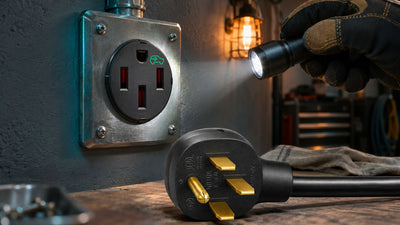
The outlet is the easiest to identify. Look at the receptacle behind your charger. A NEMA 14-50 is a four-prong 240V outlet, usually in a garage or on a dedicated wall near the parking spot. A NEMA 6-50 is a three-prong 240V outlet. A standard household NEMA 5-15 is the three-prong 120V type you'd plug a lamp into.
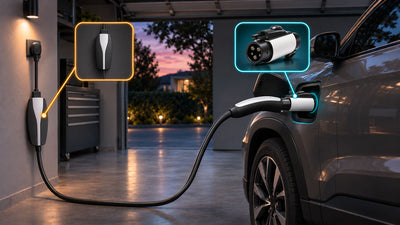
The EVSE connector is the plug that goes into the car. J1772 is the five-pin round plug used by most non-Tesla EVs through model year 2024. NACS (SAE J3400, standardized December 2023) is the slimmer plug Tesla has always used and that other automakers adopted for 2025.
| Vehicle (US market) | Through MY2024 | MY2025+ |
|---|---|---|
| Tesla Model 3 / Y / S / X | NACS | NACS |
| Ford Mach-E / F-150 Lightning | J1772 | NACS (Lightning 2025) |
| Rivian R1S / R1T | J1772 | NACS |
| Hyundai IONIQ 5 / Kia EV6 | J1772 | NACS |
| Chevy Bolt / Equinox EV | J1772 | NACS (Equinox EV) |
| GMC Hummer EV | J1772 | NACS |
| VW ID.4 / Nissan Leaf | J1772 | J1772 (confirm at delivery) |
MY2025 trim rollouts vary. Confirm the inlet on your window sticker or by looking at the car at delivery before ordering a connector-specific cable.
Component-by-component: what carries over
The decision matrix below pairs the five pieces of a typical home-charging setup against the five pivot scenarios. Y means the component carries over without changes; N means something needs to swap, add, or re-check.
| Component | Same inlet | Different inlet | PHEV→BEV | Second EV | Downgrade |
|---|---|---|---|---|---|
| NEMA 14-50 outlet | Y | Y | Y | Y / add 2nd | Y |
| Branch circuit (NEC 625) | Y | Y | Y | Y | Y |
| Portable EVSE (plug-in) | Y | N (swap variant) | N (if 16A L1) | Y | Y (resell) |
| Hardwired EVSE | Y | N (replace or adapter) | Y | Y | Y |
| Extension cable | Y (re-check A) | N (inlet-specific) | Y | Y | Y |
| Wall-mount holder | Y | Y (if universal) | Y | Y | Y |
| NEMA adapters (EVSE) | Y | Depends on EVSE | Y | Y | Y |
What always carries over
Three pieces of your setup are vehicle-agnostic. The NEMA 14-50 receptacle doesn't care what plugs into it — it delivers 240V single-phase up to 50A regardless of brand. The branch circuit (wire, breaker, ground) you had installed under NEC 625 is sized for the circuit, not the car. A universal wall-mount holder with an open plug cradle fits both J1772 and NACS plugs because the handle bodies are close in size.
What usually doesn't
Connector-specific hardware is the sticking point. A hardwired J1772 wall unit stays put but the plug no longer fits a 2025+ NACS car without an adapter. The Tesla Mobile Connector is NACS-only and sold with swappable NEMA input adapters — those adapters move the plug end to different wall outlets, but the car-side connector is permanently NACS. If you switch from a Tesla to a J1772 car, the Mobile Connector doesn't become a J1772 charger; you'd need a different EVSE.
Match power to the new battery
When stepping up from a PHEV to a BEV, your old charger's amperage matters more than it used to. A PHEV with a 12-18 kWh battery and a 3.3 kW onboard charger reaches full in 4-6 hours on a 16A Level 1 unit. A 75 kWh BEV on the same Level 1 charger needs 24+ hours.
A 32A Level 2 portable charger on a NEMA 14-50 outlet delivers roughly 7.7 kW. That brings a drained 75 kWh pack to full in about 10 hours — one overnight window. Per AFDC guidance, Level 2 at this power level is the typical home target for a BEV.
The 14-50 outlet you already have supports 32A continuous without changes. NEC 625 requires the branch circuit to be rated at least 125% of the continuous current, which a 50A breaker on 6 AWG wire already satisfies.
Which WenStorm charger to buy
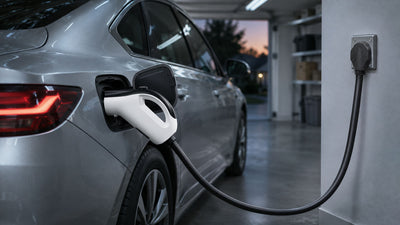
If you need a new EVSE because your inlet changed or because you're stepping up from Level 1, pick a unit that gives you flexibility in case you switch again. The WenStorm Level 2 Portable comes in J1772 and NACS variants — same body, same NEMA 14-50 input, same 32A rating. If you buy for your current car and later switch inlets, you only replace the connector-end unit, not the whole kit.
WenStorm sells the products featured below. WenStorm is not affiliated with any vehicle manufacturer.

Pick the variant that matches the new car's inlet. Reuse the NEMA 14-50 outlet you already have on the wall. If the new car's inlet amperage is lower than 32A (common on some PHEVs and the base Nissan Leaf), the EVSE auto-negotiates down — the rating is a maximum, not a required load.
If you also need an extension cable to reach the new car's charge port, pick one that matches the new inlet type.

When replacing hardware is NOT the right move
Not every EV switch requires buying something new. Skip the upgrade in these cases:
- Your current EVSE already matches the new car's inlet AND meets its onboard charger amperage. Buying a higher-rated charger adds no speed — the car accepts only what its OBC supports.
- You're switching between two J1772 cars with similar battery sizes. Your existing kit covers it; a cable amperage check is the only task.
- The new car is a PHEV. A Level 1 charger on a standard 5-15 outlet often fully recharges a PHEV overnight; buying Level 2 is optional.
- You're moving within six months. Portable Level 2 on a 14-50 outlet moves with you. Don't hardwire a new unit on the way out.
- The new car hasn't been delivered yet. Trim-level inlet changes in MY2025 are still rolling out — confirm at delivery before ordering an inlet-specific accessory.
- You're an apartment or condo renter without a dedicated outlet. The outlet question is landlord-level, not EVSE-level. Buying a Level 2 unit without an outlet to plug it into solves nothing.
- You already own a certified adapter that bridges your EVSE to the new car's inlet. Carmaker-supplied adapters (for example, the Tesla J1772 adapter) are an accepted path at home.
Related reading
- NACS vs J1772 in a multi-EV household
- Adding a portable backup when a second EV joins
- New EV owner checklist
- Tesla NEMA 6-50 vs 14-50: which outlet to install
- EV extension cable buyer's guide
Frequently asked questions
Does the NEMA 14-50 outlet I installed for my old EV work with any new EV?
Yes. The outlet is agnostic to vehicle brand and connector type. It delivers 240V up to 50A to whatever EVSE plugs into it, and the EVSE handles the car-side connector. If your old setup was a 14-50 outlet with a 32A plug-in Level 2, the outlet works with any 32A plug-in Level 2 on either J1772 or NACS.
Can I use my Tesla Mobile Connector with a non-Tesla EV?
Not directly. The Mobile Connector's output is a NACS plug permanently attached to the cable. A J1772 car has a different inlet. Some owners use a NACS-to-J1772 adapter in reverse (NACS plug into J1772 inlet), but per Tesla's current documentation, Tesla doesn't formally support this direction and prohibits extension cables of any kind on the Mobile Connector.
Will my extension cable work with the new car?
It depends on the cable type and the connector match. A J1772-to-J1772 extension works for any J1772 car on either side; a NACS extension needs a NACS car. The amperage rating must also meet or exceed the EVSE's current — a 50A-rated cable handles a 32A EVSE comfortably, but a 32A cable paired with a 40A EVSE is a mismatch.
What if I'm going from one EV to two?
You have three options. Share the existing outlet by alternating charge nights (simplest, zero hardware). Add a smart-splitter that time-slices the single circuit between two EVSEs. Or install a second NEMA 14-50 branch circuit if your panel has the amperage headroom.
Where to verify these claims
Primary sources used This article are linked inline next to each claim. For deeper verification: