EV Charging Safety: 5 Things to Check Before Plugging In

About this guide: a pre-use preflight checklist for US homeowners, renters, and fleet drivers using Level 1 or Level 2 portable EV chargers at home. Reviewed against the current NEC and manufacturer documentation. Not emergency-response advice — if your charger is already overheating, smoking, or sparking, skip to the during-and-after section.
TL;DR
Before every Level 1 or Level 2 plug-in session, confirm five things: the receptacle rating matches your charger’s plug, the branch circuit is dedicated, the receptacle is industrial-grade with no visible wear, the cable and connector show no damage, and your vehicle has no active charging-related recall. The receptacle grade and the dedicated-circuit check matter most — NEC 625.40 requires an individual branch for EVSE operating above 16A or 120V, and NEC 625.42 caps continuous EV charging at 80% of the circuit’s rated capacity. If you see discoloration, smell burning plastic, or hear arcing during a session, stop and get a qualified inspection.
The five checks, in order of urgency
Run these in sequence the first time you set up a new charger or a new outlet. After that, check 4 (cable and connector condition) is weekly; checks 1, 2, 3, and 5 are one-time per setup unless something changes (new charger, new outlet, new vehicle, software update, or a recall notice). The "during-and-after" section below covers the warning signs to watch for during active charging.
1. The receptacle rating matches the charger’s plug — AND the branch is sized for it
The physical plug shape tells you nothing about the circuit behind the receptacle. A NEMA 14-50 receptacle should be on a 50A circuit, but installers occasionally wire a 14-50 onto a 30A or 40A breaker. If the plug fits and the breaker holds for a few minutes, you might not notice the mismatch until the outlet overheats.
What to check: open your electrical panel, find the breaker that controls this outlet (label it if it isn’t), and confirm the amperage printed on the breaker handle matches the receptacle rating:
- NEMA 5-15 (standard household) → 15A breaker (sometimes 20A on a shared circuit)
- NEMA 14-30 (dryer outlet) → 30A breaker
- NEMA 14-50 (RV / range / EV) → 50A breaker
- NEMA 6-50 (welder outlet) → 50A breaker
If the breaker size is smaller than the receptacle’s rated capacity, the receptacle itself is derated to the breaker. Continuous EV charging is still capped at 80% of the breaker rating per NEC 625.42 — so a 50A receptacle on a 40A breaker caps at 32A continuous, not 40A.
2. The branch circuit is dedicated to this outlet — nothing else on it
NEC Article 625.40 requires an individual branch circuit for EVSE operating above 16A or above 120V — which covers every Level 2 setup and any Level 1 charger pulling more than 16A. The 2023 NEC also permits specified exceptions for managed-load / smart-splitter systems that share a circuit intelligently. For a standard portable Level 2 charger (32A or 40A) on a typical home circuit, treat "dedicated" as the default: no dryer, no range, no workshop tools, no second EV charger, no shared garage lighting on this breaker. Confirm your local code adoption — some jurisdictions still enforce earlier NEC editions.
What to check: with the breaker you labeled in Check 1, flip it OFF and walk the house. Any outlet, light, or appliance that loses power when that breaker is off is on this circuit. If anything other than the charging outlet goes dark, the branch is not dedicated.
A shared circuit is the leading cause of nuisance breaker trips during EV charging. More dangerously, a shared circuit can carry a cumulative load that exceeds its rating when the dryer kicks on mid-charge — the breaker may trip, but the receptacle has already run hot for the minutes before the trip. Have an electrician move the EV outlet to a dedicated circuit before continuing to use it at Level 2 current.
3. The receptacle is industrial-grade, not consumer-grade (and you have inspected the installation)
Continuous EV load at 32A or 40A heats receptacle contact points. The receptacle grade determines whether that heat stays safe or accumulates into a failure. Consumer-grade NEMA 14-50 receptacles (the common hardware-store models in the $15 range) have an observed failure history under continuous EV load; industrial-grade receptacles rated for continuous duty are the correct hardware.
What to check before plugging in: look at the receptacle itself. Industrial-grade 14-50 units (Hubbell HBL9450A, Bryant 9450FR, or equivalent) are visibly heavier than hardware-store models, typically have a metal face plate, and often carry the manufacturer logo on the face. If you do not know what grade is installed, ask a licensed electrician to inspect it before continuous EV load runs through it. Visually check for cracks in the face, loose or bent prong sockets, discoloration around the contact points, or any sign of previous heat damage — any of these is a stop-and-replace condition.
The conversation to have with the electrician if you are uncertain: "my 14-50 will be used for continuous EV charging and I want an industrial-grade replacement rated for continuous duty."
4. The cable and connector show no cuts, exposed conductors, bent pins, corrosion, or melted plastic
EV charging cables carry continuous current for hours and are physically handled in and out of a parked vehicle multiple times a week. Mechanical damage accumulates. A weekly visual inspection catches issues before they become connection faults.
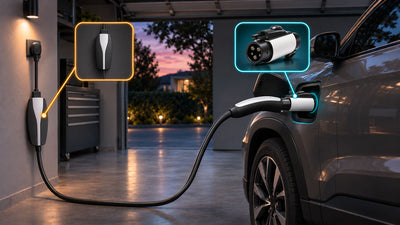
What to check: run your hand along the full cable length looking for cuts in the outer jacket, bulges, exposed inner conductors, or kink-flattening. Check the vehicle-side connector (J1772 or NACS) for bent pins, blackened or melted plastic around the pins, or corrosion on any metal surface. Check the wall-side plug for the same.
Any one of these is a stop condition. Melted plastic in particular — even small discoloration around a prong — is evidence that the connection ran hot in a prior session. Replace the charger before the next session. Do not try to clean corrosion off a connector with a wire brush; replace the unit.
5. Your vehicle has no active charging-related recall and its software is current
Several 2016–2022 EV models have had charging-related recalls that materially change the safe charging envelope. Some caps overnight charge current; others require avoiding Level 1 entirely until a remedy is installed; others affect the OEM mobile connector specifically.
What to check: run your VIN through the NHTSA recall lookup and note any charging-related entries. Specific recalls worth knowing about:
- Chevy Bolt battery recall (various 2017–2022 EV / 2022 EUV VINs). Pre-remedy, General Motors asked owners to limit state of charge and park outdoors during charging. Status depends on your VIN — some units have the remedy, some do not.
- Audi / Porsche NHTSA 23V-841 and 23V-842 charging-cable recall. Affected the 240V charging cable supplied with specific Audi e-tron and Porsche Taycan / Macan EV units; the remedy involves a free replacement cable.
- Tesla NHTSA 16E-091 adapter recall. Historical (2016) recall of Tesla NEMA 14-30, 10-30, and 6-50 adapters following reported overheating events; NEMA 14-50 was not in the recall scope. Replacement adapters were issued at the time.
Confirm your vehicle’s charging software is current — most 2020+ EVs push OTA updates that include charging-system fixes. An out-of-date charging firmware can cause the car to accept current it should not (or refuse current it should, which is annoying but safer).
What this checklist is not
This is a pre-use preflight for existing equipment and outlets. It does not cover:
- Branch-circuit installation. Running a new 240V circuit for a 14-50 or hardwiring a Level 2 EVSE is a licensed-electrician job. See the NEMA 14-50 install guide for the install scope.
- Emergency response to active overheating. If you see smoke, smell burning plastic, or hear arcing, stop the session at the vehicle first (unplug at the car, not at the wall) and cut power at the breaker. Do not approach a receptacle that is visibly damaged or smoking — call your utility or fire service.
- Specific charger brand diagnostics. Fault codes, app errors, and manufacturer-specific lockouts are covered in the product’s own documentation. This checklist covers the electrical envelope every charger shares.
During charging and after: what to watch for
Preflight is before you plug in. These warning signs appear during or after a charging session and tell you the installation has a problem:
- Visible discoloration, melting, or burn marks on either the wall plug or the vehicle-side connector — even small browning around a prong is evidence the connection ran hot. Stop using the equipment.
- Burning-plastic smell or visible smoke near the outlet. Do not touch the equipment. Cut power at the breaker if you can do so without approaching the outlet. Contact a qualified electrician or your utility.
- Arcing (a visible spark) when you connect or disconnect, or audible clicking from the outlet during charging.
- The breaker has tripped more than once on this circuit at the same current setting. This is the breaker telling you something is wrong, not a nuisance trip.
- Your car’s center screen reports a persistent charging fault that does not clear after unplugging and re-plugging at a different, known-good outlet.
- Visible heat shimmer or a receptacle plate that radiates warmth you can feel from a few inches away. Do not touch the equipment to confirm. Stop the session from the vehicle (unplug at the car), cut the breaker if it is safe to approach, and have a licensed electrician inspect.
In all of these cases: unplug at the vehicle first (never pull the live plug at the wall), cut power at the breaker, and stop using the specific outlet and cable until an electrician (for the outlet) or a replacement charger (for the cable) is in place. Continuing to use failing equipment under continuous EV load is the pathway from a minor issue to a receptacle fire.
Do not approach visibly smoking, sparking, or arcing equipment to investigate. The pre-use preflight checks above help you catch problems before they get to this stage; once a fault is active, stay back and get qualified help.
Related reading
- EV Charging Outlet Wear: 7 Warning Signs to Check — detailed visual guide to the receptacle-condition failure patterns referenced in Check 3.
- Why NEMA 14-50 Outlets Melt with EV Chargers (And How to Prevent It) — the physics behind the consumer-vs-industrial receptacle distinction.
- Why Does My EV Charger Keep Tripping the Breaker? — diagnostic walkthrough for Check 2 trip events.
- Charging an EV on a 100-Amp Panel Without a $4,000 Upgrade — load-sharing options when a dedicated circuit isn’t possible.
- NEMA 14-50 EV Charging Guide — install-side context for the receptacle referenced throughout.
If you’re reviewing WenStorm equipment, every WenStorm product page publishes the specific circuit requirements, plug type, and continuous current rating for that SKU. This checklist applies regardless of brand.
Sources
- NFPA 70, National Electrical Code (NEC), Article 625.40 — Electric Vehicle Branch Circuit — requires an individual branch circuit for every EVSE. Current adopted edition; consult your local Authority Having Jurisdiction for the edition in force.
- NFPA 70, NEC, Article 625.42 — Rating — EV charging is a continuous load; conductors and overcurrent protection must be sized at 125% of continuous current (equivalent to an 80% ceiling on the circuit’s rated capacity).
- US Department of Energy, Alternative Fuels Data Center — Charging at Home — independent reference for residential charging equipment categories and installation context.
- National Highway Traffic Safety Administration — Recalls VIN lookup — authoritative for active recalls affecting your specific VIN, including the charging-related recalls named in Check 5.
- Hubbell HBL9450A and Bryant 9450FR — industrial-grade NEMA 14-50 receptacles commonly specified for continuous EV charging; manufacturer datasheets are the primary source for the continuous-duty rating referenced in Check 3.