EV Extension Cable Buyer's Guide: J1772 vs NACS, Length, and What Not to Do

TL;DR
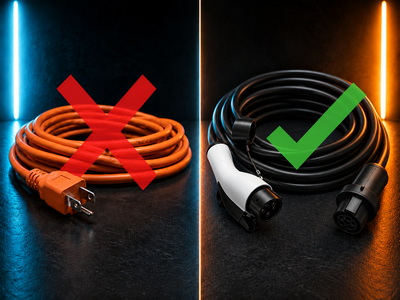
Wall-outlet side: never. Do not extend with a household cord; Tesla Mobile Connector prohibits extensions of any kind. Vehicle side (EVSE handle to car): match the plug shape. Use a J1772 extension for J1772 EVSEs, NACS for Tesla Wall or Mobile Connectors — including a J1772 EVSE + Tesla-via-adapter setup, which still needs a J1772 extension on the charger side. WenStorm's J1772 runs $129.99 (32A, 21 ft) to $339.99 (50A, 50 ft); NACS is $169.99–$339.99 (50A only).
Disclosure: WenStorm sells the J1772 and Tesla/NACS extension cables discussed below.

WenStorm J1772 EV Extension Cable
21 to 50 ft, 32A or 50A. Built with UL 2263-certified EV cable (UL-US-2407470-0). For Bolt, Ioniq, Rivian, Mach-E, and any other J1772 EV.
Buy It NowFrom $129.99
WenStorm Tesla/NACS Extension Cord
50A across all lengths (21 to 50 ft). Built with UL 2263-certified EV cable (UL-US-2407470-0). Confirm your specific Tesla or NACS EVSE's manual permits an extension first.
Buy It NowFrom $169.99Full safety framework — should I use one? →
Table of contents
- When to use an EV extension cable
- Which cable matches your EV (J1772 vs NACS)
- Choosing your length (21 to 50 ft)
- Sizing your cable — the actual math
- What NOT to do (safety anti-patterns)
- How to route the extension safely
- Special considerations by EV brand
- How to compare EV extension cable brands
- Frequently asked questions
When to use an EV extension cable
Level 2 EV chargers ship with a fixed cable — typically 20 to 25 feet. That works in most single-car garages when the outlet is on the same wall as the vehicle's charging inlet. When it doesn't work — the driver's-side inlet is 8 feet short of the plugged-in cable, the car parks in the driveway instead of the garage, the outlet is in the laundry room around a corner — the correct fix is a vehicle-side extension cable.
Critical distinction: the extension must be on the vehicle side of the EVSE (between the EVSE's factory cable end and your car's inlet). Never on the line side (between your wall outlet and the EVSE's plug). We explain why in the safety section below.
Real scenarios that call for an extension:
- Outlet on the opposite wall from the vehicle's charging inlet
- Car parks in the driveway; outlet is inside the garage
- Detached garage or workshop with the outlet on one side and parking on the other
- RV park pedestal that's fixed at one end of the site pad
- Public 240V outlet at a destination (campground, rental property) that's too far from your parking spot
Which cable matches your setup (J1772 vs NACS)
The extension has to match the entire charging path, not just your car. Identify these three points in order:
- The connector on the end of your AC charger (the "EVSE handle" — usually J1772 or NACS, sometimes labeled Tesla).
- Whether an approved AC adapter is in the path. If the EVSE handle and vehicle inlet don't match connector types, the vehicle manufacturer + EVSE manufacturer + adapter instructions must all permit the configuration before adding an extension.
- Your vehicle's charging inlet.
Then match the extension to the path:
Direct J1772 setup (EVSE handle is J1772, vehicle inlet is J1772)
Use a J1772-to-J1772 extension. Most 2013 through 2024 EVs use J1772 — Chevy Bolt, VW ID.4, Hyundai Ioniq 5/6, Kia EV6/EV9, Ford Mustang Mach-E, Ford F-150 Lightning, Nissan Leaf, Audi Q4 e-tron, and many others. Confirm your specific trim's inlet type in the vehicle owner's manual before ordering.

· certified via WenStorm Certification Center
Direct NACS setup (EVSE handle is NACS, vehicle inlet is NACS)
Use a NACS-to-NACS extension. Applies to Tesla vehicles and to non-Tesla EVs shipped with a native NACS inlet. Because manufacturers are still transitioning trim-by-trim, always confirm your specific model year and trim's inlet type in the vehicle owner's manual before ordering — don't rely on brand-level assumptions.

· Tesla Mobile Connector: confirm manual first
Adapter-in-path setup (EVSE handle and vehicle inlet don't match)
Before adding an extension, verify that (a) your EVSE manufacturer permits AC adapters, (b) your vehicle manufacturer supports the adapter you'll use, and (c) the adapter's own instructions permit an extension in the path. Common example: a J1772 EVSE charging a Tesla through a J1772-to-Tesla adapter typically calls for a J1772 extension (matched to the EVSE handle, before the adapter), not a NACS extension. Do not assume cross-connector combinations are universally compatible.
Choosing your length (21 to 50 ft)
Measure the path the cable will actually follow between your EVSE's factory cable end and your vehicle's charging inlet — not the straight-line distance. Add 3 to 5 feet of slack so the cable never sits taut at either end.
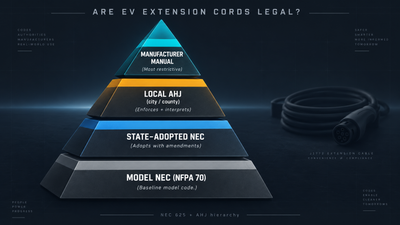
U.S. code note: NEC 625.17(C) limits the overall usable EVSE cord/cable length to 25 ft unless a cable-management system is part of the listed EVSE. For portable EVSE the measurement runs from the attachment plug to the vehicle connector; for fastened-in-place equipment, from the EVSE to the vehicle connector. States and municipalities adopt different NEC editions — confirm your local authority having jurisdiction's rules before adding an extension that pushes the total past 25 ft. See Can You Use an Extension Cord With an EV Charger? — NEC 625.17(C) note for full context.
| Length | Best for |
|---|---|
| 21 ft | Same-wall garage where the outlet is close to the parked vehicle's inlet side |
| 25 ft | Standard home garage with the outlet on the opposite wall or ceiling |
| 30 ft | Long garages, tandem parking, or workshop setups |
| 40 ft | Detached garage or driveway extension from a garage-mounted EVSE |
| 50 ft | Backyard parking pad or a detached workshop reached from a house-mounted EVSE. Do NOT route across a public sidewalk, driveway, or street — that creates a trip and traffic hazard and is often prohibited by local ordinance. |
For a walk-through of how to measure the routed path (with real garage examples), see Is a 25-Foot EV Charger Cable Long Enough?
Sizing your cable — the actual math
Voltage drop across an extension cable adds resistance to the charging path. Below 1% is imperceptible; below 3% is safe per NEC 210.19 informational note; above 3% and you'll start seeing EVSE derating at high loads. Here's what WenStorm's cables deliver at real EVSE outputs and lengths — the table nobody else publishes.
| Your EVSE output | 21 ft | 25 ft | 30 ft | 40 ft | 50 ft | Recommended WenStorm SKU |
|---|---|---|---|---|---|---|
| 16A (dryer-outlet Level 2) | 0.3% | 0.4% | 0.5% | 0.6% | 0.8% | Any J1772 or NACS variant |
| 24A (Tesla derated / dryer-outlet) | 0.4% | 0.5% | 0.6% | 0.9% | 1.1% | Any J1772 or NACS variant |
| 32A (WenStorm portable, Tesla Mobile Connector, common L2) | 0.5% | 0.6% | 0.8% | 1.1% | 1.4% | Any J1772 or NACS variant (32A J1772 at 21 ft is the budget pick) |
| 40A (Emporia plug-in, Wallbox 40A, Grizzl-E Classic) | 0.7% | 0.8% | 1.0% | 1.4% | 1.7% | 50A J1772 or NACS only (32A cable exceeded) |
| 48A (Emporia hardwired, Wallbox 48A, Tesla Wall Connector, Grizzl-E Ultimate 48A) | 0.8% | 1.0% | 1.2% | 1.6% | 2.0% | 50A J1772 or NACS only |
| 50A (ChargePoint Home Flex maxed) | 0.8% | 1.0% | 1.3% | 1.7% | 2.1% | 50A J1772 or NACS only (at cable ceiling) |
| >50A (Ford Charge Station Pro 80A, Grizzl-E Ultimate 80A) | Not compatible — exceeds cable rating | None (use a longer-cable EVSE or hardwire relocation) | ||||
Values calculated using 8 AWG copper conductors (WenStorm 50A cable spec — 2×8 AWG + 1×10 AWG + 2×18 AWG per the Certification Center) at 240V, 25°C ambient, per NEC 310.16 ampacity tables. Voltage drop scales linearly with length and current; heavier gauge reduces drop proportionally to circular-mil area.
When voltage drop actually matters: a 40A EVSE on a 50 ft extension delivers 39.3A instead of 40A (1.7% drop). Your car won't notice. What CAN cause the car to notice: high inlet temperature triggering the vehicle's onboard derating (not the cable's fault), or a loose plug joint adding contact resistance to the drop calculation (inspect the plug ends monthly on outdoor installs).
What NOT to do (safety anti-patterns)
Don't extend the wall-outlet side of your EVSE — the physics, not just the disclaimer
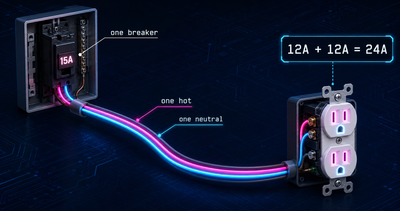
Household extension cords are typically rated for 15A at 125V and cannot safely carry the 30–50A / 240V current a Level 2 EVSE draws. That mismatch is a documented cause of connector heat damage in NHTSA charging-equipment incident reports and voids most EVSE warranties. But the deeper reason is one nobody publishes: the thermal sensor that protects your wall receptacle lives INSIDE the EVSE plug itself.
Every major EVSE — Tesla Mobile Connector, ChargePoint Home Flex, Wallbox Pulsar, Emporia Pro, Grizzl-E — has a temperature sensor built into its plug body that monitors the wall receptacle contact for overheating. When the sensor detects abnormal heat at the plug body, the EVSE derates or trips the connection to prevent a fire. This is the actual safety chain that keeps your NEMA 14-50 outlet from melting.
When you insert a household extension cord between the wall outlet and the EVSE plug, the sensor now measures the extension's plug body — not the wall receptacle where the actual failure would occur. The protection chain is broken. A properly-gauged 10 AWG outdoor extension cord passes the current fine, but it also defeats the thermal sensor's job. The wall receptacle can heat up unmonitored until it fails.
Real-world evidence: NHTSA recall 16E-091 (Tesla, 2016) affected 6,729 Mobile Connectors after temperature sensors caught overheating events at NEMA 14-50 receptacles. The sensor did its job because it was directly at the interface. Add an extension cord upstream, and those events wouldn't have been detected until the receptacle was already failing. This is why the manufacturer ban is physics, not liability.
The correct fixes: use a longer-cable EVSE, install a receptacle closer to your parking spot (electrician + permit), or add a car-side J1772 extension (which is a separate product on the vehicle side of the EVSE, where the sensor topology isn't affected).
Don't use a hardware-store extension cord for any part of an EV charging path
Even for occasional Level 1 (120V) charging, a generic hardware-store extension cord's insulation, conductor gauge, and plug/receptacle quality are not designed for continuous EV loads. Use an EV-listed extension product only.
Don't cross connector types without a manufacturer-approved AC adapter
A J1772 extension cable does not plug into a NACS vehicle inlet, and a NACS extension cable does not plug into a J1772 vehicle inlet. If your setup crosses connector types (for example, a Tesla Gen 2 Mobile Connector charging a J1772 vehicle), source the specific AC adapter your vehicle manufacturer supports. Do not use a generic third-party adapter for that path.
Don't try to extend a DC fast-charge cable
Supercharger, Electrify America, and EVgo stations use liquid-cooled cables built into the station. There is no consumer-grade way to extend a DC fast charger, and any attempt to do so risks damaging the vehicle inlet or the station.
Don't exceed the cable's documented continuous-current rating
The extension's own documented current rating must meet or exceed your EVSE's maximum continuous output. Read the rating from your EVSE's product manual, not from your vehicle's onboard charger — the EVSE's configured output is what determines the load on the cable. Common home EVSEs top out at 32A, 40A, 48A, or 80A. The WenStorm cables ship in 32A or 50A ratings, so a 50A cable covers EVSEs up to 50A — but does NOT cover higher-output units such as the Ford Charge Station Pro, which can supply up to 80A. A cable rated below your EVSE's continuous output will overheat.
How to route the extension safely
Every rule below has a specific reason — either a documented failure mode or a code/insurance concern. Follow all of them.
- Never route the cable through a closing door, window, or garage door. Crushed insulation is a documented failure mode in EV charging incident reports.
- Keep every connector off the ground and out of standing water. The J1772 and SAE J3400 connector standards are designed for outdoor operation, but connections sitting in puddles are outside the intended use envelope.
- Do not drive over any cable or connector. A single vehicle pass over the plug body can crack the housing and expose energized contacts.
- Do not cross a public sidewalk, driveway, or roadway. This creates a trip and traffic hazard and is often prohibited by local ordinance. Longer-reach charging in these situations requires a permitted install with an approved cable-management system, not an extension cord.
- Avoid sharp bends and mechanical tension. The plug interfaces bear the load if the cable is pulled tight; over time this causes intermittent contact and connector heating.
- Do NOT tightly coil energized excess cable. A tightly coiled cable under load can retain heat and, in extreme cases, damage the insulation. Lay excess cable out loosely per the product's own routing instructions.
- Never chain multiple extensions. Each additional connector pair adds contact resistance and a potential failure point.
- Stop charging immediately if a connector becomes abnormally hot, loose, damaged, or discolored. Any of these signs indicates a failing connection that needs inspection or replacement.
- Obtain permission before using an RV park pedestal, rental property outlet, or workplace charging setup. The outlet owner may have specific policies or amp limits, and unauthorized use can void your renter or host agreement.
Special considerations by EV brand
Tesla drivers
Tesla's Gen 2 Mobile Connector is a Tesla-branded accessory with a NEMA 14-50 plug (via the removable outlet adapter) and a NACS vehicle-side head. Tesla's Gen 2 Mobile Connector owner's manual instructs owners not to use an extension cord with the Mobile Connector. WenStorm's NACS extension cord is a third-party accessory that physically fits the Mobile Connector's cable end, but Tesla does not review or approve third-party vehicle-side extensions for use with the Mobile Connector. Follow Tesla's own charging guidance and do not treat physical fit as Tesla approval. If reach is a persistent issue for a Tesla, the Tesla Wall Connector — designed for permanent installation — is Tesla's supported longer-reach path.
Ford (Mustang Mach-E, F-150 Lightning) drivers
Both Ford EVs use J1772 through model year 2024 (NACS-native trims begin 2025). The Ford Charge Station Pro is a hardwired 48A EVSE — check its cable length before ordering an extension. For portable-EVSE setups (Ford Mobile Charger with 240V adapter), a 32A or 50A J1772 extension covers the reach gap. Vehicle-family recall status: verify at NHTSA VIN lookup before relying on overnight charging.
GM (Bolt EV/EUV, Blazer EV, Silverado EV) drivers
Bolt EV/EUV models (2017-2022) and 2022 Bolt EUV are subject to an active battery-related recall (GM Bolt recall; NHTSA 21V-650) with specific charging precautions for affected VINs. Verify your VIN at Chevrolet's recall lookup and follow the manufacturer's charging guidance before adding any extension to the charging path. Blazer EV and Silverado EV use J1772 through 2024, NACS from 2025.
Rivian (R1T, R1S) drivers
Both use J1772 through 2024, transitioning to NACS on 2025 models. The Rivian Portable Charger ships with a NEMA 14-50 plug and a J1772 vehicle head at 40A on 240V; a J1772 extension in the 50A rating handles the reach gap.
Hyundai / Kia (Ioniq 5/6, EV6, EV9) drivers
Ioniq 5/6 uses J1772 through the pre-NACS transition. Onboard charger is 10.9 kW per Hyundai's published spec — a J1772 extension in the 50A rating fits comfortably within that ceiling. Kia EV6 and EV9 follow similar rules per model year.
VW / Audi (ID.4, Q4 e-tron) drivers
Both use J1772 through 2024. Standard J1772 extension cable applies. VW-issued charging cables tend to be shorter (about 20 ft) than the market average — extensions are a common addition.
Most other EVs
If your vehicle uses J1772 and your EVSE outputs continuous Level 2 current at or below its rated ceiling, the same rules apply: match cable rating to EVSE output, match connector to vehicle inlet, keep the extension on the vehicle side of the EVSE only.
How to compare EV extension cable brands
When comparing extension cables across brands, six specs actually matter. Marketing copy about "heavy duty" or "premium quality" means nothing without them. Use this checklist for any brand — WenStorm, Lectron, or the growing list of aftermarket sellers on Amazon.
| What to check | WenStorm J1772 / NACS | Lectron J1772 40A (representative competitor) | Why it matters |
|---|---|---|---|
| Continuous-current rating | 32A or 50A (J1772); 50A (NACS) | 40A (per Lectron product listing) | Must meet or exceed your EVSE's maximum output. A 40A cable does NOT cover 48A hardwired chargers (Emporia Pro, Wallbox Pulsar Plus 48A, Grizzl-E Ultimate 48A). |
| Length options | 21, 25, 30, 40, 50 ft (5 lengths) | 20 ft, 40 ft (2 lengths, per Lectron listing) | More length options = less wasted slack coiled at the ends. Coiled excess cable retains heat under load. |
| Documented certification | Built with UL 2263-certified EV cable per the WenStorm Certification Center | UL 2251 (plugs/couplers) per Lectron marketing | UL 2251 covers the plug and coupler; UL 2263 (Cert No. UL-US-2407470-0) covers the cable material itself. Neither is the same as UL 2594 (full EVSE listing). Ask any brand for the specific documented listings on the exact SKU you're buying — do not accept "UL-listed" without a certificate reference. |
| Weather rating on the assembled SKU | Check the specific product page — WenStorm publishes IP ratings per SKU | IP66 claimed on the Lectron product page | Outdoor use with any extension exposes the coupler to rain, snow, and thermal cycling. Verify the exact SKU's published IP rating, not the connector standard's rating. |
| Terminal pin material | Silver-plated copper | Silver-plated (per Lectron marketing) | Silver has higher conductivity than brass or bare copper, reducing resistance heat at the connector interface under sustained Level 2 load. WenStorm and Lectron match on this spec — both are ahead of the generic brass-terminal cables sold in Amazon marketplace listings. |
| Connector cycle life (mate/unmate) | >10,000 cycles (tested no-load) | Not published | Extensions fail at the connector interface, not the cable. A 10,000-cycle rating means you can plug/unplug daily for 27+ years before mechanical wear affects the contact. |
| Operating temperature | -30°C to +50°C (-22°F to +122°F) | Not published | Matters if you charge outdoors in Minnesota winters or Phoenix summers. Cables rated for narrower ranges become brittle in cold or trip thermal protection in heat. |
| Warranty | 2 years (see WenStorm 2-Year Limited Warranty) | 12 months (per Lectron listing) | The failure mode on extension cables is the plug/coupler interface, not the cable itself. Longer warranties protect you when a connector wears out early. |
| Price (entry) | J1772: from $129.99 (32A, 21 ft) · NACS: from $169.99 (50A, 21 ft) | J1772: from ~$180 (40A, 20 ft, Amazon) | WenStorm's 32A budget option undercuts the market for buyers whose EVSE tops out at 32A — most standard Level 2 units. |
Cable construction detail: WenStorm's extension cables use 2×8 AWG conductors for the power lines, 1×10 AWG for the equipment ground, and 2×18 AWG for the control pilot and proximity signal. The 8 AWG power gauge is the standard specification for continuous 50A EV charging under NEC 310.16 ampacity tables. Operating altitude: up to 2,000 m.
What we still don't publish (and won't claim until we do): the specific NRTL file number for the UL-certified cable, and independent test data confirming the control-pilot signal passes end-to-end without attenuation. Both will appear on the Certification Center as engineering completes documentation.
Frequently asked questions
Can I use one extension cable with any Level 2 EVSE?
Only if the cable's connector type matches your vehicle's inlet AND the cable's current rating meets or exceeds the EVSE's continuous output. J1772 cables work with any J1772 EVSE and J1772 vehicle. NACS cables work with any NACS EVSE and NACS vehicle. Cross-connector combinations require a manufacturer-approved AC adapter and are not universally supported.
Does an extension cable slow down charging?
An EV-listed extension of the correct current rating adds negligible resistance and does not reduce charging speed at typical Level 2 currents. If you notice slower charging after adding an extension, check the connector fit (loose plugs generate resistance and heat), the cable rating vs the EVSE output, and the vehicle's own state-of-charge behavior — batteries taper charging speed as they approach full regardless of cable.
Is the same 25 ft the right pick for both J1772 and NACS variants?
Yes. The 25-foot length is measured end-to-end regardless of connector type; the connector shape at either end doesn't change the cable's physical reach.
What if my measured routed length is between 25 ft and 50 ft?
Size up to the next available length. Extra cable coiled at either end is safer than a cable pulled taut, which stresses the plug interfaces and can loosen the connection over time.
How long does the extension cable itself last?
The typical failure modes are the plug and connector interfaces, not the cable insulation. Inspect the plug-end and vehicle-end connectors every few months for discoloration, warmth after unplugging, or loose fit. Replace the cable if any of those signs appears rather than continuing to charge with a degraded connection.
Can I extend an existing extension cable with another extension?
No. Chaining extensions doubles the connector interfaces (each pair of joins adds contact resistance) and voids most EV-listed extension warranties. If a single extension of the length you need doesn't exist, address the root cause: relocate the outlet, re-park the vehicle, or install a longer-cable EVSE.
Are extension cables certified the same way as the EVSE?
No — the certification path is different. WenStorm's extension cables are built with UL 2263-certified EV cable (see the WenStorm Certification Center for the specific component listings). The EVSE has its own separate certification (typically UL 2594 for the complete unit). A cable-component listing does not extend to the EVSE, and vice versa; each product's certification governs its own rated output and use conditions.
Related reading
- Is a 25-Foot EV Charger Cable Long Enough? — the routed-path measurement walkthrough
- The 6-Item EV Road-Trip Backup Kit — where the extension cable fits in a portable-charging setup
- J1772 vs NACS: What's Actually Changing in 2026 — connector-standard transition context
- EV Charging Outlet Wear: 7 Warning Signs — receptacle safety for the outlet the EVSE plugs into
Written by Erik Nyholm, EV Charging Specialist at WenStorm. Erik covers electrical safety, receptacle and connector wear, cold-weather charging behavior, and NEMA / J1772 / NACS spec nuance.
Real questions from EV owners
Join the Outlet & Electrical Safety discussion →