Switching from a J1772 EV to a Tesla or Other NACS Vehicle: Do You Need a New Charger?

TL;DR
Your NEMA 14-50 outlet carries over, but your J1772 EVSE needs a decision: replace it with a NACS unit or add a J1772-to-NACS adapter at the car. The outlet is connector-agnostic. The cleanest path for a Tesla or 2025+ NACS vehicle is a native NACS EVSE on the same 14-50. The adapter path works but adds one more link to inspect and must be rated for your EVSE's amperage. Tesla publishes a J1772-to-NACS adapter in its own catalog for Tesla vehicles.
Which situation describes you?
Pick the row that matches your current gear and your new vehicle: the next step is listed on the right.
| Your situation | Next step |
|---|---|
| You own a WenStorm Level 2 Portable J1772 and are switching to a Tesla | Replace with the NACS variant on the same 14-50 outlet, or add a J1772-to-NACS adapter rated for 32A |
| You own a hardwired J1772 EVSE (Grizzl-E, ChargePoint Home Flex, etc.) | The adapter path is cheaper than rewiring; verify the adapter is rated for your unit's output amperage |
| You own a 48A hardwired J1772 wall unit | 48A-rated J1772-to-NACS adapters are less common — check availability before you plan around it |
| Your NEMA 14-50 outlet is already installed on a 50A circuit | The outlet carries over as-is: no electrician visit required for the connector change |
| Your new vehicle is a 2025+ Ford F-150 Lightning, Rivian, Chevy Equinox EV, or Hyundai/Kia with a NACS inlet | Native NACS EVSE is cleanest; check the vehicle's home-charging guide for its specific onboard-charger rating |
Identify what you already own
Before buying anything, confirm three things about your current setup: the outlet type on the wall, the EVSE's output amperage, and the connector on its end. The decision tree branches on these three facts.
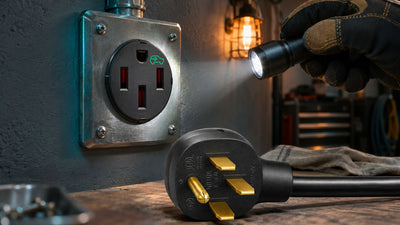
The outlet is the easy one. If you charge off a 14-50 receptacle today, that same receptacle feeds a Tesla, a 2025 Rivian, or any other NACS vehicle through a NACS-ended cable. The Alternative Fuels Data Center notes that Level 2 EVSEs use the same residential 240V infrastructure regardless of vehicle brand.
The EVSE output is on the data plate or in the product manual. A WenStorm Level 2 Portable is rated 32A. A ChargePoint Home Flex ranges 16-50A depending on dipswitch setting. A Grizzl-E Classic is 40A hardwired. The adapter you choose later has to match or exceed this rating.
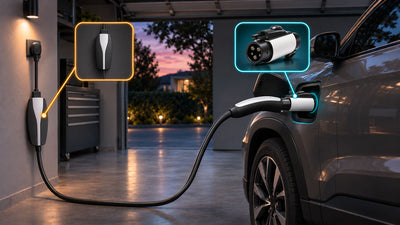
The connector is visible on the cable end. J1772 is the 5-pin round-plus-two-flat-tabs shape. NACS (also called J3400 after its 2023 SAE standardization) is the smaller rectangular Tesla-style head. If you have J1772 today and your new car is NACS, you have a mismatch to resolve.
| Vehicle | Model years with J1772 inlet | Model years with NACS inlet |
|---|---|---|
| Ford F-150 Lightning | 2022-2024 | 2025+ |
| Rivian R1S / R1T | Through 2024 | 2025+ |
| Hyundai IONIQ 5 | Through 2024 | 2025+ |
| Kia EV6 | Through 2024 | 2025+ (US-built) |
| Chevy Equinox EV | — | 2025+ |
| Tesla (all models) | — | All years (TPC/NACS) |
Trim and build-date splits matter inside a model year. Verify the inlet type at delivery — look at the car's charge port before you commit to an adapter-only path.
The outlet carries over: the EVSE is the decision
A NEMA 14-50 receptacle feeds a 50A/240V circuit. It does not know or care which brand of car is parked beside it. The National Electrical Code Article 625 governs the EV Power Transfer System connected to that outlet, including the branch-circuit sizing rule of ≥125% of the EVSE's continuous current. For a 32A portable EVSE on a 14-50, that math already works on a 50A circuit.
Any electrician work you already paid for stays done. The permit stays valid. The GFCI protection stays in place. You are only changing the device that plugs into the outlet, or the cable that comes out of that device.
What changes is the connector on the car-side end of the EVSE cable. That's where the three options diverge.
Three paths from J1772 to NACS
Option 1 — Replace the EVSE with a native NACS unit. You unplug the J1772 unit, plug in a NACS version into the same 14-50 outlet, and you're done. No adapter in the daily-use path. For a WenStorm Level 2 Portable owner, the NACS variant has the same body, same NEMA 14-50 plug, same 32A rating: only the car-side connector differs. If you intend to keep the car long-term and dislike adapters, this is the cleanest answer.
Option 2 — Keep the J1772 EVSE and add a J1772-to-NACS adapter at the car. The adapter sits on the EVSE's J1772 handle and presents a NACS-shape to the vehicle inlet. Tesla publishes a J1772 adapter in its Tesla Shop for Tesla vehicles; third-party J1772-to-NACS adapters exist from brands like Lectron and A2Z EV but their vehicle compatibility is narrower than Tesla's own. Pros: cheapest option, portable (you can take the adapter to a friend's J1772 EVSE too). Cons: one more connection to inspect, and the adapter's amp rating must meet or exceed your EVSE's output.
Option 3: Hybrid path for multi-EV households. If one driver stays on J1772 and one is switching to NACS, keep the J1772 EVSE and use the adapter only when the NACS car charges. This avoids re-buying hardware for a transitional period. The multi-EV household guide covers the swap cadence and adapter storage in detail.
Adapter direction matters — and amperage matters more
Direction trips people up. A J1772-to-NACS adapter accepts a J1772 plug on its input side and presents a NACS plug on its output side. It belongs at the vehicle inlet, screwed onto the end of your J1772 EVSE cable. A NACS-to-J1772 adapter is the opposite direction: it goes on a NACS cable (like a Tesla Mobile Connector) to feed a J1772 car. These two adapters are not interchangeable.
Amperage is the second trap. Adapters have an amp rating stamped on the shell or printed in the listing. If your J1772 EVSE outputs 40A continuous and you clip on a 32A-rated adapter, you've bottlenecked the system at 32A — or worse, overloaded a cheap adapter. Match the rating to your EVSE output, not to your vehicle's maximum acceptance rate.
Charging speed through a quality adapter is set by the EVSE output and the vehicle's onboard charger acceptance, whichever is lower. The adapter itself contributes negligible loss when sized correctly. A 32A J1772 EVSE delivers roughly 7.2 kW to a Tesla through an adapter: the same 7.2 kW it delivered to a J1772 car yesterday.
Which WenStorm product to buy
If you are keeping the same NEMA 14-50 outlet and want a native NACS EVSE, the Level 2 Portable is the direct swap for a WenStorm J1772 owner — identical body, same 32A output, NACS connector on the car-side end.
WenStorm sells the products featured below. WenStorm is not affiliated with any vehicle manufacturer.

At checkout, pick the NACS variant to match a Tesla or 2025+ NACS vehicle. The J1772 variant exists in the same listing for owners staying on J1772. Same price, same spec, different plug.
If your switch is temporary: say, one driver on NACS and one still on J1772 — and the J1772 EVSE already works, the adapter path from Tesla or Lectron is cheaper. In that case don't buy a new EVSE; buy the adapter and keep the existing cable.
When replacing the EVSE is not the right fix
Several situations argue against a native-NACS EVSE purchase and point to a different solution instead.
- You still have a J1772 vehicle in the household: keep the J1772 EVSE and use an adapter on the NACS car; you'll want the J1772 cable intact for the other vehicle.
- Your J1772 EVSE is hardwired (not plug-in) — a J1772-to-NACS adapter is cheaper than paying an electrician to swap the unit.
- You lease the Tesla or NACS vehicle for 24 months and will likely rotate again: adapter path preserves optionality.
- Your J1772 EVSE is a high-amperage unit (40A or 48A) and your new NACS vehicle's onboard charger is lower (e.g. 32A on a Tesla Model 3) — you aren't using the extra amps today, so there's no speed loss to recover.
- You rent and the EVSE belongs to the landlord: adapter is the only reversible option.
- You can't confirm your model year's inlet type yet (ordered car not delivered) — don't buy EITHER a new EVSE or an adapter until you see the actual port on the vehicle.
- Your charging habit is overnight 8-10 hour sessions on a daily driver: 32A versus 40A versus 48A changes nothing when you have 10 hours of plug time; don't pay for amperage you can't use.
Related reading
- NACS vs J1772 in a multi-EV household — how to split one EVSE across two vehicles with different inlets
- Tesla Model 3 home-charging guide: onboard-charger acceptance and real-world speeds
- Tesla Model Y home-charging guide — same chassis-level acceptance details
- Should you keep your old EVSE as a backup?: the case for not reselling the J1772 unit
- Tesla 6-50 vs 14-50 outlet decision — if you don't already have 14-50 installed
Frequently asked questions
Can I use a Tesla Mobile Connector with my old NEMA 14-50 outlet?
Yes. The 14-50 outlet is agnostic to connector type. A Tesla Mobile Connector (Gen 2 or Gen 3) with its NEMA 14-50 adapter plugs into the same outlet your J1772 EVSE used. The outlet feeds 240V and up to 50A; the EVSE throttles to its own rating (32A for the Mobile Connector).
Does the J1772-to-NACS adapter slow charging?
Not in any way you'll notice. Charging speed is set by the lower of the EVSE's output rating and the vehicle's onboard-charger acceptance. A properly sized adapter adds negligible resistance. A 32A J1772 EVSE delivers roughly 7.2 kW to a Tesla through the adapter: identical to what it delivered to the J1772 car.
Can I resell my J1772 EVSE?
Yes, and the secondary market is active — J1772 remains the installed-base connector on most pre-2025 EVs. But keeping it as a backup unit has value too: travel, friends with J1772 cars, or a hedge against your new NACS EVSE failing. The cost of storage is usually lower than the cost of replacing it later.
What if my 2025 vehicle's inlet is different from what the brochure said?
Build-date splits inside a model year are common during the J1772-to-NACS transition. Verify the inlet at delivery before buying hardware. If the car ships with a J1772-to-NACS adapter from the manufacturer (several brands include one for 2025+ owners), you may not need a separate purchase at all.
Where to verify these claims
Primary sources are linked inline above. For a deeper reference list on the specs mentioned:
- Tesla Mobile Connector and adapter documentation: adapter catalog, amp ratings
- AFDC Electric Vehicles: Charging at Home — Level 2 infrastructure overview
- NFPA 70 (National Electrical Code): Article 625 EV Power Transfer System requirements
- SAE J3400 standard — NACS connector standardization (December 2023)