Short answer: If a Tesla is the only thing that will ever plug into this outlet, install a 6-50 and save the wire cost; if the outlet might ever charge another EV or an RV, install a 14-50.
Who this guide is for: Tesla owners charging with the Mobile Connector (Gen 2 or Gen 3), deciding which 240V outlet to install in a garage or driveway. If you're wall-mounting a hardwired 40A or 48A EVSE, the trade-off math is different and this specific comparison does not apply — the Mobile Connector caps at 32A regardless of outlet, which is the number every calculation below assumes.
Still not sure which is the correct fit for your car?
What NEMA 6-50 and NEMA 14-50 physically are

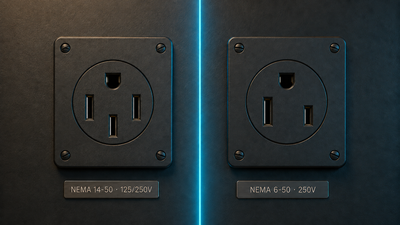
A NEMA 6-50 is a 50-amp, 240-volt receptacle with three prongs: two hots and a ground. It has no neutral. It was originally standardized for welders and industrial equipment that only need 240V phase-to-phase.
A NEMA 14-50 is also a 50-amp, 240-volt receptacle, but it has four prongs: two hots, a neutral, and a ground. The extra neutral pin lets it deliver 120V on either leg, which is why it's the default plug on RVs and shore-power pedestals.
The difference is the neutral. Everything else — voltage, current rating, breaker size (50A), wire ampacity requirement — is the same under the National Electrical Code.
Does a Tesla actually use the neutral pin?
No. The Tesla Mobile Connector charges the car with 240V across the two hot legs. The neutral pin on a 14-50 adapter is not connected internally on the Tesla Mobile Connector — Tesla's own service documentation confirms the neutral is unused for EV charging.
This is why the Tesla Mobile Connector is offered with both a 14-50 adapter and a 6-50 adapter at the same 32A output rating. Neither outlet gives the car more power than the other.
Load-bearing disclosure: WenStorm NEMA adapters are Tesla Gen 2 Mobile Connector accessories only. They are not a universal EVSE input and are not compatible with third-party Level 2 chargers or non-Tesla vehicles. If you drive a Ford, Rivian, Hyundai, or any J1772/CCS EV, this comparison still applies to your outlet choice, but you'll need a J1772-based EVSE — not a WenStorm adapter — to charge from it.
What most 6-50 vs 14-50 guides get wrong for Tesla owners
Search results for "NEMA 6-50 vs 14-50" are dominated by generic comparisons that treat every EV setup the same. Two errors show up repeatedly, and both matter for the install decision:
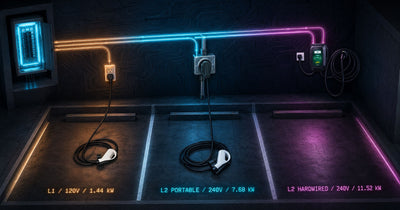
Error 1: Both outlets deliver 9.6 kW. True only if you're using a hardwired 40A wall connector. The Tesla Mobile Connector is software-limited to 32A on any 240V NEMA circuit — Gen 2 and Gen 3 both. That's 7.68 kW at 240V, roughly 30 miles per hour on a Model 3 or Y and 22 miles per hour on a Model S or X per Tesla's published charging rates. A 14-50 does not out-charge a 6-50 for a Tesla Mobile Connector user. If your comparison article quotes 9.6 kW, it's answering a different question than the one you're asking.
Error 2: "Adapters between 6-50 and 14-50 are unsafe." Correct for third-party outlet-to-outlet adapters (a 6-50 male plug wired to a 14-50 receptacle in a dongle), because those fabricate a neutral or bond neutral to ground and violate NEC 250.24(A)(5). Wrong when applied to Tesla's Mobile Connector adapter architecture, which is a plug-side accessory that identifies the outlet type to the connector so it can enforce the correct current limit. Tesla ships six of these adapters as first-party accessories. WenStorm manufactures Gen 2-compatible equivalents that are ETL Listed by Intertek. The distinction matters: contractor-style outlet adapters are unsafe; Mobile Connector adapters are the intended, code-compliant path.
Both of these errors push readers toward "install the 14-50 by default." That's still often the right answer for other reasons — but it should be the right answer for the right reasons, not because a generic article confused hardwired-EVSE numbers with Mobile Connector numbers.
Install cost: how much do you actually save with a 6-50?
The savings come from wire. A 6-50 on a 50A breaker needs 3-conductor cable (two hots + ground), typically 6/2 with ground NM-B or THHN. A 14-50 on a 50A breaker needs 4-conductor cable (two hots + neutral + ground), typically 6/3 with ground.
As of August 2026, 6/2 NM-B runs roughly $4.50–$5.50 per foot at U.S. big-box retailers; 6/3 NM-B runs roughly $5.50–$7.00 per foot. On a typical 40-foot garage run, that's a materials difference of $40–$60 on wire alone.
The receptacle itself is also cheaper. An industrial-grade 6-50R is often $15–$25; a comparable 14-50R for EV duty (Hubbell HBL9450A, Bryant 9450FR) is $60–$90. Add the plate and box, and the 6-50 install typically comes in $80–$150 lower on parts.

Electrician labor is similar. Pulling one extra conductor doesn't add meaningful time on a 40-foot run, so the labor line on your quote should be nearly identical either way.
Why 14-50 is still the industry default
Three reasons keep 14-50 as the default recommendation from most electricians and EV blogs:
RV compatibility. A 14-50 is the standard 50A RV shore-power plug. If you or a future homeowner ever parks a travel trailer or Class A RV in the driveway, the outlet just works.
Third-party EVSE compatibility. Most portable Level 2 chargers on the market — including Emporia, Grizzl-E, ChargePoint Home Flex plug-in, and Lectron — ship with a 14-50 plug by default. A 6-50 outlet blocks that market entirely unless the reader buys an adapter.
Resale value. When you list the house, "14-50 EV outlet in garage" is a checkbox buyers recognize. "6-50 welder outlet" reads as a welder outlet, even though it charges an EV identically.
How to make the decision

Option 1 — Install the 6-50
Good fit if: Tesla is the only EV in the household and you don't foresee that changing, no RV plans, you want to save $80–$150 on parts, and you're comfortable knowing the outlet is Tesla-plus-adapter specific.
You'll need the Tesla NEMA 6-50 adapter separately. Tesla stopped bundling adapters with the Mobile Connector in 2022, so the OEM Tesla 6-50 adapter is a $50 accessory and the WenStorm equivalent is $51.99 with a 2-year warranty.
Option 2 — Install the 14-50
Good fit if: there's any chance a second EV enters the household, you or a future owner might plug in an RV, you're already planning to buy a J1772 portable Level 2 charger, or you're renovating and the resale checkbox matters.
The 14-50 install costs a bit more up front but keeps every downstream option open. If you're on the fence, this is the safer default.
Same as the 6-50 path: Tesla stopped bundling the 14-50 adapter with the Mobile Connector in 2022, so you'll need to buy it separately. Tesla's own 14-50 adapter is around $45; the WenStorm equivalent is $59.99 with 170+ verified reviews.
Can I install a 6-50 now and upgrade to 14-50 later?
Yes, but it's a rewire, not a swap. The 6-50 circuit only pulled three conductors. Adding a neutral means pulling a fourth wire from the panel to the outlet box, which typically means fishing new cable through the wall or running surface conduit. Budget the cost of a second install job, not a $20 receptacle change.
The reverse (14-50 downgraded to 6-50) is a receptacle swap and cap-off of the unused neutral. That's a 15-minute job.
Code and safety notes for either install
Both outlets go on a dedicated 50A double-pole breaker per NEC 625.40 (individual branch circuit for EV supply equipment). Wire ampacity must match the breaker — 6 AWG copper is the standard call for a 50A EV circuit at typical run lengths.
NEC 210.8(F) requires GFCI protection for 240V receptacles installed in garages and outdoor locations. Either a GFCI breaker or a GFCI-protected receptacle satisfies this. GFCI breakers for 50A double-pole run $110–$150 as of 2026 and are the more common install.
The Tesla Mobile Connector is thermally monitored at the plug and will throttle or shut off if the receptacle overheats. That's a backstop, not a substitute for a properly torqued, industrial-grade receptacle.
Frequently asked questions
Does the Tesla Mobile Connector come with a 6-50 adapter?
No. Tesla unbundled adapters from the Mobile Connector in 2022. Elon Musk said on Twitter at the time that the adapters were "not needed" for most buyers because most owners had already installed a Wall Connector. The 6-50 adapter is now sold separately by Tesla, or as a lower-cost equivalent from WenStorm.
Will a 6-50 outlet charge my Tesla at full speed?
Yes. The Tesla Mobile Connector is capped at 32A on any 50A NEMA circuit regardless of adapter. A 6-50 delivers the same 32A / roughly 7.7 kW as a 14-50 through the same Mobile Connector.
Can I use a 6-50 outlet with a non-Tesla EV?
Only if you have a J1772 EVSE that plugs into a 6-50 (rare — most portable Level 2 units ship with a 14-50 plug). WenStorm's 6-50 adapter is Tesla Mobile Connector-specific and will not work as an input to a third-party EVSE.
Do I need a permit to install either outlet?
Almost always yes. Most U.S. jurisdictions require an electrical permit and inspection for any new 240V circuit. Your electrician will pull it as part of the quote.
Is the federal EV charger tax credit still available in 2026?
No. The federal §30C Alternative Fuel Vehicle Refueling Property Credit ended June 30, 2026. Equipment installed after that date is not eligible. Check your state and utility programs for local rebates that may still apply.
The bottom line
The 6-50 vs 14-50 decision is a bet on how narrow your charging setup will stay. A Tesla-only garage saves real money on a 6-50 with zero charging-speed penalty. A garage that might someday host a second EV, an RV, or a third-party portable charger is better served by the 14-50 and its extra neutral wire.
Whichever outlet you install, if you're charging a Tesla with the Mobile Connector you'll need the matching adapter. Tesla doesn't ship it in the box anymore.