Portable vs Wall-Mounted EV Charger: Which Do You Actually Need?

By Nathan Park — WenStorm
Most "portable vs wall-mounted EV charger" articles are written by brands that sell one or the other, and it shows. The wallbox side sells you on install permanence and 48A max amperage. The portable side sells you on price and portability. Both are true. Neither answers the actual question a buyer is asking, which is: which one fits how I actually charge?
The honest answer is scenario-dependent. Portable Level 2 is the correct primary choice for renters, movers, single-EV households, and anyone who parks overnight for 8+ hours. Wall-mounted Level 2 is the correct choice for long-term homeowners who need 48A charging (which requires hardwiring), multi-EV households, or buyers who want app-based load management. Both categories are legitimate — they solve overlapping problems with different tradeoffs.
Below: what "portable" and "wall-mounted" actually mean (the marketing conflates them), the verified 2026 spec + cost comparison, what each category does better, six scenario-based buyer profiles, and the shared receptacle-stress failure mode that neither category eliminates.
What "Portable" and "Wall-Mounted" Actually Mean
Two definitions get conflated across the market. Sorting them out first saves a lot of buyer confusion.
Portable Level 2 chargers are designed to plug into an existing 240V outlet with no wall-mount hardware. No bracket, no drilled screws, no J-hook holster. The electronics sit either in a small in-line control box on the cable, or (in newer designs) integrated into the connector handle itself. The whole assembly weighs little enough that carrying it from house to house, or trunk to Airbnb, is realistic. WenStorm's Level 2 portable and Lectron's J1772/NACS portables are examples.
Wall-mounted Level 2 chargers (also called wallboxes or EVSEs) are designed to be bolted to a wall. They may ship with a NEMA plug on the tail (making them "plug-in" capable) or be hardwired directly to a dedicated circuit. Either way, they're engineered as stationary equipment. The wall bracket takes the weight; the connector cable coils on a holster. Emporia Pro, ChargePoint Home Flex, Wallbox Pulsar Plus, JuiceBox 40, and Grizzl-E Classic are examples.
The marketing muddle is that wall-mounts with a NEMA plug variant frequently get listed as "portable." They aren't. A 20-pound wall unit with a pre-attached mounting bracket doesn't become portable because it can technically be unplugged. See our 2026 US portable buyer's guide for the honest portable shortlist and our Emporia Pro vs WenStorm comparison for a direct wall-mount vs portable head-to-head.
The 2026 Spec + Cost Comparison
Category-level comparison of what each product type typically delivers. Individual products vary — for specific brand-level specs and verified prices, see the linked comparisons above.
| Spec | Portable Level 2 | Wall-Mounted Level 2 |
|---|---|---|
| Design category | Plug-in only, no wall mount | Wall-mounted; NEMA plug or hardwired variants |
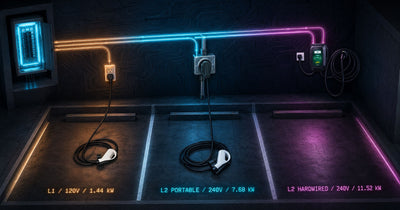
| Typical max amperage | 32–40A (7.7–9.6 kW at 240V) | 40A plug-in / 48A hardwired (9.6–11.5 kW at 240V) |
| Cable length (typical) | 16–25 ft | 18–25 ft |
| Installation | Plug into an existing compatible NEMA 14-50 outlet on an adequate dedicated circuit — no new install required if outlet exists | Wall mounting required; electrician needed for hardwiring and typically recommended for plug-in variants + panel work |
| App / load management | Standalone; no app on most portables | WiFi apps, load management, solar integration common (product-dependent) |
| Weather rating (typical) | IP54–IP67, product-dependent | NEMA Type 3R or 4, product-dependent |
| Warranty (typical) | 2 years (third-party portables) | 3 years (typical wall-mount category) |
| Hardware price (USD)Delta | $220–$310 typical | $450–$800 typical |
| Total installed cost | Effectively the hardware price when a compatible outlet already exists | Hardware + install labor; ranges from several hundred to several thousand dollars depending on wire run, panel capacity, permits, trenching, and any service upgrade |
| Moves when you move | Yes — it's yours | No, if hardwired; possible-but-impractical if plug-in wall-mount |
Two observations from this table.
The 48A ceiling is a hardwired-only spec. A NEMA 14-50 plug is limited to 40A continuous under NEC continuous-load rules — the 80% rule for continuous loads. If you see "48A portable" in marketing, that's almost always a wall-mount product with a plug-in variant that's limited to 40A on the plug and only reaches 48A when hardwired. True portable Level 2 chargers currently cap at 40A.
Installed cost is where wall-mount pricing gets fuzzy. Hardware is $450–$800 typical, but total installed cost depends on how far the run is from your electrical panel, whether you need permits, whether the panel has capacity, and whether trenching or a service upgrade is required. Honest ranges span several hundred to several thousand dollars. Anyone quoting a single flat number is guessing about your specific installation.
What Each Category Does Better
Where Portable Wins
Lower total cost. $220–$310 hardware, zero installation cost when a compatible outlet already exists. Compared to a wall-mount that's $450–$800 hardware plus install labor, the delta is real — often $500 to several thousand dollars.
Moves with you. If you rent, if you might move within 5 years, if you travel with the charger to a second property, if you sell the house — the portable follows you. A hardwired wall-mount stays with the property; a plug-in wall-mount can technically be uninstalled, but at 20+ pounds with a pre-attached bracket, it isn't designed to travel.
No install decisions. No electrician appointment (assuming compatible outlet exists), no permit, no drilling, no landlord amendment, no wall-material questions. Plug it in and charge.
Compatible with Airbnb, campgrounds, and travel scenarios. A portable in the trunk means you can charge at any RV park, Airbnb host with a NEMA 14-50, or friend's garage with a compatible outlet. See our road trip charging guide for the outlet-scouting framework.
Where Wall-Mounted Wins
Higher amperage ceiling (hardwired only). 48A hardwired charging delivers up to ~11.5 kW at 240V versus ~7.7 kW for a 32A portable. For a driver with a short parking window (park at 11 PM, out at 6 AM) or daily driving over 200 miles, that speed difference matters. Overnight parking of 8+ hours, either fills the battery.
App control and load management. Most modern wall-mounts include WiFi, scheduled charging (for time-of-use tariff optimization), solar-aware charging, and dynamic load management for shared circuits. Portables are typically standalone with no app.
No plug interface at all (when hardwired). Hardwiring removes the NEMA receptacle as a failure point. Continuous 32A+ charging is thermally close to what residential 14-50 outlets are rated for, and worn or improperly installed receptacles can degrade. Hardwiring sidesteps that whole class of concern.
Multi-EV load sharing. Two wall-mounts on the same circuit with load balancing typically pencils out better than two portables sharing one outlet. Wall-mount ecosystems are designed for this; portables aren't.
Cleaner permanent installation. If you value the aesthetic of a wall-mounted unit with a holster and a coiled cable — instead of a portable set on the floor or hanging on a hook — that's a real preference and a legitimate reason to pick wall-mounted.
The Decision Framework — 6 Buyer Profiles
Six common scenarios and the honest recommendation for each.
Profile 1 — You rent your home. Portable. A wall-mounted install stays with the property when your lease ends; a portable comes with you. See our renter's guide for the full lease conversation and outlet-audit playbook.
Profile 2 — You own but might move within 5 years. Portable, or a plug-in wall-mount you're willing to leave behind as a house-sale feature. Hardwiring a wallbox you'll leave behind in 3 years is money spent on someone else's house.
Profile 3 — You own long-term, single EV, park overnight. Either. This is the "which do you prefer" scenario, not the "which is objectively better" scenario. Overnight parking (8+ hours) refills any EV from empty at 32A. The wallbox delivers app control and a cleaner install; the portable delivers lower cost and travel flexibility. If you don't need the wallbox's specific features, portable is the cost-efficient answer.
Profile 4 — You own long-term, drive over 200 miles daily, or have a short parking window. Wall-mounted, hardwired at 48A. Portable Level 2 caps at 40A on a plug; if you genuinely need more input power, hardwiring is the only path.
Profile 5 — You have two or more EVs on the same circuit. Wall-mounted with load management. Two portables sharing one 14-50 outlet is workable in theory but not designed-for; wall-mount ecosystems (Emporia, ChargePoint, Wallbox) have dynamic load balancing built in.
Profile 6 — You live in an apartment or condo with limited electrical access. Portable is usually the only viable option; wall-mount installations typically require HOA/landlord approval, permits, and sometimes electrical panel upgrades. See our apartment charging guide for the full framework and our rental charging guide for the plug-in-only path.
The Shared Failure Mode — Plug-Side Receptacle Stress
Any plug-in charger — portable or plug-in wall-mount — shares one failure mode: the NEMA receptacle at the wall. Continuous 32–40A charging is thermally close to what residential 14-50 outlets are rated for. If the outlet is worn, residential-grade rather than commercial-grade, or improperly installed, contact resistance rises, heat builds, plastic softens, and in the worst documented cases the outlet melts.
This isn't manufacturer FUD. According to Emporia's own NEMA 14-50 outlet-safety guidance, the failure pattern is documented and specific:
“Documented cases of NEMA 14-50 outlet failures from EV charging show scorched outlets, melted plugs, and smoke damage. ... EV charging requires an outlet specifically designed for continuous, high-amperage loads, not just any 14-50 receptacle that happens to fit the plug.” — Emporia Energy, NEMA 14-50 Outlet Safety
The US Department of Energy takes the same view on the electrical side, noting that EV charging falls under the NEC's continuous-load rules:
“EV charging infrastructure is considered a continuous load by the National Electrical Code (NEC). ... Electricians can inform homeowners whether their home has adequate electrical capacity for vehicle charging.” — US Department of Energy, Alternative Fuels Data Center
It's a category property of continuous 32A+ charging on residential outlets — not a specific-product defect. Any experienced EV electrician will say the same.
How the two categories handle this differs at the margins. In-line control box portables (Lectron, Tesla Mobile Connector, most generics) sit mid-cable, so the outlet carries cable weight plus the small hanging plug. Connector-handle portables (WenStorm) eliminate the mid-cable box entirely. Wall-mounts bolted to the wall carry essentially no weight on the outlet at all.
None of these design choices eliminate the underlying receptacle failure risk. That's a function of the outlet itself, the wiring behind it, and how it was installed. What you can do as a buyer: have a qualified electrician install an industrial/commercial-grade NEMA 14-50 receptacle suitable for continuous EV charging on a dedicated 50A circuit, and have it inspected periodically. If the risk is a first-order concern, hardwiring a wall-mount removes the receptacle from the equation entirely.
Our Take — What We'd Buy in Each Scenario
If your scenario is rent, single EV, overnight parking: WenStorm's portable Level 2 at $219.99. Lowest total cost, moves with you, no install.
If your scenario is own long-term, single EV, 40A useful: still portable — Lectron J1772 at $249.99 for the plug-in 40A path, or WenStorm at $219.99 if 32A is enough (which it is for most drivers).
If your scenario is own long-term, need 48A, want app control: wall-mounted, hardwired. Emporia Pro is the reference product in that category — see our direct comparison for the 40A plug-in vs 48A hardwired math and the full spec comparison.
If your scenario is multi-EV household: two wall-mounts with load management. Portables aren't designed for this.
If your scenario is uncertain — could go either way in the next 5 years: start with a portable. If you later decide you want a wallbox, you haven't committed. The portable becomes your travel/backup unit and the wallbox becomes your daily driver. Committing to a hardwired install first and later deciding you want portability is the more expensive mistake.
Frequently Asked Questions
Is a portable EV charger as safe as a wall-mounted one?
A properly certified portable EV charger and a properly certified wall-mounted charger both meet the same electrical safety standards — look for a listing by a nationally recognized testing laboratory (such as UL or Intertek/ETL) to applicable standards including UL 2594 and UL 2231. The safety difference between the two categories is not the charger itself; it's the outlet. A hardwired wall-mount removes the NEMA receptacle from the equation entirely, which eliminates one failure mode (plug-side thermal stress). A plug-in unit — portable or wall-mount — depends on the receptacle being commercial-grade, correctly installed, and inspected periodically.
Can I charge as fast with a portable as with a wallbox?
At 240V, portable Level 2 chargers typically supply up to 7.7 kW at 32A or 9.6 kW at 40A. Wall-mounted chargers supply the same power on a plug-in variant (40A max on NEMA 14-50) and up to 11.5 kW at 48A when hardwired. Real-world miles added per hour varies by vehicle efficiency, temperature, and charging losses. For overnight parking of 8+ hours, portable and wall-mounted both refill any EV from empty. For shorter windows or high-mileage days, the 48A hardwired ceiling matters.
Do I need a permit for either?
For a portable used with an existing, code-compliant outlet, typically no new permit is required — you're plugging in a device, not modifying the property. For a wall-mounted install (hardwired or plug-in), local electrical codes typically require a permit for new circuit work, dedicated circuit installation, or panel upgrades. Requirements vary by jurisdiction; a licensed electrician working in your area will know the local rules.
Which one does my insurance prefer?
Ask your insurer directly. Homeowners and renters insurance policies vary substantially in what they cover for EV charging equipment and related liability. Get any required coverage or documentation in writing before you begin charging, regardless of which category you choose.
What if I have two EVs?
Wall-mounted with load management is the designed-for answer. Two wall-mounts on one 60A circuit with dynamic load balancing (Emporia PowerSmart, ChargePoint Home Flex load management, Wallbox load balancing) share power intelligently. Two portables sharing a single 14-50 outlet is workable if only one charges at a time, but you don't get automated balancing.
What about apartment / condo charging?
Portable is usually the only viable option in apartment or condo settings without a purpose-built charging installation. Wall-mount installations in shared or common-area parking typically require HOA/landlord approval, permits, insurance requirements, and sometimes electrical infrastructure upgrades. See our apartment charging guide and rental charging guide for the full playbook.
Our Bottom Line
The portable vs wall-mounted question isn't about which category is objectively better. It's about which set of tradeoffs matches your specific situation. Renters, movers, single-EV overnight-parking households, and apartment dwellers should default to portable — it's the correct primary choice for those scenarios, not a compromise. Long-term homeowners with 48A EVs, multi-EV households, or buyers who want app-based load management should default to wall-mounted. Everyone else can go either way, and the honest tiebreaker is cost: portable is dramatically less expensive when a compatible outlet already exists.
Two years from now the category boundary may shift — portable connector-handle designs are spreading, hardwired 48A may become code-required in more jurisdictions, and multi-EV households will keep growing. For today, the framework holds: match the product to the scenario, not to the marketing.
Sources
- Emporia Energy — NEMA 14-50 Outlet Safety: What EV Owners Need to Know
- US Department of Energy, Alternative Fuels Data Center — Charging Electric Vehicles at Home
- Emporia — Emporia Pro EV Charger Product Page
- WenStorm — Level 2 Portable EV Charger 32A NEMA 14-50 Product Page
- WenStorm — Return & Refund Policy (Warranty)