Tesla NEMA 14-30 Adapter for Renters: 24A Dryer Charging

TL;DR
For Tesla-owning renters with a NEMA 14-30 dryer outlet within cable reach, a WenStorm 14-30 adapter on the Tesla Gen 2 Mobile Connector delivers 24A / 5.76 kW Level 2 charging with no permanent install. That’s about 15–18 miles of range per hour — enough to cover most nightly driving. Verify the receptacle is a 14-30 (not a 10-30 or 14-50), that the existing dryer circuit is code-compliant and in sound condition, and that landlord policy allows an adapter. If the outlet is a 10-30 (non-grounding), get a licensed electrician’s evaluation first.
The Renter's Real Question
Most Tesla home-charging guides assume a Wall Connector installation. For renters, that path is often impractical: you may lack permission to modify the property, and any hardwired equipment installed on a wall you do not own stays behind when you move.
An adapter-based approach uses your existing Tesla Gen 2 Mobile Connector plus a manufacturer-approved NEMA adapter that identifies the outlet rating to the Mobile Connector. The Mobile Connector then limits its current draw to the appropriate ceiling for that outlet. When properly matched to a code-compliant, unmodified existing dryer receptacle, this is a legitimate Level 2 charging path.
The economics depend on the specific comparison and your specific lease term, but a WenStorm NEMA 14-30 adapter is a fraction of the cost of a Wall Connector install and moves with you when your lease ends. The question is not primarily economic: it is whether your specific dryer outlet, circuit, and installation are appropriate for continuous EV charging. The rest of this guide addresses that question.
Is Your Dryer Outlet a NEMA 14-30 or Something Else?
Before buying any adapter, verify what you actually have. Three residential outlets get confused constantly:
How to identify each
NEMA 14-30: four-prong receptacle with two flat hot conductors, an L-shaped neutral, and a separate round equipment-grounding pin. Rated for 30A at 240V. This is the current NEC-compliant standard for new dryer installations in most jurisdictions.
NEMA 10-30: older three-prong, non-grounding dryer receptacle with two flat hots and one L-shaped neutral, but no separate equipment-grounding conductor. Older dryer installations were permitted to bond the appliance frame through the neutral under specific code provisions. Because EV charging equipment normally relies on a reliable grounding path, have a licensed electrician evaluate an existing 10-30 circuit before EV charging use. Covered in a separate guide.
NEMA 14-50: four-prong receptacle with all straight blades (no L-shape anywhere), physically larger housing, rated for 50A at 240V. Common in RV parks, workshops, and garages built or upgraded for EV charging.
If your outlet has four prongs and it is on a dryer or in a laundry area, it is most likely a NEMA 14-30. Three prongs indicates a 10-30 and requires a different adapter plus additional electrician evaluation. A physically larger four-prong outlet indicates a 14-50 and requires a different adapter and circuit rating.
Why the difference matters
The adapter must match the outlet both physically and electrically. A manufacturer-approved adapter identifies the outlet rating to the Mobile Connector, which then limits current draw accordingly. A passive shape-changing adapter that provides no current-limit signaling to the Mobile Connector is not equivalent, and using one to force a higher-current EVSE onto a smaller-current receptacle is a fire risk regardless of price or brand. Match the specific adapter to the specific outlet, and use only adapters that the EVSE manufacturer approves for the specific configuration.
The WenStorm Tesla NEMA 14-30 Adapter
The WenStorm NEMA 14-30 adapter is designed for the Tesla Gen 2 Mobile Connector. It plugs into a standard four-prong dryer outlet and identifies the outlet rating to the Mobile Connector, which limits current draw to the 24A continuous ceiling appropriate for a 30A branch circuit.
Design points relevant to continuous EV charging duty:
- Nickel-plated pins. Bare brass contacts oxidize over months of thermal cycling, and oxidized contacts have higher electrical resistance. Higher local resistance at 24A continuous produces more heat, which accelerates oxidation. Nickel plating is a well-established mitigation for this compounding failure mode.
- Reinforced housing. WenStorm builds the adapter with reinforced materials and a molded connector designed to resist mechanical wear and heat cycling over years of continuous use.
- Marketed specifically for the Tesla Gen 2 Mobile Connector. Not a universal EVSE adapter. The adapter identifies the outlet rating to the Gen 2 Mobile Connector; other EVSEs are not supported by this specific product.
WenStorm publishes an ETL Listed badge for its portable Level 2 charger product line. For any specific adapter SKU, verify current certification status against WenStorm's live product page and, where a lab-verified record is required, request the underlying SKU-matched certificate.
Compatible with the Tesla Gen 2 Mobile Connector and works with current Tesla models per the WenStorm product-page compatibility list. Fits a standard NEMA 14-30 dryer outlet.
See the WenStorm NEMA 14-30 adapter →
Charging Speed on a NEMA 14-30
A NEMA 14-30 outlet is on a 30A breaker at 240V. Under NEC 210.19(A)(1) and 210.20(A), branch circuits must be sized for 125% of the continuous load they serve. EV charging is treated as a continuous load under Article 625. The practical result:
- 30A breaker × 80% (mathematical result of the 125% sizing rule) = 24A continuous charging current
- 24A × 240V ≈ 5.8 kW input power
Actual range added depends on the specific Tesla model, its onboard-charger efficiency, cabin thermal management, battery temperature, and other factors. Tesla's Gen 2 Mobile Connector charging tables list approximately 21-22 miles per hour for Model 3 and Model Y at 24A on 240V, with somewhat lower rates for the larger Model S and Model X. For most renters with typical daily driving needs, an 8-10 hour overnight session at 24A adds enough range to cover several days of ordinary use. A dedicated NEMA 14-50 circuit (permitting up to 32A or 40A continuous) charges faster but requires new electrical work.
Renter-Specific Considerations
Landlord permission
Whether you need explicit landlord permission depends on your lease, your state's tenant right-to-charge law (if any), and any HOA or condominium-association rules that apply to your specific property. Plugging in a portable device to an existing, unmodified outlet is typically treated differently from installing new electrical equipment on the property, but the specific answer depends on your lease and jurisdiction, and this article is not a substitute for reading your specific lease or consulting a landlord-tenant attorney about your specific situation.
Several states have residential-tenant right-to-charge statutes (California Civ. Code §1947.6, Colorado C.R.S. §38-12-601, Illinois 765 ILCS 1085/35, Connecticut §47a-13b, Oregon HB 2511 codified at ORS 90.462). Each has specific scope, exclusions, and conditions the landlord may impose. Other states have statutes that primarily protect condominium unit owners rather than tenants. Your rights depend on which statute (if any) applies to your specific rental situation. See our tenant EV charging installation guide for the state-by-state framework.
Regardless of legal requirements, having a conversation with your landlord before nightly charging begins is generally a good idea. Framing matters: describing the setup accurately (plugging a portable charging device into an existing dryer outlet) rather than in language that could imply property modification (installing a charger) helps set expectations correctly.
Sharing the outlet with the dryer
A 30A dryer circuit cannot support both a dryer's peak draw and continuous EV charging simultaneously. Do not operate both loads simultaneously on the same circuit, and do not rely on the breaker as an operating control; an overloaded breaker may not trip immediately. Avoid passive Y-splitters. Alternate use only, with EV charging typically overnight and dryer use during the day.
The cable route
The Tesla Gen 2 Mobile Connector cable is a specific length (check Tesla's documentation for your unit). Plan a cable route that does not pass through doors that will close on the cable, does not run under a rolling garage door that will close during the night, and is not exposed to moisture, snow, or standing water. If the only viable route requires closing a door on the cable, use a doorway pass-through kit specifically rated for that purpose, or wait until the route can be modified.
Setup Steps
Before first use, confirm the electrical readiness of the circuit per the section below. Once verified:
- If the dryer is on the same outlet, unplug it first.
- Plug the WenStorm NEMA 14-30 adapter into the dryer outlet. It should insert with firm pressure, and should not wobble when seated.
- Plug the Tesla Mobile Connector's wall end into the WenStorm adapter.
- Connect the Mobile Connector to your Tesla's charge port.
- Verify in the Tesla app that charging has started and that the current-draw indicator matches the expected 24A continuous ceiling for a 30A circuit.
- Set a charge limit per your typical driving needs and your battery's recommended usage pattern.
- Optional: schedule charging to start at your utility's off-peak rate window, if applicable.
Electrical Readiness the First Time (and Periodically)
Inspect the receptacle before first use, and re-inspect per the equipment manufacturer's maintenance instructions. A licensed electrician's evaluation is warranted for the initial setup, especially in an older building or if any of the risk indicators below apply.
Visual inspection of the receptacle. No discoloration around any prong hole (any brown, gray, or black around the openings), no visible arc damage, no wobble when a plug is inserted, no cracked or deformed plastic. If any of these are present, do not use the receptacle for continuous EV charging until a licensed electrician has evaluated and, if warranted, replaced it.
Verify the breaker size and wire compatibility. Confirm the breaker is 30A (someone may have upsized without upsizing the wire, which is a fire risk regardless of what is plugged in) and that the wire gauge and conductor material (copper, aluminum, or a mix) are compatible with the receptacle's terminals per the locally adopted code. Both are electrician-verify items rather than DIY-verify items.
Conductor and termination compatibility. Aluminum conductors are not automatically unsafe, but the receptacle, terminals, and installation must be approved for the conductor material (CU/AL rating, connection method, torque, condition). Small-gauge legacy solid-aluminum branch wiring from the 1965-1975 era presents different concerns from properly installed larger stranded aluminum conductors. An electrician should verify the conductor type before continuous EV load.
No extension cords. The Tesla Mobile Connector cable is rated for its charging current at its rated length. Extension cords are typically not rated for continuous 24A EV charging, and voltage drop over an added length can cause the adapter and outlet to overheat. Move the vehicle closer if the standard cable does not reach.
Do not rely on touch alone for safety. Some temperature rise can occur during continuous charging. Stop charging if the plug or receptacle becomes unusually or increasingly warm, uncomfortable to touch, discolored, loose, noisy, or produces an odor. Follow any temperature warning or fault shown by the Mobile Connector or the vehicle. The breaker is not a temperature monitor for the receptacle; loose or resistive connections can overheat locally without drawing enough total current to trip the breaker.
The Full WenStorm Tesla NEMA Adapter Lineup
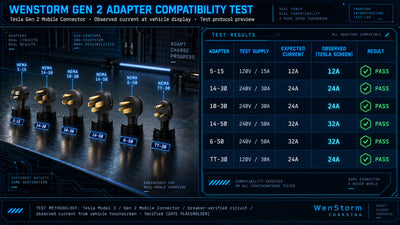
The 14-30 covers the renter/dryer scenario. WenStorm sells NEMA adapters for the Tesla Gen 2 Mobile Connector across other common residential and travel outlet types:
| Adapter | Outlet | Typical location | Continuous EV limit |
|---|---|---|---|
| NEMA 14-30 | 4-prong 30A dryer outlet (grounded) | Laundry rooms, utility areas, newer apartments | 24A / ~5.8 kW |
| NEMA 10-30 | 3-prong 30A older dryer outlet (non-grounding) | Older homes and buildings; requires electrician grounding review | 24A / ~5.8 kW |
| NEMA 14-50 | 4-prong 50A range/RV outlet | Modern garages, workshops, RV parks | 32A / ~7.7 kW (Tesla Gen 2 Mobile Connector ceiling) |
| NEMA 6-50 | 3-prong 50A welder outlet (no neutral) | Workshops, older garages | 32A / ~7.7 kW (Mobile Connector ceiling) |
| NEMA TT-30 | 3-prong 30A RV outlet (120V) | RV parks and campgrounds | Level 1-equivalent rates |
For the full breakdown of each outlet type and the amp math behind each speed, see our Tesla NEMA Adapter Guide. If you are not sure which outlet you have, our Solution Finder walks through an identification process that matches your outlet to the right adapter. Existing circuits may still require inspection by a qualified electrician before EV charging.
When You Should Not Use This Setup
An adapter-based approach to dryer-outlet EV charging is appropriate for some renters and inappropriate for others. Skip the plug-in setup and get a licensed electrician to evaluate the specific situation if any of the following apply:
- The outlet has visible scorch marks, discoloration, arc damage, cracked plastic, or a burning smell
- The plug wobbles noticeably when inserted or does not seat firmly
- The building has aluminum branch-circuit wiring and no documented professional evaluation of the specific circuit terminations for continuous EV load compatibility
- The breaker for the outlet is not 30A (upsized-breaker-without-upsized-wire is a fire risk regardless of what is plugged in)
- The outlet is outdoors and lacks appropriate weather protection or GFCI protection as required by locally adopted code
- The dryer that shares the outlet runs during the same window you would be charging (the two loads cannot run simultaneously on a 30A circuit)
- Any repeated interruption of charging happens on the same outlet within a short window (see our EV charger stopped mid-session diagnostic for the escalation rule)
In any of these cases, either hire a licensed electrician to evaluate and address the underlying issue, or fall back to Level 1 charging from a standard 120V outlet using the Level 1 adapter that ships with the Mobile Connector.
Not sure if your setup is safe? Use the WenStorm Solution Finder →
Frequently Asked Questions
Can a Tesla charge from a NEMA 14-30 dryer outlet?
Yes, when the outlet is code-compliant and in good condition, the circuit is a properly sized dedicated 30A branch, and you use a manufacturer-approved adapter that identifies the outlet rating to the Tesla Gen 2 Mobile Connector so the Mobile Connector limits current to 24A continuous. Tesla's Gen 2 Mobile Connector charging tables list approximately 21-22 miles per hour for Model 3 and Model Y at 24A on 240V. This is Level 2 charging, though at a lower amperage than a Wall Connector on a 60A hardwired circuit.
Do I need permission from my landlord?
It depends on your lease, your state's tenant right-to-charge law (if any applies to your specific rental), and any HOA or condominium-association rules that apply to your specific property. Plugging in a portable device to an existing, unmodified outlet is typically treated differently from installing new electrical equipment, but the specific answer depends on your lease. Read your lease, and consult a landlord-tenant attorney for your specific situation before assuming permission is or is not required. See our tenant EV charging installation guide for the state-by-state framework.
What is the difference between a NEMA 14-30 and a NEMA 10-30 for Tesla charging?
Both are 30A 240V dryer circuits and both permit up to 24A continuous EV charging with the appropriate Tesla Gen 2 Mobile Connector adapter. The physical difference is grounding: NEMA 14-30 is a four-prong grounding receptacle with a separate equipment-grounding conductor; NEMA 10-30 is a three-prong non-grounding receptacle where older installations were permitted to bond the appliance frame through the neutral under specific code provisions. Because EV charging equipment normally relies on a reliable grounding path, an existing 10-30 circuit warrants specific licensed-electrician evaluation before EV charging use. Each requires a different WenStorm adapter (they are not interchangeable).
How fast will my Tesla charge on a NEMA 14-30?
24A continuous at 240V, which is approximately 5.8 kW input power. Tesla's Gen 2 Mobile Connector charging tables list approximately 21-22 miles per hour for Model 3 and Model Y, with somewhat lower rates for Model S and Model X. Actual range added varies with vehicle model, onboard-charger efficiency, cabin thermal management, and battery temperature. An 8-10 hour overnight session adds range appropriate for typical daily driving.
Is it safe to leave my Tesla plugged into a dryer outlet overnight?
When the receptacle is code-compliant and in good condition, the circuit is properly sized, the adapter is a manufacturer-approved Tesla Gen 2 Mobile Connector accessory, and there are no visible warning signs on the receptacle or the connection, overnight charging is a supported use case for this equipment. The Mobile Connector includes UL-required ground-fault and thermal protection that interrupts charging on detected anomalies. Do not rely on touch alone to determine safety; stop charging if the plug or receptacle becomes unusually or increasingly warm, uncomfortable to touch, discolored, loose, noisy, or produces an odor. A licensed-electrician evaluation of the specific receptacle before first nightly use is strongly recommended.
Do I need to unplug my dryer to charge my Tesla?
Yes, when the dryer and the Tesla share the same 30A outlet. A 30A circuit cannot support both loads simultaneously. Alternate use only: EV charging typically overnight, dryer use during the day. If your building has a separate dedicated 14-30 with no dryer on it, no need to unplug anything.
An adapter-based Level 2 charging setup using an existing NEMA 14-30 dryer outlet can be an appropriate lease-friendly option for renters when the outlet, circuit, and installation support continuous EV load and a manufacturer-approved adapter identifies the outlet rating to the Tesla Gen 2 Mobile Connector. Verify the outlet condition and get a licensed-electrician evaluation for your specific installation before nightly use.
See the WenStorm Tesla NEMA 14-30 adapter →
Related reading: