EV Charging for Airbnb Hosts: Guest Policies, ROI, and When Not to Offer It

Two existing WenStorm articles cover the how-to side of adding EV charging to an Airbnb: how to add EV charging as an amenity without a $5,000 install and the Airbnb EV Charger Playbook for under $300. This article covers a different question: is it worth adding, what policies should protect you, and when should you say no?
Direct answer: In urban and destination markets where guests routinely drive EVs, offering charging can be a real listing differentiator. Some hosts see occupancy or nightly-rate premiums for it. Every host who offers it also picks up added equipment wear, new liability questions, an electricity-attribution decision, and a new guest-communication task. This guide walks through the business decision, the policy language, the liability and insurance calls, and the situations where the right answer is not to offer EV charging at all.
What this guide covers
- Is it actually worth adding? What the signal says
- Three hosting scenarios that decide the setup
- Guest-facing policy — what to put in the listing and house manual
- Liability, deposit language, and insurance
- When to say no — honest scenarios to skip it
- Equipment (and where to defer to the how-to guides)
- Tax and utility questions to ask a professional
- Recommended host setup
- Frequently asked questions
1. Is it actually worth adding? What the signal says
The commercial case for adding EV charging as a listing amenity depends heavily on your specific market. Three signals are worth checking before deciding.
Nearby EV registration density. Hosts in California, Texas metros, Washington, Oregon, Colorado, and Northeast urban markets see a higher share of EV-driving guests than hosts in markets where EV adoption is still emerging. Your state DMV or a public EV-registration dashboard for your county is a useful sanity check before deciding whether the amenity fits your guest mix.
Airbnb listing search-filter usage. Airbnb lets guests filter for "EV charger" on many market pages. If you can view competitor listings in your market, the share already flagging EV charging as an amenity is a proxy for guest expectation. Where most comparable listings offer it, not offering can cost you bookings. Where few offer it, being the one that does may earn a small preference premium or may make no measurable difference.
Your own booking history. If guests have asked about EV charging in inquiries over the past twelve months, that is direct signal for your listing. If nobody has asked, the demand at your listing may not yet justify the spend.
A cabin two hours from any DC fast charger will see a different EV-guest picture than a downtown Portland rental. Match the decision to your market, not to a national average.
Break-even math by market type (2026)
The table below models return-on-investment for a $242.98 Universal Airbnb Host Kit (portable NACS 32A EVSE + NACS-to-J1772 adapter, no install cost if a code-compliant NEMA 14-50 already exists at the parking spot). Every row uses the same session assumption: 10 kWh per overnight guest-charging session, priced at the US residential average of $0.183/kWh per EIA, giving an electricity cost of about $1.83 per session. The "nightly premium" column is the additional listing fee you charge for the amenity (either bundled or a line-item surcharge). Actual numbers vary by market, tariff, guest mix, and how you attribute electricity — treat this as a decision-framework, not a forecast.
| Market type | Typical nightly premium | Sessions / month (estimate) | Monthly electricity cost | Net monthly revenue | Payback on $242.98 kit |
|---|---|---|---|---|---|
| Urban EV-dense (SF Bay, LA, Portland, Seattle, Austin) | $10–$15 / night | 15–20 | ~$27–$37 | ~$115–$260 | 1–2 months |
| Suburban EV-adjacent (Denver metro, NYC suburbs, Boston metro, DC-area) | $5–$10 / night | 10–15 | ~$18–$27 | ~$32–$123 | 2–8 months |
| Destination / vacation (Napa, Sedona, Aspen, coastal resorts) | $10–$20 / night | 8–15 | ~$15–$27 | ~$65–$273 | 1–4 months |
| Rural / low-EV (Midwest small towns, non-EV-hub regions) | $0–$5 / night | 0–4 | ~$0–$7 | ~$0–$13 | May not recover |
What this means: If you host in an EV-dense urban or destination market and guests actually book, the equipment cost recovers fast — often in the first quarter. If you host in a low-EV rural market where nobody has asked about charging, adding the amenity is a bet on future demand rather than a proven ROI. The middle two market types depend heavily on your specific listing's booking cadence, so track your own inquiry-mentions of EV charging over 90 days before spending.
Table assumptions: 10 kWh per session (typical overnight guest top-up on a mainstream EV), EIA 2026 US residential average of $0.183/kWh, single-vehicle guest at a time, no additional install cost. Your utility rate, session length, and vehicle mix will shift the numbers. Higher-mileage guests or Level 1-only outlets change the model materially.
2. Three hosting scenarios that decide the setup
The right equipment and policy depend on which of three hosting scenarios describes yours.
Single unit, hosted by the property owner
The most flexible scenario. You own the property, you make the electrical decisions, and you set the guest policy. The Universal Airbnb Host Kit approach (a portable NACS 32A EVSE with a NACS-to-J1772 adapter) serves the widest range of guest vehicles from a single existing NEMA 14-50 outlet, with no ongoing maintenance beyond routine outlet inspection.
Single unit, hosted in a leased property (co-host or lessee host)
Adds a landlord-approval conversation on top of the guest-policy conversation. Before offering EV charging to guests, the underlying lease and landlord agreement must permit the electrical use and the resale of electricity to guests. Some leases explicitly forbid subletting electricity; some require landlord approval for any commercial-adjacent use of the property. See our apartment EV charging guide for the landlord-approval framework.
Portfolio host (multiple units, one host)
Standardization matters across units. If you host three or more properties, the policy language, the equipment setup, the electricity-attribution method, and the guest-communication script should be identical unit to unit. Guest complaints often trace to inconsistency across a portfolio ("the last host let me charge for free; this one wants me to pay"). Standardize before scaling.
3. Guest-facing policy — what to put in the listing and house manual
A clear, guest-facing policy communicated at booking-time prevents most of the friction that hosts report after adding EV charging. Four elements to include.
In the listing description and amenity list
- State that EV charging is offered
- State the tier (Level 1 / Level 2) and approximate rate ("Level 2 charging, approximately 25-30 miles per hour")
- State the connector (J1772 / NACS / adapter-included)
- State any material restriction (assigned parking spot, weather-dependent, single-vehicle only, additional fee)
In the guest house manual (before check-in)
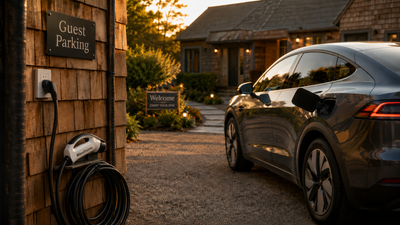
- The exact location of the charging equipment
- Basic operating instructions (plug order, LED indicators to watch for, what to do if a warning light appears)
- A clear statement of the electricity-cost arrangement (see Section 4)
- Contact info if anything goes wrong during their stay
- The specific outlet the EVSE is intended to use — guests should not plug into any other outlet in the property
Electricity cost — what the guest actually pays
Three approaches work in practice:
- Included in the nightly rate. Simplest for the guest and cleanest for shorter stays. Works when guest driving is bounded. A single overnight-charged EV drawing about 10 kWh will not materially change your utility bill.
- Flat per-night surcharge. A small line-item on the nightly rate (typically $5 to $15 per night) covers typical charging. Once the policy is written, you do not have to touch it again.
- Metered or actual-usage. The most accurate but the highest guest-friction. Some connected EVSEs report per-session kWh; some hosts install a dedicated sub-meter. Reimbursement follows the actual utility rate. Best fit for longer stays or higher-mileage guests.
Whichever you choose, put it in the listing before the guest books. Surprising a guest at check-out with an unexpected electricity charge shows up quickly in reviews.
4. Liability, deposit language, and insurance
Three legal-adjacent decisions matter before offering EV charging.
Damage-deposit language. Your damage-deposit terms should specifically address damage to the receptacle, cable, and charging equipment caused by guest misuse. Generic "damage to the property" language may not cover a melted 14-50 or a cut EVSE cable. Spelling out charging equipment as covered protects both sides by making the expectation explicit. Have a local attorney review the exact wording. Do not draft a liability clause from an online template without qualified review.
Insurance coverage. Airbnb's AirCover for Hosts currently advertises up to $3 million in host damage protection and $1 million in host liability insurance, but specifics (limits, exclusions, and claim procedures) vary by policy version, jurisdiction, and cause. If you carry a separate short-term rental policy or a commercial umbrella, verify EV charging equipment coverage explicitly with the carrier. Do not assume homeowners insurance covers guest damage to EV charging equipment. Many policies exclude business equipment or short-term rental use.
What not to promise the guest. Do not guarantee in your listing or house manual that the charging equipment will "always work" or "charge at maximum rate." Guests use those promises to seek refunds when their vehicle charges slower than they expected. Set expectations in ranges ("approximately 25 to 30 miles per hour, depending on vehicle"), not absolutes.
Do not include an indemnity or hold-harmless clause asking the guest to accept liability for any damage or incident traceable to the charging equipment. That kind of clause shifts risk in ways an ordinary guest cannot fairly accept, and it may be unenforceable in your jurisdiction. Get an attorney's review before signing anything expansive.
5. When to say no — honest scenarios to skip it
Some hosting situations are not ready for EV charging yet. Spotting them up front avoids equipment cost, guest disputes, and reputational hits.
- Your existing 14-50 or dedicated 240V outlet is aged, discolored, on aluminum-conductor wiring, or otherwise unfit for continuous EV load without electrician evaluation. Do not offer guest EV charging on an outlet you would not charge on yourself every night.
- Your parking arrangement has no compatible outlet within reasonable cable reach of the guest's parking spot. Guests will not tolerate a cable draped across the driveway or through a doorway.
- Your lease or HOA does not permit resale of electricity or commercial-adjacent use of the property. Adding paid EV charging without written landlord or HOA approval risks lease termination.
- Your insurance policy excludes guest use of EV charging equipment and you are unwilling to change carriers or add a rider.
- Nobody in your guest mix has asked. No market signal means new equipment wear without revenue.
- You cannot commit to routine outlet and equipment inspection. Guest-used equipment sees more insertion cycles and more variability than owner-used equipment. The host needs to catch warning signs and act on them.
None of these are permanent conditions. If the answer today is not yet, revisit annually as your building, landlord, insurer, and guest mix change.
6. Equipment (and where to defer to the how-to guides)
This article does not repeat the equipment-selection how-to already covered in the sibling articles. For install-cost comparison and the sub-$300 setup path, see the Airbnb EV Charger Playbook. For the "without a $5,000 install" framework, see how to add EV charging as an Airbnb amenity.
What matters at the host-decision level:
- Single portable Level 2 EVSE plus a NACS-to-J1772 adapter (the WenStorm Universal Airbnb Host Kit approach). Serves both a Tesla and a non-Tesla guest from one setup. Best fit for hosts with a mixed-vehicle guest mix.
- Two portable EVSEs (one J1772, one NACS). More equipment, more storage, more coordination. Rarely justified for a single-unit host.
- Hardwired Level 2 wall unit. Permanent installation, higher install cost, delivers up to 48A for vehicles that can accept it. Consider only for portfolio hosts committing to the amenity long-term. WenStorm does not sell hardwired 48A units. A Tesla Universal Wall Connector or equivalent third-party unit is the honest recommendation for the hardwired path.
7. Tax and utility questions to ask a professional
Three questions that a licensed tax professional or your utility should answer before you set your electricity-cost policy:
- How is the amenity revenue reported? Any per-night surcharge or bundled rate that includes electricity is part of your rental income. IRS Publication 527 (Residential Rental Property) is the authoritative federal reference for how rental income and expenses are reported; the tax treatment of amenity revenue and the deductibility of the equipment cost are jurisdiction-specific and change with your rental structure.
- Is the additional electricity you supply to guests taxable as a resale? In some states, resale of electricity by a non-utility may trigger a resale tax registration or a licensing requirement. Your accountant knows.
- Is your building on a residential, commercial, or short-term rental utility tariff? The tariff affects both your per-kWh cost and your allowed use. Adding EV charging as a paid amenity may or may not be allowed on your existing tariff.
These are jurisdiction- and utility-specific. Do not rely on general internet guidance. A single consultation with a tax professional or a call to your utility's customer-service line typically resolves both.
Level 2 install incentives for short-term rental properties. If you are considering upgrading from a portable EVSE to a hardwired Level 2 wall unit, some states and utilities offer rebates that can offset the install cost. The DOE Alternative Fuels Data Center state laws and incentives database is the authoritative federal research tool for finding current rebates in your state. Verify with the administering utility before you file — programs change frequently and short-term rental properties are sometimes excluded from residential-only rebate categories.
8. Recommended host setup
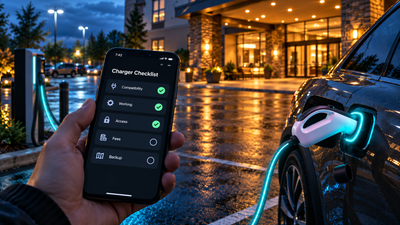
For most single-unit hosts, the Universal Airbnb Host Kit ($242.98) is the highest-value starting point. It pairs a NACS 32A portable Level 2 EVSE with a NACS-to-J1772 adapter — so a Tesla-driving guest and a non-Tesla-driving guest both charge from the same equipment on the same NEMA 14-50 outlet. No install work is required if a compatible, code-compliant NEMA 14-50 already exists at the parking spot.
Alternatives:
- If your guest mix is exclusively J1772 vehicles, the Level 2 Portable EV Charger ($219.99) in the J1772 variant is a lower-cost setup.
- If your guest mix is exclusively Tesla vehicles, the same product in the NACS variant is the equivalent.
- For portfolio hosts committing to the amenity long-term, hardwired wall-mounted 48A units from Tesla, ChargePoint, Emporia, or Wallbox are worth evaluating alongside our EV charger mounting guide.
Not sure which fits your specific property and guest mix? Our Solution Finder walks through the questions and returns the matching kit.
9. Frequently asked questions
Will offering EV charging actually get me more bookings?
It depends on your market. In markets where most comparable listings already offer EV charging, not offering can cost bookings from EV-driving guests filtering by amenity. In markets where few competitors offer it, being the one that does may earn a small preference premium or may make no measurable difference. Check your specific market's competitor listings and your own inquiry history before assuming a universal benefit.
Should I include electricity in the nightly rate or charge separately?
Both work. Included is simpler for the guest and cleaner for short stays. A flat per-night surcharge covers typical charging without any meter-reading. Metered or actual-usage is most accurate for longer stays or higher-mileage guests. Pick one and put it in the listing at booking time. Surprise electricity charges at check-out are a fast track to a bad review.
What if a guest damages my charging equipment?
Your damage-deposit terms should specifically address damage to the receptacle, cable, and charging equipment caused by guest misuse. Airbnb's AirCover for Hosts includes some equipment damage coverage, but specifics vary — verify with Airbnb support and your own insurance carrier before assuming coverage. For portfolio hosts, a short-term-rental-specific insurance policy with explicit EV-equipment coverage is often the cleanest option.
Can I offer EV charging if I'm renting the property from a landlord?
Only if your lease permits it and your landlord approves. Some leases explicitly forbid subletting electricity or commercial-adjacent use of the property. See our apartment EV charging guide for the landlord-approval framework. Get approval in writing before advertising the amenity.
How do I handle a guest whose EV charges slower than expected?
Set expectations before check-in. Guests seeing "Level 2 charging, approximately 25 to 30 miles per hour, depending on vehicle" rarely complain about slower rates than they expected. Guests seeing "Fast Level 2 charging" without qualifiers do complain. Vehicle onboard-charger acceptance rates vary. A base-trim EV with a 32A ceiling will charge at 32A regardless of what the EVSE can deliver.
Should I ban DC fast charging use of the property's electricity?
DC fast chargers are not residential equipment and cannot be used at typical Airbnb properties. If a guest asks whether they can bring or install DC fast charging equipment, the answer is no. DC fast charging requires three-phase commercial power and dedicated electrical infrastructure, not the residential-outlet-based charging your property supports.
What's the honest downside of offering EV charging?
Four things get added to your workload. Physical wear on the receptacle, cable, and adapter. Liability questions around guest damage and guest injury during use. A communication burden covering setup instructions, warning-sign awareness, and dispute resolution. And an attribution decision about who pays for the electricity, at what rate, and how it gets metered. None of these are dealbreakers. Many hosts run EV charging cleanly for years. But the "free amenity, no ongoing work" framing you see on host forums does not match what running the amenity actually looks like month over month.
Related reading: our how to add EV charging as an Airbnb amenity and Airbnb EV Charger Playbook cover the install-cost side. Apartment EV charging guide covers the landlord-approval framework for leased-property hosts. EV charging outlet warning signs covers the routine inspection the host should be doing.
Real questions from EV owners
- Airbnb host said "yes to EV charging" — I show up and it's a 120V garage outlet. Am I still OK?
- My in-laws' lakeside cabins keep getting asked about EV charging — Level 2 chargers, or just list it as bring-your-own-cord on PlugShare?