How to Add EV Charging to Your Airbnb (No $5k Install)

TL;DR
Yes — most Airbnb hosts can add EV charging without hiring an electrician. If your property has a garage outlet, a dedicated dryer outlet, or an RV hookup (see the outlet-types table below), a portable Level 2 EV charger turns any of those into a guest amenity for under $300 — no permit, no installation appointment, no permanent hardware. Hardwired install only makes sense for high-volume hosts (10+ EV-guest nights per month) or properties with no existing 240V outlet within cable reach.
Most articles about adding EV charging to a rental property assume you're hiring an electrician. That assumption is wrong for most hosts.
If your property has a garage, a dedicated dryer outlet, or an RV hookup, you already have what you need. A portable Level 2 EV charger turns any of those outlets into a guest amenity for under $300. No permit. No installation appointment. No hardwired equipment permanently attached to your wall.
Below: which outlets work, how to set up guest access, and when hardwired actually makes sense.
Want to see the charger that makes this work? See the WenStorm portable EV charger →
Why EV Charging Is Becoming a Must-Have Airbnb Amenity
EV adoption in North America has crossed the threshold where a meaningful share of travellers drive electric — and those guests actively look for EV charging as a listed amenity when browsing accommodations.
Airbnb includes EV charging as a listed amenity category for hosts to select, though user-facing search-filter visibility has varied across regions and UI updates. Hosts who list it become more discoverable in Airbnb's ML-ranked results, per multiple host-community reports since 2022. Hosts who don't are invisible to that segment of guests. A 2023 survey of EV drivers found that EV charging availability influences accommodation choice for over 60% of respondents on longer trips.
The premium is real. Properties with EV charging listed command $10–$30 more per night in comparable markets, according to Airbnb host forum data. For a property booked 200 nights per year, that's $2,000–$6,000 in additional annual revenue — from a one-time charger purchase that costs under $300.
The only thing stopping most hosts is the assumption that adding EV charging requires a contractor.
Do You Already Have the Right Outlet?

Most North American garages and driveways have at least one of the outlets below. Any of them supports EV charging for guests.
| Outlet Type | Typical Location | Miles Added Per Hour | What It Supports |
|---|---|---|---|
| NEMA 14-50 | Garage, driveway, workshop | 25–30 miles/hr | Level 2 portable charging |
| NEMA 6-50 | Garage, workshop | 20–25 miles/hr | Level 2 portable charging |
| NEMA TT-30 | RV hookup, some garages | 5–10 miles/hr | Level 1 higher-current (120V/24A with Tesla Gen 2 Mobile Connector + TT-30 adapter) |
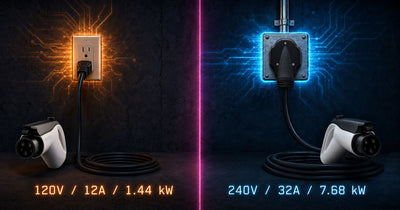
| Standard 120V (NEMA 5-15) | Anywhere | 3–5 miles/hr | Level 1 charging |
NEMA 14-50 is the most common high-power outlet in North American garages — it's the same outlet many electric ranges and dryers use. If your property has one accessible from the driveway or garage, a portable Level 2 charger plugs directly into it. No modification needed.
A guest who arrives with 40% charge and stays two nights gets a full battery from a NEMA 14-50 setup without any thought or planning. That's the value you're advertising.
The No-Install Option: Portable Level 2 Charger

A portable Level 2 EV charger is a plug-in device — it connects to your existing outlet on one end and to the guest's car on the other. No mounting, no dedicated circuit installation, no permit.
Most portable chargers include a J1772 connector, which works with every non-Tesla EV sold in North America. Tesla owners can connect with a J1772 adapter, which ships standard with every Tesla. If you also want to accommodate Tesla's older connector directly, adapters are available separately.
At a NEMA 14-50 outlet, a portable Level 2 charger delivers 25–30 miles of range per hour. A guest staying two nights who plugs in each evening can easily add 150–200 miles — enough to cover most of a long road trip leg.
For guest access, the setup is simple: leave the charger coiled near the outlet with a note on how to connect. No app, no account, no PIN. Guests with any EV know how to plug in.
Security note: a portable charger left accessible to guests carries some theft risk. A simple cable lock through the charger handle and around a fixed point costs under $20 and eliminates casual theft. For a property in a low-risk area, most hosts leave it unlocked.
The Hardwired Option: When It Makes Sense

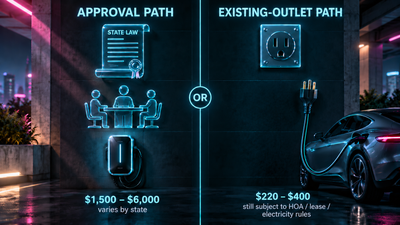
Hardwired Level 2 chargers — units permanently mounted to the wall with a dedicated circuit — cost $400–$900 for the hardware plus $600–$3,500 for electrician labour and potentially a panel upgrade. Total cost is typically $1,500–$5,000 depending on your property's electrical situation.
For most single-unit Airbnb hosts, the ROI doesn't justify it over a portable charger. For hosts managing multiple units, a high-volume property, or a property where guests typically stay one night (road trip corridor), hardwired may be worth it.
| Portable Charger | Hardwired Level 2 | |
|---|---|---|
| Upfront cost | $150–$350 | $1,500–$5,000 |
| Installation required | None | Electrician + permit |
| Charge speed (NEMA 14-50) | 25–30 miles/hr | 25–50 miles/hr |
| Works at multiple properties | Yes | No |
| Guest experience | Plug in manually | May have app/RFID |
| Theft risk | Low (lockable) | None |
| Best for | Most Airbnb hosts | Multi-unit, high volume |
How to Set Up Guest Access (And What to Put in the House Manual)

Store the charger coiled near the outlet it uses — don't lock it in a cabinet guests have to hunt for. If it's in a garage, a hook or bin near the outlet works. The goal is that a guest who needs it finds it without asking.
In your Airbnb house manual, include:
- Where the charger is stored
- Which outlet it uses and where that outlet is located
- The connector type (J1772, works with all non-Tesla EVs; Tesla owners need their J1772 adapter from the glovebox)
- Approximate range per hour at your outlet type
- Whether to coil and return the charger to its spot after use
On your listing, mark "EV Charging" under amenities. In the amenity description or listing notes, specify whether it's Level 1 or Level 2 and the outlet type — EV drivers will want to know this before booking, and accuracy builds trust.
Level 2 at a NEMA 14-50 is worth advertising specifically. "Level 2 EV charging (NEMA 14-50, ~28 miles/hour)" tells a prospective guest everything they need to plan around.
See the WenStorm portable EV charger →
Frequently Asked Questions
Can I add EV charging to my Airbnb without an electrician?
Yes, if your property has a NEMA 14-50, NEMA 6-50, TT-30, or standard 120V outlet accessible from the garage or driveway. A portable EV charger plugs directly into any of these without installation. The only case where an electrician is needed is if you're adding a new dedicated circuit or upgrading your panel.
What outlet do I need to offer EV charging at my Airbnb?
NEMA 14-50 is ideal — it's the most common high-power garage outlet and delivers 25–30 miles of range per hour. NEMA 6-50 is similar. A standard 120V outlet works too, at 3–5 miles/hour, which is enough for guests staying multiple nights but slow for one-night stays. A TT-30 RV hookup works with an adapter.
How much extra can I charge per night for EV charging?
Market data from Airbnb host forums suggests $10–$30 per night above comparable listings without EV charging, depending on the market. Some hosts charge a flat amenity fee of $5–$15 per stay instead. Either approach recovers the cost of the charger within a few bookings.
Will guests damage or steal the EV charger?
Damage is rare — EV chargers are designed for regular consumer use and the connection is simple. Theft risk for a portable charger is low in most properties but non-zero. A cable lock through the handle and around a wall anchor costs under $20. Most hosts in lower-risk areas leave it unlocked with no issues.
Does adding EV charging actually increase Airbnb bookings?
For guests who drive electric, it's often decisive — they filter for it. The incremental bookings depend on EV penetration in your guest demographic and market. In urban and suburban markets in 2024+, EV ownership is high enough that listing EV charging moves you into filtered search results for a meaningful share of potential guests. The ROI on a $200–$300 portable charger is typically recovered within the first few bookings that book partly because of the amenity.
You don't need a contractor or a $5,000 budget to list EV charging on Airbnb. If your property has a garage outlet, you likely have everything you need today.
See the WenStorm portable EV charger — built for exactly this setup →
Related reading: