The Airbnb EV Charger Playbook: How to Add Charging for Under $300

By Rae Martinez — WenStorm
A pattern shows up on any EV road-trip planning thread: the night before departure, someone opens Airbnb, filters for "EV charger," and everything without that little bolt icon disappears from their search results.
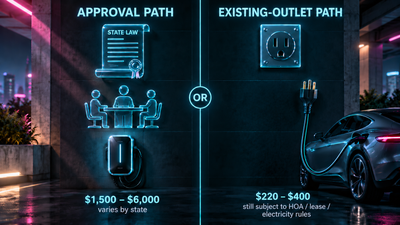
Adding EV charging to your Airbnb has been reframed as an expensive project. Wallbox, ChargePoint, and the electrician trade press have collectively landed on a $2,000-$5,000 hardwired install as the recommended answer. For a short-term rental where the guest sleeps at your property and needs enough range to leave in the morning, that's overspec.
Below: what EV guests actually filter for, why the standard "add EV charging" advice overshoots for short-term rentals, and how to add legitimate Level 2 charging to your Airbnb in one afternoon for under $300.
Why EV Guests Are Filtering for This Now
Airbnb added "EV charger" to its amenity filter in 2022. What changed by 2025 was that enough EV owners had road-tripped that the filter is genuinely a first-pass search criterion, not a nice-to-have. On the ground, this looks like: an EV owner planning a trip opens the map, filters for "EV charger," and eliminates 60-80% of listings in the area before even looking at photos.
If your listing doesn't have the filter checkbox on, you're invisible to that guest. Not "ranked lower." Invisible. That's the thing every guide undersells.
The second-order effect is that filtered listings compete against a smaller pool. More amenities on your listing also lifts search ranking generally — Airbnb's algorithm weights amenity count heavily. Adding one legitimate amenity is worth more than most of the styling and photography advice hosts spend money on.
What Every "Add EV Charging to Your Airbnb" Guide Tells You
Read three or four of the top-ranked host guides on this topic and you'll walk away with the same recommendation stack:
- Wallbox Pulsar Plus — around $700 for the unit, $1,500-$2,000 installed
- ChargePoint Home Flex — $700 for the unit, similar install cost
- Electrician + permit — required in most jurisdictions for hardwired 240V circuits
- Load calculation — panel needs to have capacity, sometimes an upgrade
- HOA / landlord approval — needed if you're not the freehold owner
Total installed cost for the "recommended" path: $2,000-$5,000 depending on your panel proximity, wire run distance, permit fees, and local electrician rates. If you're renting the property to Airbnb it out, add lease negotiation and possibly denied approval to that list.
That advice isn't wrong. It's just spec'd for a permanent installation at a home you own long-term, not for a short-term rental where you might sell the property or lose the lease in eighteen months.
What EV Guests Actually Need (Not What Guides Assume)
Here's what actually happens when an EV owner books your Airbnb.
They arrive somewhere between 4pm and 8pm, drained from the drive. They park, walk in, put down bags, cook or order out. Somewhere around 10 or 11 they plug the car in. They sleep. They wake up between 7 and 8, load the car, drive off.
Total charging window: nine to eleven hours. The typical need isn't a full charge — it's enough range for the next leg of the drive, which for most drivers is 200-250 miles.
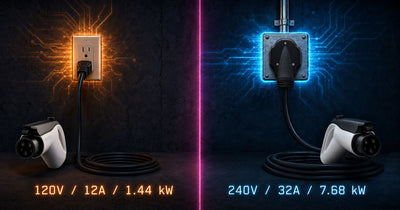
A 32-amp portable Level 2 charger delivers about 25 miles of range per hour. Nine hours of charging is 225 miles. That's the entire spec conversation for an Airbnb use case.
Same-hour fast charging matters at DC fast chargers on the highway. Not at a rental where the guest is sleeping. Every buying guide that recommends 48A hardwired for Airbnb charging is answering a use case that doesn't exist.
The Portable Level 2 Alternative Nobody Recommends
Portable Level 2 chargers plug into a 240V outlet — the same kind you already have for a dryer, an electric range, or a garage subpanel. When your property already has a code-compliant, adequately sized outlet on a dedicated branch circuit, a portable EVSE can avoid new installation, new permit, and new hardwired equipment. Compliance with your lease, HOA, and any property-specific rules still applies, and a licensed electrician should confirm the existing outlet and circuit are suitable for continuous EV charging before nightly guest use.
The specs that matter for a rental use case:
- 32A output — nine hours of overnight charging = 225 miles of range. Enough for any road-trip guest.
- 25 ft cable — long enough to reach cars parked outside the garage door or across the driveway.
- Adapter kit — NEMA 14-50, 14-30 (dryer), and 10-30 (older dryer) covers essentially every 240V outlet in an American home.
- Portable — you unplug it, coil the cable, and it fits in a garage cabinet. If you sell the property, it comes with you.
- J1772 or NACS — J1772 works for every non-Tesla EV out of the box. NACS variants work for Teslas and increasingly for 2025+ non-Tesla models. Some products let you pick the connector at order time so you cover both.
The install-and-forget move a lot of hosts make is buying a wall-mounted Level 2 unit and hardwiring it in. That's fine if you own the property and plan to keep it. If you're renting or you might sell within a few years, you've spent $2,000+ on infrastructure you can't take with you. A portable unit costs a tenth as much and moves with you.
The Setup — When You Already Have a Suitable 240V Outlet
The steps below apply when your property already has a properly installed, code-compliant 240V outlet (NEMA 14-50, 14-30, or 10-30) on a dedicated branch circuit with enough capacity for continuous EV charging load. If the outlet needs to be added, upgraded, or the circuit needs to be evaluated, that's an electrician + permit conversation, not a DIY afternoon. Have a qualified electrician confirm the specific installation is suitable before hosting a guest.
Step 1 — Identify Your Outlet
Walk to your dryer, your electric range, or your garage panel. Find the plug. It'll be one of three types:
- NEMA 14-50 — the "standard" 240V outlet. Four large flat prongs. Common in RV-friendly garages and newer homes.
- NEMA 14-30 — dryer outlet. Three visible prongs plus a curved neutral pin. Common in most homes.
- NEMA 10-30 — older dryer outlet, three prongs, no separate ground pin. Common in pre-1996 construction.
If you see any of those, you have a 240V circuit already. If your home only has 120V outlets (regular wall outlets), that's Level 1 territory — plug-in charging that only adds ~40 miles overnight. Enough for guests who arrived with plenty of range, but tighter for road-trip guests. You can still list "EV charger" if that's all you have; just note "Level 1" in the description.
Step 2 — Order the Charger and Adapter Kit
Match the charger to your outlet. Most portable Level 2 chargers ship with a NEMA 14-50 plug and sell adapter kits separately for other outlet types. Total spend: $200-$300 depending on the model and adapter set. Zero installation cost.
Step 3 — Test It Before a Guest Arrives
Two ways: (a) call a friend with an EV over for coffee and let them plug in for twenty minutes; (b) if you don't know any EV owners yet, use a plug-in voltage tester on the outlet before your first booking to confirm it's wired correctly. Both are worth the peace of mind. Level 2 outlets that were wired for a dryer decades ago sometimes have loose terminals — the same failure mode that shows up in melted NEMA 14-50 outlets on EV forums. Test before you list.
Step 4 — Add "EV Charger" to Your Airbnb Amenities
In the listing editor: Amenities → Parking and facilities → EV charger. Check the box. If Airbnb asks the type, select "Level 2." If it asks the connector, select whichever your unit ships with (J1772 covers non-Tesla; NACS covers Tesla).
Step 5 — Photograph It
Take three photos: (a) the outlet in your garage with the charger nearby, (b) the charger's connector, so guests can see whether it's J1772 or NACS at a glance, (c) an EV plugged in during test-day. Add these to your listing photo carousel. EV guests scroll listing photos specifically to verify the charger is real — a written amenity claim without photos gets skipped.
The ROI Math — Why $220 Pays for Itself in Two Bookings
Rough numbers, honest math. A portable Level 2 charger runs around $220 for a decent 32A unit. Add $30-50 for adapters. Total setup: under $300.
Booking uplift depends on your area, season, and how many EV drivers filter for the amenity in your market. The mechanism is straightforward: Airbnb's EV-charger filter removes non-EV-friendly listings entirely from the search results, so any listing WITH the amenity competes against a smaller pool for that segment of guests. Hosts in EV-heavy markets (California, the Pacific Northwest, Colorado, the Northeast corridor) generally see meaningful additional bookings from the segment; hosts in low-EV-adoption areas see less. If your average nightly is $150, one additional booking recovers the entire setup cost, and every subsequent EV-filtered booking is incremental revenue on hardware you already own.
The secondary ROI is the amenity-count boost to your general search ranking. Adding one more legit amenity moves your listing up in results for guests who aren't filtering for EV charging specifically. That's harder to attribute, but it compounds.
The Install-and-Forget Mistakes I See Hosts Make
Three patterns I've watched hosts regret:
Hardwiring a Level 2 unit and then selling the property. Two years later, the hardware stays with the house. New buyer inherits a fixed asset that may not match their needs. Portable Level 2 stays with you.
Buying a heavy plug-mounted charger for a rental outlet. Most portable chargers put a heavy control box (a "brick") directly on the NEMA plug. In a rental, that plug gets cycled by every EV-owning guest — several times a week in busy months. A brick hanging on a residential-grade outlet accelerates a failure mode that regulators have specifically recalled cables for (Porsche/Audi 23V-841/842, December 2023, 134,000 units). Look for a charger that puts the electronics at the car end instead of the outlet end.
Overspeccing 48A. As discussed above, overnight guests don't need 48A. You paid the extra cost and the extra weight for no benefit.
Host Rules That Actually Belong in Your Listing
Your Airbnb house rules field is the only place a booking guest is guaranteed to see your policy. Airbnb surfaces it at booking, at check-in, and in the app. If your EV charging stance is not in the house rules, it doesn't exist for the purposes of expectation-setting or dispute resolution.
Three example rules variants — pick the one that matches your setup and paste it into your Airbnb house rules field, adjusting specifics as needed.
Variant A — Permissive (you're comfortable hosting EV drivers routinely):
EV charging is available. A portable charging unit is provided along with written instructions posted next to the outlet you will use. Please set your vehicle's charge limit to 80% and unplug before checkout. If you need faster charging, the nearest public Level 2 station is [address / distance]. If a breaker trips or the outlet feels warm to the touch, please stop charging, unplug if safe, and contact us right away — do not reset the breaker yourself.
Variant B — Conditional (you'll allow it with restrictions or a fee):
EV charging is available on request. Please message us before booking if you plan to charge an EV during your stay so we can confirm the setup suits your vehicle. Any additional cost is either included in the nightly rate for confirmed EV bookings or collected via Airbnb's Resolution Center after your stay, in line with Airbnb's fee policy. Please confirm whether your vehicle uses J1772 or NACS AC charging and whether you will bring the manufacturer-approved adapter.
Variant C — Prohibited-with-alternative (your property isn't suited for guest EV charging):
This property does not offer EV charging. The parking area is not served by a suitable outlet, and we cannot accommodate improvised cable routes. The nearest public Level 2 charging is at [address / distance]. Please plan accordingly if you drive an EV.
Variant C is the most underrated of the three. Turning away a booking you can't safely support is a better outcome than a two-star review from a guest whose car didn't charge — or a damaged outlet or an insurance dispute you weren't prepared for.
When You Should Decline an EV-Charging Guest
There are specific setups where guest EV charging isn't appropriate, regardless of how much you want the booking. Check your property against the list below in one pass. If any apply, use Variant C above.
- Two-prong ungrounded outlets. Common in pre-1962 buildings. Do not charge from ungrounded outlets under any circumstances.
- Aluminum wiring. Homes built between roughly 1965 and 1975 may have it. Aluminum expands and contracts more than copper under sustained heat, which loosens connections over time. Have an electrician evaluate and approve the specific circuit for EV charging use before hosting a guest.
- Visibly worn or discolored outlets. Any brown, gray, or black around the prong holes is a sign of arc damage. Have the outlet replaced before any charging equipment goes near it.
- Circuit shared with high-draw appliances. If your only accessible outlet shares a breaker with the microwave, AC, dishwasher, or a space heater, a tripped breaker during a guest stay is a matter of when, not if.
- Cable routes that require running a flexible cord through a window, door, or under a rolling garage door. Flexible cords aren't designed for this use. Both NEC and OSHA flexible-cord guidance warn that cord damage at edges creates shock, burn, and fire risk. If you want to offer charging as an amenity, install a properly located outdoor-rated outlet, or a dedicated EV charging point, with a qualified electrician and any required local permit.
- Building has an active fire-safety restriction on EV charging in enclosed or subsurface spaces. Some municipalities have introduced local restrictions on unsupervised Level 2 charging in enclosed garages. Check your local jurisdiction before offering an amenity you can't legally provide.
If two or more of these apply, decline the booking gracefully with Variant C and refer the guest to a public station.
The Guest Instruction Sheet — Print, Laminate, Post
A guest reads two things reliably: the check-in message and any physical sign taped to the surface they're about to use. Everything else is optional.
A one-page printed instruction sheet, laminated in a plastic sleeve and taped near the outlet, covers what you need. What belongs on it:
- Which outlet to use, with a photo of that specific outlet in your unit.
- Where the charging equipment is stored and how to unspool the cable.
- Any relevant charge-limit request (80% is a common host policy, though actual electrical safety is enforced by the vehicle and the charging equipment, not by the guest).
- The exact language: "If the breaker trips, or the outlet or plug feels warm to the touch, stop charging, unplug if safe, and text the host right away. Do not reset the breaker yourself."
- What not to plug into the same outlet (space heaters, other high-draw appliances).
- Your contact for issues, with a preferred communication window.
Don't rely on a PDF linked in the check-in message. Print, laminate, tape it up. Adoption is close to 100% when the instructions are physically present at the point of use.
Our Pick — WenStorm Level 2 Portable
For an Airbnb use case specifically, I recommend the WenStorm 32A portable. The specific reasons:
- 32A hits the overnight math. Nine hours of charging = 225 miles.
- 25 ft cable. Reaches from a garage outlet to a car parked in the driveway. This detail matters when the guest can't get inside the garage because you're storing bikes.
- Electronics in the connector handle at the car end. No heavy brick hanging on your dryer or garage outlet. If your Airbnb is a long-term investment, the outlet is a long-term investment. Nothing wears it out.
- J1772 or NACS at order time. You pick based on what your average guest drives. If you're not sure, J1772 is safer because it works for every non-Tesla EV out of the box, and Tesla owners just carry the NACS-to-J1772 adapter.
- $220 unit. Below the setup budget for essentially every host I've talked to.
Frequently Asked Questions
Do I need an electrician to add EV charging to my Airbnb?
Not always — depends on your existing outlet. If your property already has a properly installed, code-compliant 240V outlet (NEMA 14-50, 14-30, or 10-30) on a dedicated branch circuit with adequate capacity for continuous EV charging load, a portable Level 2 charger plugs into it directly. If the outlet needs to be added, upgraded, or the circuit needs to be evaluated for continuous load, that's an electrician + permit conversation. A hardwired unit (Wallbox, ChargePoint Home Flex) always requires a licensed electrician and typically a permit. When in doubt, have a qualified electrician evaluate the specific outlet and circuit before hosting a guest.
Which NEMA outlet do I need?
NEMA 14-50 is ideal (50A circuit, 40A continuous — full 32A charging speed). NEMA 14-30 (dryer, 30A circuit) works with an adapter and gives 24A charging — about 5.5 kW, still enough for overnight. NEMA 10-30 (older dryer) also works with an adapter, same amperage as 14-30. If your rental only has 120V outlets, you can offer Level 1 charging, which adds about 40 miles overnight — worth listing but weaker for road-trip guests.
Will EV charging spike my utility bill?
At 32A for nine hours, one full guest charge costs roughly $8-$14 depending on your local electricity rate (varies by state, calculated on ~62 kWh added). You can bake this into your nightly rate, or add "$10 EV charging fee" as a separate line item — some hosts do, most don't. Under $15 per booking is usually noise compared to your other utilities.
Can I charge guests extra for using the EV charger?
Airbnb permits optional paid amenities under specific conditions. If a fee is disclosed at booking, it should be either included in the nightly price (when Airbnb's standard fee fields don't otherwise apply) or collected after the stay through Airbnb's Resolution Center. A simple "EV fee" text field isn't universally available in the standard listing settings. Check Airbnb's current fee-collection policy and Resolution Center rules before publishing a rate. Many hosts choose to include the amenity as a free perk to lift booking rate; the incremental electricity cost is usually small relative to the booking uplift.
Does AirCover cover an EV-charging fire or outlet damage?
AirCover for Hosts is not an insurance policy. It provides limited protection against certain guest-caused damage, subject to Airbnb's current terms. Normal wear and tear is excluded. Faulty design, workmanship, deterioration, or lack of maintenance may also be excluded. Hosts are expected to take reasonable care to avoid losses. Routine outlet deterioration isn't something to expect AirCover to reimburse. Ask your property or commercial-host insurer whether guest EV charging is a covered use, and whether any installation, inspection, or equipment requirements apply. This isn't legal or insurance advice.
What if my guest's car doesn't have the right adapter?
Ask each EV guest at booking to confirm whether their vehicle accepts J1772 or NACS AC charging and whether they'll bring the manufacturer-approved adapter. Connector availability and included accessories vary by vehicle and model year, and native-NACS non-Tesla vehicles are entering the market. AC charging adapters and DC fast-charging adapters aren't interchangeable.
Can I run guest charging on the same circuit as the air conditioner?
No. Even a Level 1 charger drawing 12A leaves little headroom on a 15A circuit for the AC compressor to cycle on. When the compressor kicks in, the breaker trips. If you plan to host EV guests, have an electrician confirm that the charging outlet is on a dedicated circuit with adequate capacity for continuous charging load. Don't rely on guests to coordinate appliance use.
What if my Airbnb doesn't have a garage?
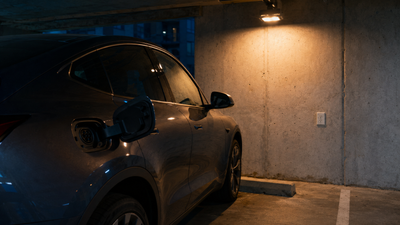
Doesn't matter — you need a 240V outlet, not a garage. Many hosts run the charger cable out through a garage door gap, a slightly-open side door, or a cable pass-through in the wall. If your outlet is inside the house and the car parks in a driveway, a 25 ft cable will reach through a garage door or window. Just note in your listing "cable runs from garage" so guests know what to expect.
The station's fine. The cable is 4 feet. Same principle applies to your Airbnb — you don't need to rebuild anything. What you need is a $220 piece of hardware plugged into an outlet you already own, an amenity checkbox in your listing editor, and three photos. Guests filtering for EV charging will find you. The rest is real bookings.