Can You Charge an EV From a Dryer Outlet? 14-30 vs 10-30
Can any EV charge from a dryer outlet? 14-30 vs 10-30 safety, charging speed, WenStorm's product limit, and licensed-electrician criteria.

TL;DR
Modern 4-prong dryer outlet (NEMA 14-30): yes, with a compatible EVSE. A 30A dryer circuit supports up to 24A continuous EV charging (~5.8 kW at 240V). Tesla drivers pair the Gen 2 Mobile Connector with a NEMA 14-30 adapter. Older 3-prong dryer outlet (NEMA 10-30): yes, with licensed-electrician grounding evaluation first. The 10-30 is a three-wire, non-grounding receptacle. WenStorm's 32A Level 2 Portable Charger (fixed NEMA 14-50 plug): not compatible with either dryer outlet. Its 32A continuous rating and 14-50 plug shape exceed the 30A dryer circuit's 24A EV limit — use it on a dedicated 14-50 receptacle instead.
Option 1 — Modern 4-prong dryer outlet
Option 2 — Older 3-prong dryer outlet
Still not sure which is the correct fit for your car?
Quick compatibility summary
| Outlet | Circuit | Continuous EV limit | Recommended WenStorm product | Notes |
|---|---|---|---|---|
| NEMA 14-30 (modern 4-prong, post-1996) | 30A | 24A / ~5.8 kW at 240V | Tesla Gen 2 NEMA 14-30 adapter (Tesla only) | Non-Tesla EVs need a 24A-settable EVSE with a native 14-30 plug — not sold by WenStorm. |
| NEMA 10-30 (older 3-prong, pre-1996) | 30A | 24A max / ~5.8 kW at 240V | Tesla Gen 2 NEMA 10-30 adapter (Tesla only) | Three-wire, non-grounding receptacle — licensed-electrician grounding evaluation required before use. |
| NEMA 14-50 (dedicated 50A circuit) | 40A or 50A | 32A or 40A / ~7.7–9.6 kW | WenStorm Level 2 Portable Charger (32A, fixed 14-50 plug) | The direct-plug WenStorm charger fits a dedicated 14-50 receptacle — not a 14-30 or 10-30 dryer outlet. |
NEMA 14-30 vs NEMA 10-30: The Physical and Electrical Difference
Two different dryer receptacles show up in US homes depending on when the electrical work was done:
- NEMA 14-30: four-prong receptacle with two 120V hot conductors, one neutral, and a separate equipment grounding conductor. This is the current NEC-compliant configuration for new dryer installations in most jurisdictions.
- NEMA 10-30: an older three-prong, non-grounding dryer receptacle with two hot conductors and a neutral but no separate equipment-grounding conductor. Older dryer installations were permitted to bond the appliance frame through the neutral under specific code provisions. Because EV charging equipment normally relies on a reliable grounding path, have a licensed electrician evaluate an existing 10-30 circuit before using it for EV charging.
Both are 30A receptacle configurations commonly used for electric dryers. Their condition, terminal design, conductor compatibility, and manufacturer instructions must be evaluated before they are subjected to repeated, long-duration EV charging.
The presence of a NEMA 10-30 versus a NEMA 14-30 in a specific house is a signal about when the electrical work was done. An existing 10-30 that was properly installed to the code adopted at that time can continue in service for its original dryer duty. Using it for continuous EV charging is a separate question that requires the grounding review noted above.
The 30A Circuit → 24A Continuous EV Load Math
Under the National Electrical Code, a branch circuit must be sized for 125% of the continuous load it serves (NEC 210.19(A)(1) and 210.20(A)). EV charging is treated as a continuous load under Article 625. The practical result for a 30A dryer circuit:
- 30A breaker × 80% (mathematical result of the 125% sizing rule) = 24A continuous EV charging current
- 24A × 240V ≈ 5.8 kW power delivery from the EVSE
Drawing more than 24A continuously can overload a 30A branch circuit and eventually trip the breaker. Separately, loose or resistive connections can overheat at the plug or receptacle without drawing enough total current to trip the breaker. The breaker is not a temperature monitor for the receptacle. A properly designed EVSE for dryer-outlet use limits its current draw to 24A regardless of what it could physically deliver on a larger circuit.
Which EVSEs Actually Fit (and Which Don't)
Three categories of EVSE, each with different dryer-outlet compatibility:
Category A: EVSEs that recognize a manufacturer-approved 14-30 or 10-30 adapter and limit current accordingly
Some portable EVSEs work as a system with the manufacturer's own NEMA adapter lineup. The adapter identifies the available outlet rating to the EVSE, and the EVSE limits charging current accordingly. The Tesla Gen 2 Mobile Connector is the widely known example: Tesla's NEMA adapters (including 14-30 and 10-30, subject to market and configuration) signal the outlet type, and the Mobile Connector applies the appropriate current limit. A passive shape-changing adapter that provides no current-limit signaling or protection is not equivalent, even if the physical plug fits.
For non-Tesla EVSEs, check the specific manufacturer's charging instructions before assuming that a manufacturer's adapter both fits and enforces the correct current limit. Do not assume; verify against the product's own documentation.
Category B: EVSEs with a fixed higher-current plug (e.g., NEMA 14-50) that physically do not fit a 14-30
Some portable EVSEs ship with a fixed NEMA 14-50 plug and no user-swappable plug options. A NEMA 14-50 plug will not physically fit a NEMA 14-30 receptacle; the plug blades are arranged differently. The WenStorm Level 2 portable EV charger is in this category. It ships with a fixed NEMA 14-50 plug and a 32A maximum output. There is no WenStorm-approved 14-30 or 10-30 adapter for the WenStorm charger itself. If your only 240V outlet is a dryer receptacle, use a different EVSE that is designed and manufacturer-approved for that receptacle type (with current limiting), or have a licensed electrician install a NEMA 14-50 circuit for the WenStorm.
Category C: EVSEs with configurable current settings that can be set to 24A
Some smart EVSEs (via app or DIP switches inside the unit) can be manually configured to a lower maximum current. A user-set current limit on the vehicle touchscreen alone does not make an otherwise unsupported adapter safe. The EVSE and adapter must be designed as a compatible system per the manufacturer's charging instructions. Verify both the current setting availability AND the manufacturer's explicit permission for the specific adapter and circuit combination before relying on this configuration.
Decision: use the existing dryer circuit, or install a new EV-dedicated circuit?
Once you know what fits on your existing 30 A dryer outlet, the natural next question is whether it's worth paying an electrician to install a dedicated EV charging circuit instead. The comparison below walks through the real trade-offs. All installation costs are illustrative ranges from published US electrician-cost surveys (HomeAdvisor, Qmerit, local utility estimators) — they vary significantly by region, panel capacity, wire-run distance, and local permit fees. Get at least two quotes before committing.
| Dimension | Keep existing 30 A dryer circuit (14-30 or 10-30) | Install a new EV-dedicated 50 A circuit (NEMA 14-50 or hardwired 48 A) |
|---|---|---|
| Max continuous charging current | 24 A (80% of the 30 A circuit per NEC 625.42) | 40 A on a 50 A circuit, or 48 A hardwired on a 60 A circuit |
| Power delivered | 5.76 kW (240 V × 24 A) | 9.6 kW (40 A) or 11.5 kW (48 A) |
| Range added per hour (typical) | 18–22 miles | 30–38 miles (40 A) or 36–44 miles (48 A) |
| Hours to charge a 75 kWh pack from empty | ~13 hours (ignoring losses) | ~7.8 hours (40 A) or ~6.5 hours (48 A) |
| Equipment cost (one-time) | NEMA 14-30 or 10-30 adapter: $50–75. Portable Level 2 EVSE: $220–400. Total: ~$270–475. | Portable 40 A EVSE OR 48 A hardwired unit: $400–750. Total: ~$400–750. |
| Installation cost (illustrative US ranges) | $0 if the dryer receptacle and circuit are in good condition. $100–400 if an electrician replaces the receptacle or adds a bonded ground. | $500–2,500 for a new 50 A branch circuit to the garage with short wire run and sufficient panel capacity. $2,000–4,500 if a panel upgrade (100 A → 200 A) is needed first. |
| Permit / inspection required | Not for the outlet itself. May be required if the circuit is modified. | Yes, in most US jurisdictions. Permit + inspection fee typically $100–300. |
| Can share with the dryer? | Not simultaneously. Either (a) manually unplug one when using the other, or (b) use a listed load-management splitter such as Splitvolt or NeoCharge ($400–600 added hardware). | Dedicated — no scheduling conflict. The dryer keeps its own circuit. |
| Future-proofing for next EV | Capped at 24 A continuous regardless of the next vehicle's onboard charger. If your next car has an 11.5 kW onboard charger, you can't use half of it on this circuit. | Supports every current EV's onboard AC charger at 40–48 A. Headroom for a 2nd EV with a load-management EVSE later. |
| Who it's best for | Low daily miles (< 40/day), apartment-adjacent garage with existing dryer outlet, renters, short-term solution, buyers who want to validate EV ownership before investing in installation. | Multi-EV household, long daily commute, frequent road trips, planning to add solar or home battery, buyer who wants charging done in 6–8 hours overnight regardless of EV model. |
When keeping the dryer circuit genuinely makes sense
- You drive < 40 miles per day. Overnight on 24 A fully recovers your daily use with hours to spare.
- Your garage already has a dryer outlet in a convenient spot; running new conduit would be expensive.
- You're renting or planning to move within 2 years — the install investment doesn't amortize.
- Your main electrical panel has limited free capacity, and a panel upgrade would push the install cost well above $3,000.
When installing a new circuit pays for itself faster
- You drive > 60 miles per day or run multiple EVs — the 24 A ceiling means you're spending hours waiting that you wouldn't otherwise.
- Your utility offers a time-of-use (TOU) rate with a narrow overnight off-peak window. Faster charging lets you fit the full session into the cheapest hours.
- You already pay a monthly premium for a high electrical panel capacity — leaving it unused is sunk cost.
- Local utility, state, or federal rebates cover a meaningful share of the install (DOE Alternative Fuels Data Center maintains the current list by state).
In short: a 30 A dryer circuit is the right answer for a surprising number of households, especially those who already have the outlet in a convenient location. A new 50 A or 60 A circuit is the right answer when daily miles outgrow the 24 A ceiling, when multiple EVs share one driveway, or when a utility rebate materially drops the install cost. The comparison above is the first-pass filter — a licensed electrician's site visit is the next step either way.
What a Licensed Electrician Should Verify
Even when the EVSE is compatible and configured correctly, the underlying dryer circuit still needs to be suitable for continuous EV charging load. A licensed electrician's evaluation typically includes:
- Receptacle condition. No discoloration around any prong hole, no visible arc damage, no wobble when a plug is inserted, no cracked or deformed plastic. The electrician should verify whether the particular receptacle manufacturer permits the device to be used for sustained EV charging; "commercial grade" or "industrial grade" by itself does not prove EV suitability, and at least one major manufacturer explicitly labels certain 14-30 receptacles as not recommended for EV charging. Where the existing receptacle is unsuitable, the electrician may recommend replacing the equipment, installing a dedicated EV circuit, or using an approved hardwired EVSE.
- Breaker rating and wire gauge. Confirm the breaker is actually 30A (someone may have upsized without upsizing the wire) and confirm the wire is properly sized for the breaker under your locally adopted code.
- Ground condition. Especially important for a NEMA 10-30, which has no separate equipment grounding conductor. The electrician should evaluate whether the existing grounding path is adequate for continuous EV load or whether the circuit should be upgraded to a NEMA 14-30 with a separate ground.
- Conductor and termination compatibility. Aluminum conductors are not automatically unsafe, but the receptacle, terminals, and installation must be approved for the conductor material. An electrician should verify the conductor type and size, CU/AL terminal rating, connection method, torque, and condition. Small-gauge legacy solid-aluminum branch wiring presents different concerns from properly installed larger stranded aluminum conductors.
- Shared-circuit review. If the receptacle is on the same branch circuit as the dryer, both loads cannot run simultaneously. See the FAQ below.
If your electrician recommends against nightly EV use of a specific dryer circuit, do not use it. That recommendation is based on facts specific to your installation that a general blog cannot evaluate.
Charging Speed at 24A
At 24A continuous on 240V, an EVSE delivers about 5.8 kW to the vehicle before conversion losses. For most passenger EVs with a daily driving need of roughly 20 to 50 miles, a dryer-outlet setup provides adequate overnight charging. For larger-battery vehicles or higher daily energy needs, the 24A ceiling may not be enough, and a proper NEMA 14-50 dedicated circuit is a better fit. Your vehicle's onboard-charger rating also caps the delivered rate; check your owner's manual for the specific value. Our why is my EV charging slowly guide walks the full "what caps the delivered rate" question.
Warning Signs (Stop Charging If Any Appear)
Inspect the receptacle before use and follow the equipment manufacturer's maintenance instructions for how often to re-inspect. Some temperature rise can occur during continuous charging, but do not rely on touch alone to determine safety. Stop charging if the plug or receptacle becomes unusually or increasingly warm, uncomfortable to touch, discolored, loose, noisy, or produces an odor. Follow any temperature warning or fault shown by the EVSE or vehicle.
Specific signs that call for stopping and getting an electrician evaluation before further use:
- Discoloration around any prong hole (brown, gray, or black, any color other than the original outlet color)
- Audible buzzing, crackling, or humming from the outlet during charging
- A plug that wobbles noticeably when inserted or does not seat firmly
- Repeated breaker trips under EV load
- Burning-plastic smell near the outlet
- Any temperature-related fault or warning displayed by the EVSE or vehicle
See our NEMA 14-50 outlet melt guide for the underlying receptacle failure mechanism (which also applies to 14-30 and 10-30 receptacles under continuous EV load).
The WenStorm Product Line and Dryer Outlets
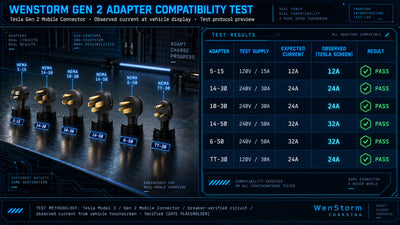
The WenStorm Level 2 portable EV charger is a fixed 14-50, 32A unit and is not compatible with a NEMA 14-30 or 10-30 dryer outlet. WenStorm does sell a separate line of NEMA outlet adapters specifically for the Tesla Gen 2 Mobile Connector (14-30 and 10-30 among others). Those adapters signal the outlet rating to the Tesla Mobile Connector, which then limits current draw appropriately. They do not fit and are not intended for the WenStorm portable charger.
If you own a Tesla and your only available 240V outlet is a dryer receptacle, the correct WenStorm product for that scenario is the applicable Tesla Gen 2 Mobile Connector NEMA adapter (14-30 or 10-30). If you own a non-Tesla EV and your only 240V outlet is a dryer receptacle, use an EVSE designed and manufacturer-approved for that receptacle type, or have a licensed electrician install a NEMA 14-50 circuit for a fixed-plug EVSE like the WenStorm portable.
The WenStorm Level 2 Portable also carries a handle-side thermal cutoff: a sensor inside the connector interrupts the charging session at 85°C (185°F) connector-handle temperature and resumes once it drops below 70°C (158°F). This is a device-side protection at the vehicle end of the cable, catching downstream heat before it reaches the vehicle inlet. It is not a wall-receptacle overheat sensor and does not relieve the installer from using a correctly rated circuit and a sound outlet — points that matter more, not less, when the circuit is a repurposed 30A dryer line.
Which dryer outlet do you have?
Match the slot pattern on your wall outlet.
Always verify the actual outlet shape before ordering. Home age alone is not a reliable way to identify an outlet.
Select your outlet type Not sure? Compare outlet shapes in the Solution FinderRelated Reading
- Tesla NEMA 14-30 Adapter: The Renter's Guide — Tesla-specific 14-30 setup
- Tesla NEMA Adapter Guide — Tesla's full NEMA adapter lineup
- Why NEMA 14-50 Outlets Melt with EV Chargers — receptacle failure mechanism
- Why Is My EV Charging Slowly? — diagnostic on what caps the delivered rate
- NEMA 14-50 vs 6-50 for EV Charging — if you are installing a new dedicated 50A circuit
FAQ
Can any EV charge from a dryer outlet?
Physically, a NEMA 14-30 or 10-30 dryer circuit is 240V at 30A and permits up to 24A continuous EV charging under NEC continuous-load rules. But not every EVSE is designed for that use. Tesla's Gen 2 Mobile Connector with a manufacturer-approved 14-30 or 10-30 adapter identifies the outlet rating and limits current to 24A. A fixed NEMA 14-50 EVSE like the WenStorm portable does not physically fit a 14-30 receptacle. Check your specific EVSE's charging instructions before assuming compatibility.
Can I use a WenStorm 32A portable EV charger with my NEMA 14-30 dryer outlet?
No. The WenStorm ships with a fixed NEMA 14-50 plug that does not physically fit a 14-30 receptacle. WenStorm does not offer a 14-30 adapter for the WenStorm charger. If your only 240V outlet is a dryer receptacle and you want to use the WenStorm, have a licensed electrician install a NEMA 14-50 circuit for it. If you own a Tesla, WenStorm sells NEMA 14-30 and 10-30 adapters for the Tesla Gen 2 Mobile Connector as a separate product line.
Can I run the dryer and charge the EV simultaneously?
No. Do not operate both loads simultaneously on the same 30A circuit. Do not rely on the breaker as an operating control; an overloaded breaker may not trip immediately. Avoid passive Y-splitters and repeated daily unplugging. A listed automatic load-sharing or transfer device may be an option when it is compatible with the equipment and accepted under local code.
Can I use a passive Amazon adapter to plug a 14-50 EVSE into a 14-30 outlet?
Not safely. A passive shape-changing adapter provides no current-limit signaling or protection to the EVSE. The EVSE will draw its full rated current on a circuit that cannot safely support it, which trips the breaker at best and creates a fire risk at worst. Manufacturer-approved adapters designed as a system with a specific EVSE (Tesla's Gen 2 Mobile Connector adapters are the widely known example) signal the outlet rating so the EVSE can limit its draw. Only use an adapter that the specific EVSE manufacturer approves for that specific circuit.
What if my EV charges fine on the dryer outlet but the plug feels warm?
Some temperature rise can occur during continuous charging, but do not rely on touch alone to determine safety. Stop charging if the plug or receptacle becomes unusually or increasingly warm, uncomfortable to touch, discolored, loose, noisy, or produces an odor. Follow any temperature warning or fault shown by the EVSE or vehicle. Have a licensed electrician evaluate the receptacle before further use.
What is the difference between a NEMA 14-30 and a NEMA 10-30?
Both are 30A 240V dryer circuits. NEMA 14-30 is a four-prong grounding receptacle with two hot conductors, a neutral, and a separate equipment grounding conductor. NEMA 10-30 is a three-prong non-grounding receptacle with two hot conductors and a neutral but no separate equipment-grounding conductor. Older dryer installations were permitted to bond the appliance frame through the neutral under specific code provisions. Because EV charging equipment normally relies on a reliable grounding path, a licensed electrician should evaluate an existing 10-30 circuit specifically before EV charging use.
Sources
- Tesla Gen 2 NEMA Adapters product page
- Tesla Charging Product Guides
- U.S. Department of Energy, Alternative Fuels Data Center — Electricity for EV Charging at Home
- Leviton NEMA 10-30 receptacle specifications (identified as non-grounding)
- Leviton NEMA 14-30 receptacle specifications and EV-use warning
- NEC 210.19(A)(1), 210.20(A), and Article 625 — Continuous load and EV charging provisions (National Electrical Code, current edition; consult your local Authority Having Jurisdiction for the adopted edition)
- Your vehicle's owner's manual for the specific onboard-charger (OBC) rating, which sets the ceiling on how much AC current the vehicle will draw regardless of what the EVSE can deliver.
Marcus Chen covers EV charging electrical safety, NEC-aligned diagnostics, and installation guidance for WenStorm. Content is educational, not electrical or insurance advice. Given the safety-adjacent nature of dryer-outlet EV charging, we strongly recommend a licensed-electrician evaluation of your specific receptacle, circuit, and vehicle before nightly use.
Real questions from EV owners
Join the EV Adapters & Connector Compatibility discussion →