NEMA 14-50 EV Charging: Portable Charger vs Tesla Adapter

TL;DR
Yes — a NEMA 14-50 outlet gives you Level 2 home charging without an electrician if you add compatible portable equipment between the outlet and the car. WenStorm's 32A portable Level 2 charger plugs into a 14-50 and delivers up to 7.7 kW with a J1772 or NACS connector; Tesla owners with a Gen 2 Mobile Connector can use a 14-50 adapter instead for the same 32A ceiling. NEC Article 625 caps continuous EV loads at 80% of circuit capacity, which is why a 50A circuit delivers 40A maximum (the equipment self-limits to 32A on most portable units for additional headroom). Before using an existing outlet for daily charging, verify the circuit, receptacle, and condition are suitable.
What Is a NEMA 14-50 Outlet?
A NEMA 14-50 is a 240V / 50A four-prong electrical outlet — the standard outlet used for home EV charging in the United States.

You can identify it by its four straight blades — two horizontal hot blades, one straight neutral, and one round ground. Every blade is straight; nothing is L-shaped. That's what separates it from the NEMA 14-30, which has an L-shaped neutral blade (and is physically smaller because it's rated for 30A instead of 50A).
Where to find a NEMA 14-50 in your home or building:
- Garage (very common — often installed for RV hookups or workshop equipment)
- Utility room or storage area
- Outdoor power pedestal
- Some apartment garages and laundry rooms
Check your garage before assuming you need new wiring. A surprising number of homes already have a NEMA 14-50 that's never been used for EV charging.
Why NEMA 14-50 Is the Gold Standard for Home EV Charging

The NEMA 14-50 is rated at 50 amps on a dedicated 240V circuit. EV chargers draw at 80% of rated capacity (per NEC safety code), so you get up to 40A of actual charging current — delivering 7.2–9.6kW depending on your charger.
At that rate, you're adding 30–35 miles of range per hour. At 32 A continuous on a NEMA 14-50 outlet, a 75 kWh battery pack takes roughly 10 hours to fully charge from empty (75 kWh ÷ 7.68 kW ≈ 9.8 hours, before charging losses). That's enough to add 200+ miles of range overnight for typical daily driving.
That's the same performance you'd get from most wall-mounted Level 2 chargers — without paying for installation.
| Charging setup | Max input power | Theoretical minimum time for 75 kWh | Typical range added per hour |
|---|---|---|---|
| NEMA 5-15 (standard wall), 12 A | 1.44 kW | 52.1 hours | 3–5 mph |
| NEMA 14-30 (dryer), 24 A | 5.76 kW | 13.0 hours | 18–22 mph |
| WenStorm NEMA 14-50, 32 A | 7.68 kW | 9.8 hours | 25–30 mph |
| Suitable NEMA 14-50 setup, 40 A (40 A-rated EVSE) | 9.60 kW | 7.8 hours | 30–38 mph |
| Suitable 48 A setup (60 A circuit, hardwired or 48 A plug-in) | 11.52 kW | 6.5 hours | 36–44 mph |
These are idealized calculations from kWh ÷ kW, not promised charge times. Real-world charging takes longer because of charging losses, battery thermal management, and conditions. Vehicle onboard chargers may also cap the actual rate — see the three-tier compatibility table below. For Tesla-specific per-vehicle charging rates with the Mobile Connector, see Tesla's own support documentation.
The NEMA 14-50 gets you within 10–15% of a hardwired Level 2 charger's speed — without the $500–$1,500 installation cost.
NEC Article 625 — the rules for 14-50 EV charging
The US National Electrical Code's Article 625 sets the rules for every EV charging circuit in the United States. Three provisions matter when charging on a NEMA 14-50:
-
80% continuous-load derating. A 50A branch circuit may deliver no more than 40A continuously. EV charging is a continuous load by definition (operates ≥3 hours). This is why a 50A outlet delivers a 32-40A charge, not 50A.
-
Dedicated circuit. NEC Article 625 requires that EV supply equipment be served by its own branch circuit — you cannot share a 14-50 with a welder, dryer, or RV hookup. Shared circuits trip breakers and void most warranties.
-
Listed equipment. The EV charger (whether portable or wall-mounted) must be listed by a nationally recognized testing laboratory (NRTL) — look for UL, ETL, or CSA markings on the housing.
The US Department of Energy's Alternative Fuels Data Center on home charging covers the broader residential installation picture, including when a dedicated 14-50 circuit is worth installing vs. upgrading to a hardwired Level 2 unit.
How many amps will my EV actually draw on a NEMA 14-50, and how fast will it charge?
The answer depends on two things: your EV's onboard AC charger maximum, and the charger-side current limit (which is almost always the binding constraint on this circuit).
The math: why 50 amps becomes 32 amps in practice
- NEMA 14-50 outlet rating: 50 amps, 240 V single-phase
- NEC 625.42 continuous-load rule: EV charging exceeds 3 hours, so the circuit is continuous and conductors + OCPD must be sized at 125% of load (or load de-rated to 80% of circuit capacity).
- Theoretical max continuous: 50 A × 0.80 = 40 A. 40 A operation requires a 40 A-rated EVSE — either hardwired or a plug-in portable rated for 40 A (Wallbox Pulsar Plus, Lectron 40 A portable, and similar units all support this on a NEMA 14-50 circuit).
- Practical plug-in max: 32 A continuous for the Tesla Mobile Connector with the Tesla NEMA 14-50 adapter, and for most other plug-in portable Level 2 chargers.
- Power delivered at 32 A continuous: 240 V × 32 A = 7.68 kW (commonly rounded to 7.7 kW).
Where your EV sits on this circuit
EVs fall into three onboard-charger tiers that determine whether the 32 A circuit draw is actually the binding limit, or whether your car itself tops out at a lower rate:
| Vehicle onboard AC charger tier | Representative EVs in this tier | Actual draw on NEMA 14-50 (32 A circuit) | Range added per hour (typical) |
|---|---|---|---|
| Tier 1 — 7.2 kW onboard max | Chevrolet Bolt EV / EUV, older Nissan Leaf | 30 A — vehicle is the binding limit | 22–25 miles |
| Tier 2 — 11–11.5 kW onboard max | Tesla Model 3 / Y, Ford F-150 Lightning, Hyundai Ioniq 5 / 6, Kia EV6 / EV9, VW ID.4, Rivian R1T / R1S, most 2022+ EVs | 32 A — circuit is the binding limit | 25–30 miles |
| Tier 3 — 19 kW+ onboard max | Lucid Air, Porsche Taycan with optional 19.2 kW charger | 32 A — circuit is still the binding limit; vehicle capability unused on this outlet | 25–30 miles |
Tier assignment is based on the vehicle's published onboard AC charger specification from the manufacturer's documentation. Confirm your specific model year and trim before assuming — some trim levels within the same model offer different onboard chargers (notably Porsche Taycan and Audi e-tron GT).
What this means for your purchase decision
- For Tier 1 EVs, a 32 A portable charger gives you the full benefit of your car's onboard charger — you can't go faster without upgrading the vehicle.
- For Tier 2 EVs (the vast majority of EVs on the road in 2026), a 32 A portable Level 2 is the practical ceiling on a NEMA 14-50 outlet unless you upgrade to a hardwired 48 A EVSE on a 60 A circuit — which requires an electrician and panel capacity.
- For Tier 3 EVs, the NEMA 14-50 outlet caps you at well below your vehicle's capability. Consider a hardwired 48 A install if you have the panel capacity and routinely need faster home charging.
How Many Amps Is a Tesla NEMA 14-50 Adapter?
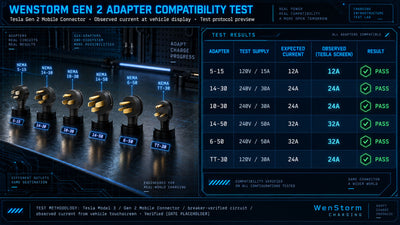
The WenStorm Tesla NEMA 14-50 adapter allows the Tesla Gen 2 Mobile Connector to charge at up to 32A at 240V — delivering approximately 28–32 miles of range per hour.
By comparison, the Gen 2 mobile connector on a standard 120V wall outlet draws only 12A, adding just 3–5 miles per hour. The NEMA 14-50 adapter upgrades your charging to true Level 2 speed using the charger you already own.
Important: WenStorm NEMA 14-50 adapters are compatible with the Tesla Gen 2 Mobile Connector only. The Gen 2 connector has a visible adapter slot on the side of the connector body. Gen 3 connectors do not have this slot and are not compatible.
Can You Charge a Tesla with a NEMA 14-50?
Yes — and there are two ways to do it, depending on your setup.
Option 1: WenStorm NEMA 14-50 Adapter (Tesla Gen 2 Mobile Connector)
If your Tesla came with a Gen 2 Mobile Connector, plug the WenStorm NEMA 14-50 adapter into the connector's adapter slot. Then plug that into your NEMA 14-50 outlet.
That's it. You're now charging at up to 32A — Level 2 speed, zero installation, $59.99.
Shop WenStorm NEMA 14-50 Tesla Adapter →
Option 2: WenStorm Portable Level 2 Charger (All EVs including Tesla)
If you don't have a Gen 2 mobile connector — or if you drive a non-Tesla EV — the WenStorm Portable Level 2 Charger plugs directly into your NEMA 14-50 outlet and delivers up to 32–40A via J1772 connector.
Tesla owners can use their car's included J1772 adapter to connect. All other J1772 EVs (Ford, Chevy, Hyundai, Rivian, etc.) connect directly.
Shop WenStorm Portable Level 2 EV Charger →
NEMA 14-50 Adapter vs Wall-Mounted Charger — Which Should You Buy?
| NEMA 14-50 Adapter | Wall-Mounted Level 2 Charger | |
|---|---|---|
| Cost | $59.99 | $300–$800 + installation |
| Installation | None | Licensed electrician required |
| Charging speed | 32A / ~30 mph | 40–48A / ~35–44 mph |
| Compatibility | Tesla Gen 2 only | All EVs (J1772/NACS) |
| Portability | Yes — take it with you | No — wall-mounted |
| Setup time | Seconds | Hours to days |
The verdict: If you drive a Tesla with a Gen 2 mobile connector and already have a NEMA 14-50 outlet, the adapter is the obvious choice — same overnight charging performance at a fraction of the cost.
If you need compatibility with multiple EVs or want more than 32A, the WenStorm Portable Level 2 Charger or a wall-mounted unit makes more sense.
Common wiring mistakes with a NEMA 14-50
Four mistakes come up most often in EV owner forums and electrician post-mortems. Each one can trip a breaker, damage the receptacle, or in the worst case start a fire:
-
Using a dryer outlet instead of a true 14-50. NEMA 14-30 (dryer) is a 30A outlet with different pin spacing. It cannot deliver the 40A continuous that EV charging on a "50A setup" expects. Visually distinguishable by the pin configuration — count the holes before plugging in.
-
Backing a 14-50 outlet with 10 AWG wire. A 50A circuit requires 6 AWG (copper) at minimum per NEC Table 310.16. 10 AWG is rated for 30A — a common shortcut when adding an outlet without a load calculation. Overheats under continuous EV load.
-
Using an un-tested RV extension cord between the outlet and the charger. RV extension cords are often rated for intermittent 50A, not continuous. The EV charger will draw continuously for hours — read the cord's duty cycle label before extending.
-
Skipping the GFCI requirement for garage installations. Current NEC editions require GFCI protection on 14-50 receptacles in garages. Older installations may lack it; retrofitting a GFCI breaker is straightforward and recommended before daily EV use.
If the outlet is warm to the touch after an hour of charging, if the plug has visible scorch marks, or if the breaker trips repeatedly, stop and have the circuit inspected before continuing.
What About "240V EV Charger Adapter"? (Clearing Up the Confusion)
When people search for a "240V EV charger adapter," they usually mean one of two things:
-
An adapter that lets their EV charger plug into a 240V outlet — this is exactly what the WenStorm NEMA 14-50 adapter does for Tesla Gen 2 mobile connector owners.
-
A standalone charger that plugs into a 240V outlet — this is the WenStorm Portable Level 2 Charger — a portable EVSE that plugs into a NEMA 14-50 outlet on one end and your car's J1772 connector on the other.
What people are not looking for: extension cords, voltage converters, or generic electrical adapters from hardware stores. Those are not safe for EV charging loads.
The WenStorm Level 2 Portable Charger (32 A) is ETL Listed to UL 2594 for EV charging. Certification coverage for the Tesla NEMA 14-50 adapter varies by model year — see the WenStorm Certification Center for the current listing on the specific SKU you're buying. Neither product changes the rating of your underlying circuit: the WenStorm charger is rated for up to 32 A continuous on a NEMA 14-50 circuit, not the full 40 A continuous that a dedicated 40 A EVSE would deliver.
For a complete comparison of all 240V outlet types and which adapter fits each one, see our Tesla NEMA adapter full guide →.
- NFPA 70 (National Electrical Code), Article 625 — US code for EV supply equipment, continuous-load derating, dedicated-circuit requirements. nfpa.org/codes-and-standards NEC catalog
- US DOE Alternative Fuels Data Center — Home Charging — independent reference for Level 1/Level 2 charging equipment categories, cost of installation, and selection criteria. afdc.energy.gov/fuels/electricity-charging-home
- US DOE Alternative Fuels Data Center — EV Benefits — context on continuous-load behavior and residential equipment. afdc.energy.gov/fuels/electricity-benefits
- Tesla Mobile Connector Owner's Manual (Gen 2) — manufacturer spec for 14-50 adapter use at 32A on a Tesla Mobile Connector. tesla.com/support/charging/mobile-connector
Primary sources used in this guide
FAQ
How many amps is a Tesla NEMA 14-50 adapter?
The WenStorm Tesla NEMA 14-50 adapter delivers up to 32A at 240V when used with the Tesla Gen 2 Mobile Connector on a 50A circuit. This adds approximately 28–32 miles of range per hour and charges a 75 kWh battery in about 7–8 hours.
Can you charge a Tesla with a NEMA 14-50 outlet?
Yes. Tesla owners with a Gen 2 Mobile Connector can use the WenStorm NEMA 14-50 adapter — no installation required. Tesla owners with a Gen 3 connector or any other EV can use the WenStorm Portable Level 2 Charger, which plugs directly into a NEMA 14-50.
Is a NEMA 14-50 outlet safe for daily EV charging?
Yes. NEMA 14-50 outlets on a dedicated 50A circuit are designed for continuous high-draw loads. EV chargers operate at up to 80% of the circuit's rated capacity (32 A continuous for most plug-in portable chargers like the WenStorm 32 A unit; 40 A continuous for 40 A-rated EVSE units), which is within NEC guidelines. Use a certified EV charging adapter — not generic electrical adapters — to ensure safety.
What's the difference between a NEMA 14-50 adapter and a wall charger?
A NEMA 14-50 adapter (like WenStorm's) works with your Tesla's existing Gen 2 Mobile Connector and requires no installation. A wall-mounted Level 2 charger is a separate EVSE unit that must be hardwired or plugged in permanently, typically by an electrician. The adapter delivers 32A; most wall chargers deliver 40–48A. For overnight home charging, both are fast enough to fully charge most EVs.
Does the WenStorm NEMA 14-50 adapter work with all Tesla models?
The WenStorm NEMA 14-50 adapter is compatible with all Tesla models that use the Gen 2 Mobile Connector — Model 3, Model Y, Model S, and Model X. It is not compatible with the Gen 3 Mobile Connector. Check your connector for the adapter slot on the side of the body before ordering.
You May Already Have the Outlet. All You Need Is the Adapter.
Check your garage for a large 4-prong outlet with four straight blades and no L-shape anywhere (the L-shape belongs to the smaller NEMA 14-30). If you find one, you have a NEMA 14-50 — and you're one $40 adapter away from full Level 2 home charging tonight.
Shop WenStorm NEMA 14-50 Tesla Adapter →
Not sure which product fits your car? Use the WenStorm Charging Solution Finder →