Why WenStorm Portable EV Chargers Have No Inline Control Box

TL;DR
A wall-mounted control box hanging off a NEMA 14-50 outlet concentrates heat at the plug interface and puts several pounds of hanging weight on the receptacle over months of use — two known ways to stress the outlet. That's why WenStorm's portable Level 2 charger has no inline control box; the electronics live inside the vehicle-side connector instead, without changing charging performance (up to 32A / 7.7 kW on 240V NEMA 14-50). Outlet quality still matters: use a properly-installed, EV-rated NEMA 14-50 receptacle on a correctly-sized circuit.
Option 1 — Portable Level 2 Charger (standalone)

Option 2 — Portable Charger + J1772 Adapter (bundle)

What the control box actually does
A portable Level 2 EV charger is a self-contained safety and control unit with a plug on each end. Inside, an In-Cable Control Box (ICCB) houses the switching relay, the ground-fault protection, the temperature monitoring, and the pilot-signal circuit that communicates charging current to the vehicle. This is the “brains” of an EVSE.
That functionality has to sit somewhere on the cable. Different manufacturers make different choices about where. Most portable chargers place it inline — a rectangular housing that sits along the cable, often right at the wall-plug end.
Where WenStorm places the electronics
WenStorm integrates the charger’s control and protection electronics into the vehicle-side connector handle. The NEMA wall end has no bulky inline control enclosure. The handle is slightly thicker than a bare J1772 or NACS plug to accommodate the internal electronics, but it still fits any standard J1772 or NACS charging inlet.
The cable running from the wall to the car is just cable. The NEMA plug at the wall end is a plain plug.
When connected, the vehicle inlet supports the connector handle. When disconnected, store the connector in its holster or carrying case; do not leave it on the ground or in standing water.
Why WenStorm selected this architecture
We selected this design because we wanted a portable charger that felt genuinely portable. A 25-foot cable with a mid-cable enclosure is harder to coil into a case, harder to fit into a trunk with other gear, and requires managing a rigid housing that can knock against paint or interior trim. Removing that enclosure makes the whole charger easier to move between home, rentals, campgrounds, and road trips.
The architecture also simplifies the wall end. A bare NEMA plug is small enough that it doesn’t interfere with adjacent outlets or wall-plate covers, and it’s easier to seat squarely in a receptacle without lever-arm from a nearby enclosure.
The architecture itself is not unique to WenStorm — other manufacturers offer handle-integrated designs in some product lines. What matters for this product family is that we selected this approach for our whole portable lineup after evaluating the trade-offs.
Side-by-side: brick-style portable vs WenStorm no-brick design
The comparison below covers portability and ergonomics only — the dimensions a buyer can verify by looking at the two products on a shelf or in a product photo. Safety-related differences (receptacle wear, long-term thermal behavior, strain on plug blades) are a separate question that depends on measurement, not design intent. See the "What the design does — and doesn't — solve" section below for how we draw that line.
| Design dimension | Typical brick-style portable (Tesla Mobile Connector, Ford Mobile Power Cord, etc.) | WenStorm no-brick design |
|---|---|---|
| Where the control electronics live | An inline enclosure (the "brick") in the middle of the cable, typically within 2–3 ft of the wall plug. | Integrated into the vehicle-side connector handle. The wall end is a plain NEMA plug; the cable from wall to car is just cable. |
| What hangs from the outlet | The brick is suspended between the plug and the vehicle, with the wall plug carrying its weight when the brick isn't resting on the ground. | A plain NEMA plug. No mid-cable mass pulls on the plug blades. |
| Cable coiling for storage | The cable has to coil around the fixed-size brick, which sets a minimum coil diameter. | Cable coils into a tight continuous loop with no fixed obstruction. Packs flat in a carry bag or trunk organizer. |
| Fit in a tight outlet enclosure or RV pedestal | Needs clearance for both the plug AND the brick behind it. In tight spaces, the brick can prevent the plug from seating fully. | Only the plug needs clearance. Fits behind furniture, in recessed outlet boxes, and in RV pedestals with no mid-cable obstruction. |
| Mid-cable snag risk during setup | The brick is a rigid object that can catch on door frames, tailgates, trunk edges, and rental furniture. | A plain cable slides past the same obstacles. No rigid mid-cable element to catch. |
| What the design does not change by itself | Charging speed (both determined by the vehicle, outlet, and amperage), electrical safety certification (both require independent NRTL listing — WenStorm is ETL Listed to UL 2594), outlet integrity over time (depends on the receptacle and installation, not the charger shape). | |
Everything above describes mechanical design and ergonomics — differences you can see and test by handling both products. None of it establishes that one design is safer than the other over time. "Does the no-brick design make charging safer?" is a measurement question (receptacle wear, blade heating, long-term thermal cycling) that requires independent testing to answer, which we do not have for our product relative to specific competitor products.
Practical benefits: storage, portability, cable handling
- Coiling and storage. A cable with no inline enclosure coils into a tight loop and packs flat in a carry bag or trunk organizer. A cable with a mid-cable box has to be coiled around the box, which sets a minimum bend radius and eats storage space.
- No mid-cable snag point. A rigid enclosure can catch on door frames, tailgates, and rental furniture during setup. A plain cable slides past all of those.
- Wall-end fit. A bare NEMA plug seats fully in tight outlet boxes, behind furniture, or in RV pedestals without needing clearance for a large enclosure.
Engineering trade-offs
Integrating the ICCB into the connector handle isn’t free. It solves the portability and packaging problems above, but it introduces engineering constraints:
Heat dissipation. The control board and relay generate heat during charging. A large mid-cable enclosure radiates that heat into open air with plenty of surface area. A connector-integrated design has to move the same heat through a smaller housing that’s often gripped by the car’s inlet.
Weight balance. A too-heavy connector handle is awkward to plug in and hangs poorly on its holster. The design keeps the added mass small enough that the connector still handles like a slightly thicker standard J1772 or NACS plug.
Sealing. Because the control electronics are integrated into the vehicle-side handle, that housing must protect them from dust and water exposure. WenStorm currently publishes an IP55 rating for this charger: dust-protected and protected against water jets under specified test conditions. IP55 does not mean waterproof or suitable for immersion; keep the outlet, plug and all connections away from standing water. See the WenStorm Certification Center for the full listing.
What the design does — and doesn’t — solve
Removing the mid-cable enclosure is a portability and packaging decision. It does not, on its own, make outlet quality or installation irrelevant.
Sustained 32-amp continuous charging still stresses receptacle contacts thermally, regardless of what charger is plugged in. Loose breaker terminations, undersized wire, corroded contacts, or a builder-grade receptacle that wasn’t designed for continuous EV load can still overheat over time — a pattern we cover in more depth in Why NEMA 14-50 Outlets Melt with EV Chargers. An EV-rated industrial NEMA 14-50 receptacle (Hubbell HBL9450A, Bryant 9450FR, or equivalent) on a properly installed, correctly-sized 50-amp circuit is still the recommended install for any Level 2 portable charger.
The two most-cited NHTSA recall filings for portable EV chargers document different failure modes. Porsche 23V-841 cites elevated resistance at the receptacle interface and damaged cable crimps, while Tesla 16E-091 cites insufficient-quality welded connections inside certain adapters. Neither filing establishes that the location of the control box caused those failures. WenStorm’s architecture should therefore be understood as a portability and packaging decision — not as a proven recall-prevention feature. For a broader comparison of design approaches, see Emporia Pro vs WenStorm: The Wall-Mount vs Car-End Design Decision.
Specifications
- Output: up to 32A at 240V (~7.7 kW)
- Cable length: 25 ft
- Vehicle connector: J1772 or NACS
- Wall plug: NEMA 14-50
- Ingress protection: IP55 for the charger body — dust-protected and protected against water jets. This rating does not cover the wall receptacle or plug-to-outlet connection.
- Safety listing: ETL Listed to UL 2594
- Warranty: 2-year WenStorm warranty
Frequently asked questions
Does WenStorm’s design mean I don’t need an industrial-grade NEMA 14-50 receptacle?
No. Sustained 32-amp continuous charging still stresses receptacle contacts thermally, regardless of charger architecture. EV-rated industrial receptacles (Hubbell HBL9450A, Bryant 9450FR, or equivalent) on a properly installed 50-amp circuit are still recommended over builder-grade residential 14-50 outlets, which have a documented history of thermal failure under continuous EV load.
Is the connector handle heavier than a standard J1772 or NACS plug?
Slightly. The connector housing is thicker than a bare plug to accommodate the internal electronics, but it’s still small enough to grip comfortably and fit standard J1772 or NACS inlets on all supported vehicles. It handles more like a slightly oversized standard plug than a brick with a plug on it.
Does this design make WenStorm’s charger safer than a Tesla Mobile Connector or a Porsche Mobile Charger?
Not in a way we can claim from the design alone. Different portable chargers have different failure histories tied to different components (welded connections, receptacle-interface resistance, adapter design). WenStorm’s architecture removes the packaging inconvenience of a mid-cable enclosure, but every portable Level 2 charger — ours included — benefits from a properly installed, EV-rated outlet.
Can I use the WenStorm L2 portable charger with an existing NEMA 14-50 outlet, or do I need to install a new one?
If you already have a NEMA 14-50 outlet installed on a dedicated 50-amp double-pole breaker, the WenStorm L2 portable charger plugs in and works without additional electrical work. Before first use, verify the receptacle is EV-rated and not a low-cost builder-grade 14-50 — residential-grade receptacles have a documented history of thermal failure under continuous 32A load regardless of what plugs into them. If you are installing new or replacing an old outlet, an industrial-grade receptacle (Hubbell HBL9450A, Bryant 9450FR, or equivalent) is recommended.
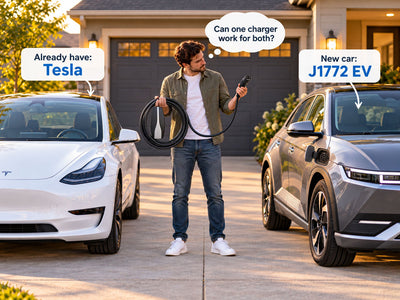
Does the WenStorm L2 portable charger work with both Tesla and non-Tesla EVs?
Yes, and there are three ways to set it up depending on your household:
- Non-Tesla only (Chevy, Ford, Hyundai, Nissan, Rivian, and more): buy the J1772 version of the charger.
- Tesla only: buy the NACS version — it connects natively without an adapter.
- Mixed household (Tesla + a non-Tesla EV): buy the NACS version and add the WenStorm NACS to J1772 Adapter. The adapter converts the NACS output to J1772, so the same charger works for both vehicles — useful when a Tesla and a J1772 EV share the same garage.
All variants deliver up to 32A at 240V and use the same in-connector electronics architecture.
How does the WenStorm L2 portable charger compare to a hardwired Tesla Wall Connector?
The Wall Connector charges faster (up to 48A hardwired vs the WenStorm portable’s 32A) and integrates with Tesla’s smart-charging network, but it requires professional hardwired installation (typically $400 to $1,500 for parts and labor), is not portable, and is Tesla-only. The WenStorm L2 portable is 32A max, plugs into a NEMA 14-50 outlet you can install yourself or already have, and travels with you when you leave the house. Choose the Wall Connector for maximum home charging speed and Tesla-network integration; choose the portable for flexibility, travel use, and lower install cost.