32A vs. 40A EV Charging: Which Is Right for Your Home?
32A Level 2 chargers deliver 7.7 kW; 40A deliver 9.6 kW. The 25% speed difference only matters when your vehicle's onboard charger accepts more than 7.7 kW and your home has a suitable 50A circuit. Buyer guide.

TL;DR
A 32A Level 2 EV charger delivers up to 7.7 kW to the vehicle. A 40A Level 2 charger delivers up to 9.6 kW — about 25% faster. The 40A advantage only matters if the vehicle's onboard charger can accept more than 7.7 kW and the home has a suitable 50A branch circuit with a receptacle rated for that continuous load. For many drivers charging overnight on a NEMA 14-50 outlet, 32A comfortably recovers a typical day's driving. This article walks through when each rating is the right pick, what neither rating protects you from, and where WenStorm's 32A Level 2 Portable Charger fits.
32A vs 40A at a glance
| 32A charger | 40A charger | |
|---|---|---|
| Max power (240V) | 7.68 kW (~7.7 kW) | 9.6 kW |
| Minimum branch-circuit breaker | 40A (per NEC 125% continuous-load rule) | 50A |
| Common outlet | NEMA 14-50 on a 50A circuit works; NEMA 14-30 on a 30A circuit works with a 24A-derated setup | NEMA 14-50 on a 50A circuit |
| Overnight energy at 8 hours | Up to ~61 kWh supplied by the EVSE before charging losses | Up to ~77 kWh supplied by the EVSE before charging losses |
| Speed advantage | Baseline | 25% faster max, when the vehicle's onboard charger can accept it |
| Range added | Varies by vehicle efficiency, temperature, charging losses, and onboard-charger limits | Same variables, higher ceiling |
Per US Department of Energy guidance on EVSE infrastructure, continuous-load circuit sizing requires a breaker rated at least 125% of the EVSE load: a 32A charger needs a 40A breaker minimum, a 40A charger needs a 50A breaker minimum.
How fast each rating actually charges
The theoretical numbers above — ~61 kWh over 8 hours at 32A, ~77 kWh at 40A — are the energy the charger delivers to the vehicle's inlet before charging losses. Real battery energy stored is lower because of voltage variation across the charging cycle and onboard-charger conversion efficiency (typically single-digit-percent losses in normal conditions, more in cold weather).
Range added to your specific EV depends on:
- Your vehicle's real-world efficiency (small sedans manage 3.5–4.5 mi/kWh in mild weather; large SUVs and pickups often 1.8–2.5 mi/kWh; both drop in cold conditions).
- Your vehicle's onboard AC charger acceptance rate (see next section).
- Ambient temperature (cold-weather battery conditioning consumes a share of incoming energy before it reaches the battery).
- The starting state of charge (a full 10-to-100% cycle is slower on average than a shallower cycle at high state-of-charge tapering).
What onboard-charger acceptance means for this choice
The EVSE (the wall unit or portable) is only half of the equation. The vehicle's onboard AC charger sets the ceiling on how much AC power it will actually accept from the EVSE. Some real-world examples:
- A vehicle with a 7.2 kW onboard AC charger will not draw more than that even if you plug in a 40A / 9.6 kW EVSE. In this case, a 32A EVSE fully saturates the car's AC input and a 40A EVSE gains nothing.
- A vehicle with an 11 kW or 11.5 kW onboard AC charger can pull the full 9.6 kW from a 40A EVSE and see the 25% speed advantage.
- Some larger EVs (certain Ford Lightning trims, Rivian R1T, etc.) have onboard AC chargers rated for 11.5 kW or more and benefit most from a 40A or higher EVSE.
Check your vehicle's spec sheet for its Level 2 AC charging rate before deciding whether a 40A EVSE adds anything for you. If the number is 7.7 kW or lower, a 32A EVSE is not the bottleneck; the onboard charger is.
When 32A is enough
32A / 7.7 kW covers overnight recovery for most home charging scenarios:
- Daily commute plus errands under about 100–150 miles.
- An 8-hour or longer overnight parking window.
- A vehicle whose onboard AC charger is 7.7 kW or lower.
- A home whose existing electrical service supports a 40A dedicated circuit (needed for a 32A charger per NEC).
- An owner willing to plan around the charging window rather than pushing peak throughput.
When 40A is genuinely faster
40A / 9.6 kW is worth the extra spec (and the additional install cost for a 50A circuit) when:
- Your vehicle's onboard AC charger accepts more than 7.7 kW (11+ kW is common on newer larger EVs).
- Your daily driving consistently exceeds ~150 miles.
- Your available parking window is shorter than 8 hours.
- You're charging a second EV overnight on the same setup.
- Your home already has the electrical service for a 50A dedicated circuit without a costly panel upgrade.
What neither rating protects you from
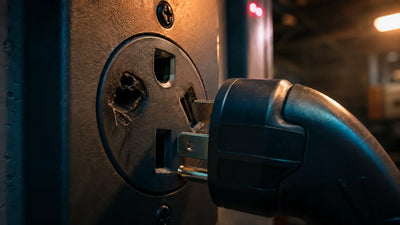
This is the important part: lower charger amperage does not make an unsuitable outlet safe. A loose, damaged, corroded, or improperly-installed NEMA 14-50 receptacle can still overheat at 32A. The failure mode at the plug/receptacle interface is elevated resistance under sustained continuous load, and that failure mode is present at both 32A and 40A. Lower current reduces the rate at which resistive heat builds up, but it does not eliminate the problem.
Any 14-50 outlet used for regular EV charging should be:
- Installed by a licensed electrician per NEC 625.40 (individual branch circuit for EV supply equipment).
- Rated for continuous EV load (industrial-grade receptacles like the Hubbell HBL9450A and Bryant 9450FR are commonly recommended in the EV community; consult your electrician for current product recommendations).
- Inspected by a licensed electrician if there is any sign of looseness, discoloration, abnormal warmth, or arcing.
Owners should not open the receptacle, torque the terminations, or modify the wiring themselves. That is the electrician's job.
What NHTSA recall filings show about resistance and overheating
Manufacturers have filed several recalls with NHTSA related to portable EV charging equipment and elevated resistance at connection interfaces. These filings document a class of failure mode, not a per-amperage indictment:
- Porsche 23V-841 (2023) attributes overheating to elevated resistance at certain lower-quality receptacle interfaces used with the Mobile Charger. The manufacturer's remedy replaces the NEMA cable with one that includes a temperature sensor.
- Audi filed a companion recall for its Compact Charging System in 2023 (dealer notice with equivalent remedy). Consult NHTSA's recall lookup for the current Part 573 report.
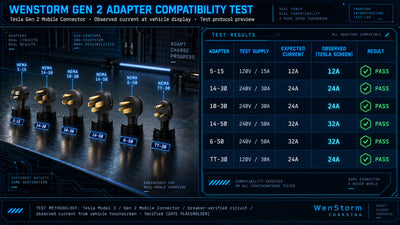
- Tesla 16E-091 (2016) covered 6,729 NEMA 14-30, 10-30, and 6-50 adapters (not the 14-50 adapter) with potentially insufficient welded connections.
The pattern in these filings is that resistance at plug and connection interfaces can cause overheating during sustained charging. That's a category of failure, not proof that any specific amperage was the root cause. The takeaway for buyers is: receptacle and connection quality matter, regardless of the charger's amperage rating.
Where WenStorm's 32A charger fits
The WenStorm Level 2 Portable EV Charger is rated at 32A on 240V (up to 7.7 kW), with a fixed NEMA 14-50 plug and temperature monitoring at the connector. Per the product page, it's designed for owners who want plug-in Level 2 charging from an existing or newly-installed 14-50 outlet without hardwiring. J1772 and NACS variants are available at the same price.
If your vehicle's onboard AC charger accepts 7.7 kW or less, or if your daily driving fits within an overnight window at 7.7 kW, the 32A rating is a match. If your vehicle accepts more and you need the extra 25% throughput, a 40A charger from another brand may fit your setup better. Both categories exist because different buyers have different needs.
How real owners talk about this on Reddit
The 32A / 40A / higher-amperage debate comes up often on r/electricvehicles. In a widely-upvoted thread titled “You DO NOT need a huge capacity circuit to charge an EV,” the OP describes receiving quotes north of $10,000 to upgrade their electrical service for a 60A charger install and instead running their Tesla on a NEMA 6-20 (20A / 240V) circuit with the mobile connector at 16A. It fully covers their overnight drive. Another commenter on the same thread notes their family shares a single 40A circuit between two 20A EVSEs for two EVs. A third runs a 100 kWh Kia EV9 on a 1.7 kW / 8-amp 240V circuit and still gets enough overnight to cover a return commute.
The through-line: many buyers over-spec their electrical setup because they assume more amperage is strictly better. For daily driving patterns most people actually have, matching charger amperage to the vehicle's onboard charger and the parking window matters more than maxing out the circuit.
Frequently asked questions
Is 32A enough for my daily commute?
For most drivers, yes. 32A / 7.7 kW over an 8-hour overnight window supplies up to ~61 kWh to the vehicle before charging losses. That covers a typical daily commute for most EVs. Range added varies by vehicle efficiency, temperature, charging losses, and onboard-charger limits — check your vehicle's spec sheet for its real-world AC charging rate.
What's the actual speed difference between 32A and 40A?
40A delivers 25% more maximum power (9.6 kW vs 7.7 kW) when the vehicle's onboard AC charger can accept the full rate. If the vehicle's onboard charger is capped at 7.7 kW or lower, a 40A EVSE gains nothing over a 32A EVSE.
Can I safely run a 40A charger on any NEMA 14-50 outlet?
No. A NEMA 14-50 outlet on a 50A breaker code-permits up to 40A continuous per NEC, but the outlet must be a dedicated branch circuit installed to code, with a receptacle rated for continuous EV load and torqued terminations. If any of those conditions is uncertain, a licensed electrician should evaluate the outlet before use.
Does WenStorm sell a 40A charger?
No. The current WenStorm portable Level 2 lineup is 32A. See the portable EV chargers collection for current models.
How do I find my vehicle's onboard AC charger rating?
Check the vehicle's spec sheet from the manufacturer for the Level 2 or AC charging rate (usually listed in kW). If the number is 7.7 kW or lower, a 32A EVSE is not the bottleneck. If it's 11 kW or higher, a 40A or higher EVSE may add meaningful speed.
What should I do if my 14-50 outlet feels warm during charging?
Stop charging and have the outlet inspected by a licensed electrician. Warmth at the plug or receptacle is a sign of elevated resistance at the connection — a documented failure mode across the EV charging category, not something to charge through.
Shop the WenStorm Level 2 Portable EV Charger
Related reading: Why WenStorm built portable-first · Why WenStorm chargers have no wall-hanging brick · Why NEMA 14-50 outlets fail under EV loads · WenStorm 2-year limited warranty