Tesla Model 3 Home Charging: 32A vs 48A
RWD caps at 32A. Long Range and Performance can accept 48A but only with a hardwired 48A EVSE (Tesla UWC). Which home setup unlocks the full rate.

Disclosure: WenStorm publishes this article and sells the WenStorm Level 2 Portable EV Charger referenced in the buy-box below. Tesla and other referenced brands are not affiliated with WenStorm; their trademarks are used descriptively.
Recall / safety-notice check. Before following any overnight-charging advice for your specific Tesla Model 3, verify the vehicle's current recall status via Tesla's owner support portal and via NHTSA's recall lookup at nhtsa.gov/recalls. Tesla issues software recalls periodically; some carry specific charging or parking guidance. As of 2026-07-30 the WenStorm editorial team is not aware of an active general Tesla Model 3 recall that alters standard home-charging setup, but that status can change; check your specific VIN before assuming.
The right home charging setup for a Tesla Model 3 depends on which trim you have. Tesla documents different AC acceptance rates for the Rear-Wheel Drive base trim versus the Long Range and Performance trims, and the difference changes which home charger and circuit unlock the vehicle's full documented rate.
Direct answer: A Model 3 Rear-Wheel Drive accepts up to 32A / 7.7 kW on 240V AC. A Model 3 Long Range or Performance accepts up to 48A / 11.5 kW on 240V AC. Tesla's own Gen 2 Mobile Connector is capped at 32A regardless of the vehicle's higher acceptance rate; unlocking the 48A / 11.5 kW rate on a Long Range or Performance requires a compatible hardwired EVSE on a dedicated 60A circuit. For most Model 3 drivers on typical daily mileage, a 32A portable Level 2 EVSE on a NEMA 14-50 outlet delivers a comfortable overnight charge regardless of trim.
Quick Reference: Model 3 Onboard Charger by Trim
| Trim | Max AC acceptance | Max continuous amps at 240V |
|---|---|---|
| Model 3 Rear-Wheel Drive | 7.7 kW | 32A |
| Model 3 Long Range | 11.5 kW | 48A |
| Model 3 Performance | 11.5 kW | 48A |
Verified against Tesla's current onboard-charger reference page. Trim availability and specifications can change between model years and refresh cycles; if you own a specific Model 3 configuration, confirm the AC acceptance rate on the vehicle touchscreen's charging-current limit setting or in the current Tesla documentation for your VIN.
All current Tesla Model 3 vehicles delivered in North America use a native NACS (SAE J3400) inlet. A J1772 station charges a Model 3 via a manufacturer-approved J1772-to-NACS adapter (Tesla currently states that this adapter is included with every new US Tesla vehicle delivery per the Tesla J1772 adapter product page). A NACS station charges directly with no adapter.
The 32A vs 48A Split
Tesla positions the Rear-Wheel Drive as the entry-level Model 3, and its 7.7 kW / 32A onboard-charger rating reflects that positioning. The Long Range and Performance variants have the higher-capacity 11.5 kW / 48A onboard charger. Both variants use the same NACS inlet, so both charge on the same home EVSEs; the difference is only in what current the vehicle will accept.
Practical implication: an EVSE that can deliver more than 32A continuous is only meaningful for Long Range and Performance owners. For a Rear-Wheel Drive owner, the vehicle caps AC acceptance at 32A regardless of what the EVSE is capable of delivering. There is no vehicle-side upgrade to raise the Rear-Wheel Drive's 7.7 kW ceiling short of aftermarket vehicle service.
Home Circuit and EVSE Options by Model 3 Trim
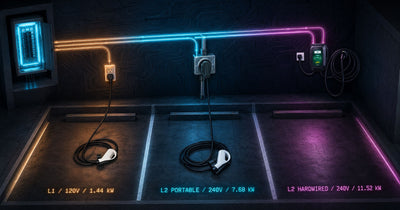
Option 1: Level 1 on a dedicated 120V circuit (all Model 3 trims)
A NEMA 5-15 or NEMA 5-20 outlet on a dedicated 120V branch circuit delivers approximately 1.4 kW (12A on 15A) or 1.9 kW (16A on 20A) of continuous charging power. For a Model 3 driver whose typical daily driving is under 30-40 miles, Level 1 on a dedicated 120V circuit can be sufficient over an 8-12 hour overnight window. DOE guidance recommends confirming any Level 1 circuit's suitability with a licensed electrician before nightly use.
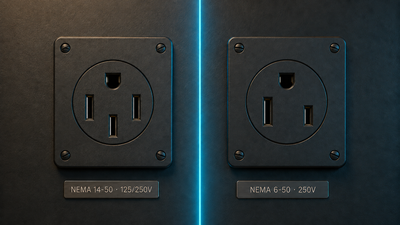
Option 2: NEMA 14-50 plug-in Level 2 with a 32A portable EVSE (all Model 3 trims)
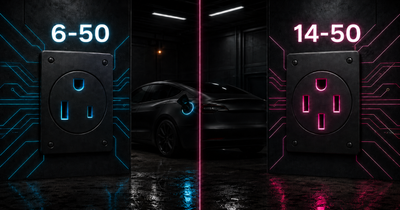
A NEMA 14-50 outlet on a dedicated 50A branch circuit permits up to 40A continuous EV charging under NEC 210.19(A)(1) and 210.20(A). A 32A portable Level 2 EVSE (such as the WenStorm Level 2 Portable in NACS variant, or Tesla's own Gen 2 Mobile Connector) delivers 32A continuous / approximately 7.7 kW at 240V:
- For a Model 3 Rear-Wheel Drive (7.7 kW / 32A OBC ceiling), the 32A EVSE delivers the vehicle's full rate. Delivered rate: ~7.7 kW.
- For a Model 3 Long Range or Performance (11.5 kW / 48A OBC ceiling), the 32A EVSE is below the vehicle's acceptance rate. Delivered rate: ~7.7 kW (EVSE-limited).
Tesla's own Gen 2 Mobile Connector is also capped at 32A regardless of vehicle acceptance rate, so a 32A NACS-native portable EVSE (like the WenStorm) is functionally equivalent for Long Range and Performance owners in terms of delivered rate: you get 32A / ~7.7 kW either way.
No new charger installation may be needed if the property already has a compatible, correctly wired, and inspected NEMA 14-50 receptacle on a dedicated 50A branch circuit. A new receptacle or a new dedicated circuit typically requires a licensed electrician per locally adopted code.
Option 3: 48A hardwired Level 2 on a dedicated 60A circuit (Long Range and Performance only)
For Model 3 Long Range and Performance owners who want to unlock the vehicle's full 11.5 kW acceptance rate, a 48A hardwired Level 2 EVSE on a dedicated 60A branch circuit is the setup that delivers it.
Tesla's Universal Wall Connector is the well-known 48A hardwired option, listed by Tesla at $600 when checked 2026-07-30, with a NACS vehicle-end connector and an integrated J1772 adapter for multi-vehicle households. It supports up to 48A on a compatible 60A circuit and carries a four-year residential-use warranty per the Tesla Universal Wall Connector product page.
WenStorm does not sell a hardwired 48A EVSE and is not competing on that specific spec. For a Model 3 LR or Performance owner who wants the full 11.5 kW rate and is willing to hardwire, the Tesla Universal Wall Connector is a straightforward recommendation. WenStorm's 32A portable is a portable / renter / travel alternative, not a competitor to the hardwired 48A option.
For a Rear-Wheel Drive Model 3 owner, a 48A hardwired setup is over-provisioned; the vehicle still caps at 7.7 kW / 32A. A 32A NEMA 14-50 plug-in is a better cost-benefit match than a hardwired 48A install unless you plan to replace the Rear-Wheel Drive with a Long Range / Performance or a different EV that accepts 48A. A 48A installation provides additional charging capacity for a future EV if your household plans include one.
Depleted-to-Full Charging Time
Approximate charging time from a fully depleted battery to full state-of-charge, based on Tesla's published battery capacities and the delivered power for each setup. Actual time varies with driving conditions, battery temperature, cabin conditioning, and state-of-charge tapering above roughly 80% (charging slows in the last portion to protect the battery). The vehicle stops charging when the battery reaches its state-of-charge target (typically 100%, or a lower limit if you set one).
| Trim | Setup | Delivered rate | Approx. depleted-to-full time |
|---|---|---|---|
| Rear-Wheel Drive | Level 1 (16A / 20A 120V circuit) | ~1.9 kW | ~30-34 hours |
| Rear-Wheel Drive | Level 2 32A (NEMA 14-50 plug-in OR Tesla Mobile Connector) | ~7.7 kW (matches vehicle OBC) | ~8-9 hours |
| Long Range / Performance | Level 1 (16A / 20A 120V circuit) | ~1.9 kW | ~38-42 hours |
| Long Range / Performance | Level 2 32A (NEMA 14-50 plug-in OR Tesla Mobile Connector) | ~7.7 kW (EVSE-limited) | ~10-11 hours |
| Long Range / Performance | Level 2 48A (hardwired 60A circuit, Tesla Universal Wall Connector) | ~11.5 kW (matches vehicle OBC) | ~7 hours |
For most Model 3 drivers, home charging replaces the day's driving overnight rather than filling a depleted battery from empty. If your daily driving is 30-60 miles and you park at home 8+ hours nightly, a 32A NEMA 14-50 plug-in setup is more than enough regardless of trim. The 48A hardwired option matters most for Long Range and Performance owners with short charging windows or same-day depleted-to-full turnaround.
For Long Range or Performance owners who want the full 11.5 kW / 48A hardwired rate: Tesla's Universal Wall Connector ($600 per Tesla's product page) is the honest recommendation. WenStorm's 32A portable is the portable / renter / travel alternative. Households with a J1772 secondary vehicle: consider the Universal Airbnb Host Kit.
Multi-Vehicle Households
If your household has a Model 3 plus another EV with a J1772 inlet (Chevy Bolt, Ford Mustang Mach-E in some model years, Hyundai IONIQ 5 in some model years, Chevy Blazer EV, Honda Prologue, Rivian in some model years, and many others), the mixed-connector charging question splits into four options. See our One EV Charger for NACS and J1772 Cars: 4 Home Options for the full walkthrough. The short version: WenStorm's Universal Airbnb Host Kit ($242.98) bundles a NACS 32A charger with a NACS-to-J1772 adapter, letting one EVSE serve both connector types.
Related Reading
- Tesla Mobile Connector vs Portable Level 2 — the Tesla-specific portable-EVSE comparison
- Tesla NEMA Adapter Guide — Tesla Gen 2 Mobile Connector's full NEMA adapter lineup
- One EV Charger for NACS and J1772 Cars: 4 Home Options — mixed-connector household guide
- Why NEMA 14-50 Outlets Melt with EV Chargers — receptacle-thermal failure mechanism
- Why Does My EV Charger Keep Tripping the Breaker? — panel-breaker-trip diagnostic
- Why Did My EV Charger Stop Charging Mid-Session? — the symptom-organized diagnostic if a session ends before completion
Frequently Asked Questions
How many amps does a Tesla Model 3 charge at?
A Model 3 Rear-Wheel Drive accepts up to 32A continuous on 240V AC (7.7 kW onboard charger). A Model 3 Long Range or Performance accepts up to 48A continuous on 240V AC (11.5 kW onboard charger). If your home EVSE delivers less than the vehicle's ceiling, the EVSE is the limit; if the EVSE delivers more, the vehicle caps at its OBC rating. Check your vehicle touchscreen's maximum charging-current setting for the specific VIN.
Is a 32A charger enough for a Model 3 Long Range?
For overnight charging on typical daily mileage: yes. A 32A EVSE delivers ~7.7 kW. If your daily driving replaces less than a full battery each night and you park at home 8+ hours, 32A is more than enough regardless of trim. If you routinely arrive with a near-empty battery and need same-day full turnaround, or if your parking window is under 8 hours, a 48A hardwired setup unlocks the vehicle's full 11.5 kW acceptance rate and reduces depleted-to-full time from ~10-11 hours to ~7.
Can I use the Tesla Mobile Connector at 48A on a Model 3 Long Range?
No. Tesla's Gen 2 Mobile Connector is capped at 32A continuous regardless of the vehicle's higher acceptance rate. To deliver 48A to a Long Range or Performance, you need a compatible hardwired 48A EVSE (such as the Tesla Universal Wall Connector on a dedicated 60A circuit) or a third-party 48A hardwired EVSE listed for the installation.
Do I need the Tesla J1772 adapter?
Tesla currently states on its J1772 Charging Adapter product page that this adapter is included with every new US Tesla vehicle delivery. This adapter lets your Model 3 (which has a NACS inlet) charge from a J1772 station. If you charge only at home with a NACS-native EVSE (the WenStorm NACS variant, a Tesla Wall Connector, or similar), you may never use the J1772 adapter, but it is useful for public J1772 stations and travel. Reverse direction (NACS charger → J1772 vehicle in a mixed household) requires a separate NACS-to-J1772 adapter, which WenStorm sells standalone or as part of the Universal Airbnb Host Kit bundle.
What outlet do I need for a home Level 2 charger for my Model 3?
A NEMA 14-50 outlet on a dedicated 50A branch circuit is the most common Level 2 setup for a plug-in portable charger. For Long Range and Performance owners who want the vehicle's full 11.5 kW acceptance rate, a 48A hardwired EVSE on a dedicated 60A circuit is required. Either installation typically requires a licensed electrician per locally adopted code. NEC 625.40 generally requires an individual branch circuit for EVSE installations above 16A or 120V.
Should I get the Tesla Wall Connector or a portable Level 2 charger?
Both work well; the tradeoffs are portability, cost, and installation complexity. A portable EVSE (like the WenStorm NACS variant at $219.99) moves with you if you rent, travel, or want to charge at friends' NEMA 14-50 outlets, and does not require hardwiring. Tesla's Universal Wall Connector ($600 per Tesla's current product page) is a hardwired 48A unit with an integrated J1772 adapter, which unlocks the full 11.5 kW rate for Long Range and Performance owners but requires professional hardwired installation on a dedicated 60A circuit. For a Rear-Wheel Drive owner where the vehicle caps at 32A anyway, the cost-benefit favors the portable setup unless you specifically want the wall-mounted convenience.
Summary
For a Tesla Model 3 Rear-Wheel Drive, a 32A portable Level 2 charger on a NEMA 14-50 outlet delivers the vehicle's full 7.7 kW documented rate and provides comfortable overnight charging for typical daily mileage. For a Long Range or Performance, the same 32A portable delivers ~7.7 kW (still comfortable overnight, functionally equivalent to Tesla's own Gen 2 Mobile Connector); a 48A hardwired EVSE on a dedicated 60A circuit unlocks the full 11.5 kW rate for drivers with higher daily energy needs or short charging windows. Tesla's Universal Wall Connector is the well-known 48A hardwired option. All Model 3 variants use native NACS, so any NACS-native EVSE fits directly. Verify your specific vehicle's current recall status before following any overnight-charging advice.
Sources
- Tesla — Onboard Charger ratings (authoritative for Model 3 trim-specific AC acceptance rates).
- Tesla — Universal Wall Connector product page (authoritative for 48A / 11.5 kW rating, 24-foot cable, four-year residential warranty, and current $600 US price as checked 2026-07-30).
- Tesla — SAE J1772 Charging Adapter product page (authoritative for the current statement that this adapter is included with every North American Tesla delivery).
- Tesla — Charging product guides (authoritative for Mobile Connector and Wall Connector documentation).
- NHTSA — Recalls lookup (authoritative for active recalls affecting a specific VIN or vehicle family).
- Your Tesla owner's manual and the maximum-charging-current setting on your vehicle touchscreen — authoritative for your specific VIN's AC acceptance rate and any recall-related charging guidance.
- NEC 210.19(A)(1) and 210.20(A) — Continuous-load sizing (125% of continuous load; 80% ceiling as the mathematical result). National Electrical Code, current edition; consult your local Authority Having Jurisdiction for the adopted edition.
- NEC Article 625 — EV charging system installation provisions, including 625.40 individual-branch-circuit requirement and 625.42 continuous-load classification.
- SAE J3400_202312 — Standard for the North American Charging Standard (NACS) coupler (first technical-information-report version published December 2023).
- U.S. Department of Energy, Alternative Fuels Data Center — Electricity for EV Charging at Home.
- WenStorm — Level 2 Portable EV Charger product page (NACS variant for Tesla owners; J1772 variant for other vehicles).
- WenStorm — Universal Airbnb Host Kit (NACS 32A charger + NACS-to-J1772 adapter bundle for mixed-connector households).
Real questions from EV owners
Join the Home Charging & NEMA Outlets discussion →