Adding a Second EV to the Household: Do You Need a Second Charger?

TL;DR
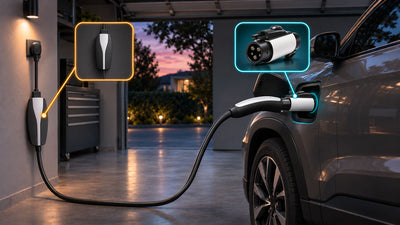
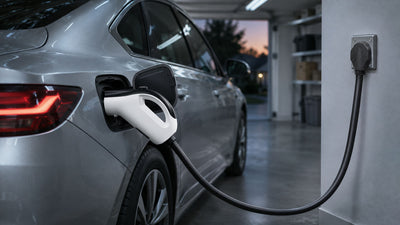
Most two-EV households don't need two chargers if both cars plug in overnight and share one inlet type. A single 32A portable Level 2 EVSE adds about 25 miles per hour, so two EVs needing 4-6 hours each fit inside a 10-hour window with a plug swap. Buy a second EVSE when parking is split, scheduling fails, or inlets differ (J1772 + NACS) and you need both charging independently. For mixed-inlet, a NACS EVSE with a SAE J3400 plug plus a NACS-to-J1772 adapter serves both cars from one unit.
Which situation describes you?
Pick the row that matches your parking, inlets, and nightly charging window.
| Your situation | Next step |
|---|---|
| Both EVs share one inlet type (J1772+J1772 or NACS+NACS), both plug in overnight, 10+ hour window | Keep one portable EVSE. Swap plugs mid-night or in the morning. No second purchase needed. |
| Same inlet type, but scheduling doesn't line up (shift work, one EV needs full charge daily) | Add a second portable EVSE on a second 240V outlet, or add a smart splitter to one circuit. |
| Mixed inlets (one J1772 car, one NACS car), moderate daily use | One NACS 32A EVSE with a NACS-to-J1772 adapter serves both from a single unit. |
| Mixed inlets, both EVs need overnight full charges (two long commutes) | Two separate EVSEs on two outlets. The adapter path becomes a bottleneck when both cars need the full window. |
| Parking at opposite sides of the house, running a second circuit is expensive | A smart splitter on one shared circuit lets both EVs plug in; only one charges at full current at a time. |
Identify your two EVs: inlets, onboard chargers, nightly need
Before deciding, write down three numbers for each car: inlet type, onboard-charger maximum AC rate, and daily miles driven. The combination tells you whether one EVSE can realistically serve both.
Inlet type is physical. A J1772 inlet accepts J1772 plugs; a NACS inlet accepts NACS plugs. The two shapes don't interchange without an adapter. Model-year 2024 and earlier EVs from Chevy, Ford, Rivian, Hyundai, Kia, VW, and Nissan use J1772. Tesla has always used NACS (formerly TPC). Starting with 2025 model year, Ford Lightning, Rivian, Hyundai IONIQ 5, Kia EV6 (US-built), Chevy Equinox EV, and GMC Hummer EV ship with NACS inlets. Verify at delivery because transition timing varies by trim.
| Vehicle | Model year 2024 and earlier | Model year 2025+ |
|---|---|---|
| Tesla Model 3 / Y / S / X | NACS | NACS |
| Ford F-150 Lightning / Mach-E | J1772 | NACS (Lightning), check trim (Mach-E) |
| Rivian R1S / R1T | J1772 | NACS |
| Hyundai IONIQ 5 / Kia EV6 | J1772 | NACS (US-built) |
| Chevy Bolt / Equinox EV | J1772 | NACS (Equinox EV) |
| VW ID.4 / Nissan Leaf | J1772 | J1772 (confirmed through 2025) |
Onboard-charger maximum is in your owner's manual. Most 2020+ BEVs accept 32A (7.7kW) or more; most PHEVs cap at 16A to 32A (3.3 to 7.7kW). A 32A portable EVSE will deliver 32A to any car whose onboard charger meets or exceeds 32A, and will deliver the car's max if the car's limit is lower.
The scheduling math: can one 32A EVSE actually serve both cars?
At 32A on 240V, a Level 2 EVSE adds roughly 25 miles of range per hour to a typical BEV. Two EVs that each drove 40 miles need about 1.6 hours each, or 3.2 hours total. Even two cars that each drove 100 miles need about 4 hours each, or 8 hours total — still inside a 10-hour overnight window.
Where this fails: shift work, two long commutes stacked on the same day, or an EV with a low state of charge from a weekend trip. If both cars arrive home at 7pm empty and both need to leave at 6am full, one EVSE delivering 32A for 11 hours gives roughly 275 miles total between them — tight for two long-range BEVs needing 200+ miles each.
The practical pattern most two-EV households settle into: plug in the lower-SoC car first, let it hit a target (say 80%), then swap. Tesla, Ford, and Hyundai apps all show current SoC and estimated completion time, which makes the swap decision easy from the couch.
Mixed inlets: one EVSE with an adapter, or two separate EVSEs?
A J1772 EV and a NACS EV share no plug. You have three paths.
Path 1: one NACS 32A EVSE plus a NACS-to-J1772 adapter. The adapter sits on the EVSE plug when the J1772 car is charging and comes off when the NACS car is charging. This works because the adapter translates connector shape only; the J1772 protocol runs through the NACS pin arrangement. WenStorm's Universal Airbnb Host Kit bundles a 32A NACS portable EVSE with the adapter, which is the simplest two-car setup if you prefer one EVSE and don't mind swapping an adapter.
Path 2: two separate EVSEs. One J1772, one NACS, each on its own 240V outlet. This is the right call when both cars need the full nightly window at the same time, or when parking is physically separated so one EVSE can't reach both cars.
Path 3: a dual-protocol wall-mounted charger. Tesla's Universal Wall Connector is the dominant example — it has a NACS plug with a built-in adapter for J1772. For portable Level 2, the adapter path (Path 1) is simpler and avoids a hardwired install.
Note on adapters and Tesla's own charging equipment: Tesla's Mobile Connector and Wall Connector prohibit extension cords per Tesla's current charging documentation, and third-party adapters are not accepted at Tesla Superchargers for non-Tesla vehicles. Adapters between a non-Tesla EVSE and a J1772 vehicle are a different case — they're widely used in home charging and don't involve Tesla's networked DC equipment.
Shared circuits and smart splitters: how one outlet serves two EVs
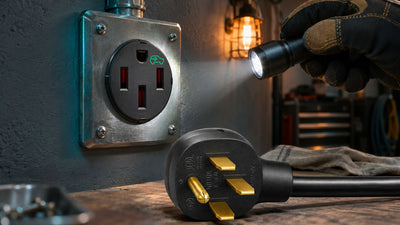
A NEMA 14-50 outlet on a 50A breaker supports 40A continuous per NEC Article 625, which requires branch-circuit sizing at 125% of the EVSE's continuous load. A 32A EVSE draws 32A continuous, well inside that limit. But two 32A EVSEs on the same 50A circuit can't both run at full output — the circuit would see 64A.
Two solutions share one circuit without an upgrade. A smart splitter (NeoCharge is the common example) lets both EVs plug in but only passes current to one at a time, auto-switching when the first car finishes. A load-managed EVSE from a single vendor can throttle both outputs so the combined draw stays under 40A continuous — slower per car, but both charge simultaneously.
If you're on a shared 14-50, assume one EV charges at full current at a time. That's fine for most overnight patterns and avoids running a second circuit, which typically costs $800 to $1,800 depending on panel distance.
Which WenStorm portable charger to buy for a two-EV household
Two SKUs cover the common two-EV decisions. Pick the Universal Airbnb Host Kit if your household has mixed inlets (one J1772 EV, one NACS EV). Pick a second Level 2 Portable in the right inlet variant if you already own one WenStorm EVSE and need a second unit for parallel charging.
WenStorm sells the products featured below. WenStorm is not affiliated with any vehicle manufacturer.


When a second charger is NOT the right fix
A second EVSE solves scheduling and reach problems, but it isn't the right call for every two-EV household. Skip the second unit when any of the following apply.
- You already have two EVSEs installed and the slow car just has a lower onboard-charger limit — adding a third unit won't speed up a car that caps at 16A.
- Your second car is a PHEV with a 3.3 to 6.6kW onboard charger — a shared 32A EVSE delivers more current than the PHEV can accept, so adding a second L2 doesn't help.
- You have one 120V Level 1 outlet as your only electrical option — a second L2 EVSE won't work until you install a 240V circuit.
- Both EVs are driven under 30 miles per day — one L1 charger or one L2 at reduced current handles the combined load inside an overnight window.
- You're moving in the next 12 months — a portable L2 EVSE moves with you, but a hardwired install doesn't recoup its cost in that window.
- Your utility has a time-of-use rate with a narrow off-peak window (say, 4 hours) — two EVSEs on one meter can exceed demand charges; a smart splitter or load-managed single unit is cheaper to operate.
- Your panel is already at capacity — a second 50A circuit may require a service upgrade ($2,500 to $5,000) that a smart splitter avoids entirely.
Related reading
- NACS vs J1772 in a Multi-EV Household: Which Standard Wins at Home?
- Do You Need a Second EV Charger as a Portable Backup?
- Two PHEVs, One Outlet: How to Share a Single 240V Circuit
- EV Extension Cable Buyer's Guide
- New EV Owner Charging Checklist
Frequently asked questions
Can two EVs charge at the same time from one NEMA 14-50 outlet?
Not at full current. A 50A breaker supports 40A continuous, which fits one 32A EVSE. Two 32A EVSEs would draw 64A and trip the breaker. A smart splitter lets both EVs plug in but only charges one at a time, or a load-managed EVSE throttles both to stay under 40A combined.
Does my J1772 car work with a NACS EVSE through an adapter?
Yes, at home. A passive NACS-to-J1772 adapter lets a NACS EVSE deliver AC charging to a J1772 vehicle because the J1772 signaling protocol runs through the NACS pin layout. This is different from DC fast charging at a Tesla Supercharger, where Tesla restricts which adapters work with non-Tesla vehicles.
Will a 50A-rated EVSE charge faster than a 32A EVSE?
Only if your car's onboard charger accepts more than 32A. Most 2020+ BEVs cap AC input at 32A to 48A; a few (Rivian, some Lucid, Porsche Taycan) accept 48A or higher. For a 32A-capable vehicle, a 32A EVSE and a 48A EVSE deliver identical charging rates.
Can I use one Level 2 EVSE for a BEV plus a PHEV?
Yes, and it's a common setup. The PHEV's onboard charger (typically 3.3 to 6.6kW) will limit its own charging rate regardless of what the EVSE can deliver. Plug the lower-SoC car first and swap when it finishes.
Where to verify these claims
Primary sources are linked inline throughout this guide. For deeper verification:
- NFPA 70 (National Electrical Code), Article 625 — Electric Vehicle Power Transfer System
- SAE J3400 — NACS Connector Standard (standardized December 2023)
- U.S. DOE Alternative Fuels Data Center — EV Charging Infrastructure
- Tesla Mobile Connector support documentation
- Your vehicle's owner's manual — onboard-charger maximum AC rate and inlet type specification