Are EV Extension Cords Legal in the US? What NEC 625 Says

TL;DR
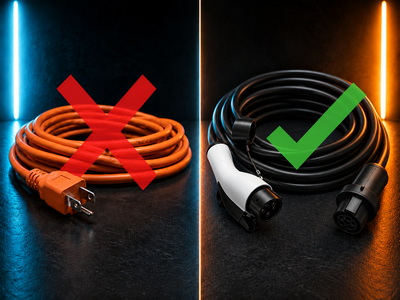
There is no simple nationwide yes-or-no. Supply-side extension cords are prohibited by some manufacturer manuals — Tesla's Gen 2 Mobile Connector manual says "Do not use an extension cord." Vehicle-side J1772/NACS extensions are a different product category, but they are not automatically code-compliant: NEC 625.17(C) sets an overall usable cord/cable length ceiling (generally 25 ft, measured attachment-plug to vehicle-connector), and the EVSE listing, manufacturer instructions, and local AHJ all apply. UL 2263 certification of the cable stock alone does not make a finished extension assembly automatically legal.
Table of contents
- The short legal answer — vehicle-side vs supply-side
- What NEC Article 625 actually says
- How EV charging requirements actually get enforced
- What your local AHJ does
- The manufacturer prohibition problem
- When you actually need a permit
- Fit-check — 32A vs 50A vehicle-side extension
- Frequently asked questions
The short legal answer — vehicle-side vs supply-side
There is no single federal statute that bans EV extension cords. Whether a specific cable is legal for a specific installation depends on which side of the EVSE it sits on, on the EVSE manufacturer's instructions, on the adopted NEC edition, and on the AHJ that enforces it.
Supply-side extension — a cord between the wall outlet and the EVSE. Tesla's Gen 2 Mobile Connector Owner's Manual (tesla.com/ownersmanual) states directly: "Do not use an extension cord." Other portable EVSE manuals impose similar restrictions; the exact wording varies by brand and should be read directly.
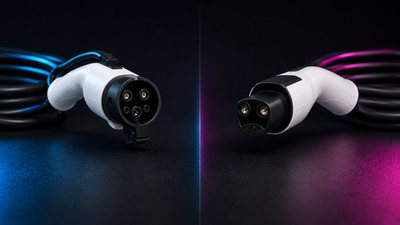
Vehicle-side extension — a cable between the EVSE's J1772/NACS connector and the vehicle inlet. WenStorm's J1772 extensions and equivalent products from Lectron, EVDANCE, and others fall in this category. Manufacturer manuals generally do not prohibit vehicle-side extensions as a class, but the combined charging path still has to comply with NEC 625.17(C) and with the EVSE and vehicle instructions.
A UL 2263 certificate on the cable stock is helpful evidence, but it does not, by itself, establish that the finished assembly plus your EVSE plus your installation is code-compliant.
What NEC Article 625 actually says
NEC Article 625 (Electric Vehicle Power Transfer System) governs EV charging equipment installation. It is part of NFPA 70, updated on a three-year cycle. The current model editions in active circulation as of 2026 are NEC 2020, NEC 2023, and NEC 2026 (adoption is early).
Sections most relevant to the extension-cord question:
- NEC 625.17(C) — overall usable cord/cable length. The rule limits the overall usable length of the EVSE's cord-and-cable system (generally to 25 ft) unless qualifying cable management is part of the listed EVSE. For portable EVSE, the measurement runs from the face of the attachment plug to the face of the vehicle connector. An aftermarket vehicle-side extension adds to that combined path — it is not automatically exempt. Always check total-length compliance for your specific EVSE + extension combination.
- NEC 625.44 — connection method. Article 625 distinguishes cord-and-plug-connected EVSE from permanently connected (hardwired) EVSE. In the 2026 NEC, connection method depends on EVSE type and receptacle rating; the code requires the attachment plug on cord-and-plug equipment to be rated at least 125% of the equipment's maximum rating. Prior editions used somewhat different framing — always check your jurisdiction's adopted edition.
- NEC 625.54 — GFCI protection. The 2026 NEC substantially expanded the GFCI requirements in this section. Cord-and-plug EV charging receptacles up to a specified voltage-to-ground require GFCI protection, and higher-voltage EV supply equipment brings in special-purpose GFCI (SPGFCI) requirements. Prior NEC editions were narrower. This is an edition-specific area — do not assume a single simple rule applies in every jurisdiction.
- NEC 625.40 — individual branch circuit. Each EV supply equipment installation generally requires an individual branch circuit that supplies no other outlet, subject to defined exceptions for managed-load systems.
- NEC 110.3(B) — listing and instructions. Listed or labeled equipment must be installed and used in accordance with any instructions included in the listing or labeling. This is the code hook that imports manufacturer manual language into the enforceable framework.
What NEC does not say: Article 625 does not contain a categorical, one-size-fits-all prohibition on vehicle-side EV extension cables. But it also does not exempt an aftermarket extension from the overall-length rule in 625.17(C).
Compliance for a specific installation is a combined question of adopted-edition text, EVSE listing scope, manufacturer instructions, and AHJ discretion — not just a UL certificate on the cable stock.
How EV charging requirements actually get enforced
The NEC is a model code published by the NFPA. It becomes enforceable law only when a state, county, or city adopts it. Adoption schedules and amendments vary widely, and the "hierarchy" is really a directional enforcement flow rather than a ranking of authorities.
Reference points as of 2026 — verify against your local AHJ or the NFPA CodeFinder before relying on any specific example:
- Most states operate on NEC 2020 or NEC 2023. NEC 2026 adoption is early — for example, Texas TDLR adopted the 2026 NEC as the state electrical code effective September 1, 2026 (limited exceptions apply).
- California adopts the NEC as the California Electrical Code (CEC) — part of Title 24 — with California amendments. The 2025 California Electrical Code (effective January 1, 2026) adopts the 2023 NEC with amendments.
- Some states delegate adoption to municipalities, and many states that adopt statewide still allow local amendments. Two houses on the same block can, in principle, sit under slightly different requirements.
A "state-by-state" static table decays quickly and misses the amendments and municipal-adoption layer. Check the NFPA CodeFinder or call your city or county electrical inspector's office — they can name the enforced edition and any local amendments in one phone call.
What your local AHJ does
The AHJ (Authority Having Jurisdiction) is the person or office empowered to interpret the adopted code and approve equipment, materials, and installations. For most residential EV charging in the US, this is a city or county electrical inspector.
AHJ responsibilities include:
- Interpretation of adopted-code sections where the text leaves room.
- Approval authority for equipment and materials. Under NEC 110.2, equipment required or permitted by the code must be approved by the AHJ. Even for listed equipment, the AHJ retains approval responsibility for the installation as a whole.
- Amendment enforcement. Local amendments to the adopted NEC apply on top of the model text.
- Permit and inspection requirements for fixed electrical work.
- Acceptance of NRTL listings. OSHA notes that local governments may determine the nature and extent of their acceptance of NRTL certifications; the mainstream three in North America are UL, ETL/Intertek, and CSA.
A UL 2263 certificate on the cable stock, an ETL Listed EVSE, or any other NRTL mark is important supporting evidence — but the AHJ is still the enforcing authority for the specific installation. A licensed electrician familiar with your jurisdiction can tell you what your AHJ will accept faster than you can read the code yourself.
The manufacturer prohibition problem
Even where the adopted NEC and the AHJ would permit an extension, the EVSE manufacturer's manual can impose its own restriction. Under NEC 110.3(B), listed or labeled equipment must be used in accordance with instructions included in the listing or labeling — which imports manufacturer manual language into the enforceable framework.
Documented example. Tesla's Gen 2 Mobile Connector Owner's Manual (available at tesla.com/ownersmanual) states directly: "Do not use an extension cord." This applies to the supply-side scenario for the Mobile Connector.
Other manufacturers. Three commonly-cited portable Level 2 EVSE manuals — Emporia EV Charger, ChargePoint Home Flex, Wallbox Pulsar Plus — carry restrictions that address extension-cord use. The exact wording, scope, and whether the restriction is limited to supply-side or extends to any extension varies by brand. Read the specific manual for your EVSE.
Vehicle-side extensions are generally a separate category and are less often addressed in EVSE manuals, but a buyer should still confirm against the specific EVSE and vehicle manuals for their installation.
When you actually need a permit
Permit requirements are jurisdiction-specific, but the general pattern in most US jurisdictions is:
- Installing a new dedicated 240V circuit + outlet — permit almost always required. Requires a licensed electrician, load calculation, and inspection.
- Hardwired Level 2 EVSE installation — permit almost always required.
- Plugging a portable Level 2 EVSE into an existing, previously permitted NEMA 14-50 (or similar) outlet — the plug-in operation is generally not new fixed electrical work, so it typically does not trigger a new permit. That does not, on its own, establish code compliance for the total installation — the existing outlet, circuit, and configuration still have to be code-appropriate for continuous EV charging.
- Adding a vehicle-side extension cable between the EVSE and the vehicle is not fixed electrical work either. But it does add to the combined cord-and-cable length under NEC 625.17(C), and it must not conflict with the EVSE's listing or manufacturer instructions. "No permit" is not the same as "guaranteed compliant."
- Modifying existing wiring or splicing a supply-side cord — either prohibited outright by the EVSE manufacturer or requires a permit and inspection.
If you are unsure whether a specific configuration triggers a permit or a compliance concern, ask your AHJ directly — a single phone call typically resolves it.
Fit-check — 32A vs 50A vehicle-side extension
If you have confirmed that a vehicle-side extension is permitted by your EVSE manual and consistent with your adopted-code total-length constraints, the next question is amperage. Match to your EVSE's actual output configuration — not to the receptacle it plugs into, and not to the vehicle's onboard-charger maximum:
| EVSE configuration | Right extension tier |
|---|---|
| Portable Level 2 EVSE that pilots at 32A continuous (WenStorm's own Level 2 Portable and many other 32A portables) | 32A · 21 ft — $129.99 |
| Portable Level 2 EVSE that pilots at 40A continuous | 50A · 21+ ft — from $169.99 (cable rating must meet or exceed EVSE output) |
| Plug-in NEMA 14-50 wall-mounted EVSE (typically limited to 40A continuous per the 80% rule on a 50A receptacle — e.g., ChargePoint Home Flex plug-in is capped at 40A output) | 50A · 21+ ft — from $169.99 |
| Hardwired 48A or 50A EVSE on a suitably sized circuit | 50A · 21+ ft, and re-check total-length compliance under NEC 625.17(C) |
| Parking spot > 21 ft from the EVSE cable end | 50A tier — 25 / 30 / 40 / 50 ft variants are 50A only |
Common over-buy pattern: buyers see "50A" as an upgrade and buy the 50A tier when the EVSE only pilots at 32A. A 50A-rated cable will carry 32A fine (rated amperage is a maximum), but buyers pay more for capacity they will never use unless the EVSE itself is later upgraded. Match to your EVSE's pilot rating.
Common misconception: a NEMA 14-50 receptacle is a "50A outlet," but a plug-in EVSE on that receptacle is typically limited to 40A continuous by the 80% continuous-load rule. Continuous 48A/50A charging generally requires a hardwired EVSE on a suitably sized circuit — not a plug-in configuration. Check your EVSE's spec sheet before assuming.
For a full spec-by-spec comparison against EVDANCE (WenStorm's closest direct competitor on J1772 extensions), see WenStorm vs EVDANCE: J1772 Extension Cable Specs Compared. For the underlying voltage-drop math that justifies 8 AWG for 50A continuous EV charging, see Why 8 AWG Is Enough for 50-Amp EV Charging.
Frequently asked questions
Is there a federal law banning EV extension cords?
No. There is no federal statute in the United States that categorically bans EV extension cords. Federal EV-charging regulation is limited to NHTSA vehicle-side rules and OSHA workplace rules. Extension-cord legality for residential use is governed by state-adopted NEC, local AHJ enforcement, and manufacturer instructions — none of which are federal law.
Does NEC 625 prohibit EV extension cords?
Not as a categorical class. But NEC 625.17(C) does limit the overall usable EVSE cord-and-cable length (generally to 25 ft, measured attachment-plug to vehicle-connector for portable EVSE, unless qualifying listed cable management applies). An aftermarket vehicle-side extension adds to that combined path and must be evaluated against the total-length rule for your specific EVSE + extension + adopted-edition combination. NEC 110.3(B) also requires listed equipment to be used per its instructions, which imports manufacturer manual language.
If my state hasn't adopted the latest NEC, which edition applies?
Whichever edition your specific AHJ enforces, with any local amendments. Statewide adoption is a starting point, but many states allow municipalities to adopt independently, and adopted editions frequently include local amendments. Call your city or county electrical inspector's office, or check the NFPA CodeFinder tool.
Does using a vehicle-side extension automatically require a new permit?
Not typically. Plugging in a listed portable EVSE and adding a vehicle-side extension is generally not fixed electrical work, so no new permit is usually triggered. But that does not, by itself, establish code compliance — the total-length rule, the EVSE's listing scope, and the manufacturer's instructions still apply. If unsure, ask your AHJ.
Can I use a household extension cord for supply-side EV charging?
No. Tesla's Gen 2 Mobile Connector Owner's Manual directs users not to use an extension cord for the Mobile Connector; other portable Level 2 EVSE manuals impose their own restrictions with varying wording. Using a household cord to power an EVSE creates a safety hazard (household cords are not rated for 30A+ continuous current) and can conflict with the EVSE's listed use under NEC 110.3(B).
What certifications should a vehicle-side EV extension have?
The most common evidence is a UL 2263 certificate on the EV cable stock (or CSA C22.2 No. 332 for Canada) and UL 2251 for the plug and coupler. WenStorm publishes its cable-stock certificate as UL-US-2407470-0 covering models EVE / EVJE to UL 2263 + CSA C22.2 No. 332. A certificate on the cable stock is helpful supporting evidence, but a UL-listed complete finished assembly is not the same class of listing and is often not available. Ask the seller for the specific certificate scope.
Does using an extension cable affect my warranty?
It may. Vehicle warranties cover the vehicle; the EVSE and any extension are separate products with separate warranty terms. Using a configuration that conflicts with the EVSE manufacturer's listing or instructions may affect warranty coverage under the EVSE's terms — particularly if the configuration is related to a failure. Read your EVSE's warranty terms and the vehicle owner's manual before choosing an extension.
Related reading
- Can You Use an Extension Cord With an EV Charger? — the safety framework
- UL 2263 vs UL 2251 vs UL 2231: What They Cover — the certification decoder
- EV Extension Cable Buyer's Guide: J1772 vs NACS, Length, and What Not to Do — full sizing walkthrough
- WenStorm vs EVDANCE: J1772 Extension Cable Specs Compared — direct competitor comparison
WenStorm J1772 Extension Cables
Vehicle-side J1772 extension cables built with UL 2263-certified EV cable (UL-US-2407470-0, models EVE / EVJE, UL 2263 + CSA C22.2 No. 332). IP66 connector rating, 2-year warranty. Always check total-length compliance under NEC 625.17(C) for your specific EVSE + extension combination.


Not sure what amperage you have? Check the "Output" rating on your EV charger. Your extension cable should be rated at least as high as your charger's maximum output.
Written by Nathan Park, Standards & Certifications Specialist at WenStorm. Nathan covers NEC compliance, UL / ETL / CSA product listings, and the distinction between model code, state-adopted code, AHJ enforcement, and manufacturer instructions.
Real questions from EV owners
Join the Outlet & Electrical Safety discussion →