Can You Charge Two EVs From One Outlet? 4 Safe Options

Quick answer: Yes, two EVs can share one 240V outlet—but not by running two ordinary chargers through a passive Y-splitter. Safe options include alternating one EVSE between the vehicles, using a listed automatic EV charging splitter that prevents both chargers from exceeding the circuit capacity, installing load-sharing EVSEs, or adding a second dedicated circuit. The right option depends on your combined daily charging demand and available electrical capacity.
The 4 Safe Options at a Glance
| Solution | Both charge simultaneously? | Best for |
|---|---|---|
| Alternate one portable EVSE between vehicles | No, one at a time | Low to moderate combined daily driving |
| Listed automatic switching device (single EVSE, auto-switches between two cars) | Not simultaneously, but hands-off | Two vehicles sharing the same available circuit capacity |
| Dual-port or load-sharing EVSE (Emporia Intelligent Load Sharing, Wallbox Pulsar Plus with Dynamic Load Management) | Yes, at divided power | Frequent simultaneous overnight charging |
| Second dedicated circuit installed by a licensed electrician | Yes, at full power | High daily energy demand, both cars need max range every morning |
The rest of this guide covers what makes each option work, when to pick it, and where the common Reddit answers (passive splitters, "just alternate," or "install a second circuit") each fall short.
The Electrical Answer
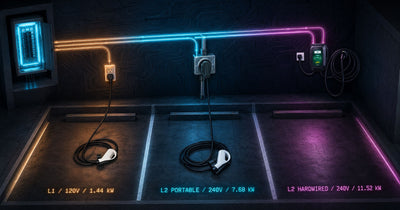
EV charging is treated as a continuous load, which under the National Electrical Code means the branch circuit must be sized for 125% of the continuous current the load draws. Practically, that means a 15A branch circuit permits about 12A continuous, a 20A branch circuit permits about 16A continuous, and a 50A branch circuit permits about 40A continuous. Two independent EV chargers drawing their default rates simultaneously will usually exceed the circuit's continuous rating, regardless of whether they're plugged into one outlet via a splitter or into two outlets on the same circuit.
An important nuance the standard "the breaker will trip" answer misses: a standard thermal-magnetic breaker responds to overcurrent, not to localized heating at loose or worn receptacle contacts. Two chargers combined into one receptacle via a passive splitter can heat the contact points enough to degrade the receptacle over time even when the total current stays below the breaker's trip threshold. The receptacle can fail slowly, well before the circuit protection ever acts. That's why "the breaker will save you" isn't a complete safety argument.
The U.S. Department of Energy's home-charging guidance recommends evaluating capacity, code requirements, and permits with a qualified electrician before installing or upgrading home EV charging, and treats Level 1 and Level 2 setups as belonging on dedicated branch circuits. See the DOE Alternative Fuels Data Center home-charging page linked in the Sources section for their current guidance.
Note also that receptacle rating and branch-circuit rating aren't the same thing. A NEMA 5-15 receptacle can appear on either a 15A or a 20A branch circuit under applicable NEC provisions. The 12A continuous limit is a consequence of the circuit's rating and any other loads on it, not the receptacle shape by itself. If you're planning multi-EV charging, the question is what the branch circuit can handle continuously, not what shape the outlet is.
Option 1 — Alternate One EVSE Between Two Vehicles
This is the option that costs nothing beyond the single EVSE you already need for one car. It's not glamorous, and hardware brands don't promote it because it doesn't sell more hardware. For most dual-EV households, it's the correct answer.
The math is basic: daily charging need equals daily miles divided by vehicle efficiency in miles per kWh. Combined household daily demand equals both cars' needs added together. Available charging energy per overnight session is roughly the charger's power in kW multiplied by the hours plugged in and by about 0.9 to account for charging losses. If combined daily demand is less than the energy one charger can deliver during the hours the outlet is available across both cars, alternating works.
A quick example. If one car needs 15 kWh per day (roughly 60 miles at 4 mi/kWh, typical for a mid-size sedan EV) and the other needs 10 kWh per day (a PHEV or a short-commute battery EV), combined demand is 25 kWh per day. A 32A / 7.7 kW Level 2 charger delivers roughly 62 kWh in a nine-hour overnight session, minus losses, or about 55 kWh usable. Alternating so each car charges every second or third night comfortably covers the household. If daily demand approaches or exceeds what one charger can deliver over available hours, alternating stops being enough and you should look at Option 3 or 4.
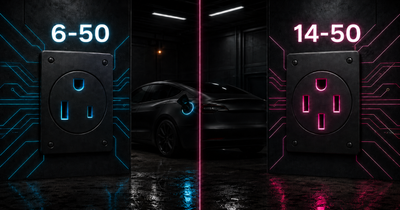
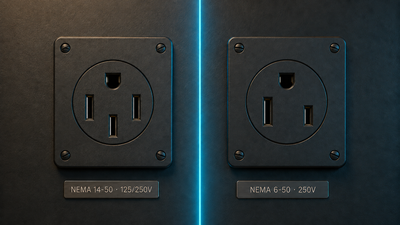
An operational tip that saves receptacle wear: leave the wall plug connected to the outlet, and swap the connector between the two vehicles instead of unplugging the wall end every night. High-current NEMA 14-50 receptacles are rated for insertion and withdrawal cycles, but every cycle contributes to contact wear. The J1772 or NACS connector on the car side is designed for much higher plug-and-unplug frequency. Keep the wall connection stable; move the car connector.
Option 2 — Listed Automatic Switching Device
An automatic transfer switch or listed splitter (not to be confused with a passive Y-adapter) sits between the outlet and two connected EVSEs, and hardware-enforces the rule that only one EVSE draws power at a time. When Car A finishes, the switch hands power to Car B. Neither driver has to remember to swap the connector at 2 a.m.
Two important qualifications. First, this is a "not simultaneously" solution, not a "both at full power" solution. It solves the "who has to swap the connector at midnight" problem without solving the "we both need max charge simultaneously" problem. Second, the specific device you use must be UL-listed for continuous EV charging use, installed to code, and configured by a qualified electrician. Passive Y-adapters that just split the receptacle into two live outlets are not this — they are the dangerous kind that combines loads on the receptacle. Passive Y-adapters are not the same category and should not be substituted here.
Insurance and code considerations matter. Talk to your electrician about which specific transfer device is listed for use with your specific EVSEs and your specific circuit, and confirm the installation is inspected and permitted where local rules require it.
Option 3 — Dual-Port or Load-Sharing EVSE
Purpose-built dual-EV charging systems solve the "both cars need charge at the same time" problem by hardware-enforcing a shared power budget. When only one car is plugged in, it receives the full available power. When both are plugged in, the two EVSEs coordinate and each takes half (or a configured split) of the shared circuit's capacity.
Two examples with product documentation:
- Emporia Intelligent Load Sharing — Emporia publishes a support article on load sharing between two or more compatible Emporia chargers on a shared circuit. See the Emporia help center article linked in the Sources section.
- Wallbox Pulsar Plus with Dynamic Load Management — multiple Wallbox Pulsar Plus units can use Wallbox's Dynamic Load Management feature to share available capacity. See the Wallbox product page linked in the Sources section for the current feature documentation.
Cost tradeoffs. Two units plus a shared 50A or 60A dedicated circuit typically runs $1,500 to $3,000 all-in for hardware plus $500 to $1,500 for electrician labor and permit, depending on panel proximity, wire run distance, and whether your panel has spare capacity. If daily combined demand regularly exceeds what one charger on one circuit can deliver, load-sharing hardware is usually cheaper than adding a second full-capacity dedicated circuit for each car.
Load-sharing systems are not limited to two EVSEs. Some products support three or more units on a shared circuit under a common power budget, subject to the manufacturer's specifications and to what the branch circuit's continuous rating actually permits. The rule is available capacity divided across whatever's actively charging, not "one circuit per car" as an absolute.
Option 4 — Second Dedicated Circuit
The cleanest and most expensive option: a licensed electrician runs a second dedicated branch circuit from the panel to a second receptacle or hardwired EVSE. Both cars charge at full power, independently, simultaneously.
Cost ranges are wide because they depend on panel proximity, wire run distance, whether trenching is needed for detached garages, permit fees, and whether your existing panel has capacity for another 40A or 50A circuit. A second 15A or 20A 120V circuit for a Level 1 fallback runs $200 to $800. A second dedicated 40A or 50A 240V circuit for a Level 2 receptacle runs $500 to $2,500. A panel upgrade to make room for the new circuit adds $1,500 to $4,000 or more depending on service size.
When Option 4 is the right call: both cars are large-battery EVs with high daily energy demand, both drivers routinely need max range every morning with no ability to alternate, or you already know you'll add more electrical load in the near future (workshop, hot tub, second HVAC) and want to size the panel upgrade for all of it at once.
A note on NEC-permitted exceptions to "one dedicated circuit per EVSE." Under NEC 625.42 and the broader energy-management provisions, listed EV energy-management systems can serve multiple EVSEs on shared capacity under specific listing and installation conditions. These are engineered systems, not casually-added receptacles. If a design like this is what you want, it belongs in the hands of a licensed electrician who can specify the listed equipment and get the installation inspected against the adopted code in your jurisdiction.
Why Passive Splitters Are the Wrong Answer
Every dual-EV thread on Reddit eventually has someone recommend a Y-adapter that turns one 240V outlet into two. These are typically passive: no active current management, no protection against both connected chargers pulling their maximum simultaneously.
Three failure modes:
Electrical. A passive splitter doesn't derate current. If both chargers try to pull their maximum, the splitter, the outlet, and the wire behind the outlet all see the combined load. Standard overcurrent protection eventually trips if the total exceeds the breaker rating, but as noted earlier, that protection doesn't catch localized contact heating at the receptacle.
Mechanical and thermal. Two heavy connectors, two cables, and combined load through one receptacle creates more lateral and downward force on the contacts than a single plug does. Loose or worn contacts can overheat under continuous load without exceeding the circuit's rating.
Certification and insurance. If a splitter isn't UL-listed for continuous EV charging load, using it may fall outside what a property insurance policy considers a supported installation. Insurance coverage after an incident depends on the specific policy, the cause of loss, and how the equipment was installed and rated. Talk to your insurer if you have a permanent EV charging setup, and ask specifically about coverage in the event of an electrical fire from EV charging equipment. Guidance from major carriers (see State Farm and Allstate articles in the Sources section) generally treats professionally installed, listed equipment on properly sized circuits as the expected baseline.
If you see a splitter recommendation without a specific UL-listed part number and a note that it enforces total current (which passive Y-adapters do not), skip it. The listed automatic transfer devices in Option 2 are a different product category.
When to Say You Can't Support the Setup Yet
There are property conditions where dual-EV charging shouldn't be added without first fixing the underlying electrical situation:
- Two-prong ungrounded outlets. Never charge from ungrounded outlets, regardless of setup.
- Aluminum wiring without verified electrician upgrades. Aluminum expands and contracts more than copper under sustained heat, loosening connections over time. Continuous EV load accelerates this. Have an electrician evaluate and approve any circuit before dual-EV use.
- Visibly worn or discolored outlets. Any brown, gray, or black around prong holes indicates arc damage. Replace before adding any EV load.
- Panel already near its rated continuous load. A licensed electrician's load calculation should precede any second-circuit or high-current shared-circuit install.
- Local jurisdictions with active restrictions on EV charging in enclosed or subsurface parking. Check your local code and any applicable municipal notices.
Related Reading
- Portable vs Wall-Mounted EV Charger: Which Do You Actually Need? — the broader decision between portable and installed hardware
- WenStorm vs Lectron Portable EV Chargers
- WenStorm vs ChargePoint Home Flex
- Why NEMA 14-50 Outlets Melt with EV Chargers — the receptacle-stress context for continuous EV load
For PHEVs charging on a shared 120V outlet, see the specific PHEV load-math walkthrough in Charge Two PHEVs on One Outlet: The 120V Truth.
FAQ
Is it OK to charge two PHEVs from one 120V outlet at the same time?
Two PHEVs pulling simultaneous 12A each from a 15A or 20A branch circuit will typically exceed the continuous-load rating. The safe options are the same as for two full-battery EVs: alternate one at a time (Option 1), use a listed automatic switching device (Option 2), or install a second dedicated circuit (Option 4). For a PHEV pair with modest daily use, alternating is usually enough. Verify daily kWh need for each vehicle and confirm one overnight session per vehicle every second or third night covers it.
Can I use a splitter to charge two EVs from one outlet?
Not a passive Y-adapter splitter, no. Passive splitters combine loads on the receptacle, don't enforce total current limits, and are typically not listed for continuous EV charging use. Listed automatic switching devices (which look similar but hardware-enforce one-at-a-time operation) are a separate category and are legitimate. If you're considering a specific product, verify it is UL-listed for continuous EV charging load and consult your electrician about installation.
What's the cheapest way to charge two EVs at home?
For most dual-EV households: alternate one portable EVSE between the two vehicles using an existing code-compliant 240V outlet. Zero equipment cost beyond the single EVSE. If daily driving is heavier and alternating doesn't keep up, the next-cheapest option is often adding a second Level 1 (120V) circuit for the lower-demand vehicle so both cars have a source. Load-sharing dual-EVSE systems and second dedicated Level 2 circuits are the more expensive options for households that need simultaneous full-power charging.
Can I install a second NEMA 14-50 outlet on the same circuit as the first for two EVs?
Casually adding a second receptacle to an existing dedicated EV circuit for simultaneous use isn't the right approach. However, listed EV energy-management systems under NEC 625.42 can serve multiple EVSEs on shared capacity when designed and installed by a qualified electrician using listed equipment. If load-sharing across two EVSEs on one circuit is what you want, it's an engineered solution, not a DIY add.
Does my homeowner insurance cover damage from a two-EV charging setup?
Coverage depends on your policy, the cause of loss, and how the equipment was installed and rated. Standard homeowner policies generally treat professionally installed, listed EV charging equipment on properly sized circuits as the expected baseline. Uncertified adapters, non-listed splitters, or setups outside manufacturer instructions may create coverage disputes. Call your insurer, describe your specific setup, and get any conditions in writing. This isn't legal or insurance advice. See the State Farm and Allstate resources linked in Sources for one common carrier framing.
What if my two EVs have different connectors, one J1772 and one NACS?
Alternating still works. Swap the connector between vehicles as part of the same physical swap cycle. Included adapters vary by manufacturer, model year, and market — verify what your specific vehicles came with rather than assuming every EV ships with a J1772-to-NACS or NACS-to-J1772 adapter. If your setup requires an adapter that didn't ship with the car, use a manufacturer-approved model.
The four options above cover essentially every safe way to charge two EVs from one home electrical service. Passive splitters are not a fifth option. If your daily driving pattern fits alternating (Option 1), that's the honest cheapest answer. If it doesn't, the choice between listed switching (Option 2), load-sharing hardware (Option 3), and a second circuit (Option 4) comes down to daily energy demand and how much simultaneous charging matters to you. Any hardware installation should be evaluated by a licensed electrician against your panel capacity and local code, and any hardwired equipment should be insured under your property policy with the insurer notified in writing.
See the WenStorm Portable Level 2 EV Charger →
Use the WenStorm Solution Finder →
Sources
- U.S. Department of Energy, Alternative Fuels Data Center — Electricity for EV Charging at Home
- Emporia Energy — Intelligent Load Sharing (help center)
- Wallbox Pulsar Plus product page (Dynamic Load Management feature documentation)
- State Farm — What to Know About EV Home Charging and Homeowners Insurance
- Allstate — EV Charging Station Coverage Overview
- WenStorm Return Policy — 2-year warranty
- NEC 210.19(A)(1), 210.20(A), 210.21(B)(3), 625.42 — Continuous load and EV energy-management provisions (National Electrical Code, current edition; consult your local AHJ for jurisdiction-specific adoption)
Nathan Park covers EV charging safety, adapter compatibility, and multi-vehicle charging scenarios for WenStorm. Content is educational, not electrical, legal, or insurance advice.