TL;DR
Most first-time EV owners can charge at home on the outlets they already have — if the outlet and circuit are verified suitable for continuous EV load. The six-step framework below identifies your car’s connector, verifies the outlet and circuit, then picks Level 1 or Level 2. Level 1 on a dedicated 120V circuit is a legitimate solution, not a fallback. A 200A service upgrade is often avoidable: an NEC Article 220 load calc may permit Level 2 on 100A or 125A panels. The federal 30C charger tax credit expired for property placed in service after June 30, 2026.
Step 1 — Identify your vehicle's connector and onboard AC limit
Before you buy any charger, check two things about your vehicle:
- The inlet type. J1772 (five-pin round) on most non-Tesla EVs shipped before 2025, or NACS (Tesla's connector, now adopted by many 2025+ models). The charger's connector must match the inlet, or you need a manufacturer-approved adapter between them.
- The onboard AC charger limit. Every EV has a maximum AC charging rate set by the onboard charger, typically 6.6, 7.7, 9.6, or 11.5 kW. A 48A / 11.5 kW EVSE does not charge a 7.7 kW car faster than a 32A / 7.7 kW EVSE does. Look this up in your owner's manual before sizing the charger.
If your household has both J1772 and NACS vehicles, plan for a manufacturer-approved adapter between them, or pick a portable EVSE the manufacturer sells in both connector versions.
Step 2 — Calculate the energy you need each day
Instead of a fixed "miles per day" threshold, do the math for your specific vehicle:
Required wall energy per day = daily miles ÷ vehicle efficiency (mi/kWh) ÷ charging efficiency
Example: 30 miles/day, 3 mi/kWh, ~85% charging efficiency = ~11.8 kWh/day. Time to deliver ~11.8 kWh at common supply levels:
| Supply | Maximum power | Approx. time |
|---|---|---|
| 120V / 12A (typical OEM Level 1) | 1.44 kW | ~8.2 hours |
| 240V / 24A (portable L2 on 30A circuit) | 5.76 kW | ~2.0 hours |
| 240V / 32A (portable L2 on 40A circuit) | 7.68 kW | ~1.5 hours |
| 240V / 48A (hardwired L2 on 60A circuit) | 11.52 kW | ~1.0 hour |
"Miles per hour" is a property of the vehicle, not the charger — Tesla's Mobile Connector at 32A delivers roughly 20–30 mph depending on the vehicle. Redo the math for your daily miles, your vehicle's efficiency, and any winter derating (cold weather can cut real-world efficiency 20–30%).
Step 3 — Identify the available outlet
Walk to your parking space and photograph every outlet within cord reach. Blade shape and outlet body identify the receptacle type per NEMA WD-6:
- NEMA 5-15 — standard 120V, three prongs. Level 1 territory.
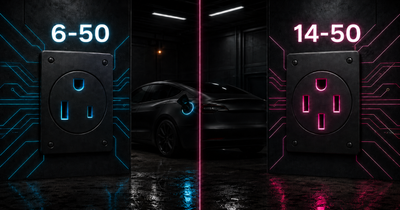
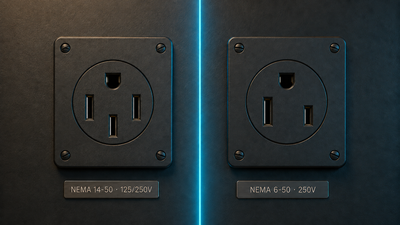
- NEMA 14-50 — 240V, 50A. Round or U-shaped ground on top; two vertical hot slots and one vertical neutral slot at the bottom.
- NEMA 14-30 — 240V, 30A dryer outlet. Round or U-shaped ground on top; two hot slots and an L-shaped neutral at the bottom.
- NEMA 10-30 — older three-prong 240V dryer outlet. Three-wire, non-grounding; the frame was historically bonded through the neutral under specific code provisions. Extra caveats for EV use; ask an electrician before adapting.
- NEMA TT-30 — 120V, 30A RV pedestal. Not 240V. Do not confuse with a 240V dryer outlet.
The outlet shape only tells you what the receptacle is intended to be. It does not confirm the breaker, the wire, the wiring condition, the grounding, or whether the circuit is dedicated. That is Step 4.
Step 4 — Confirm the outlet and circuit are suitable
Before plugging a continuous EV load into any existing outlet, have a licensed electrician confirm:
- The receptacle is undamaged, not loose, not discolored, and rated for continuous EV load.
- The breaker matches the receptacle and the wire. Actual sizing depends on conductor type, temperature rating, distance, and local code, which is why the electrician makes the call, not a blog table.
- The circuit is dedicated to that outlet. NEC 625.40 generally requires an individual branch circuit for EVSE outlets above 16A or 120V.
- Required protective devices are in place. NEC 625.54 establishes GFCI requirements for receptacles used for EV charging. Do not remove code-required protection.
- Panel capacity supports the load. An NEC Article 220 load calculation on the specific building service is the correct first step, not a $3,000 upgrade quote. A listed EV energy-management system (EVEMS) can add the load without a service upgrade in many cases; whether that applies to your panel is the electrician's call.
An existing 14-30 dryer circuit sometimes qualifies for shared EV use and sometimes does not. It may be worn from repeated unplugging, may lack current protective devices, may be shared, or may not be compatible with the specific EVSE. Do not assume the outlet's presence is authorization.
Step 5 — Choose Level 1, portable Level 2, or hardwired Level 2
Match the charger to the outlet and the daily-energy math:
- Level 1 (120V). Sufficient when Step 2's math fits inside your parking window at 1.2–1.9 kW delivered. Lowest friction for renters and anyone who may move within a lease term.
- Portable Level 2 (240V, plug-in). Best when a suitable 240V outlet exists and Level 1 cannot cover your energy need. Moves with you at the next rental or the next house. Limited to 40A per NEC 625.44.
- Hardwired Level 2 (240V, permanent). Best when you need above 40A, or a permanent outdoor enclosure, or the installation is genuinely permanent. Requires an electrician, a permit, and an inspection. 48A is worth considering for multi-EV households, short charging windows, large batteries, or time-of-use billing plans — not only for high-daily-mileage owners.
Do not use conversion adapters to fit a larger-plug EVSE onto a smaller outlet unless the EVSE manufacturer explicitly approves the exact configuration. The plug shape does not change the current the EVSE draws.
Step 6 — First-charge safety check
Before you leave the EV charging overnight, verify:
- The car and the EVSE both show an active charging session within 30 seconds of plug-in.
- The connector latches into the vehicle inlet audibly and does not pull out with light hand pressure.
- Ten minutes into the session, the wall plug and receptacle face are not unusually warm to the touch and there is no odor of hot plastic. Do not rely on touch alone as a safety test — but odor, discoloration, unusual warmth, buzzing, or a loose fit are all reasons to stop charging.
- The amperage the vehicle reports on its charge screen matches what you expect for the circuit and the EVSE setting. The vehicle-displayed amperage is authoritative for what is actually flowing.
- If a breaker trips, do not repeatedly reset it. Identify the trip type (standard thermal-magnetic, GFCI, AFCI, or dual-function) and diagnose the specific fault before restarting.
Outdoor and wet-condition charging
Outdoor charging is possible when the EVSE and all connections are used according to their manufacturer ratings. J1772 and NACS connectors are designed to de-energize the pins until the vehicle confirms a locked connection. Keep the receptacle, wall plug, and any adapter connection protected from water, and never use a wet, loose, corroded, or damaged outlet.
"IP55" and similar ratings describe water-resistance under specific conditions, not blanket waterproofing. Confirm the exact rating on your specific EVSE, adapter, and outlet enclosure — a rating on the EVSE does not extend to a wall receptacle exposed to rain.
Right-to-charge and renter considerations
Some states and municipalities limit a landlord's ability to reject qualifying EV-charging requests, but the eligible property types, tenant obligations, insurance requirements, and installation rules differ. Verify the current law for the property's location before relying on a right-to-charge provision, and consult a landlord-tenant attorney licensed in your state before quoting statute language to a landlord.
Renters do not automatically default to a plug-in portable. A landlord-approved shared Level 2, a hardwired installation the landlord funds, or a plug-in portable are all legitimate paths — the best one depends on lease terms, building electrical capacity, and the landlord's willingness to invest.
FAQ
Do I need an electrician to install an EV charger at home?
Not necessarily for a plug-in portable when a suitable, permitted outlet is already in place — but a licensed electrician should confirm that the specific outlet and circuit are suitable for continuous EV load before you rely on it. Hardwired installations always require a licensed electrician, and typically a permit and inspection.
Do I need a 200A panel for an EV charger?
Not automatically. Many 100A and 125A residential panels can host a 32A EV circuit after an NEC Article 220 load calculation, and a listed EV energy-management system can allow Level 2 charging on smaller panels without a service upgrade. Get the load calculation before accepting an upgrade quote.
Can I plug my EV into a regular household outlet?
Yes, with a Level 1 EVSE on a dedicated 120V branch circuit that is not shared with other significant loads. Do not use household extension cords or splitters. Confirm the outlet is not shared with a refrigerator, freezer, or shop tools before relying on it for overnight charging.
How fast does a 240V charger charge an EV?
That depends on the EVSE current, the vehicle's onboard AC charger limit, and the vehicle's state-of-charge taper. A 32A / 7.68 kW EVSE will not charge a 7.7 kW-limited car any faster than the car allows. Check your vehicle's published charging table for miles-per-hour figures at each amperage — those are more accurate than derived math.
Can I use a dryer outlet to charge my EV?
Sometimes, and only with a manufacturer-approved adapter and a licensed electrician's confirmation that the specific 14-30 or 10-30 outlet, breaker, wire, and dedicated-circuit status are suitable for continuous EV load. Do not share the circuit with the dryer. Older 10-30 receptacles are three-wire non-grounding devices with extra caveats.
Is the federal 30C tax credit still available?
The federal 30C charging-equipment tax credit ended for property placed in service after June 30, 2026. Equipment installed earlier may still qualify if the property and location met the applicable requirements. See IRS Form 8911 instructions for current-year rules, and consult a tax professional for your specific situation.
Is hardwired always better than plug-in?
No. Plug-in portable Level 2 is often the right choice for renters, owners who may move, and households whose daily energy need fits inside a 32A / 7.68 kW envelope. Hardwired is the right choice when you need above 40A, when a permanent outdoor enclosure is required, or when the installation is genuinely permanent.