Why Guides Say NEMA 14-50 Over 6-50 for EV Charging (And Why It Doesn't Really Matter)
Neither is inherently faster. Both support up to 40A EV charging on a 50A circuit. Real difference is the neutral pin (14-50) and EVSE plug selection.

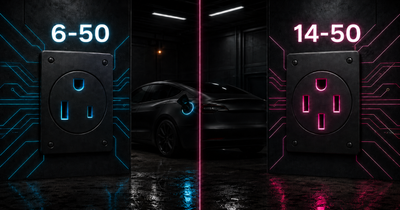
On a properly installed 50A circuit, both NEMA 14-50 and NEMA 6-50 support up to 40A continuous EV charging (about 9.6 kW at 240V). Every guide recommends 14-50 as the default, but 6-50 delivers the same speed to the car. The outlet does not decide how fast you charge — the EVSE, the vehicle's onboard charger, and the branch-circuit sizing do.
Correct comparison table
| Spec | NEMA 14-50 | NEMA 6-50 |
|---|---|---|
| Prong count | 4 (two hots, neutral, ground) | 3 (two hots, ground) |
| Voltage rating | 125/250V | 250V |
| Circuit rating | 50A | 50A |
| Continuous EV charging (NEC 80% derating) | Up to 40A | Up to 40A |
| Max delivered power at 240V | Up to 9.6 kW | Up to 9.6 kW |
| Neutral available | Yes (used by 120V loads at RV pedestals; unused by most 240V EVSEs) | No |
| Typical use | RV park pedestals, some ranges, most plug-in EVSEs | Welder circuits, some industrial 240V equipment |
| Plug-in EVSE selection | Wider — most portable and plug-in wall units ship with a 14-50 plug | Narrower — supported via 6-50-native EVSEs or manufacturer-approved adapters |
Sources: Leviton NEMA 14-50 spec (279); Leviton NEMA 6-50 spec (5374). Continuous-load derating is a mathematical result of NEC 210.19 / 210.20 continuous-load sizing (branch-circuit conductors and overcurrent devices sized to at least 125% of the continuous load), applied through NEC Article 625 for EV charging, subject to the locally adopted code edition.
Which outlet is faster for EV charging?
Neither. On a code-compliant 50A branch circuit with a matching EVSE, both deliver up to 40A continuous at 240V — around 9.6 kW to the vehicle. Actual mi/hr recovery depends on your car's onboard charger and battery efficiency, not on whether the plug has a neutral pin.
Two common misconceptions to skip:
- "14-50 unlocks 40A because it has a neutral." No — the 40A ceiling comes from the 50A breaker under NEC continuous-load sizing. 6-50 on the same 50A breaker delivers the same 40A.
- "6-50 is only for welders." No — 6-50 is a valid 240V outlet for EV charging when the EVSE is 6-50-native or the EVSE manufacturer approves a 6-50 adapter for that specific unit.
Neutral and wiring differences
Most 240V Level 2 EVSEs use two hot conductors and equipment ground, without using the neutral. However, a NEMA 14-50 receptacle is a four-wire 125/250V configuration and must be wired according to its listing and local code, even if the EVSE plugged into it never touches the neutral. The neutral is not "wasted copper" — it is part of the 14-50 configuration and provides flexibility for equipment (RV pedestals, ranges) that needs both 120V and 240V from the same outlet.
Wire and conductor sizing depends on wiring method, insulation temperature rating, terminal temperature rating, conductor material, distance, ambient conditions, and locally adopted code. A qualified electrician should size the circuit conductors accordingly. Do not treat any single AWG-per-outlet rule as universal — the correct conductor for your specific installation may be different from a neighbor's.
Existing 6-50 versus existing 14-50
The retrofit decision is almost always to keep the outlet you already have.
- Existing verified 6-50 (welder or industrial circuit): use a 6-50-native EVSE (either a plug-in unit that ships with a 6-50 plug, or the manufacturer-approved 6-50 adapter for your specific EVSE). Do not use a generic hardware-store 6-50-to-14-50 pigtail — adapters are safe only when the EVSE manufacturer specifically approves them for that equipment and application.
- Existing verified 14-50 (RV, range, or dedicated EV circuit): the plug-in EVSE market is broadest here. Verify the receptacle grade (industrial-grade / EV-duty per KB TECH-12 is preferable to residential-commodity), the breaker sizing, and the receptacle condition before daily EV use.
- Legacy 14-30 (dryer) or 10-30 (older dryer): these are 30A circuits, not 50A. Do not attempt a 30-to-50 adapter — the branch circuit isn't rated for continuous 40A EV load. Different guide.
The general principle: match the EVSE plug (or manufacturer-approved adapter) to the outlet you already have, verified by a qualified electrician before daily continuous EV load.
New installation: hardwired versus receptacle
If you're installing a new 240V circuit for EV charging, compare a plug-in NEMA 14-50 receptacle against a hardwired Level 2 EVSE before deciding.
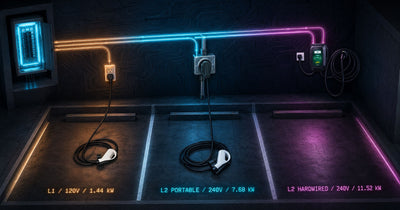
- Plug-in 14-50 (portable EVSE): lower equipment cost, wider EVSE selection, moves with you when you move. Capped at 32A or 40A continuous depending on the specific EVSE.
- Hardwired Level 2 (48A EVSE on a 60A circuit): higher continuous current (up to 48A / 11.5 kW), permanent installation, better for large battery packs and short overnight windows. Installation cost is typically higher than a plug-in 14-50 install.
Installation cost varies substantially. Panel work, trenching, permitting, long runs, and load-management equipment can push a new-circuit install well above a simple garage 14-50 quote. Get two written quotes before committing.
Tesla Gen 2 and Gen 3 Mobile Connector compatibility
Both current Tesla Mobile Connector generations use removable adapters, and both cap at 32A / 7.7 kW regardless of which adapter is attached.
- Gen 2 Mobile Connector: discontinued as a new-sale accessory but widely in the field. Uses a proprietary swappable-adapter interface. NEMA 14-50 and NEMA 6-50 adapters are both available (WenStorm sells current-production versions of both adapter types specifically for the Gen 2 Mobile Connector — see the WenStorm Certification Center for the ETL Listed scope, which covers the AC EV Charger models, not the standalone adapters).
- Gen 3 Mobile Connector: current Tesla product ($300 as of August 2026, per Tesla's shop). Per Tesla's Gen 3 Mobile Connector owner's manual and the Tesla adapter compatibility page, the Gen 3 supports removable adapters including NEMA 14-50 and NEMA 6-50 at 32A / 7.6 kW. The Gen 3 is not restricted to a fixed 14-50 plug.
- Tesla Wall Connector: hardwired equipment — the outlet type discussion does not apply. Up to 48A on a suitable 60A circuit.
Historical note: NHTSA campaign 16E-091 (2016) recalled approximately 6,729 first-generation Tesla Mobile Connector adapters — specifically the NEMA 14-30, 10-30, and 6-50 adapters, per the official NHTSA recall bulletin. NEMA 14-50 adapters were not part of that recall. The documented defect was insufficient-quality internal ultrasonic-welded electrical connections inside the adapters — not receptacle strain or EVSE weight. The remedy was replacement adapters.
Safety and outlet inspection
Regardless of outlet flavor, EV charging is a continuous high-current load that stresses receptacles differently than the intermittent loads most receptacles were originally installed for. Have any pre-existing 14-50 or 6-50 you did not personally install evaluated by a qualified electrician before daily EV use.
- Torque and terminations: loose or improperly torqued terminations at the receptacle are a known failure mode. Verified at install time per NEC 110.14 and the receptacle manufacturer's spec sheet on de-energized equipment.
- Receptacle grade: per KB TECH-12, prefer industrial-grade or EV-duty receptacles over residential-commodity units for daily continuous EV charging.
- Warning signs to stop use: heat discoloration, loose plug fit, cracks, corrosion, breaker trips, buzzing, or a hot plug on a session that used to run cool. Any of those, discontinue use and have the outlet evaluated. See the EV charging outlet warning signs guide.
- Outdoor installation: the receptacle must be in a weatherproof enclosure with an in-use cover per NEC 406.9(B). Never plug into a wet, loose, corroded, or damaged outlet.
WenStorm places the control electronics near the vehicle connector rather than in a wall-end control brick, reducing the amount of equipment mass located near the wall receptacle. This does not eliminate the need for a properly installed, undamaged outlet — receptacle condition and installation quality still control whether the outlet is safe for daily EV load.
Decision tree
- You already have a 6-50: use a 6-50-native EVSE or the manufacturer-approved 6-50 adapter for your specific unit. Do not use a generic pigtail.
- You already have a 14-50: use any code-compliant plug-in Level 2 EVSE. Verify grade and condition first.
- You have neither: decide between a new plug-in 14-50 (cheaper, portable) and a hardwired 48A install (faster, permanent) before choosing the outlet.
- You only have a 30A dryer outlet: different guide — see our EV charging from a dryer outlet article.
- You have no 240V circuit and cannot install one: a Level 1 portable charger on a standard 120V outlet may work for lower-mileage daily driving — see is an EV worth it if you can't charge at home.
Federal and state charging-equipment incentives (2026 status)
The federal Alternative Fuel Vehicle Refueling Property Credit (§30C) generally required qualifying charging equipment to have been placed in service on or before June 30, 2026. Because it is now past that date, the federal credit no longer applies to newly installed home charging equipment unless Congress reinstates or extends the credit. State and utility rebate programs may still be active — check the DOE Alternative Fuels Data Center state laws and incentives database for current programs in your state, then verify with the administering utility before you file.
Relevant product options
Place products after you've decided which outlet applies to your situation.
If you have an existing verified NEMA 14-50 outlet
If you have an existing verified NEMA 6-50 outlet and a Tesla Gen 2 Mobile Connector
If you don't yet have a suitable 240V circuit
Start with the outlet-versus-hardwired decision above, not with product selection. Get two written quotes from qualified electricians before committing. Then decide between a plug-in 14-50 install (compatible with portable Level 2 chargers) and a hardwired 48A install (permanent, higher output). Only after the circuit decision does the equipment choice make sense.
Frequently asked questions
Is a NEMA 14-50 outlet the same as a dryer outlet?
No. Modern dryers generally use NEMA 14-30 (30A circuit). NEMA 14-50 is a 50A circuit typically found on ranges, RV pedestals, and dedicated EV circuits. Do not confuse the two, and do not attempt to plug a 14-50 EVSE into a 14-30 outlet — the 30A circuit is not rated for continuous 40A EV load.
Can I use a generic 6-50-to-14-50 pigtail adapter?
Do not use a generic hardware-store pigtail unless the EVSE manufacturer specifically approves that adapter for that equipment and application. Never create a neutral-to-ground connection inside an adapter. If your outlet and EVSE plug types don't match, use a manufacturer-approved adapter or a native-plug EVSE — not an improvised conversion.
Does the Tesla Wall Connector plug into a 14-50 outlet?
No. The Tesla Wall Connector is hardwired equipment. Outlet type does not apply to hardwired installs. Up to 48A on a suitable 60A hardwired circuit.
Do both outlets support 40A continuous EV charging?
Yes. Both NEMA 14-50 and NEMA 6-50 on a 50A branch circuit support up to 40A continuous per NEC 210.19 / 210.20 continuous-load sizing, delivering roughly 9.6 kW at 240V. The outlet is not the limiting factor — the EVSE's rating, the vehicle's onboard charger, and the branch-circuit sizing decide the actual continuous current.
What was the 2016 Tesla adapter recall about?
NHTSA campaign 16E-091 (2016) recalled approximately 6,729 first-generation Tesla Mobile Connector adapters — specifically the NEMA 14-30, 10-30, and 6-50 adapters. NEMA 14-50 was not part of that recall. The documented defect was insufficient-quality internal ultrasonic-welded electrical connections inside the adapters. The remedy was replacement adapters. See the NHTSA recall bulletin for the primary source.
Can the federal §30C tax credit still cover a new EV charger install in 2026?
Generally no. Per current IRS guidance, eligible refueling-property equipment had to be placed in service on or before June 30, 2026. Newly installed equipment after that date does not qualify unless Congress extends the credit. Consult a tax professional for your specific situation.
Related reading: EV charging from a dryer outlet · EV charging outlet warning signs · is an EV worth it if you can't charge at home · WenStorm Certification Center.
Real questions from EV owners
Join the Home Charging & NEMA Outlets discussion →