Buying Your First EV in 2026: The Complete Guide

By Nathan Park · EV Product Comparison & Industry Writer · Published July 2026
The 2026 EV market is a genuinely different place than 2024 or 2025. Three big shifts landed this year and they change the buyer's decision in specific ways.
The federal EV tax credit — the $7,500 write-off that shaped every buying decision from 2023 through mid-2025 — expired on September 30, 2025. Buyers can no longer claim it on new EVs. Automakers reacted quickly with $7,500-$10,000 discounts of their own to fill the gap. On some models the total price you pay is actually lower today than it was during the tax-credit era.
The NACS connector transition also crossed a real threshold. Nearly every new EV shipping in 2026 has a native NACS port (or a bundled adapter for the ones that don't), which means Supercharger access at delivery is the default rather than a promise.
And the model lineup has shifted at the value end. The 2026 Nissan Leaf is now the cheapest new EV in America at $29,990 with 303 miles of range and native NACS — a combination that would have been impossible 18 months ago. Hyundai's Ioniq 5 won Kelley Blue Book's Best EV three years running. Tesla's Model Y is still the best-selling EV in America at $41,630 with 357 miles of range.
This guide covers the complete buying decision for that market: whether an EV is right for you at all, which one to buy, new versus used, what charging setup you actually need on day one, tax credits and rebates, and the specific mistakes first-time buyers make.
See the WenStorm portable EV charger →
Is an EV Right for You Right Now?
Every first-time EV buyer's guide starts by trying to sell you on EVs. This one starts differently. There are situations where "not yet" is the honest answer, and the buying decision goes better if you can identify yours before spending $30,000-$60,000.
Five questions worth answering honestly before you shortlist a specific vehicle:
How far do you drive on a typical day? The average American drives about 40 miles per day. If you're under 60, almost any modern EV handles your daily driving without stress. If you're over 100 miles daily, the calculation changes — you'll want a longer-range EV and probably a Level 2 home charging setup.
What's your parking situation? Homeowners with garages have the widest options. Renters and apartment dwellers have real options too but the setup is different (see the day-1 charging section below). Street parkers without any home charging access face the hardest EV ownership case in 2026 — it's not impossible, but it requires deliberate planning around workplace charging or public infrastructure.
Do you drive in real cold weather? EVs lose 20-40% of their usable range at temperatures below −10 °C, and Level 1 charging can drop to near-zero net gain overnight in extreme cold. If you drive through Canadian winters or northern-US winters regularly, the range calculation on the sticker isn't what you'll experience for four months of the year. Not a dealbreaker — a longer-range EV plus a properly weatherproofed portable Level 2 charger handles it — but plan for the reality.
Are you comfortable with software-driven cars? Modern EVs push firmware updates constantly, integrate with manufacturer apps, and rely on connected services for features from route planning to remote climate. If that sounds annoying to you, it will keep sounding annoying. If it sounds convenient, you'll enjoy it more than a comparable gas car.
Can you handle the initial capital outlay? Even with OEM discounts, EVs cost more upfront than comparable gas cars. The 5-year total cost of ownership tilts back toward EV once fuel and maintenance savings compound — but if the down payment or monthly payment is a stretch, that math doesn't help you in month one.
If four or five of those come back "yes without hesitation," an EV probably fits you well in 2026. If two or three feel like maybes, a plug-in hybrid might be a better bridge. If most feel like nos, it's worth waiting another year — the technology and infrastructure continue improving fast.
The 2026 EV Market — What's Actually New
Three shifts changed the buyer's landscape this year in ways that matter for your decision.
The federal tax credit ended. The $7,500 clean vehicle credit expired September 30, 2025 under the Inflation Reduction Act's original schedule. Buyers can no longer claim it on new EVs purchased after that date. This sounds bad — and if OEMs had done nothing it would be — but automakers responded with direct discounts of $7,500-$10,000 on many models. On the Ford Mach-E, Chevy Equinox EV, and Hyundai Ioniq 5, the total price you pay today is often lower than during the credit era, because the OEM discount stacks with state and utility incentives that continue to apply.
NACS became the dominant standard. Roughly half of new non-Tesla EVs in 2026 ship with native NACS ports, and the other half ship with a factory NACS adapter for Supercharger access. Ford has committed to NACS across the Mach-E and F-150 Lightning refresh. GM's Chevrolet Bolt, Blazer EV, and Equinox EV land native NACS on the 2027 model year. Hyundai and Kia rolled native NACS onto Ioniq 5 (2025+), EV6 (2025+), and Ioniq 9 / EV9 (2026+). Rivian's 2026 R1S and R1T refresh moves to native NACS. Toyota's bZ (formerly bZ4X), Mercedes CLA, Nissan Leaf, Cadillac Optiq, Lexus RZ, and Lucid Gravity all launched 2026 native NACS. The J1772-vs-NACS confusion of 2024 is largely gone — Supercharger access at delivery is the default for new EVs in 2026.
The value tier finally showed up. The 2026 Nissan Leaf launched at $29,990 with 303 miles of range and native NACS — the first time in the modern EV era that a genuinely usable EV has been available under $30K new. Chevrolet's Equinox EV base trim is now under $34,000 with over 300 miles of range. Hyundai's Ioniq 5 SE Standard Range has landed under $35,000 after post-credit OEM cuts. The under-$40K tier used to be the value-compromise segment; in 2026 it's where the sweet spot lives.
For a first-time buyer these three shifts mean the buying decision is genuinely easier than it was 18 months ago. More models, cleaner charging story, better pricing. The rest of this guide is about picking the specific one that fits you.
Which EV to Buy — By Budget Tier
Every buyer's guide organizes EVs by budget. This one does too, but with an emphasis on the specific tradeoffs at each tier rather than a spec sheet dump.
Under $30,000 — the value tier
The 2026 Nissan Leaf ($29,990) is the entry point. 303 miles of range, native NACS port, front-wheel drive. The Leaf is not exciting, but it's a genuinely usable daily commuter for a price that no other manufacturer matches in 2026. If your driving is under 40 miles per day and you don't need AWD or towing, the Leaf covers you.
Below $30K there aren't other new options in mid-2026. The Chevy Bolt was discontinued for a redesign. The Mini Electric is still on sale but the range (~110 miles) makes it a niche pick for city drivers only.
$30,000 to $45,000 — the mainstream sweet spot
This is where the volume is in 2026 and where the buying decision gets interesting.
The Hyundai Ioniq 5 (from ~$35K after OEM discounts) won Kelley Blue Book's Best EV award three years running. 318 miles of range, 800V architecture for faster DC charging (~18 min from 10-80% at a suitable station), native NACS on 2025+ models. The interior is genuinely spacious. Kia's EV6 is closely related and slightly sportier.
The 2026 Chevrolet Equinox EV (from $33,600) delivers 319 miles of range on the LT trim. GM's approach here is deliberately mainstream — familiar SUV shape, straightforward interior, no software surprises. Native NACS lands on the 2027 model year, so 2026 Equinox EV buyers get a bundled Supercharger adapter rather than a native port. Not a dealbreaker for daily driving; something to factor if you road-trip often.
The Hyundai Ioniq 6 (from ~$38K) is the aerodynamic sedan variant of the Ioniq 5. 361 miles of range on the SE Long Range trim — the longest range in this price tier — thanks to the sedan drag profile. If a sedan fits your life, this is arguably the best pure-value pick at $40K.
The Kia Niro EV and Kia EV3 both sit in this tier as more budget-oriented alternatives. Shorter range but tighter pricing.
$45,000+ — the premium tier
The Tesla Model Y ($41,630 base) is the best-selling EV in America and it's not close. 357 miles of range on the Long Range AWD, mature Supercharger network access with a native NACS port from day one, and Tesla's software integration remains the smoothest in the market. For a first EV in 2026, it's still the safest pick if your budget covers it. The main tradeoffs: firm ride, minimalist interior (many buyers love it, some don't), and Tesla's polarizing brand story.
The Ford Mustang Mach-E (from ~$40K after discounts) delivers 320 miles of range in the extended-range configuration. Comfortable ride, familiar Ford interior, and — as of 2026 — a factory-bundled NACS adapter rather than a native port. Good pick if you want a Ford dealer network for service.
The Rivian R1S and R1T ($75K+) are the price-no-object picks for buyers who want a full-size SUV or pickup respectively. 2026 refresh brought native NACS. The R2 launches Q2 2026 at a substantially lower price point (~$45K) — worth watching if you want a Rivian at more mainstream money.
The Lucid Air and Lucid Gravity are the premium sedan and SUV picks, with the best-in-class range in the industry (Air Grand Touring: 512 miles).
Long-range vs standard range — the decision framework
Most modern EVs have a "standard range" and "long range" version separated by $3,000-$6,000. The long range version isn't always the right call.
Long range makes sense if you road-trip more than 4 times a year, drive over 60 miles daily, live in a cold climate (winter range hit means you need buffer), or have no home charging (public charging trips are less frequent with more onboard range).
Standard range makes sense if you drive under 40 miles daily, road-trip rarely, live in a temperate climate, and have reliable home charging (an empty battery is refilled overnight anyway).
For most first-time buyers, standard range covers you. Don't pay for range you won't use.
Model-specific gotchas
Two model lines worth flagging in 2026:
Chevrolet Blazer EV had a substantial software recall in early 2024 that pulled it off sale for months. GM has resolved the issues, but Reddit sentiment for the Blazer EV specifically remains cool — several r/electricvehicles threads document lingering software glitches into 2026. Approach with caution if you're considering one, especially the 2023 build year.
Pre-2020 Nissan Leaf used passively-cooled batteries that degrade faster in hot climates. Avoid pre-2020 Leafs as first-EV buys unless the price is extraordinary.
New vs Used EV — When Each Makes Sense
The used EV market got substantially better in 2024-2025 as Tesla's price cuts drove down comparable used values across the market. In 2026 the sweet spot for used EVs is 2020-2024 model years.
When new makes sense
The tax credit is gone but OEM discounts of $7,500-$10,000 stack on most 2026 models. Total price you pay today on a new Ioniq 5 or Equinox EV is comparable to (sometimes lower than) 2024 pricing with the credit. If you can find a 2026 vehicle at the right discount and you want the warranty, the software support horizon, and native NACS from day one, new makes sense.
New also makes sense if your driving profile is high-mileage (>15,000 miles/year) or you plan to hold the car 8+ years. Battery warranties on new EVs (8 years / 100,000 miles is standard) protect you through the expensive-to-repair window.
When used makes sense
If your driving is under 10,000 miles/year and you plan to keep the car 4-6 years, a used 2022-2024 EV is often the best value. Tesla Model 3 used prices dropped substantially in 2024-2025; a 2022 Model 3 Long Range with 40K miles is often available around $22K-$26K in 2026. Ford Mach-E, Hyundai Ioniq 5, and Kia EV6 used prices dropped similarly.
Used lease returns are the sweet spot within the sweet spot. Lease returns typically have documented service history, moderate mileage, and the pricing reflects both depreciation and the lease company's motivation to move inventory.
Used battery health verification
The single most important check for a used EV is battery state of health. Recurrent Auto provides free reports on individual used EVs that show the specific vehicle's actual battery capacity vs. its original spec. Most dealerships selling used EVs will provide a Recurrent report on request; if a seller refuses, that's a signal.
Battery health under 90% of original is common on 2020-2022 vehicles with 40K+ miles. Under 85% starts to affect daily usability. Under 80% is a reason to walk away unless the price reflects it heavily.
Used EVs to avoid
- Pre-2020 Nissan Leaf (passively-cooled battery)
- 2017-2019 Chevy Bolt (battery recall — some replaced, verify status)
- 2019-2020 Model 3 with faulty MCU2 (a Tesla-specific issue)
- Any 2023 Chevy Blazer EV until you've verified specific software patch history
- Any EV without a Recurrent report or equivalent battery health documentation
Real Total Cost of Ownership
The EV vs. gas cost comparison depends heavily on your specific situation — electricity rates in your state, gas prices, insurance quotes, driving patterns. Here's the honest framework for thinking through the numbers.
Purchase price after discounts
New 2026 EVs run $30K (Nissan Leaf) to $75K+ (Rivian R1S), with the mainstream sweet spot at $35K-$45K. OEM discounts of $7,500-$10,000 typically stack on this base price. State rebates add another $500-$5,000 depending on jurisdiction.
Used 2022-2024 EVs run $18K-$40K depending on model and battery health. Lease returns tend to price 10-15% below open-market used listings.
Charging cost
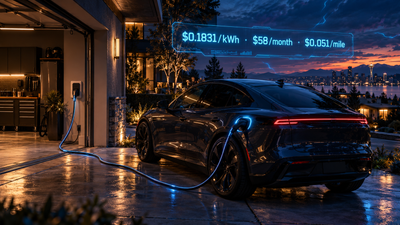
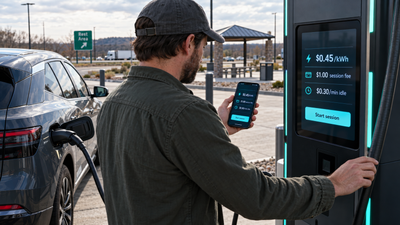
The single biggest EV vs. gas cost advantage. At the US average residential electricity rate of ~15¢/kWh, home Level 1 or Level 2 charging works out to 3-5¢ per mile. Public DC fast charging runs 15-25¢ per mile (roughly comparable to gas on a per-mile basis). Home charging on a utility TOU off-peak rate often drops to 2-3¢ per mile.
For a typical 12,000 mile/year driver on home charging, annual energy cost is $400-$700. Comparable gas cost is $1,500-$2,500 depending on vehicle. Annual savings: $1,000-$1,800.
Insurance premium
EV insurance runs 15-30% higher than comparable gas cars. Battery replacement is expensive if the car is totaled, and repair-parts availability affects premiums. Tesla insurance premiums are typically the highest in the segment; Hyundai, Kia, and Ford EV premiums tend to be more moderate.
For budgeting, expect an EV to add roughly $30-$80/month to your insurance line vs. a comparable gas car.
Maintenance savings
EVs cost $200-$400/year in typical maintenance (tire rotation, cabin air filter, wiper blades, brake fluid check). Comparable gas cars run $600-$1,200/year (oil changes, transmission service, spark plugs, coolant, filters, brake pads). Real annual savings: $400-$800.
Tire wear
EVs go through tires 10-15% faster than gas cars because of higher curb weight and instant torque. On premium performance EVs this can be more dramatic (30-40% faster). Budget an extra $200-$400/year for tires depending on model.
State registration surcharges
Several US states now charge annual EV registration surcharges to offset lost gas tax revenue. Texas, California, Colorado, Missouri, Ohio, and Washington all charge $100-$200/year in EV-specific fees. Check your state's DMV site for the current number.
5-year cost comparison
A rough 5-year total cost comparison for a $40K new EV vs. a comparable $35K gas car at 12,000 miles/year:
| EV | Gas car | |
|---|---|---|
| Purchase price (after discounts) | $32K–$35K | $35K |
| 5-yr energy cost | $2K–$3.5K | $8K–$12K |
| 5-yr insurance premium | $9K–$11K | $7K–$9K |
| 5-yr maintenance | $1K–$2K | $3K–$6K |
| 5-yr tires | $2K–$3K | $1.5K–$2.5K |
| 5-yr registration surcharge | $500–$1K | $0 |
| 5-yr total | $46K–$55K | $54K–$64K |
The EV comes out $5K-$15K cheaper over five years for most buyers. Higher-mileage drivers and buyers in high-gas-price states see bigger deltas.
Day-1 Charging Setup — What You Actually Need
Most EV articles push a $2,000 hardwired Level 2 wall charger install on day one. That's the wrong first move for most first-time buyers.
Start with your existing outlets. A standard 120V outlet (NEMA 5-15) delivers Level 1 charging at 2-4 mph, or about 25-40 miles overnight. For a driver under 40 miles/day, that's enough. The 30-day trial period on a Level 1 setup tells you honestly whether you need faster charging.
If you have a 240V dryer outlet (NEMA 14-30 or the older NEMA 10-30) within cable reach of your parking spot, you can charge at Level 2 speeds — 15-22 miles per hour with a Tesla Gen 2 Mobile Connector and the right adapter, or 150-220 miles overnight. That's enough to fully charge any modern EV from empty by morning.
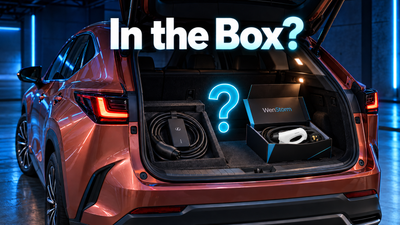
A WenStorm portable Level 2 EVSE plus the correct NEMA adapter is often the entire day-1 setup you need. The WenStorm NEMA 14-30 adapter runs $43.99, the NEMA 14-50 (found in some newer garages and RV hookups) runs $59.99, and the NEMA 10-30 for older 3-prong dryer outlets runs $44.59. Total setup including your Tesla Mobile Connector (which ships with the car): under $100.
Install Level 2 hardwired only if the 30-day Level 1 or 15A dryer-outlet trial shows you actually need faster charging. Common triggers: driving more than 60 miles/day, cold-climate winter shortfalls, or planning to keep the same house 5+ years and wanting the resale value.
For apartment renters, the setup is similar: portable Level 2 EVSE plus a NEMA adapter for whatever outlet you have access to. Our EV charging stations for apartments complete guide covers the renter-owner-property manager framework in depth.
For any first-time buyer regardless of situation, the NACS implication is that at-home charging uses the same connector (or adapter) as Supercharger charging. That simplification is one of the real 2026 improvements.
See the WenStorm portable EV charger →
Tax Credits + Rebates in 2026
The federal $7,500 credit is gone. State and utility incentives remain, and they add up.
OEMs stepped in first. Most manufacturers now offer direct discounts of $7,500-$10,000 on new EVs. On some models the OEM discount alone matches or exceeds what the federal credit provided. Check the specific manufacturer's current promotions before assuming pricing.
State rebate stacks worth checking in 2026:
- California — Clean Vehicle Rebate Project (CVRP) up to $2,000, income-qualified additional rebates
- Colorado — up to $5,000 state credit
- New Jersey — sales tax exemption + up to $4,000
- New York — Drive Clean Rebate up to $2,000
- Massachusetts — MOR-EV rebate up to $3,500
- Texas — $2,500 state credit
- Oregon — up to $2,500 standard rebate
Rebate stacks change frequently. Verify current numbers with your state's DMV or clean energy office before finalizing a budget.
Utility rebates for Level 2 install are worth checking too. Many electric utilities offer $500-$1,000 rebates on Level 2 hardwired charger installations. Southern California Edison, Xcel Energy, Duke Energy, and several others run active programs.
Section 30C — the alternative fuel refueling property credit — is still active. It covers 30% of the cost of installing EV charging equipment at your primary residence, up to $1,000. This applies to a hardwired Level 2 install; it does not apply to a portable Level 2 charger.
The leasing loophole persists. The commercial clean vehicle credit under §45W lets leasing companies claim a credit on EVs they lease out, which they then pass through as reduced monthly payments. This partially replaced the retail credit for lease-inclined buyers. Compare lease payments before assuming the retail purchase math still applies.
Common Mistakes First-Time EV Buyers Make
Eight patterns that show up in first-year EV owner regret threads. Avoiding these puts you meaningfully ahead of the average first-time buyer.
The first is assuming EPA range in winter. EPA range figures are measured at moderate temperatures. Real winter range is 30-50% less at −20 °C. Plan the range you actually need at your cold-weather worst case, not at the sticker number.
The second is underestimating home charging economics. A back-of-envelope calculation before buying — what does 12,000 miles/year at 4¢/mile home charging vs. current gas cost — clarifies the real annual saving. Some buyers get to closing without ever calculating this and are surprised (usually happily).
The third is buying too much charger. A 48A hardwired Wall Connector on a car that accepts 32A charging is money spent on capacity you can't use. Match the Level 2 charger amperage to the vehicle's onboard charger acceptance rate.
The fourth is skipping the utility time-of-use rate check. Enrolling in TOU can drop your charging cost by 40-60%. Utility default plans are almost always the wrong plan for EV owners.
The fifth is confusion about the NACS transition. In 2026, most new non-Tesla EVs either have native NACS or ship with a bundled adapter. Verify what your specific model comes with before buying add-on adapters you don't need. Our J1772 vs NACS guide has the model-by-model breakdown.
The sixth is not test-driving in real weather. If you buy an EV in July and don't verify winter behavior, your December surprise is your problem. Test drive in the coldest conditions you'll actually drive if possible.
The seventh is not verifying home electrical service before planning a Level 2 install. Older homes with 100A service can't easily support a 48A charger without a panel upgrade ($1,500-$4,000 extra). Get an electrician's inspection before committing to a specific charger.
The eighth is falling for "free charging for life" dealer promos. These are almost always limited to a specific network, expire after 2-3 years, or come with per-session time limits that make them nearly useless in practice. The actual value is usually $500-$2,000; if the dealer prices it as a $5,000 concession, they're padding.
The Test-Drive Checklist
The test drive matters more for EVs than for gas cars because the driving experience is more variable across models. Six things to check on any test drive:
Whether the manufacturer app pairs cleanly with the specific test-drive car. Software integration is a major part of daily ownership; a car whose app is buggy on the lot will be buggy in your driveway.
Your regen braking preference. One-pedal driving (Tesla-style) is polarizing — some buyers love it immediately, others find it disorienting. Test both aggressive regen and blended regen if the model supports both.
The range accuracy over the test drive. Set the trip meter, drive 20 miles at highway speed, and check whether the observed range loss matches what the display predicts.
Cold cabin warmup speed if it's cold outside. EVs warm the cabin differently than gas cars (usually a heat pump or resistive heater). Some warm faster than others; some drain range faster than others while warming.
Interior storage vs. your daily needs. EVs have unusual storage geometries (frunks, flat floors from missing transmissions, high floors from batteries). Verify your specific daily items fit.
The NACS port location — driver's side rear on Tesla, but varying on other brands. Check that your specific parking spot orientation works with the port location for both home charging and Supercharger visits.
Buying vs. Leasing in 2026
The tax credit expiry changed the buying vs. leasing math meaningfully.
Leasing now looks better for buyers who are uncertain about EV ownership, want lower monthly payments, or want to swap into whatever comes out in 2028. The commercial clean vehicle credit (§45W) still lets leasing companies claim a credit that gets passed through to buyers as reduced monthly payments. Effective savings often $50-$150/month vs. buying.
Buying looks better for buyers with 8+ year hold horizons, high annual mileage (>15,000/year), and buyers who plan to modify the vehicle (aftermarket tires, custom charging setups) that a lease wouldn't allow.
For a first-time buyer specifically uncertain about whether EV ownership will fit their life: leasing is often the honest answer. Three years to learn, then decide whether to buy out the lease or move to a different EV or return to gas.
Where to Buy — Dealer vs. Direct
Tesla and Rivian sell direct to consumers — no dealer negotiation, prices are what they are. This is either freeing (no haggling stress) or frustrating (no room to negotiate) depending on your temperament.
Ford, Chevy, Hyundai, Kia, Toyota, and every other traditional manufacturer sell through dealer networks. Dealer negotiation still applies; the specific tactics matter. Cash discounts, floor mat and window tint padding, extended warranty push, financing markup — all the standard tactics apply to EV sales too. Ford and GM have been experimenting with more direct-to-consumer online configurations that reduce dealer variance, but most sales still go through traditional channels.
Used marketplaces have consolidated. Recurrent Auto operates a used EV marketplace with battery health verification built in — the closest thing to a "trusted used EV" broker in the market. Carvana, Vroom, and CarMax sell used EVs with return periods but variable battery health documentation. Traditional used dealers vary widely.
Fleet and lease-return marketplaces — often accessible through EV-CPO programs at OEM dealers — are frequently the best-value used EV path.
Frequently Asked Questions
What's the best EV to buy in 2026?
For most first-time buyers, the Hyundai Ioniq 5 (from ~$35K after discounts) or the Tesla Model Y ($41,630 base) are the safest picks. Ioniq 5 has won Kelley Blue Book's Best EV three years running with 318 miles of range and native NACS. Tesla Model Y is still the best-selling EV in America with the most mature Supercharger network. Under $30K, the 2026 Nissan Leaf at $29,990 with 303 miles is the clear value pick.
Can I still get the federal EV tax credit in 2026?
No. The federal $7,500 clean vehicle credit expired September 30, 2025. Buyers who purchased before that date and haven't yet claimed it should still do so; buyers of new EVs after September 30, 2025 cannot claim the federal credit. State rebates and utility rebates remain available and often stack to $2,000-$7,000 depending on jurisdiction.
How much does it actually cost to own an EV per month?
For a typical $40K EV at 12,000 miles/year: about $200-$350/month in loan payment (on a 60-month loan), $30-$60/month in home electricity for charging, $150-$250/month in insurance, and $30-$70/month averaged across annual maintenance and tires. Total: roughly $410-$730/month, before any state rebates or tax credits are factored in.
Should I buy a new or used EV?
Depends on your annual mileage and hold horizon. High-mileage drivers (>15,000/year) with 8+ year hold horizons benefit from new EV warranty coverage. Lower-mileage drivers keeping the car 4-6 years get better value from a used 2022-2024 model, especially a used lease return with a Recurrent battery health report.
Do I need to install a Level 2 charger at home?
Not on day one. Start with your existing outlets. A standard 120V outlet adds 2-4 mph of range — enough for under-40 mile daily drivers. A 240V dryer outlet with a $43.99 NEMA 14-30 adapter and a Tesla Mobile Connector delivers 15-22 miles per hour, or 150-220 miles overnight. Install a hardwired Level 2 charger only if a 30-day trial shows you actually need it.
How much range do I actually need in an EV?
For daily driving, less than most first-time buyers think. Average American drives 40 miles/day; even a 200-mile EV covers this without stress. For road-trippers, 300+ miles of range meaningfully reduces stop count on long drives. For cold-climate drivers, add 30-50% buffer to whatever range you'd otherwise want. Standard-range trims cover most buyers; long-range is often paying for capacity you won't use.
What's the cheapest new EV in 2026?
The 2026 Nissan Leaf at $29,990 base price. 303 miles of range, native NACS port, front-wheel drive. The first genuinely usable new EV under $30K.
Is a Tesla Model Y still the best first EV?
For many buyers, yes. Tesla Model Y remains the best-selling EV in America with 357 miles of range, the most mature Supercharger network, and the smoothest software integration in the market. The main tradeoffs are firm ride, minimalist interior, and Tesla's brand story polarization. For first-time buyers who want the safest single pick and can afford $41,630 base, Model Y is still the default.
Buying your first EV in 2026 is a genuinely easier decision than it was 18 months ago. The tax credit expiry sounds bad but was offset by OEM discounts. The NACS transition simplified the charging story. The Nissan Leaf and Ioniq 5 have brought real value into the sub-$35K tier. The rest of the decision comes down to matching one specific vehicle to your specific driving patterns, parking situation, and hold horizon.
The day-1 charging setup is simpler than you probably think: a portable Level 2 EVSE plus the right adapter for whatever outlet you have works for most first-time buyers, with a hardwired install as an optional later upgrade.
See the WenStorm portable EV charger →
Related reading:
- New EV Owner Starter Guide 2026 — the companion guide for what to do after you buy
- EV Charging Stations for Apartments: The Complete Guide — renter, owner, and property manager framework
- J1772 vs NACS: What's Changing in 2026 — the standards transition explained
- Tesla Mobile Connector vs Portable Level 2 — the buyer comparison
- How to Charge Your EV at Home Without Installation — the home-charging pillar
- EV Road Trip Charging: How to Never Get Stranded — for your first road trip
About the author: Nathan Park writes on EV product comparisons and industry trends for the WenStorm blog. His focus is the buyer decisions that matter after you strip out the marketing — portable Level 2 versus hardwired, Tesla Mobile Connector versus third-party, J1772 versus NACS, best-of buyer's guides that actually engage with tradeoffs.