EV Charging Stations for Apartments: The Complete 2026 Guide for Renters, Owners, and Property Managers

By Priya Sharma · Renter & Apartment EV Charging Writer · Published July 2026
The phrase "EV charging stations for apartments" covers three completely different problems depending on who's typing it. A renter with one Tesla wants to know if there's a way to charge without touching the wall. A condo owner wants to know if they can install their own dedicated charger. A property manager or HOA board wants to know what it costs to add EV amenity to a whole building.
All three problems have real answers in 2026. Most articles pick one audience and pretend the other two don't exist. This guide covers all three, plus the specific decisions that separate them.
See the WenStorm portable EV charger →
The Four Types of EV Charging Stations for Apartments

Before you can decide what to buy or install, it helps to know what you're actually choosing between. Four categories show up in apartment settings, each fitting a different combination of tenant type, building type, and budget.
The first is portable Level 2 chargers — plug-in devices that use an existing outlet you already have. No install, no electrician, and the whole setup comes with you when you move. Typical charging speed sits at 15-30 miles per hour depending on the outlet you plug into. This is the fit for individual renters and owner-occupiers who don't want to touch the property.
The second is dedicated hardwired Level 2 chargers — wall-mounted units installed on a dedicated circuit, one per parking space. Typical charging speed climbs to 30-44 miles per hour. Best fit for condo owners with their own parking spot and body corporate approval to do the electrical work.
The third is shared multi-tenant Level 2 stations — one or more Level 2 chargers installed in common parking, with access control (RFID card, app, or key fob) and per-tenant billing. Best fit for apartment buildings with 10 or more units and enough EV adoption to justify shared infrastructure over individual installs.
The fourth is DC fast charging, which is very rare in apartment settings because it requires 480V three-phase power and typically $50,000-150,000 in equipment plus significant electrical upgrades. It only fits mixed-use developments with commercial ground floors, or apartment complexes located along highway corridors where the DC fast station pays back through public use.
Most apartment situations resolve to portable Level 2 or dedicated hardwired Level 2. The multi-tenant install is where it gets interesting for property managers.
If You're a Renter — The Portable Level 2 Path

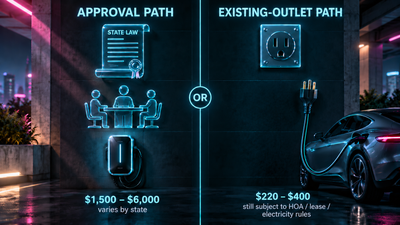
Every EV article aimed at renters starts with the wrong assumption. It assumes you can install something. You can't. Even in states with statutory tenant EV charging rights (California under Cal. Civil Code § 1947.6, Colorado under Colo. Rev. Stat. § 38-12-601), the practical reality is that installation requires landlord cooperation, sparky visits, and a check that a lot of renters don't want to write for a wall unit they'll leave behind.
The portable Level 2 path avoids all of that. You use an outlet the property already has. You bring a Type 2 or J1772 portable EVSE plus the right adapter for whatever outlet is available. The setup takes 30 seconds and leaves with you at the end of the lease.
Which outlet do you have access to? The three most common in apartment parking situations:
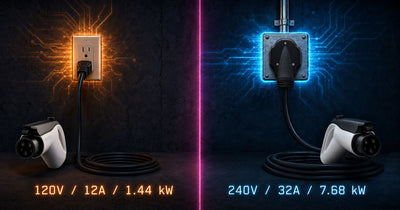
A standard 120V outlet (NEMA 5-15) on the exterior wall of the building or in a covered garage delivers Level 1 charging at 2-4 mph, or 20-40 miles overnight. Enough for typical daily commutes if you plug in most nights.
A 240V dryer outlet — either NEMA 14-30 (modern 4-prong) or NEMA 10-30 (older 3-prong) — in your unit's laundry area or a nearby utility room delivers 15-22 miles per hour with a Tesla Gen 2 Mobile Connector and the right adapter. That's 150-220 miles overnight, enough to fully charge a Model 3 or Model Y from empty by morning. Most renters underestimate this outlet. If you have a dryer in your unit, you already have it.
A 240V NEMA 14-50 outlet in a garage or by an RV pad is rare in apartment buildings but common in duplexes and older converted properties. Delivers 20-30 miles per hour with a Tesla Gen 2 Mobile Connector (Tesla's own ceiling is 30 mph on Model 3), or 25-35 mph with a genuine 40A portable Level 2 charger.
The specific product that fits your situation is a portable Level 2 EVSE plus the right adapter for the outlet you have. For a 14-30 dryer outlet, that's a $43.99 WenStorm NEMA 14-30 adapter. For a 14-50, a $59.99 WenStorm 14-50 adapter. For a 10-30 older 3-prong dryer, a $44.59 WenStorm 10-30 adapter with the safety caveats covered in our dedicated 10-30 guide.
The renter's full setup guide — including the landlord conversation framing, safety inspection checklist, and cable route planning — is in our apartment EV charging guide and the window charger guide for the trickier setups.
See the WenStorm portable EV charger for apartments →
If You Own a Condo or Apartment — The Dedicated Charger Path

Owner-occupiers have more options than renters, but the pathway isn't automatic. If your unit is in a strata or condo scheme, you almost certainly need body corporate approval before any electrical work on common property — which usually includes the parking area where you'd install a charger.
The good news: statutes in several states either prevent condo associations from arbitrarily denying EV charging installations or set procedural requirements they must follow. Florida Statute 718.113(8), Hawaii's HRS 196-7.5, and New York's N.Y. Real Property Law § 339-ll all protect condominium unit owners' rights to install EV charging in their designated parking spaces, subject to conditions. Check your specific state's statute for the exact scope — the wording of each law matters.
The typical dedicated Level 2 install for a condo owner looks like this:
- Get body corporate approval (usually 30-60 days depending on how often the committee meets)
- Hire a licensed electrician to run a new dedicated 40A or 60A circuit from the panel to your parking space
- Install a hardwired Level 2 charger (Tesla Wall Connector at 48A, or a J1772-compatible unit for non-Tesla EVs)
- Add sub-metering if the electricity feeds off common building power
Total cost for a straightforward install with an accessible panel: $1,500 to $3,500 including hardware, labor, permits, and any body corporate application fee. Difficult installs where the panel is far from the parking space or where the building panel needs an upgrade can run $5,000 to $8,000.
If you don't want the hardwired commitment — you might move in five years, or the body corporate approval process feels too slow — a portable Level 2 EVSE plugged into an existing outlet gives you 80% of the charging speed with none of the paperwork. Our Tesla Mobile Connector vs Portable Level 2 comparison covers the buyer decision when both options are on the table.
If You're a Property Manager or HOA Board — The Multi-Tenant Path

The multi-tenant apartment EV charging install is a different problem from either the renter's or the owner's, and it needs a different framework.
The core question isn't "which charger do I buy" — it's "how many stations, at what amperage, on what circuit topology, with what access control and billing." A property manager who buys the wrong topology locks the building into an expensive mistake for a decade.
The ROI case for adding EV amenity
Data from short-term rental hosts (Airbnb, VRBO) suggests EV-charging-equipped properties command a $10-30/night premium in comparable markets. Long-term rental buildings see similar dynamics: properties advertising "EV charging available" show reduced vacancy time and modest rent premiums, especially in urban markets with high EV penetration.
More important, though: renters and buyers now filter for EV charging when searching. A building without any charging option is invisible to the segment of prospective residents who drive electric. In 2026, that's roughly one in five new-car buyers in California, one in eight nationally, and rising every quarter.
Amperage and station count planning
The right number of stations depends on the building's unit count, current EV adoption among residents, and the electrical capacity of the building's main service.
Rules of thumb that hold up in most urban apartment settings:
- 1 Level 2 station per 15-20 units covers current-year needs in a typical building
- Panel capacity for 2x that number covers 3-5 year growth without a service upgrade
- 6.6-9.6 kW per station (32-40A at 240V single-phase) hits the sweet spot of charging speed and building panel efficiency
- Load management or dynamic power sharing across stations lets you install more stations without a proportional panel upgrade
A building with 100 units might start with 5-6 Level 2 stations, provisioned wiring for 10-12 total, and dynamic load management so the group doesn't exceed the panel's Level 2 allocation during peak demand.
Vendor comparison
The multi-tenant Level 2 charger market in the US has several established options, each with different tradeoffs. ChargePoint has the largest network share and the strongest resident app, but per-station cost is high and subscription fees add up. Wallbox is a European brand with solid hardware and a growing US presence. Blink Charging occupies the mid-market with mixed reviews on reliability. PowerFlex is enterprise-focused with strong load management for larger installs. EVBox is another European option entering the US market. And local sub-metering integrators pair generic Level 2 units with third-party access control and billing — often cheaper than the integrated vendors but with more moving parts to keep working.
The right vendor depends on the specific building — a 20-unit walk-up doesn't need PowerFlex's enterprise features, and a 400-unit high-rise probably shouldn't try to run on Blink.
Access control and billing
Three common models:
- Free charging — building absorbs the electricity cost as an amenity. Simplest, but not sustainable at high adoption
- Per-kWh billing — residents pay for their own electricity through the charger's built-in metering. Most common
- Monthly fixed fee — residents pay a set monthly access fee for unlimited use. Simpler billing, less accurate cost allocation
Most successful multi-tenant installs use per-kWh billing with a modest fixed monthly access fee to cover network subscription costs.
Total cost ranges
Ballpark installed costs, including hardware, labor, permits, and access-control setup:
- Single dedicated Level 2 station in an existing garage: $2,500-4,500
- 4-station bank with load management and access control: $12,000-25,000
- 10-station install with dedicated sub-panel and full building integration: $30,000-70,000
- 20+ stations with panel upgrade: $80,000-200,000+
Federal, state, and local incentives can cover 20-70% of the cost in most jurisdictions. The specific incentive stack varies by state — check the current utility rebates, state rebates, and federal tax credits before finalizing a budget.
The Three Setups That Actually Fit Most Apartments

Match your building type to the right setup:
| Building type | Best setup |
|---|---|
| Renter in any apartment | Portable Level 2 EVSE + adapter for existing outlet |
| Owner in a small condo (2-8 units) | Dedicated Level 2 hardwired for your parking space |
| Owner in a mid-size building (10-50 units) with strata approval | Dedicated Level 2 with body corporate coordination |
| Owner in a large building (100+ units) | Push the body corporate toward multi-tenant install; use portable in the meantime |
| Property manager, 10-50 units | 2-4 Level 2 stations with load management, per-kWh billing |
| Property manager, 100+ units | 6-15 Level 2 stations with dedicated sub-panel and enterprise access control |
| Body corporate committee | Bring in a specialist EV consultant for site assessment |
Common Property Manager Mistakes

Five patterns that show up in failed apartment EV charging projects, in rough order of how often they land buildings in trouble.
Installing DC fast when Level 2 is all that's needed. DC fast chargers cost 20-50x more and require significantly more electrical infrastructure. Almost no residential apartment application justifies DC fast — Level 2 covers overnight charging for everyone.
Not planning for future capacity. A building that installs 4 stations and provisions no additional capacity will need to redo the electrical work in 3-5 years when EV adoption doubles. Running conduit for 12 stations while the wall is open costs almost nothing extra, even if you only install 4 units today.
Ignoring load management from the start. Without dynamic load sharing, each Level 2 station requires its own dedicated circuit. Add 8 stations and you need a service upgrade. With load management, the same 8 stations can share a much smaller total capacity because they rarely all charge at peak simultaneously.
Vendor lock-in without app portability. Some vendor apps only work with their hardware and their billing. If the vendor discontinues a product line — as has happened with several networks — the building is stuck with orphaned hardware.
Skipping the code and permit process. Most jurisdictions require permits for new EV charging circuits over a certain amperage. Skipping this creates insurance and liability exposure, and the fix if caught later is significantly more expensive than doing it right the first time.
Frequently Asked Questions
What's the average cost of installing EV charging stations for apartments?
A single dedicated Level 2 station in an existing garage typically runs $2,500-4,500 installed. A 4-station bank with load management runs $12,000-25,000. A 10-station install with dedicated sub-panel and enterprise access control runs $30,000-70,000. Federal, state, and utility incentives can cover 20-70% of these costs depending on jurisdiction.
How many EV charging stations should an apartment building have?
A common planning rule: one Level 2 station per 15-20 units for current-year needs, with panel and wiring capacity provisioned for double that number over 3-5 years. So a 100-unit building might start with 5-6 stations and plan for 10-12 total capacity. Actual demand depends on local EV adoption rates.
Can renters install their own EV charger?
Not usually. Most rental leases prevent tenants from modifying property, and the electrical work required for a hardwired charger falls under that restriction. Renters typically use portable Level 2 EVSE with an adapter that plugs into an existing outlet — no install, no landlord approval usually required. California and Colorado have specific statutory renter EV charging rights that limit landlord refusals; check your specific state's residential tenancy authority.
Do property managers pay for EV charging electricity, or is it billed to tenants?
Most successful multi-tenant installs use per-kWh billing that charges tenants directly for the electricity they use, plus a modest fixed monthly access fee to cover network subscription costs. Free charging (absorbed by the building) isn't sustainable at high adoption. Fixed monthly unlimited-use fees are simpler but less accurate to actual usage.
What's the ROI on installing EV charging at an apartment?
For a rental building, the ROI comes from three sources: reduced vacancy time (EV-driving renters filter for buildings with charging), modest rent premiums in comparable markets, and preventing the future retrofit cost as EV adoption rises. For a strata or HOA building, the ROI is primarily property value preservation — buildings without EV amenity will see comparative value depreciation as EV adoption crosses 30-40% of new car sales, likely within 5-8 years.
Can I install my own dedicated Level 2 charger if I own the condo?
Yes in most states, subject to body corporate approval and licensed electrician requirements. Florida, Hawaii, and New York have specific statutory protections for condominium owners' EV charging installations. Other states follow varying combinations of building codes and body corporate procedural requirements. Expect 30-60 days from approval request to install, and $1,500-3,500 in total cost for a straightforward setup.
The right EV charging station for an apartment depends entirely on who you are and what building you're in. Renters need portable Level 2. Owner-occupiers need dedicated hardwired chargers with body corporate approval. Property managers need multi-tenant Level 2 installs with load management and access control. All three have real, working answers in 2026.
See the WenStorm portable EV charger for apartments →
Related reading:
- How to Charge an EV in an Apartment (Without Installation) — the renter deep-dive
- Tesla NEMA 14-30 Adapter: The Renter's Guide — the specific dryer outlet setup
- Tesla Mobile Connector vs Portable Level 2 — buyer decision comparison
- How to Safely Run an EV Charger Through a Window — the extreme rental setup
- How to Charge Your EV at Home Without Installation — the home-charging pillar
About the author: Priya Sharma writes on renter and apartment EV charging for the WenStorm blog. Her focus is the setups that actually work when you don't own the property — no-install Level 2, extension-cord safety, HOA and landlord conversations, and the budget-conscious charging solutions the standard EV guides ignore.