Tesla Mobile Connector vs Portable Level 2: What Owners Miss

The Tesla Mobile Connector vs portable Level 2 comparison usually starts with price and ends with a spec table. That misses the thing most likely to matter to you three years from now: which one your outlet survives.
On Reddit, one pattern comes up over and over. Owners describe hot handles, melted 14-50s, "loose connection" errors from the charger, and a faint smell of burning plastic. Then they blame the outlet — usually a "consumer-grade Leviton," sometimes their electrician, occasionally their breaker. The 440-upvote post that framed it best said their outlet "melted after 4 years on our 40A line" and told everyone to hardwire or use commercial-grade.
None of those threads name the full picture of what's accelerating the failure. It's not any single cause. It's a chain of contributing factors — continuous high-current load, termination torque, thermal cycling, and specific charger design decisions about where the weight sits.
See the WenStorm portable EV charger →
The Pain Owners Describe (But Misdiagnose)

Read enough EV charging threads and the same sentences show up. "Handle was getting really hot." "Melted plastic (fire hazard)." "Poor retention force." "The horror stories of plugs melting." "Loose connection/receptacle" as an error code the charger throws before shutting off.
The engagement on these threads is real. One AskElectricians post about a toasty breaker hit 1,265 upvotes. The canonical melted-outlet post on r/electricvehicles pulled 304 comments. A Grizzl-E owner in r/evcharging described the outlet melting and damaging the input plug on the charger itself — an unusual detail, because it means the failure isn't purely at the outlet side.
But the top-voted answers converge on three explanations:
- The outlet was a cheap Leviton and you should have used a Hubbell.
- The electrician didn't torque the terminals correctly.
- You need to hardwire the charger to a wall unit and skip the plug altogether.
All three are partly true. None of them is the root cause.
What Actually Melts a 14-50 (And Why Your Electrician Isn't Wrong Either)

The general mechanism is well-documented in electrical engineering literature, and Tesla's own product documentation confirms it's a real failure mode worth designing around.
Start with the load. NEC Article 625 treats EV charging as a specific class of continuous high-current load — a 32A charge session pulls 32A through the receptacle for six to eight hours at a time, sometimes nightly for years. That's the sustained condition every 14-50 receptacle powering an EV has to survive.
Add thermal cycling. IEEE Std 1283 documents how repeated heating and cooling of conductors and connectors contributes to deterioration over time. Current heats the prong contacts, brass expands, cools, contracts. Every temperature cycle very slightly loosens the contact grip. NEMA's technical guidance on torque tools for building-wire terminations stresses that terminations must be tightened to manufacturer-specified torque values and periodically re-inspected — because vibration, thermal cycling, and mechanical stress all conspire against them.
Now the loose-connection consequence. Wiring-device manufacturer Hubbell publishes technical guidance on the same failure sequence: loose terminations overheat, arc, and eventually fail. Contact area at the prong-to-outlet interface shrinks, resistance rises, heat compounds, oxidation accelerates, and by year three or four you're describing "loose retention force" on Reddit and blaming the outlet.
A portable Level 2 EV charger's control unit is not small. It's a housing full of contactors, ground-fault detection, thermistors, and a communication module — typically 1 to 2 pounds. When that housing sits at the wall-plug end of the cable, it adds one more mechanical stress factor: constant downward load on the outlet's prongs. This isn't the sole cause of outlet failure — outlet quality, terminal torque, wire gauge, and back-stab vs screw-terminal connections all matter, and the general thermal-cycling mechanism above applies regardless of charger design. But plug-side weight is a design decision that adds to the mechanical stress rather than reducing it.
Tesla themselves acknowledges the wall plug is a real failure point. The Gen 2 Mobile Connector owner's manual documents a specific fault code — four red flashes — meaning the charger has detected high temperature at the wall plug and automatically reduced current to protect it. Tesla knows the wall-plug end is where things heat up first.
Your electrician isn't wrong when they say a poorly torqued terminal or a consumer-grade outlet accelerates the failure — those factors are real. But a properly installed commercial-grade Hubbell can also loosen over years while carrying continuous 32A. Outlet quality and installation matter. Charger design matters too. The visible failure — the melted receptacle — is the end of a chain of contributing factors, not any single one.
See how WenStorm keeps the weight off your outlet →
Where Each Charger Puts Its Weight
This is the design decision the comparison articles skip.

The Tesla Mobile Connector places its control unit at the wall plug end. The electronics housing is what you insert into the outlet; the cable runs from there to the J1772 or NACS connector at the far end. When plugged in, the electronics housing rests directly on the receptacle prongs.
The portable Level 2 chargers built around the opposite design — WenStorm being one of them — put the control unit at the car end of the cable. What plugs into your wall outlet is a lightweight plug, no heavier than a phone charger. The cable runs from that light plug to the electronics housing, which sits on the ground or hangs from the car near the charging port. Nothing heavy leverages on the outlet.
Neither design is more clever than the other electrically. They handle the same amperage, do the same ground-fault detection, negotiate the same charging protocol. The difference is mechanical. One design decision protects the outlet across ten years of daily use. The other slowly loosens it.
Tesla Mobile Connector vs Portable Level 2 — Full Comparison
Setting the weight question aside, the rest of the specs still matter. Here's the head-to-head.
| Tesla Mobile Connector (Gen 2) | Portable Level 2 (WenStorm-style) | |
|---|---|---|
| Where the control unit sits | Wall plug end | Car end |
| Weight at the wall plug | ~1.5 lb hanging on the outlet | Lightweight plug, no significant weight |
| Max amps | 32A | 32A (typical), 40A available on some units |
| Cable length | ~20 ft | 20–25 ft |
| Adapters included | NEMA 5-15 only; others sold separately | NEMA 14-50, TT-30, 6-50, 5-15 in kit |
| Weatherproofing | Rated for indoor / covered outdoor use per Tesla product docs | IP66 on many units (outdoor-rated) |
| Third-party outlet acceptance | Requires properly grounded, code-compliant outlets per Tesla product docs | Accepts standard grounded outlets across the adapter kit |
| Price | Check current Tesla Shop pricing (Gen 2) | $250–$350 typical for equivalent-spec units |
| Warranty | 2-year Tesla warranty | Varies; look for 2-year minimum, ETL certification |
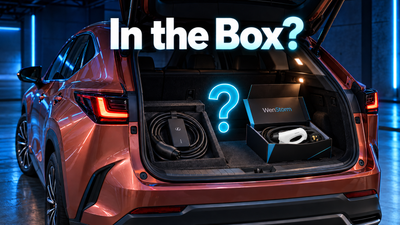
The adapter economics are worth adding up. The Tesla Mobile Connector ships with only the NEMA 5-15 adapter — a NEMA 14-50 is a separate $45 purchase, and TT-30 for RV parks is another. Road trips or family visits push the total north of $550. A portable Level 2 that includes the adapter kit in the box lands 40% under Tesla's total-cost line before the outlet-stress question is even asked.
Renters and older-home buyers hit a specific wall. Many older homes and rentals have ungrounded 3-prong 240V outlets — NEMA 10-50s that predate the mid-1990s NEC change requiring ground. Tesla's product documentation stipulates use only with properly grounded, code-compliant outlets and Tesla-supported adapters. That's the safe default, but for renters in older buildings whose only 240V outlet is a legacy 10-50, it means the Tesla setup won't work without addressing the grounding first. Portable Level 2 chargers from other manufacturers may support these outlets through their adapter sets when a ground-adapter path is workable.
Weatherproofing is the third axis. Tesla's product docs rate the Mobile Connector for indoor and covered-outdoor use — fine for garages and covered driveways, but not a fully weather-rated device. Purpose-built portable Level 2 chargers with an IP66 rating are what you want if the plug end will see rain, snow, or a hosed-down driveway. If you park outside, weather rating matters more than any other spec.
Which One Actually Fits Your Situation
The right charger depends on how you'll use it. This is the short version.
| Your situation | Pick | Why |
|---|---|---|
| Renter or homeowner with unknown outlets | Portable Level 2 with wider adapter set | Tesla's grounded-outlet requirement means legacy NEMA 10-50s need addressing first |
| Homeowner with a new dedicated NEMA 14-50 install | Portable Level 2 with car-end control unit | Either works today; weight-at-plug is a ten-year decision |
| Cold-climate outdoor charging | IP66-rated portable Level 2 | Tesla's docs rate the Mobile Connector for indoor/covered-outdoor use — not fully weather-rated |
| Road trip and travel use | Portable Level 2 with full adapter kit | Handles motels, RV parks, Airbnbs; Tesla ships only NEMA 5-15 in the box |
| Tesla-only garage with permanent Tesla Wall Connector already installed | Keep the Tesla Mobile Connector as emergency backup | Occasional-use mechanical stress is negligible |
The road-trip case gets its own guide — the adapter kit that makes a portable Level 2 work at almost any outlet is covered in the EV road trip charging guide. For the home-charging decision tree, the charge-EV-at-home-without-installation guide walks through the outlet-to-charger match for the most common setups.

See the WenStorm portable EV charger + adapter kit →
Frequently Asked Questions
Why does my EV charger outlet get hot?
Some warmth is normal at 30–40A continuous. Uncomfortably hot — hot enough to notice when you unplug — is a warning. It usually means contact resistance has crept up at the prong-to-outlet interface. Contributing factors include a portable charger with heavy plug-side electronics, back-stab (rather than screw-terminal) outlet wiring, undersized wire gauge, and outlet age. If the plastic is discolored or shows any melt, stop using the outlet until an electrician inspects it.
Does the Tesla Mobile Connector damage outlets?
Not by itself, and not immediately. The failure mode that eventually damages any high-current outlet — prong loosening from thermal cycling and mechanical stress, well documented in IEEE Std 1283 and NEMA torque guidance — applies to any 32A continuous charging setup. A plug-side weight design adds one more mechanical stress factor to that mix. Owners on Reddit describe the pattern as "melted after 4 years" — long enough that most reviews don't catch it, short enough to be a real cost of ownership. A portable Level 2 charger with the control unit at the car end doesn't add the leverage component, but outlet quality and installation still matter regardless of charger design.
Can I use a Tesla Mobile Connector with a NEMA 10-50 outlet?
Tesla's product documentation stipulates use only with Tesla-supported adapters and properly grounded, code-compliant outlets. A legacy NEMA 10-50 is ungrounded (predates the mid-1990s NEC change requiring dedicated ground), so if that's your only 240V outlet, you'll need to address the grounding first — either through an electrician-installed workaround or by using a portable Level 2 charger from another manufacturer that supports the outlet through its adapter set. See the Tesla NEMA adapter guide for the full compatibility chart.
Is a portable Level 2 EV charger safer than the Tesla Mobile Connector?
Electrically they're equivalent. Mechanically, portable Level 2 chargers that place the control unit at the car end don't add the plug-side leverage load to the outlet. That's one contributing factor among several — outlet quality, terminal torque, and wire gauge all matter too — but over multi-year daily use, reducing any mechanical stress factor helps. For occasional use, both designs are fine.
How much does the Tesla Mobile Connector cost, and is it worth it?
Check the current Tesla Shop for pricing on the Gen 2 Mobile Connector — pricing has moved over the past year and any specific dollar figure will age poorly. What's stable: it ships with only the NEMA 5-15 adapter; additional NEMA adapters (14-50, TT-30, etc.) are sold separately at additional cost per adapter. A full kit of Tesla-branded adapters lands significantly higher than the base connector price. If you specifically want first-party Tesla gear and already own a Tesla, it's a reasonable premium. If you want the widest outlet acceptance, the best price-per-adapter ratio, and a design that doesn't add plug-side stress to the outlet, a portable Level 2 alternative competes on all three axes.
The Tesla Mobile Connector vs portable Level 2 question isn't really about amps or cable length. It's about where the weight sits — and which of the two designs your outlet will still trust in year ten.
See the WenStorm portable EV charger →
Related reading: