Outlet-Side vs. Vehicle-Side: Which EV Extension Does Your Setup Actually Need?

TL;DR
Extend the vehicle side, not the outlet side. The cable between your Level 2 charger and the car is a defined product category under UL 2263 (EV Cable), with WenStorm's J1772 and NACS extensions built to that standard. The cord between the wall outlet and your charger's input has no equivalent category. Dryer or RV cords found at hardware stores are rated for intermittent loads, not the continuous 32-40A an EV pulls for 6-10 hours. If the reach gap is on the outlet side, hire an electrician to extend the branch circuit.
Which situation describes you?
Find the row that matches where your reach problem lives, then follow the recommended path.
| Your situation | What you actually need |
|---|---|
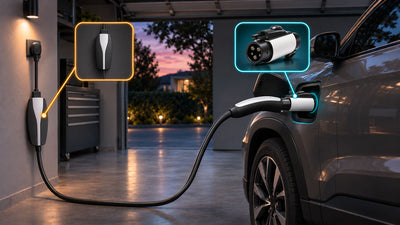
| EVSE plugs into the wall fine, but its attached charging cable can't reach the car's inlet. | Vehicle-side extension (J1772 or NACS, UL 2263). This is what WenStorm sells. |
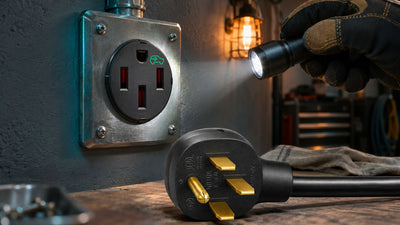
| The NEMA 14-50 outlet is on the opposite wall; EVSE's input cord can't reach the outlet. | Hire a licensed electrician to extend or relocate the branch circuit; no retail extension is appropriate. |
| You park two cars at different distances and the EVSE sits in the middle. | Vehicle-side extension matched to your connector; alternatively relocate the EVSE. |
| You park outdoors and the only outlet is inside the garage; you want to run a cord through the door. | Move the EVSE outside the garage via hardwired install or an exterior-rated outlet; do not pass a 240V appliance cord under a door. |
| You own a Tesla Mobile Connector or Wall Connector and want to extend either end. | Tesla's current charging documentation prohibits extensions on both ends; see tesla.com/support/charging. |
Identify which side has the gap
Picture the circuit as a chain with three segments. The confusion that drives most wrong purchases is treating the middle piece and the two end pieces as interchangeable. They are not.
| Segment | What it connects | Certification scope | Can you extend it? |
|---|---|---|---|
| Outlet side | Wall outlet (NEMA 14-50, 6-50, TT-30, 10-30) to EVSE input plug | No EV-specific standard; appliance-cord territory | No retail product is designed for continuous Level 2 load here. Rewire the circuit. |
| EVSE body | The charger itself (plug-in or hardwired) | UL 2594 (EVSE) | N/A — you don't extend the box itself. |
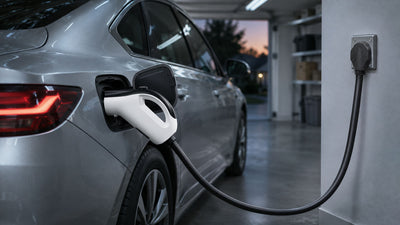
| Vehicle side | EVSE's attached charging cable to the car's charge-port inlet (J1772 or NACS) | UL 2263 (EV Cable) | Yes, with a UL 2263 J1772 or NACS extension — subject to your EVSE manufacturer's policy. |
Walk the chain in your garage. Start at the breaker panel. Follow the branch circuit to the receptacle. Note the slack in the EVSE's input cord. Open the EVSE. Measure the attached charging cable to where it reaches on the car. The segment that runs out of slack is the one with the problem.
Why the two sides have different rules
UL 2263 is the standard that governs flexible EV cable, including the cable stock used in a J1772 or NACS extension. It specifies conductor construction, insulation, strain relief, and connector mating durability under repeated plug-in cycles. WenStorm's J1772 extension is built on UL 2263 cable stock (certification UL-US-2407470-0, cable models EVE/EVJE) with 10 AWG conductors for 32A versions and dual 8 AWG conductors for 50A versions.
No comparable retail standard exists for an outlet-side extension carrying continuous 32-40A Level 2 current. Household extension cords are rated for intermittent loads, and even heavy-gauge RV or dryer cords are tested for the duty cycles of those appliances. An electric clothes dryer runs its heating element in short cycles. An RV draws air-conditioner current when the compressor is active, not for ten unbroken hours.
An EV pulls its rated amperage continuously for the full charge session. A 2024 Chevy Bolt or 2024 Hyundai Ioniq 5 at 32A will hold that current for roughly six to eight hours overnight. Any insulation weakness, loose contact, or undersized conductor in that path shows up as heat — and heat compounds over hours, not minutes. The NFPA notes that overheated extension cords are a recurring cause of residential fires; EV loads are the worst case for that failure mode.
This is why "a dryer cord is 30A rated, so it should handle a 32A EV charger" is a trap. The amperage rating is for the appliance's duty profile, not for ten hours of continuous Level 2 draw. A rating is a maximum, not an application license.
Which WenStorm product solves a vehicle-side gap
If you've walked the chain and the gap is between the EVSE's connector and the car's inlet, a UL 2263 extension is the right category. WenStorm's J1772 extension covers the larger installed base of Level 2 chargers; the sibling NACS extension is covered in the NACS extension cord buying guide.

If your car uses NACS natively (Tesla, 2025+ Ford, 2025+ GM, Rivian with NACS port), see the NACS extension cord buying guide for the Tesla/NACS variant. For a sizing walk-through on the J1772 side, the J1772 extension cable fit guide covers length and amperage selection in detail.
What to do when the gap is on the outlet side
If the chain-walk showed slack in the EVSE's charging cable but no slack between the wall outlet and the EVSE's input plug, you have an outlet-side problem. Three paths handle this correctly.
Extend the branch circuit. A licensed electrician can run new conduit and conductors from the panel (or from the existing junction) to a receptacle near where you want to charge. This is wiring work, not retail product work. Cost varies by distance, wall construction, and panel capacity. Permits are typically required.
Relocate the EVSE. If the EVSE is plug-in, you can mount it closer to the car — but it still needs a receptacle on a dedicated branch circuit at that location. If the current receptacle is far from where you want to park, that still means electrician work.
Hardwire a new EVSE at the right location. For a longer-term fix, a hardwired EVSE installed where the cable actually reaches the car eliminates the receptacle entirely. This is often the cleanest solution for garages where the panel is on the wrong wall.
None of those paths involve plugging a 25-foot dryer-cord extension into the wall and the EVSE into the far end. Do not do that.
When a vehicle-side extension is NOT the right fix
A UL 2263 J1772 or NACS extension solves one specific problem; several adjacent problems look similar but need different answers.
- Your gap is on the outlet side (between the wall receptacle and the EVSE's input plug). Rewire the circuit; no retail extension product is designed for that span under continuous 32-40A load.
- You own a Tesla Mobile Connector or Wall Connector. Tesla's current charging documentation prohibits extensions on either end — see tesla.com/support/charging.
- Your EVSE's manual explicitly prohibits extensions. Some non-Tesla manufacturers also publish extension restrictions; read your current manual before buying.
- You want to run a 240V cord under a garage door or through a window gap. The path itself is the hazard; move the EVSE instead.
- You want to charge a plug-in hybrid from a 120V outlet in a different room. A Level 1 extension solves a different problem; the vehicle-side extension in this article is for Level 2 J1772 or NACS cables.
- You need DC fast charging reach at a Supercharger or Electrify America site. Public-DCFC cables are not interchangeable with any AC Level 2 extension; the cable constructions are different and DC cables are frequently liquid-cooled.
- You haven't measured yet. Buying a 50-foot extension when 21 feet would do is a storage and cost problem; buying 21 feet when you needed 30 is a return trip. Measure before you buy.
- Your gap is because the EVSE itself is wrong for the install site (indoor-only unit at an outdoor pedestal, for example). Fix the EVSE choice first.
Related reading
- The complete EV extension cable buyer's guide — standards, lengths, amperage, and compatibility across J1772 and NACS.
- J1772 extension cable fit guide — sizing by length and current for the J1772 side.
- NACS extension cord buying guide — the Tesla/NACS counterpart to this article.
- Tesla Gen 2 Mobile Connector adapter decision matrix — adapter choices for Tesla owners who want flexibility without extensions.
- NACS vs J1772 in a multi-EV household — connector-mix planning when two cars use different ports.
Frequently asked questions
Can I use a heavy-gauge dryer cord as an outlet-side extension for my EV charger?
No. Dryer cords are built for intermittent heating-element cycles, not six to ten hours of continuous Level 2 current. A 10/3 or 6/3 dryer cord's rating assumes the duty profile it was tested for. Running 32-40A continuously through an extension not designed for continuous load is a fire-risk path — the NFPA repeatedly flags overheated cords as a residential-fire cause. Rewire the branch circuit instead.
Is there any UL-listed outlet-side extension for Level 2 EV charging?
Not as a defined retail category. UL 2263 covers the EV cable between the EVSE and the vehicle (the vehicle-side cable), not an appliance-cord extension between a wall receptacle and the EVSE's input plug. The correct fix for an outlet-side gap is electrical work, not a product.
What if my EVSE's input cord is only 12 inches and the outlet is 6 feet away?
That's a plug-in EVSE install where the receptacle is in the wrong place for the equipment. The right fix is to move the receptacle (electrician work) or to buy an EVSE with a longer input cord sized for your receptacle location. Chaining an extension between the wall and the EVSE is not a safe substitute.
Does the WenStorm J1772 extension work with Tesla cars?
Only via an adapter sequence that your EVSE's manual permits. The J1772 extension is a J1772-to-J1772 cable; Tesla owners typically use a J1772-to-NACS adapter at the car. For a NACS-native extension, use the Tesla/NACS variant covered in the NACS extension cord buying guide. Tesla's own Mobile Connector and Wall Connector do not permit extensions on either side.
Where to verify these claims
Primary sources are linked inline above. The short bookmark list below is useful if you want to confirm standards and manufacturer policy on your own.
- UL — UL 2263 (EV Cable) and UL 2594 (EVSE) standard scopes.
- NFPA — residential electrical fire data and extension-cord guidance.
- U.S. DOE Alternative Fuels Data Center — Level 1 vs Level 2 charging definitions and typical draw.
- Tesla charging support — current Tesla policy on extensions for Mobile Connector and Wall Connector.
- Your EVSE's current user manual — manufacturer-specific extension language.