J1772 Extension Cable Buying Guide: Which One Fits Your Charging Setup?

TL;DR
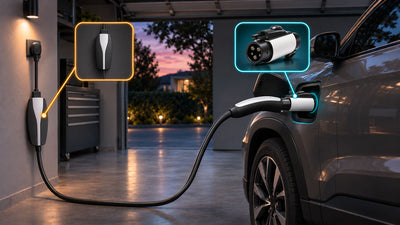
The right J1772 extension cable meets or exceeds your charger's maximum output amperage and reaches your car without strain. For portable Level 2 chargers at 32 amps or less, the WenStorm 32-amp, 21-foot variant ($129.99) fits. Before buying, confirm your EVSE's maximum output amperage, your vehicle's J1772 inlet (not NACS), and that your EVSE manual does not prohibit extensions. Tesla's Mobile Connector and Wall Connector documentation prohibits extensions. Choose a 50-amp variant (21 to 50 ft, $169.99 to $339.99) for 40-amp chargers or runs beyond 21 feet.
Design note: every WenStorm portable in this guide uses a connector-integrated no-brick architecture — the electronics live inside the handle at the car end, so nothing heavy hangs from your wall outlet during overnight charging.
Which situation describes you?
Pick the row that matches your charger and parking distance; the right next step follows.
| Your situation | Right next step |
|---|---|
| Portable Level 2 charger pulling 32 amps or less; you need less than 21 extra feet of reach | WenStorm 32A, 21 ft ($129.99) — matches the current rating of a 32-amp EVSE at the shortest length. |
| Portable Level 2 charger pulling 40 amps; any length | WenStorm 50A variant at the length you need (21 to 50 ft) — the 50-amp cable is rated above a 40-amp charger's output. |
| Hardwired Level 2 EVSE pulling 32 to 40 amps; parking needs 25 ft or more | WenStorm 50A, 25 to 50 ft — but first read your EVSE's manual, since Tesla, ChargePoint, and Grizzl-E each publish extension-cable prohibitions in their current documentation. |
| 48-amp or higher hardwired EVSE (e.g., ChargePoint Home Flex at 48A, Grizzl-E Duo at 48A) | Check the EVSE manufacturer's manual first; many prohibit extensions at this current. If permitted, choose a 50-amp WenStorm variant. If not permitted, relocate the EVSE or extend the branch circuit instead. |
| Tesla or any NACS-inlet vehicle (Model 3, Model Y 2025+, Rivian 2025+, F-150 Lightning 2025+) | A J1772 extension does not fit a NACS inlet. Use a NACS extension cable instead, or add a NACS-to-J1772 adapter to an existing J1772 EVSE. |
How to identify your J1772 EVSE's maximum output
The extension's job is to carry whatever current the EVSE delivers. If the extension is rated below the EVSE's maximum, the cable is the limiting factor. Confirming the EVSE's output amperage is the step that most often changes which cable you should buy. The amperage is listed in three places, in order of reliability:
- EVSE nameplate. On the body of the EVSE or inside the lid of a portable unit. Look for a line like "Output: 240 V AC, 32 A, 7.7 kW."
- Owner's manual or data sheet. Portable chargers list the maximum output amperage on the first page of the spec sheet. Hardwired units list it in the installation guide.
- The EVSE's own current-selection dial or app. Some portable units (e.g., Grizzl-E Classic, Lectron, WenStorm Level 2 Portable) have a user-selectable current limit — the maximum setting shown is the EVSE's maximum output.
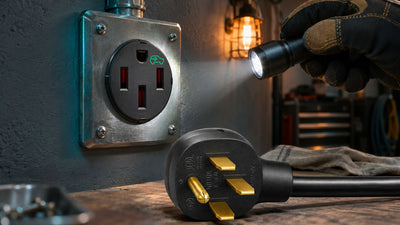
Do not infer the amperage from the plug type. A NEMA 14-50 plug can be installed on a 16-amp, 24-amp, 32-amp, or 40-amp EVSE. The plug is the connection point, not the current rating.
| What the EVSE says | Maximum output | Which WenStorm variant fits |
|---|---|---|
| "Output: 16 A at 240 V" (or Level 1 at 12–16 A on 120 V) | 16 A | 32A/21 ft is sufficient. The cable rating is above the EVSE's output. |
| "Output: 24 A at 240 V" | 24 A | 32A/21 ft is sufficient. Use a 50A variant only for length. |
| "Output: 32 A at 240 V" (common portable Level 2) | 32 A | 32A/21 ft at the shortest length; 50A variants for 25 ft or longer. |
| "Output: 40 A at 240 V" | 40 A | 50A variant only (21 to 50 ft). The 32A cable is under-rated for this charger. |
| "Output: 48 A at 240 V" (hardwired-only) | 48 A | Read the manufacturer's manual before buying any extension. If permitted, the 50A variant is at the cable's maximum rating; many manufacturers prohibit extensions at this current. |
Match amperage first, length second
Cable ratings are maximums, not minimums. A 50-amp cable can safely carry a 32-amp charging load; the reverse is not true. Using a 32-amp cable with a 40-amp or 48-amp EVSE puts the cable above its rated current, which is the condition the UL 2263 Electric Vehicle Cable standard is designed to prevent.
The 32-amp variant: when it fits
The WenStorm 32-amp, 21-foot variant uses 10 AWG copper power conductors and is rated for continuous 32-amp Level 2 service. It fits:
- Portable Level 2 chargers set at 32 amps or less (the most common home-charging configuration)
- Level 1 (120 V) portable chargers at 12–16 amps
- Any 32-amp or lower EVSE where the parking distance adds less than 21 feet beyond the charger's own cable
Price: $129.99. Variant ID 53041947443489.
The 50-amp variants: when they fit
The 50-amp variants use 2×8 AWG copper power conductors plus a 10 AWG protective ground. They are rated above the 40-amp continuous load typical of a 50-amp-rated EVSE and fit:
- Portable Level 2 chargers set at 40 amps
- Hardwired Level 2 EVSEs rated at 32 to 40 amps where the manufacturer permits an extension
- Any 32-amp charger where the parking distance exceeds 21 feet (choose the length, not the amperage)
Lengths, prices, and variant IDs:
- 21 ft — $169.99 (variant ID 53041947476257)
- 25 ft — $209.99 (variant ID 53041947509025)
- 30 ft — $239.99 (variant ID 53041947541793)
- 40 ft — $279.99 (variant ID 53041947574561)
- 50 ft — $339.99 (variant ID 53041947607329)
Measuring the extra reach you need
Measure the gap, do not estimate it. Park the vehicle where it normally sits, extend the EVSE's own cable to its reach limit, and measure from the end of that cable to the inlet on your car. The result is the minimum extra reach the extension must cover.
Add 2 to 3 feet of routing allowance for a managed path up the wall or along a baseboard. Do not add 10 feet "to be safe": unused cable coiled against the ground creates heat buildup and a tripping hazard.
For a deeper discussion of length tradeoffs, routing, and the NEC 625.17(C) 25-foot guidance that applies to installed branch circuits, see our EV Extension Cable Buyer's Guide.
Which WenStorm J1772 extension to buy
The product below is the WenStorm J1772 EV Extension Cable with six length and amperage variants. Pick the variant that matches your EVSE's output amperage first, then your parking distance.

When your EVSE's manufacturer documents a restriction
Several Level 2 charger manufacturers publish instructions that prohibit or discourage extension cables. Those statements control over any third-party cable rating. Check the owner's manual that shipped with your charger, or the current version on the manufacturer's support site, for language on extensions. Examples we commonly see:
- Tesla Wall Connector. Tesla's installation documentation states the Wall Connector should not be used with an extension cable. If your EVSE is a Wall Connector, do not add an extension on the vehicle side.
- Tesla Mobile Connector. Tesla's Mobile Connector user guide instructs owners not to use an extension cord. This applies to both the Gen 2 and Gen 3 Mobile Connectors.
- Other popular Level 2 chargers. Several ChargePoint, Grizzl-E, and other hardwired units published language discouraging or prohibiting extensions in their installation documents. The specific language varies across models and has changed across firmware and manual revisions. Read your product's current manual, not a general statement.
- Hardwired EVSEs rated at 48 amps or more. Many installation manuals in this category exclude extensions entirely. When the EVSE pulls the cable to its rated maximum, there is no safety margin left for an extension's connector resistance or routing.
If your EVSE's manual contains any of this language, the right answer is not a longer cable. Options are: move the EVSE to a wall closer to the parking spot, add a dedicated branch circuit at the new location, or step down to a lower-amperage portable EVSE whose manufacturer permits extensions.
When a J1772 extension is NOT the right fix
Eight common situations call for a different solution than buying a WenStorm J1772 extension:
- You already own a working J1772 extension that reaches your inlet. If you have a cable that meets or exceeds your EVSE's output amperage and is in good condition (no cracks, no bent pins, no overheating during use), keep it. Replace it only when the amperage rating is below your EVSE's output, the length is insufficient, or the connectors show visible damage.
- You cannot confirm your EVSE's maximum output amperage. If the nameplate is unreadable and the manual is lost, do not guess from the plug type. Contact the EVSE manufacturer's support with the serial number and ask for the maximum output rating in writing. Buying the wrong amperage class is a safety problem that is cheaper to avoid than to discover.
- Your vehicle has a NACS (Tesla) inlet. Model 3, Model Y 2025 and later, Rivian R1S/R1T 2025 and later, Ford F-150 Lightning 2025 and later, and other new EVs use the SAE J3400 (NACS) inlet. A J1772 extension's connector will not mate with a NACS inlet. Use a NACS extension or add a NACS-to-J1772 adapter to a J1772 EVSE instead.
- Your EVSE is a Tesla Wall Connector, Tesla Mobile Connector, ChargePoint Home Flex, or Grizzl-E. See the manufacturer-restriction section above. Each product's own documentation makes the warranty and safety case for not extending these units.
- You are trying to reach a DC fast-charging station. J1772 is an AC Level 1 and Level 2 standard. Public DC fast chargers (CCS1, CHAdeMO) use different connectors and are not compatible with any J1772 extension.
- You need to extend the wall-outlet side of a portable EVSE. The J1772 extension sits between the EVSE and the car. Extending the wall plug (the NEMA 14-50, 6-50, or TT-30 side) with a dryer-cord or RV-cord extension is a separate category and not covered by UL 2263. UL 2263 is the applicable certification for the vehicle-side EV cable; a dryer or RV cord is not evaluated for continuous Level 2 current.
- You need more than 50 feet of extra reach. The longest WenStorm variant is 50 feet, which is 10 feet longer than EVDANCE's 40-foot maximum. Beyond 50 feet, voltage drop and routing issues favor extending the branch circuit instead.
- Your parking is a shared-metered or landlord-controlled space. An extension cable running across walkways, through doorways, or over property boundaries creates a trip hazard, a weather-exposure problem, and in many leases a code violation. Talk to the property manager about a dedicated outlet or Level 1 charging arrangement first.
Related reading
- EV Extension Cable Buyer's Guide: J1772 vs NACS, Length, and What Not to Do — the broader guide covering connector choice, length math, and brand comparison.
- Tesla Gen 2 Mobile Connector Adapter Decision Matrix — if your EVSE is a Tesla Mobile Connector, start here before considering any extension.
- Chevy Bolt Home Charging Guide — a J1772 example: identifying the Bolt's onboard charger limit before buying any extension.
- Rivian R1S Home Charging Guide — relevant for 2024 and earlier R1S/R1T owners still on J1772 inlets.
Frequently asked questions
Does using an extension slow down charging?
No, within the cable's rating. The extension carries current at the vehicle's negotiated rate; it does not step the current down. At the top of the cable's rated range, longer runs can produce a measurable voltage drop, which the vehicle may interpret as a reason to reduce current. For the WenStorm 32-amp variant at 32 amps over 21 feet, the drop at 240 V is well under 3%, the voltage-drop threshold referenced in the NEC's informational notes to Articles 210.19 and 215.2.
Can I use the 32-amp extension with a 40-amp EVSE if I set the EVSE to 32 amps?
Only if the EVSE actually enforces the limit and you are confident it will not be changed by another user or during a software update. The safer answer is to match the extension's amperage rating to the EVSE's maximum output, not to its current setting. A 50-amp variant at 50 amps costs $40 more than the 32-amp variant at 21 feet and removes the ambiguity.
Will an extension cable void my EVSE's warranty?
It depends on the manufacturer. Tesla, ChargePoint, and Grizzl-E publish language that discourages or prohibits extensions. Some other manufacturers are silent, in which case the extension's own warranty applies (two years for WenStorm). Read your EVSE's specific manual before buying. The manufacturer's current written policy is the authority on this question.
Is the WenStorm J1772 extension rated for outdoor use?
Yes. The cable publishes an IP66 rating and an operating temperature range of −30°C to +50°C (storage range −40°C to +85°C). It is suited for driveway and garage use in standard North American climates. The connectors are rated for over 10,000 no-load mate/unmate cycles. Route the cable so it does not sit in standing water or get driven over by vehicle tires.
Where to verify these claims
Every citable claim above is linked inline to its primary source. Four references apply broadly to this article and are worth bookmarking separately:
- WenStorm — J1772 EV Extension Cable product page for live variant amperage, length, pricing, and environmental ratings.
- WenStorm — Certification Center for the UL 2263 certificate number (UL-US-2407470-0; models EVE/EVJE) and CSA C22.2 No. 332 reference.
- Your EVSE's current owner's manual, from the manufacturer's support site. The manual's output amperage specification and extension-cable policy supersede any general guidance on this page for your specific product.
- Your local Authority Having Jurisdiction (AHJ), for the edition of NFPA 70 (NEC) adopted in your jurisdiction.