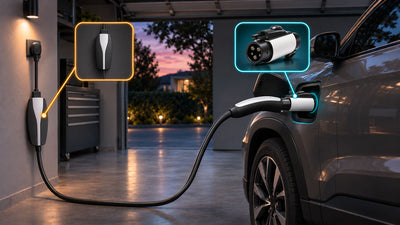
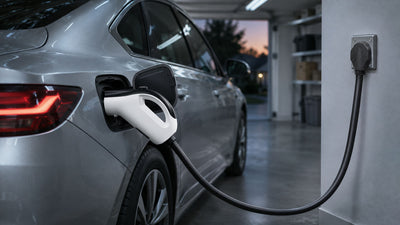
Extension Cable vs. a Longer-Cable Charger: Which Solves "Won't Reach"?

TL;DR
If your charger is a Tesla Mobile Connector or Tesla Wall Connector, a longer-cable charger is the honest answer, Tesla's charging documentation prohibits extensions on both units. If you own a WenStorm 32A portable (or another unit that permits extensions), an extension matches the amperage of your existing EVSE and costs $130–$340 depending on length. Measure the parking gap, add 2–3 feet for a managed cable path, and pick the shorter route. Over 50 feet of real gap, neither product solves it — move the circuit.
Which situation describes you?
Five common setups, each with a cleaner answer than "whichever is cheaper."
| Your current charger | Gap to inlet | Cleaner answer |
|---|---|---|
| Tesla Mobile Connector or Tesla Wall Connector | Any | Replace with a longer-cable charger, Tesla's own docs disallow extensions |
| WenStorm Level 2 Portable (32A, J1772 or NACS, 25 ft cable) | +10 to +30 ft | Add a matched-amperage extension |
| Grizzl-E, ChargePoint Home Flex, or similar third-party EVSE | Any | Read the current manual first — some non-Tesla manufacturers also publish extension restrictions |
| Any Level 2 unit | Under 5 ft | Re-route the existing cable or shift the parking position; neither product earns the spend |
| Any Level 2 unit | Over 50 ft | Hire an electrician, move the branch circuit or add a second outlet near the parking spot |
How to measure the real gap
Before choosing a product, measure the route — not the straight line.
- Park where the car will actually sit for charging. Note where the inlet is (driver-side rear on Tesla and Rivian, driver-side front on Ford F-150 Lightning and most GM EVs, passenger-side rear on Hyundai IONIQ 5 and Kia EV6).
- Run a tape measure from your EVSE's cable exit point to the inlet, following the path the cable will take, around posts, along the ceiling, over the garage door track if applicable.
- Add 2 to 3 feet of slack so the cable isn't under tension and so it can rest in a managed hook or holster without pulling at the connector.
- Subtract your current cable's length. The remainder is the gap an extension or longer-cable charger needs to cover.
A 25-foot straight-line measurement often becomes a 28-to-30-foot routed length once ceilings, corners, and strain relief enter the picture. Buying the exact minimum almost always ends with a taut cable and a frustrated homeowner on month two.
Option A vs. Option B: three-column comparison
Here is the same decision broken down by factor, assuming your existing charger is a WenStorm 32A portable or an EVSE with a documented permission to use extensions.
| Factor | Option A: Extension cable | Option B: Longer-cable charger | Winner |
|---|---|---|---|
| Cost for +25 ft of reach | $209.99 (WenStorm 50A/25 ft J1772 extension), keep existing EVSE | $219.99 for WenStorm 32A portable (25 ft cable); replacing to a 40 ft+ unit adds $100–$300 | A |
| Tesla Mobile Connector compatible | No — Tesla's charging documentation prohibits extensions | Yes, buy a longer-cable EVSE instead of extending the Tesla unit | B |
| Keeps your current smart features | Yes — your EVSE's app, scheduling, and load management stay | Only if the replacement unit matches your current feature set | A |
| Portability (RV, friends' houses, travel) | Travels with you, pairs with any compatible EVSE | A long-cable portable is easier to pack than a hardwired station | Tie |
| Installation effort | None, plug the extension between EVSE and inlet | None if it's a plug-in portable; electrician visit if hardwired | A |
| Risk if you misjudge the gap | Add another length later if the first was too short | You already bought a 40 ft unit — length is fixed | A |
A worked example: the 25-foot gap
Say your wall-mounted EVSE is in the back corner of a two-car garage and the inlet on your car sits 25 feet away once you route the cable along the ceiling and down a wall hook. Your charger's own cable is 20 feet. The real gap is 5 feet past the end of your cable, but you still need slack, so plan for a 10-to-15-foot usable extension or a replacement unit with at least a 30-foot cable.
Option A: Keep your current 32A charger. Add a WenStorm J1772 50A/25ft extension at $209.99. You now have 45 feet of total reach, your charger's app and scheduling stay the same, and the extension travels with you to campsites, Airbnbs, and friends' driveways. The 50A-rated extension carries your 32A charger's current without issue — rating is a maximum, not a required load.
Option B: Replace your charger. The WenStorm Level 2 Portable ships with a 25-foot cable at $219.99, which solves the gap exactly without an extension. If you need more than 25 feet in one piece, the market steps up to 40-foot or 50-foot portables from other brands at $320 and higher. You keep one connector in the chain, which is marginally cleaner mechanically, but you pay $100–$300 more and lose your existing EVSE's app features unless the replacement matches them.
In this scenario, both products land within $20 of each other for the 25-foot case, so the real tiebreakers are: do you want to keep your current charger's features, and do you need the extension for travel use anyway? If yes to either, Option A wins. If you dislike daisy-chained connectors or your current charger is already failing, Option B wins.
When your current charger forbids extensions
The decision collapses to Option B whenever the manufacturer explicitly disallows extensions. Tesla is the clearest example: Tesla's charging support page states extension cords are not recommended for either the Mobile Connector or the Wall Connector. Pairing an extension with a Tesla unit means operating the equipment outside its documented use.
Some non-Tesla manufacturers also publish extension restrictions in their product manuals. Grizzl-E and ChargePoint Home Flex owners should read the current version of their manual before buying any extension, policy language changes between hardware revisions, and the correct answer is whatever your specific unit's documentation says today.
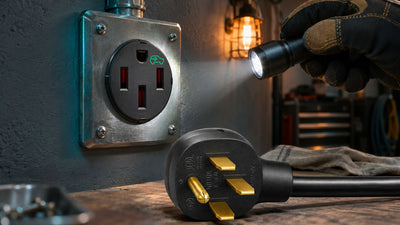
When extensions are off the table, a longer-cable charger is not a workaround — it is the correct product category. The WenStorm Level 2 Portable is one option in that category. It ships with a 25-foot cable, delivers 32A over a NEMA 14-50, and comes in a J1772 or NACS variant selected at checkout.
Which WenStorm product to buy
If your existing charger prohibits extensions, or if replacing an aging unit is already overdue, the direct-replacement path is a 25-foot portable. If your charger permits extensions and the problem is purely reach, the add-an-extension path is covered in the sibling guides linked under "Related reading."

When neither Option A nor Option B is the right fix
A few setups look like reach problems but aren't — and spending on cable in these cases trades a small frustration for a larger one.
- Your current charger already reaches the inlet with 2–3 ft of slack and you were planning to buy for peace of mind. Save the money.
- Your gap is under 5 feet. Shift the parking position by a foot or re-route the existing cable through a hook, neither product earns the spend.
- Your gap is over 50 feet. Flexible EV cable at that length starts to feel heavy and wrestles with the connector; the better answer is a licensed electrician adding a branch circuit near the parking spot.
- You own a Tesla Mobile Connector or Wall Connector and were considering an extension. Tesla's docs disallow it — this article's Option B exists specifically for your case.
- You own a DC fast-charging station or need to extend a DCFC cable. AC L2 extensions aren't interchangeable with DC fast-charging cables, which use different internal construction.
- Your charger's manual explicitly forbids extensions and you'd rather keep it. Keep the charger, move the parking spot or re-route the cable instead.
- You haven't measured yet and are picking a length from memory. Measure first, straight-line estimates miss ceilings, corners, and strain relief by 15–30%.
- Your charger is older than its warranty and already showing signs of connector wear. Replace the charger regardless; adding an extension to a failing EVSE just adds a second thing to troubleshoot.
Related reading
- EV extension cable buyer's guide — the umbrella article on when extensions are and aren't appropriate.
- J1772 extension cable fit guide, if you've decided on Option A and your charger has a J1772 handle.
- NACS extension cord buying guide — if you've decided on Option A and your charger has a NACS handle.
- NACS vs. J1772 for multi-EV households, if you're not sure which connector family you're buying into long-term.
Frequently asked questions
Can I just use a regular 240V extension cord from the hardware store?
No. EV charging cables carry a pilot signal between the EVSE and the vehicle in addition to the AC conductors, and generic 240V extensions don't carry that signal. The cable also has to be rated for continuous outdoor duty, the specific EV connector handle has to be present on each end, and the handle contacts have to meet the connector standard. A WenStorm J1772 or NACS extension is purpose-built for this; a generic cord is not.
Will a 50A-rated extension damage my 32A charger?
No. Rating is a maximum, not a required load. A 50A-rated extension can carry 32A, 24A, or 16A exactly as the EVSE commands via the pilot signal. The cable doesn't force any particular current through the car; the EVSE and the car negotiate the charging rate, and the cable just has to be rated for at least that current.
How do I know if my non-Tesla charger allows extensions?
Read the current version of your charger's product manual, not a forum post from three years ago. Manufacturer policy can change between hardware revisions. Grizzl-E, ChargePoint Home Flex, and others have published positions in their documentation — your specific unit's manual is the source of truth.
Does a longer-cable charger charge faster than my current one plus an extension?
No. Charging speed is set by the lower of (a) your car's onboard charger limit, (b) the EVSE's maximum output, and (c) the branch circuit's safe current. Adding length, whether as an extension or inside the EVSE's own cable — does not change any of these. A 32A EVSE with a 25-foot extension charges at the same rate as a 32A EVSE with a 50-foot built-in cable, assuming both are plugged into the same NEMA 14-50 circuit.
Where to verify these claims
Primary citations are linked inline above; the list below is a bookmark reference.
- Tesla charging support documentation, statement that extension cords are not recommended for Mobile Connector or Wall Connector.
- U.S. DOE Alternative Fuels Data Center — Home Charging, AC Level 2 charging basics, NEMA 14-50 context.
- NFPA 70 (National Electrical Code) — Article 625 covers EV supply equipment; your installed branch circuit is governed here.
- UL 2263, standard for EV cable stock; the WenStorm J1772 extension's cable stock is UL 2263 certified under file UL-US-2407470-0 (models EVE and EVJE).
- SAE J1772 and SAE J3400 — connector specifications for the J1772 and NACS plugs respectively; J3400 was standardized December 2023.